

Your team spent a year building domain authority, earning backlinks, and locking down Google’s first page for your top category keyword. Then a prospect typed that same keyword into ChatGPT Search. The response listed five brands. Yours wasn’t one of them. The brand that was? A smaller competitor with half your DA but a content library built for how AI actually retrieves information.
That gap between Google rankings and AI recommendations is widening every quarter, and traditional SEO dashboards can’t even show you where you stand.
Why Your Google Rankings Don’t Guarantee AI Search Visibility
Here’s the uncomfortable truth: the overlap between pages ranking in Google’s top 10 and the sources cited by AI engines like ChatGPT, Perplexity, and Gemini has dropped from roughly 70% in early 2024 to under 20% by mid-2026. Two separate discovery ecosystems now exist, and they run on different logic.
Google’s algorithm still leans heavily on domain-level link authority. AI search engines use Retrieval-Augmented Generation (RAG) to prioritize something entirely different: synthesizability and factual grounding. In practice, that means AI tools skip Google’s top 10 results about 60% of the time, often pulling from page-two or page-three sources that offer cleaner data tables or tighter definitions.
This “Page 2 Anomaly” flips a decade of SEO assumptions. The goal is no longer to have the most links. It’s to provide the most verifiable, structured truth for the model to retrieve.
How AI Search Engines Decide What to Recommend
Traditional search indexes keywords and maps them to URLs. RAG-based AI systems break a user’s prompt into semantic search vectors, then retrieve specific text “chunks” that ground the answer in verifiable evidence. They don’t rank pages. They synthesize knowledge.
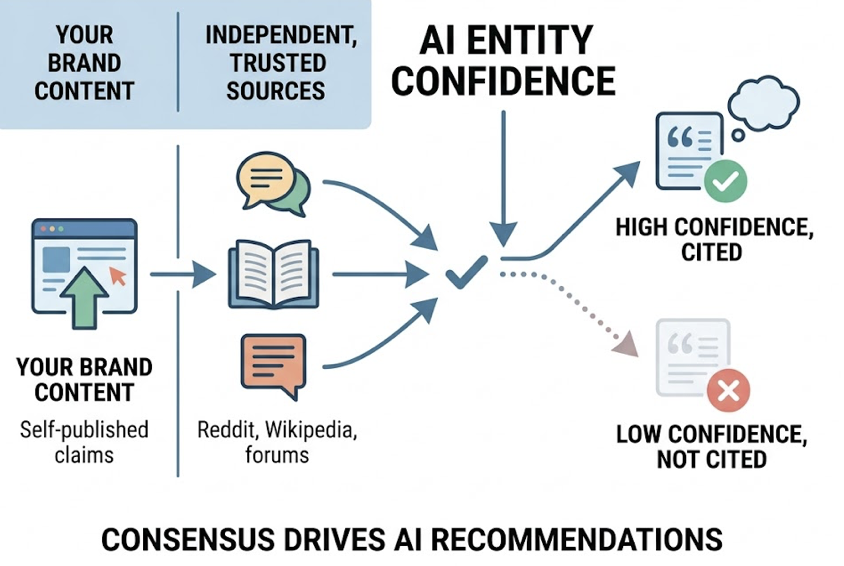
A key part of this process is “Entity Confidence,” the degree of certainty that a specific brand is the correct one to recommend. AI models check whether claims about your brand are corroborated across independent, trusted third-party sources like Reddit, Wikipedia, and industry forums. If your self-published content isn’t reflected in those consensus layers, the AI won’t cite you, regardless of your Google position.
What gets selected? Content with high information gain: original research, proprietary data, unique insights. AI engines also favor sources updated within the last 13 weeks, content with clear headings and data tables, and writing that uses a confident but neutral factual tone. Overly promotional pages get filtered out because they’re harder for the model to reuse as objective evidence.
5 Proven Ways to Improve Your AI Search Visibility
1. Audit Your Current AI Search Visibility First
You can’t optimize what you can’t measure. And in AI search, visibility is binary: you’re either cited in the synthesized answer, or you’re completely absent.
Start with a manual check. Search your category keywords on ChatGPT, Perplexity, and Gemini. Record which brands appear, in what order, and how they’re described. But manual checks don’t scale, and AI responses are probabilistic, meaning different users can get different answers for the same query.
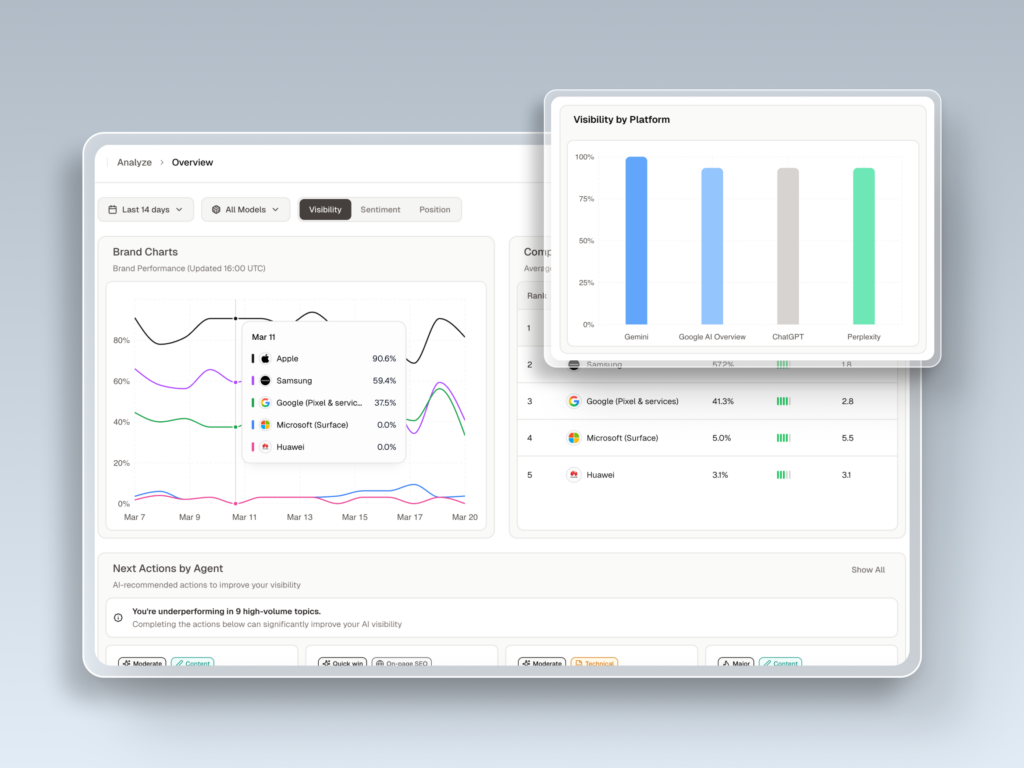
That’s where Topify fills the gap. Topify’s Visibility Tracking simulates thousands of user prompts across ChatGPT, Perplexity, Gemini, and Claude, then calculates your Visibility Score, Mention Rate, and Position relative to competitors. It’s the difference between checking one answer and monitoring a statistically meaningful sample.
The metrics that matter in 2026: AI Visibility Score (a composite of mention frequency, citation quality, and brand prominence), Sentiment Score (how positively or negatively the AI characterizes your brand), and Citation Share (the percentage of cited sources you command versus competitors for a given prompt set).
2. Optimize Content for AI Citation, Not Just Keywords
The shift from “keyword optimization” to “citation optimization” is the single biggest mindset change in AI search visibility. Your content needs to function as machine-readable evidence that an LLM can easily extract and cite.
Research through the GEO-bench benchmark shows that specific content transformations can boost visibility in AI responses by up to 40%. The highest-impact moves:
- Statistic addition. Replace vague claims with numerical data. AI engines treat numbers as high-confidence evidence.
- Expert quotations. Including quotes from recognized authorities signals expertise (E-E-A-T) that LLMs are trained to reward.
- Atomic knowledge blocks. Structure pages into short, dense paragraphs where each section leads with a direct answer (“X is…”, “X works by…”). This dramatically improves extraction rates.
- Schema markup. FAQ, Article, Person, and Organization schema helps AI agents understand the relationships between entities and facts on your page.
The goal isn’t to write for bots at the expense of readers. It’s to structure genuinely useful content so that both humans and AI models can find the answer quickly.
3. Build Authority Across the Sources AI Trusts
In AI search, your own website often isn’t the most important factor in your visibility. AI models prioritize information that’s corroborated by independent third parties. Managing this “Consensus Layer” is as critical as on-site optimization.
Citation pattern analysis from Q2 2026 reveals strong platform-specific biases. For B2B SaaS, the top citation sources are G2, Reddit, LinkedIn, and vendor documentation. For eCommerce, it’s Amazon, Reddit, Wirecutter, and YouTube. Reddit alone commands nearly 46.5% of citations on Perplexity and 21% on Google AI Overviews.
The most effective authority-building tactic in 2026 is “Barnacle GEO,” attaching your expertise to the sources AI already trusts:
- Reddit. Identify and contribute to high-value threads where category questions get asked. AI models retrieve these threads for “real-world” consensus.
- LinkedIn. AI engines cross-reference author credentials. Consistent naming and professional bios across LinkedIn and your company site strengthen entity verification.
- Tier-1 editorial PR. Mentions in outlets like Forbes or Reuters carry heavy weight because these domains are globally trusted by almost every major LLM.
- B2B review platforms. For SaaS brands, maintaining a presence on G2 or Clutch is non-negotiable. These sites provide the structured comparison data AI agents use to build vendor shortlists.
Topify’s Source Analysis traces the specific domains and URLs that AI platforms cite for your category. If Perplexity is pulling from a Reddit thread you’ve never seen, Source Analysis surfaces it so you know exactly where to focus.
4. Monitor Competitors and Benchmark Your Position
In traditional search, ranking third is often acceptable. In AI search, it’s frequently invisible.
AI responses typically mention only three to five brands. The #1 ranked brand in AI mentions captures an average of 62% of total AI Share of Voice, and the gap between #1 and #3 is typically 5x. This “Winner-Take-Most” dynamic means anything outside the top three risks total exclusion.
Topify’s Competitor Monitoring automatically detects your competitive set and compares Visibility, Sentiment, and Position side by side. You can spot “Narrative Drifts,” where a competitor is gaining trust signals, before they overtake your position. That kind of early warning is worth more than any monthly ranking report.
5. Track High-Value AI Prompts in Your Category
The nature of search has shifted to conversational, multi-variable prompts that average 23 words in length. These “Dark Queries” are invisible to traditional keyword tools but represent the most valuable research intent in any category.
Instead of optimizing for “best office chair,” you might find users are asking AI, “Which ergonomic chair is best for lower back pain during 10-hour shifts for a person who is 6 feet tall?” Targeting these specific, long-tail prompts with precise, data-backed content is the hallmark of advanced generative engine optimization.
Topify’s AI Volume Analytics analyzes real-world AI search behaviors to surface these high-value prompts. You get a view of what your audience is actually asking AI, not what a keyword planner estimates they might type into Google.
How to Measure AI Search Visibility Over Time
Measurement isn’t a one-time audit. AI models retrain and update their grounding data constantly. Citations tend to decay significantly if content isn’t refreshed at least every 13 weeks.
The conversion data makes the case for continuous tracking. Visitors referred from AI platforms like Perplexity convert at approximately 14.2%, compared to 2.8% for traditional organic search. That’s a 5x conversion lift, which means being cited in an AI response isn’t a vanity metric. It’s a direct revenue driver.
Build a measurement loop: establish baseline Visibility Scores → track weekly across platforms → correlate changes to content updates or competitor moves → iterate. Topify’s dashboard unifies these metrics into a single view, replacing the manual prompt-by-prompt checking that most teams still rely on.
5 Mistakes That Tank Your AI Search Visibility
Publishing volume without information gain. Flooding the web with AI-generated content backfires. If your content is indistinguishable from the model’s own training data, it provides no reason for the model to cite it.
Inconsistent entity information. AI models cross-reference your data across the web. Different mission statements, leadership names, or product specs on LinkedIn versus your blog create a “Trust Gap” that drops your visibility score.
Ignoring sentiment. An AI might mention your brand frequently but describe it as a “budget alternative” or a “risky choice.” Tracking mentions without tracking sentiment means you could be getting visibility that actively damages your reputation.
One-and-done optimization. AI visibility isn’t a static achievement. Content that isn’t refreshed every 13 weeks tends to lose its citation position. Treat this as a continuous loop, not a project with a deadline.
Abandoning SEO fundamentals. AI models rely on crawler accessibility, technical site health, and indexing to discover content. A page that’s not properly indexed by search engines is often invisible to AI retrieval systems too. You need a unified technical foundation that supports both channels.
Conclusion
The gap between Google rankings and AI recommendations isn’t closing. It’s accelerating. Brands that treat AI search visibility as a continuous engineering effort, not a one-time SEO add-on, will capture a disproportionate share of the highest-converting traffic online.
The playbook: measure your current AI visibility across platforms, engineer content for citation rather than just keywords, build authority in the third-party sources AI trusts, monitor competitors in real time, and discover the high-value prompts your audience is actually asking. Topify puts all five steps into a single platform, so you’re not stitching together manual checks and spreadsheets.
The brands that show up in AI answers today will own the categories of tomorrow. The ones that don’t won’t even know they’re missing.
FAQ
Q: What is AI search visibility?
A: AI search visibility is the measurable share of AI-generated answers, across platforms like ChatGPT, Perplexity, and Gemini, that cite or reference a specific brand. It’s defined by whether your brand is included in the synthesized response, not by a traditional ranking position.
Q: How is AI search visibility different from traditional SEO?
A: Traditional SEO optimizes for keyword rankings and click-through rates based on domain authority and link equity. AI search visibility optimizes for inclusion in synthesized natural language answers based on factual corroboration, content structure, and consensus across trusted sources.
Q: How long does it take to improve AI search visibility?
A: New content can enter AI citation pools in as little as 3 to 5 days. But building consistent authority and shifting an AI model’s perception of your brand typically takes 3 to 6 months. Citations also tend to decay if content isn’t refreshed every 13 weeks.
Q: Which AI search engines should I focus on?
A: It depends on your audience. ChatGPT Search and Perplexity are high-value for research-driven and B2B queries. Google AI Mode and AI Overviews are essential for mainstream consumer discovery. The most effective approach is tracking all major platforms simultaneously to spot where your visibility gaps are.

