


Your domain authority is 70. Your keyword rankings haven’t budged. Traffic is steady. Then someone asks ChatGPT for a recommendation in your category, and your brand doesn’t appear once.
That’s not a glitch. In 2024, roughly 70% of AI-cited sources ranked in the organic top 10. By 2026, that overlap has dropped to under 20%. The signals that make a brand visible to AI search engines aren’t the same ones that drive Google rankings. And if your reporting stack only tracks the old metrics, you’re watching half the screen while the other half decides your market share.
Traditional SEO Metrics Can’t Tell You What AI Says About Your Brand
Legacy SEO was built on a simple loop: rank higher, earn more clicks. Domain Authority, backlink counts, keyword positions. Those metrics still work for what they were designed to measure. The problem is they weren’t designed for AI search.
AI engines don’t rank pages. They reason through content to synthesize an answer. Instead of rewarding historical backlink profiles, models like ChatGPT and Perplexity prioritize entity confidence and semantic completeness. A brand with a DA of 70+ and multiple first-page rankings can be completely absent from AI-generated recommendation lists.
That gap gets worse when you factor in what the industry calls “dark queries.” The average traditional search query is around 4 words. Conversational queries in AI interfaces average 23 words. These long, specific prompts represent high-intent research behavior that traditional keyword tools can’t even see, let alone track. And they’re exactly where buying decisions are being formed in 2026.
| Factor | Traditional SEO | AI Search Visibility |
|---|---|---|
| Primary Unit of Value | Clicks and organic traffic | Citations and brand mentions |
| Authority Signal | Domain Authority / Backlinks | Entity confidence / Corroboration |
| Visibility Measure | Keyword ranking position | Share of Model / Mention rate |
| Success Threshold | Appearance in top 10 results | Inclusion in synthesized answer |
| User Interaction | CTR (click-through rate) | CVR (conversion visibility rate) |
Bottom line: if your dashboard only shows keyword rankings and organic traffic, it’s giving you a half-picture of your brand’s actual market influence.
What AI Search Visibility Actually Measures
AI search visibility is the composite measure of how often a brand appears in AI-generated answers, the context in which it’s mentioned, and the credibility of sources the AI uses to justify those recommendations. Unlike traditional ranking, which is relatively static, AI visibility is probabilistic. The same prompt can return different results depending on model settings, data refreshes, and retrieval architecture.
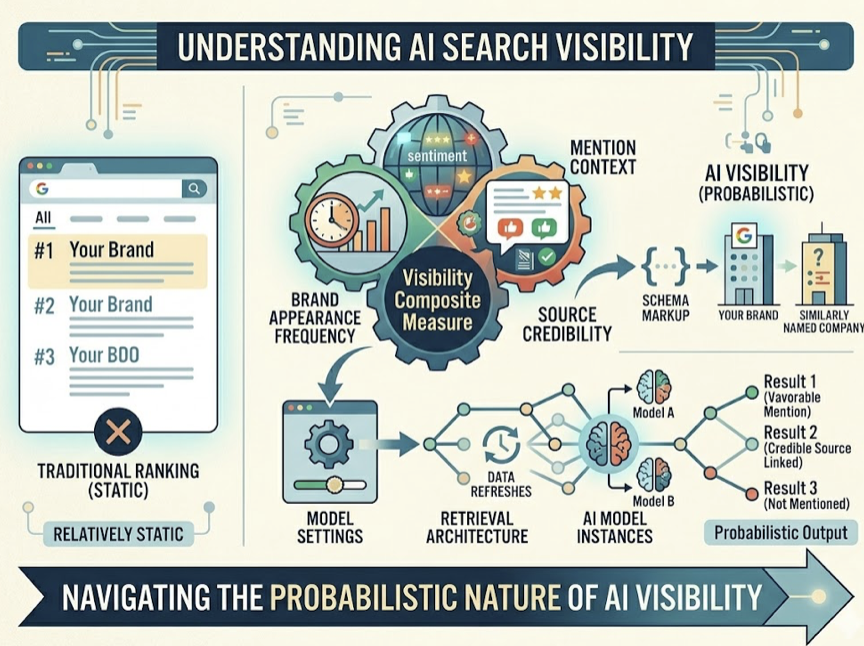
That’s why simple mention counts don’t cut it. Brands need a multidimensional framework. Topify tracks seven core metrics that capture the full picture of how AI perceives a brand:
Visibility tracks the percentage of priority prompts where your brand is explicitly named. For category leaders, a healthy baseline in 2026 sits between 30% and 45%.
Sentiment Score measures how AI frames your brand on a 0 to 100 scale. There’s a difference between being called a “leading solution” and a “budget alternative.” Visibility with a sentiment score below 40 is a liability, not an asset.
Position captures where you appear in a multi-brand response. LLMs tend to default to the first-named entity as the primary recommendation. Position 1 in an AI answer is as valuable as it used to be in SEO.
Source Coverage maps the distribution of domain types the AI cites when discussing your brand: media, reviews, forums, encyclopedias. If only your own site gets cited, the model’s confidence in your entity is shallow.
AI Volume reveals monthly demand for specific topics within AI platforms, surfacing intent that keyword tools miss entirely.
Intent Alignment evaluates whether the AI matches your brand to the right buyer persona and use case. High visibility with low intent alignment means wasted exposure.
CVR (Conversion Visibility Rate) predicts the likelihood a mention drives downstream action, separating passive factual references from active product recommendations.
This independent metrics system exists because of the zero-click reality. On AI-native platforms like Perplexity and ChatGPT’s Search mode, zero-click rates have reached between 82% and 93%. When the user never leaves the search interface, the traditional “session” metric is obsolete. Success has to be measured by Share of Model: the percentage of an AI’s knowledge base that your brand occupies.
3 Things That Changed Between 2025 and 2026
The shift from 2025 to 2026 wasn’t gradual. Three structural changes finalized the erosion of traditional SEO’s dominance in digital discovery.
AI Search Became the Default Starting Point
In 2025, most marketers still treated AI search as a brainstorming tool, something users reached for at the top of the funnel. By 2026, 37% of consumers start their search with AI tools instead of Google or Bing. And 60% of consumers say AI provides clearer, more helpful answers than traditional search engines.
That’s compressed the buyer’s journey. Instead of clicking through multiple links to compare products, users get a synthesized shortlist directly from the AI. If your brand isn’t on that shortlist, it’s effectively out of the consideration set.
Citation Sources Spread Beyond Reddit and Wikipedia
In early 2025, AI models leaned heavily on Wikipedia and Reddit for factual grounding. By 2026, the citation ecosystem has fragmented. Reddit still leads at 3.1% of all citations, but YouTube now appears in 16% of AI-generated answers, a massive jump from mid-2025.
This means visibility isn’t just about your website anymore. It’s about earning mentions in video transcripts, niche industry forums, and third-party media. Multi-platform corroboration is the new authority signal.
The SEO “Spillover Effect” Broke Down
It used to be that ranking in Google’s top 3 almost guaranteed inclusion in AI Overviews or featured snippets. That link has weakened. Analysis shows 67% of pages cited in AI Overviews don’t rank in the top 10 for the corresponding query.
AI retrieval logic now prioritizes semantic similarity and information gain over historical domain authority. Ranking for the link no longer automatically means winning the citation.
Where Traditional SEO Still Works for AI Visibility
Dismissing traditional SEO would be a mistake. In 2026, it’s shifted from being the whole strategy to being the infrastructure that AI visibility is built on.
AI engines using RAG architectures, including Perplexity and Google AI Overviews, still need to read the web before they can reason through it. A study of over 400,000 searches found that 52% of cited sources still overlap with the top 10 organic results. That overlap is shrinking, but it confirms that traditional SEO serves as the retrieval gate. If your site isn’t crawlable, mobile-responsive, or technically sound, it won’t even enter the candidate set for AI synthesis.
| SEO Element | Role in AI Visibility | What It Looks Like |
|---|---|---|
| Technical health | Retrieval prerequisite | Server-side rendering so AI bots can parse content |
| Topic authority | Synthesis credibility | Deep hub-and-spoke content structures |
| E-E-A-T signals | Entity confidence | Verifiable author bios and third-party citations |
| Structured data | Machine readability | Schema markup (Article, FAQ, Product) for fact extraction |
Here’s the thing: traditional SEO is a necessary condition, but it’s no longer a sufficient one. It provides the raw material. Without Generative Engine Optimization (GEO), that material may never get extracted or recommended.
The Gaps Traditional SEO Can’t Close
Legacy SEO tools were designed for a world of links, not synthesized opinions. That leaves three blind spots.
Tracking brand mentions in AI answers. Traditional tools tell you where a URL sits on a page. They can’t tell you how often your brand is recommended in a natural language conversation. You might see stable rankings in Ahrefs while being systematically omitted from ChatGPT recommendations. Topify’s Visibility Tracking fills this gap by simulating thousands of prompts to calculate a statistically meaningful mention rate across multiple AI platforms.
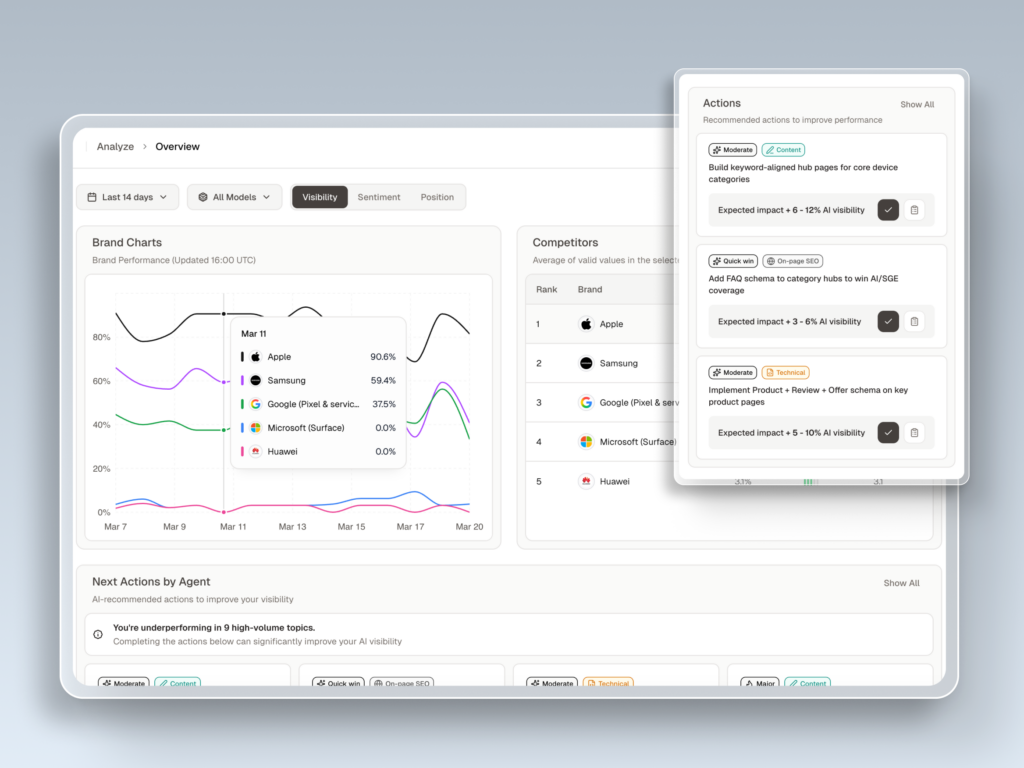
Monitoring sentiment and semantic drift. SEO tools don’t read content for tone. In AI search, how a brand is described matters as much as whether it’s mentioned. “Semantic drift,” where the AI’s version of your brand diverges from reality, can quietly erode brand equity. Topify’s Sentiment Analysis tracks perception on a 0 to 100 scale, flagging when a model starts describing your brand as “outdated” or “expensive” before those perceptions harden.
Competitor positioning in the shortlist. Legacy rank trackers show where competitors sit in a list of 100 links. AI visibility tools show where they sit in a shortlist of 3 recommendations. Topify’s Competitor Monitoring reverse-engineers the citation patterns of rivals, identifying which third-party sources are driving a competitor’s recommendations while your brand stays invisible.
How to Build an AI Search Visibility Strategy Alongside SEO
The shift from keyword optimization to citation optimization doesn’t mean starting over. It means layering a new discipline onto your existing SEO workflow.
Step 1: Audit your current Share of Model. Run a “Money Prompt Set,” 20 to 50 conversational questions that high-intent buyers in your category actually ask. This reveals whether the visibility gap is structural (AI can’t read your site), authority-based (no third parties cite you), or sentiment-driven.
Step 2: Discover high-value prompts. Traditional keyword research focuses on 4-word phrases. AI strategy focuses on 23-word prompts. Topify’s High-Value Prompt Discovery analyzes real AI interactions to find the clusters where buying decisions happen, so content teams can target the specific questions where their brand is currently excluded.
Step 3: Optimize content for AI citation. Research shows GEO-specific tactics can boost visibility by up to 40%. Three moves consistently perform: replacing vague claims with hard data to increase evidence confidence, including named expert quotations to signal E-E-A-T, and structuring content into atomic knowledge blocks of 134 to 167 words that lead with a direct answer.
Step 4: Execute and monitor continuously. AI citation patterns shift fast. Topify’s One-Click Execution lets teams generate and deploy schema-rich FAQ blocks or content updates directly to their CMS, closing the loop between identifying a gap and publishing a fix. Continuous tracking then measures the impact on your AI Visibility Score over time.
Conclusion
In 2026, SEO and AI search visibility aren’t competing strategies. They’re two sides of the same coin, but they require different skill sets and different tools.
Traditional SEO provides the retrieval-ready infrastructure. AI search visibility is where influence lives. If your reporting only tracks rankings, you’re missing the dark queries, the 23-word prompts, and the synthesized shortlists where buying decisions actually happen.
The goal for 2026 is clear: keep respecting the fundamentals of technical SEO, and start tracking Share of Model, monitoring sentiment, and optimizing for machine extraction. When a buyer asks an AI for the best solution in your category, you want your brand to be the one the machine recommends with confidence. Get started with Topify to see where you stand.
FAQ
Q: What’s the difference between AI search visibility and traditional SEO?
A: Traditional SEO focuses on ranking URLs in a list of links to drive clicks. AI search visibility focuses on being cited as an authoritative source within a synthesized answer, typically in zero-click environments where users never leave the AI interface.
Q: Does good SEO automatically improve AI search visibility?
A: Not necessarily. Traditional SEO is a retrieval gate that helps AI find your content, but a brand can rank number one on Google and still have zero visibility in AI responses. The gap usually comes from content that isn’t structured for extraction or lacks third-party corroboration.
Q: How do I check if my brand appears in AI search results?
A: You can run manual “Money Prompt” checks across ChatGPT, Gemini, and Perplexity. For statistical reliability at scale, automated tools like Topify track hundreds of prompts simultaneously to provide a composite Visibility Score.
Q: Is AI search visibility relevant for small businesses?
A: Yes. AI search often levels the playing field. Smaller brands with structured, highly specific expert content can out-cite larger competitors who rely on domain authority alone but lack atomic information density.

