

How to Show Up When Buyers Ask AI for Tool Recs
You rank on page one of Google for your primary category keyword. Your domain authority is solid. Then you ask ChatGPT, “What’s the best tool for [your category]?” and get back a list of three competitors. Your product isn’t on it.
That gap between Google rankings and AI recommendations is where SaaS deals are quietly dying. In 2025, 95% of B2B buyers purchased from a vendor that was already on their Day One shortlist. And increasingly, that shortlist is being assembled not by Google searches but by AI platforms like ChatGPT, Perplexity, and Gemini. If your product doesn’t show up in those answers, you’re out before you even know the buyer exists.
The fix starts with something most SaaS teams haven’t built yet: ai visibility tracking.
Your Google Rank Doesn’t Mean AI Knows You Exist
There’s a strategic misunderstanding baked into most SaaS marketing stacks: the assumption that strong SEO automatically translates to AI visibility. It doesn’t. The two systems run on fundamentally different logic.
Google ranks URLs based on domain authority, backlinks, and keyword density. AI answer engines like ChatGPT and Perplexity synthesize responses based on entity strength, factual corroboration across multiple sources, and how “extractable” your content is for machine readers. A SaaS company can hold the top organic spot for a category keyword and still be excluded from a ChatGPT recommendation if the AI can’t corroborate the brand’s expertise through trusted third-party sources.
That distinction matters because B2B buying behavior is shifting fast. The average buying cycle dropped from 11.3 months in 2024 to 10.1 months in 2025, and buyers are reaching out to sales reps earlier, moving the point of first contact from 69% of the journey to 61%. By the time a prospect fills out your demo form, the evaluation is mostly done. The question is whether your product made the AI-curated shortlist that informed that evaluation.
What AI Visibility Tracking Actually Measures
AI visibility tracking is not a rebrand of SEO monitoring. It’s a different measurement layer altogether, designed to answer one question: how does AI characterize, recommend, and position your brand when buyers ask about your category?
Topify, an AI search optimization platform built for this use case, breaks AI visibility into seven dimensions that give SaaS founders a full picture of their brand’s presence in the synthesized layer of the internet.
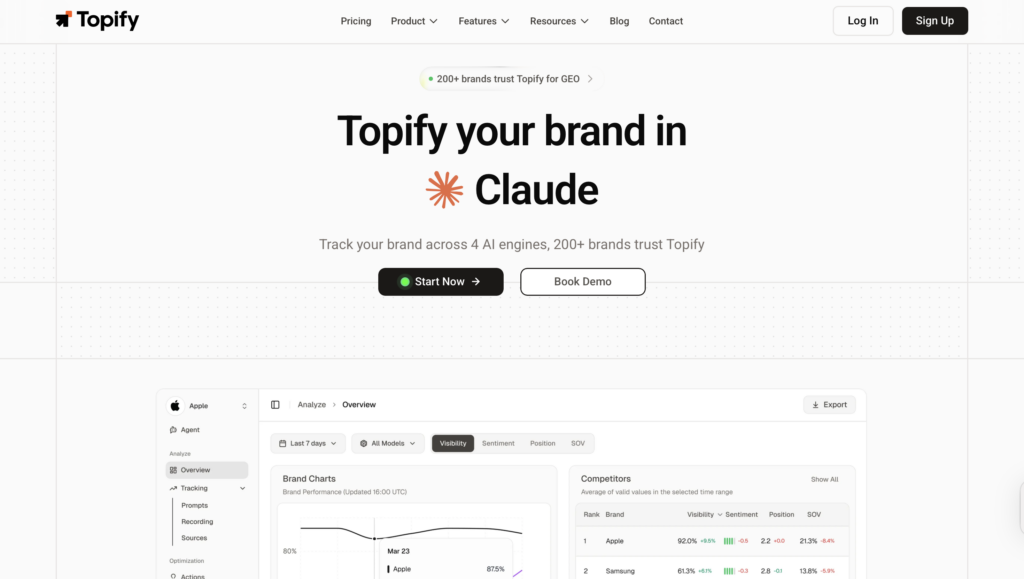
Visibility Score measures the percentage of target prompts where your brand appears. If you’re tracking 100 high-intent prompts across three platforms and your brand shows up in 45, that’s a 45% Visibility Score.
Sentiment Score captures the tone of how AI describes your product on a 0-to-100 scale. A score below 40 typically means the AI is adding caveats about pricing, complexity, or limitations. That framing shapes buyer perception before they ever visit your site.
Position Rank tracks where you land in a recommendation list. Being mentioned first carries an implicit endorsement that a fourth-place mention doesn’t.
Source Citation Share identifies which external URLs the AI is citing as its source of truth. In many categories, AI platforms rely on G2, Reddit, and industry blogs rather than your own website.
AI Volume reveals how often buyers are asking AI about your category, surfacing “dark queries” that traditional keyword tools miss entirely.
Intent Alignment checks whether AI is matching your product to the right buyer persona. High visibility for an irrelevant use case is worse than no visibility at all.
Conversion Visibility Rate (CVR) estimates the conversion probability of a specific mention context. This is the metric that connects visibility directly to pipeline. While traditional organic search traffic converts at roughly 2.8%, AI search traffic converts at 14.2%, an 8.5x advantage for SaaS companies. The average value of an AI-referred visit is $47 compared to $9 from Google.
3 Signals Your Competitors Already Own the AI Shortlist
You don’t need a full tracking platform to diagnose the problem. Three signals tell you whether AI is sending buyers to your competitors.
The Shortlist Displacement. Run 10 to 20 “best of” prompts across ChatGPT and Perplexity using your category keywords. If competitors consistently occupy the top three spots and your product isn’t mentioned, you have a retrieval gap. The AI has either not indexed your relevant content or doesn’t perceive your brand as a leader for that intent.
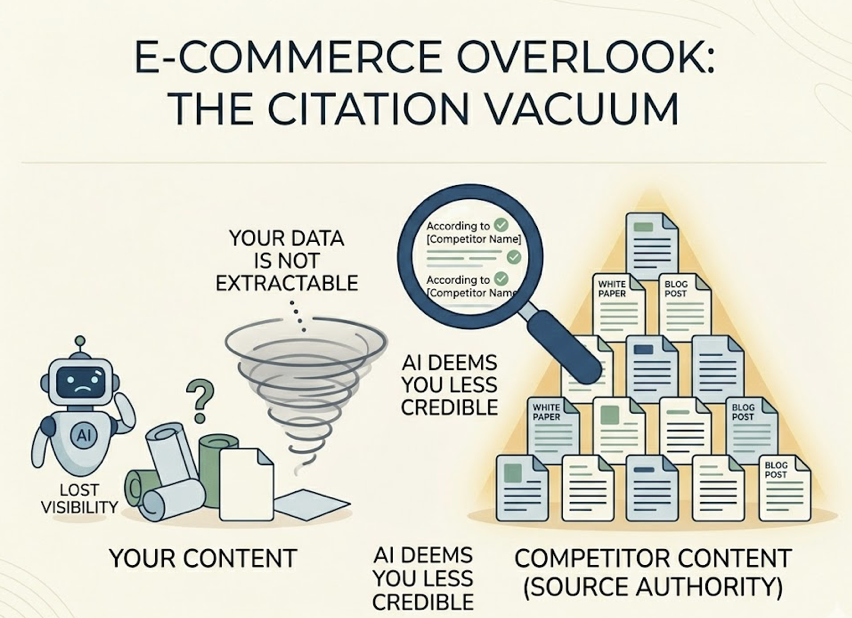
The Citation Vacuum. Check the “Sources” section in Perplexity or Gemini responses about your category. If the AI cites only competitor whitepapers, blog posts, and landing pages while explaining concepts your product solves, your competitor has established source authority. Your content is being deemed less credible or less extractable.
Semantic Drift. Ask ChatGPT or Gemini “How does [your product] work?” If the AI misrepresents your features, pricing tier, or target customer, you’re experiencing semantic drift. This happens when the model’s training data or retrieved content contains outdated or incorrect information. A founder whose enterprise platform gets described as a “free tool for students” faces immediate friction in every high-value sales conversation.
How to Set Up AI Visibility Tracking in 30 Minutes
Building a baseline doesn’t require a six-month initiative. Three focused steps can give you a working AI visibility tracking system in about half an hour.
Step 1: Identify Your High-Value Prompts
The shift from keyword tracking to prompt tracking is fundamental. Instead of monitoring “project management software,” track the full-sentence questions buyers actually ask AI.
Map prompts across the buyer journey. Awareness-stage prompts look like “What are the top trends in [category] for 2026?” Consideration-stage prompts look like “Compare [your product] vs [competitor] for [use case].” Decision-stage prompts look like “What are the security certifications for [your product]?”
Topify’s High-Value Prompt Discovery uses real-world conversational data to surface the prompts actually driving traffic, rather than relying on static search volume estimates.
Step 2: Run a Cross-Platform Baseline Audit
Each AI platform uses different retrieval logic and training data. A prompt that returns your brand in Perplexity might exclude you in ChatGPT. Run your identified prompts across ChatGPT, Perplexity, Gemini, and Google AI Overviews. Record the initial Visibility Score, Sentiment, and Position for each. That “before” snapshot is essential for measuring the ROI of any optimization you do next.
Step 3: Set Up Continuous Monitoring
AI recommendations are probabilistic and highly sensitive to model updates. A one-time audit gives you a snapshot, not a strategy.
Here’s why that matters: 50% of the content cited in AI responses is less than 13 weeks old. When OpenAI or Anthropic ships a new model version, the retrieval mechanisms change. A brand that held the top recommendation slot in one version can vanish in the next if the new model prioritizes a different set of trusted sources.
Continuous monitoring platforms like Topify automate daily querying across platforms and send alerts when a competitor gains ground or when your brand’s sentiment shifts. That’s the difference between reacting to a pipeline drop three months later and catching the visibility loss the week it happens.
From AI Visibility Tracking to SaaS Growth: 3 Moves That Work
Tracking is the diagnostic layer. Growth comes from acting on the data. Three strategies consistently move the needle for SaaS brands.
Build citation authority on the platforms AI already trusts. Research shows that 85% of brand mentions in AI responses come from third-party sites, including Reddit, G2, TrustRadius, and industry publications. If Topify’s Source Analysis shows that 60% of citations in your category come from Reddit, your content strategy should shift toward community engagement and earned media on those platforms.
Restructure content for machine extractability. AI models prefer content they can parse cleanly. That means opening product pages and blog posts with a two-to-three sentence “Bottom Line Up Front” summary that directly answers a buyer prompt. Implementing structured data like JSON-LD schema markup (SoftwareApplication, FAQPage, Organization) can drive a 67% improvement in AI coverage. And brands that publish original research are 6.5x more likely to be cited as an authoritative source.
Close gaps with one-click execution. The bottleneck for most SaaS teams isn’t knowing what to fix. It’s having the bandwidth to fix it. Topify’s AI agent can automatically generate GEO-optimized content, deploy structured data, and draft responses for community threads where competitors are being cited. Lean teams can maintain a high-velocity GEO program without tripling their content headcount. You can get started with Topify and see your brand’s current AI visibility status within minutes.
What Happens When SaaS Brands Start Tracking AI Visibility
The data from early adopters tells a clear story.
A mid-market project management platform ranking on page one of Google was appearing in only 8% of AI-driven buyer queries. Competitors were showing up in 65%. After a 90-day GEO framework that included structural content updates and a Reddit marketing campaign, they hit a 24% cross-platform citation rate, generated 47 qualified leads directly attributed to AI recommendations, and saw a conversion rate 2.8x higher than their previous organic search average.
An Australian HR SaaS called PeopleFlow started with a 6.4% mention rate across 47 test queries and zero top-recommendation positions. After restructuring core business data and optimizing for major LLMs, they achieved a 340% increase in brand mentions, moved their average recommendation position from 7th to 2nd, saw a 28% increase in demo requests with “AI research” cited as the discovery source, and cut their sales cycle length by 34%.
Those aren’t edge cases. They’re what happens when SaaS brands treat AI visibility as a measurable growth channel instead of a nice-to-have.
Conclusion
The SaaS brands that win in 2026 won’t just rank on Google. They’ll be the ones AI recommends when a buyer asks “What’s the best tool for [my problem]?” That requires knowing where you stand today, tracking how it changes week over week, and acting on the gaps before competitors fill them.
AI visibility tracking gives you that infrastructure. Start by running your category prompts across ChatGPT and Perplexity, measure your baseline, and build from there. The buyers are already asking AI for recommendations. The only question is whether your product is part of the answer.
FAQ
Q: What is AI visibility tracking?
A: AI visibility tracking is the practice of monitoring how your brand appears, gets characterized, and ranks within AI-generated answers across platforms like ChatGPT, Perplexity, Gemini, and Google AI Overviews. It measures dimensions like mention frequency, sentiment, position, and source citations to give you a complete picture of your AI presence.
Q: How often should I check my SaaS brand’s AI visibility?
A: Continuous monitoring is the standard. AI recommendations shift frequently as models update and new content gets indexed. Half of the content cited in AI responses is less than 13 weeks old, so weekly or daily tracking catches changes that a quarterly audit would miss entirely.
Q: Can AI visibility tracking replace traditional SEO?
A: No. AI visibility is built on the foundation of quality SEO, but it requires a different optimization approach called Generative Engine Optimization (GEO). SEO drives traffic to your site. AI visibility tracking ensures you make the buyer’s shortlist before the click ever happens. You need both.
Q: Which AI platforms matter most for SaaS discovery?
A: The four platforms that matter most for B2B SaaS discovery are ChatGPT for creative and strategic research, Perplexity for cited research and sourced recommendations, Gemini for the Google ecosystem, and Google AI Overviews for search result summaries. Tracking across all four gives you the most complete picture.

