

Your team ran a free AI visibility check last Tuesday. The report came back: “Visibility Score: 42/100.” Your CMO asked the obvious follow-up: “What do we do about it?” And nobody in the room had an answer.
That’s the gap between knowing you have a problem and knowing how to fix it. Free AI visibility tools are good at confirming suspicion. Paid ones are built to drive action. The difference isn’t just about features on a spec sheet. It’s about whether the data you’re getting can actually change your next quarter’s results.
The $0 Report That Tells You Nothing Actionable
Most free AI visibility tools work through a singular query mechanism. You type in your brand name, pick a prompt, and the tool checks whether you were mentioned in a single response at a single moment. You get a score.
Here’s the problem: AI models are non-deterministic. The same prompt can return different results depending on the model’s temperature setting, recent data refreshes, and cache cycles. Research into AI search volatility indicates that only about 30% of brands maintain consistent visibility across multiple regenerations of the same query. That score you captured in the morning could be irrelevant by the afternoon.
Free tools also tend to focus on a single platform, usually ChatGPT. But brand representation is highly fragmented across different models. Perplexity pulls roughly 46.7% of its top citations from Reddit. Gemini prioritizes pages that already rank well in traditional Google search. A brand winning on ChatGPT may be invisible on Perplexity.
That’s not a minor gap. That’s a strategic blind spot.
What Free AI Visibility Trackers Actually Include
Free tools generally fall into three categories, each solving a different “first step” problem.
| Tool Category | What It Does | Best For | What It Misses |
|---|---|---|---|
| Bot Access Checkers | Verifies robots.txt permissions for AI crawlers like GPTBot and PerplexityBot | Technical SEOs during initial site setup | Whether content is actually used in responses |
| Structural Graders | Audits Schema markup, heading hierarchy, FAQ structure | Content writers doing pre-publish checks | Live response tracking or brand mentions over time |
| Single-Shot Mention Trackers | Detects brand presence for a limited set of prompts | Solo founders or personal brands checking basic indexing | Historical trends, sentiment, or position weighting |
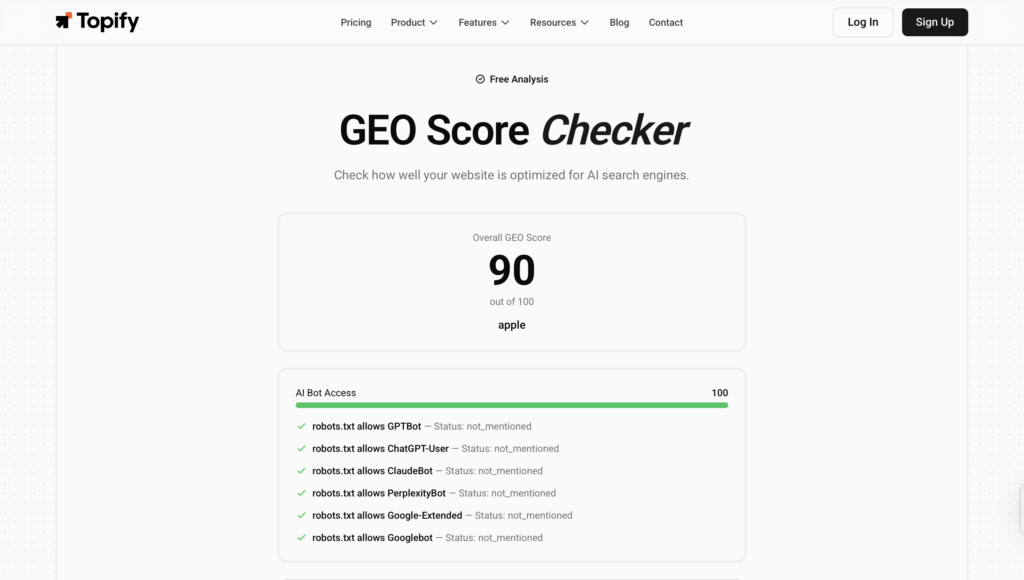
These tools are genuinely useful for situational awareness. Topify’s free GEO Score Checker, for example, evaluates a site across four dimensions: AI bot access, structured data, content signals, and overall visibility. It’s the fastest way to identify whether AI crawlers can even read your site.
But a diagnostic isn’t a strategy. And that’s where free tools hit a hard ceiling.
Where Free AI Visibility Tracking Hits a Wall
The transition from free to paid isn’t about prestige. It’s driven by three concrete limitations: frequency, depth, and cross-platform coverage.
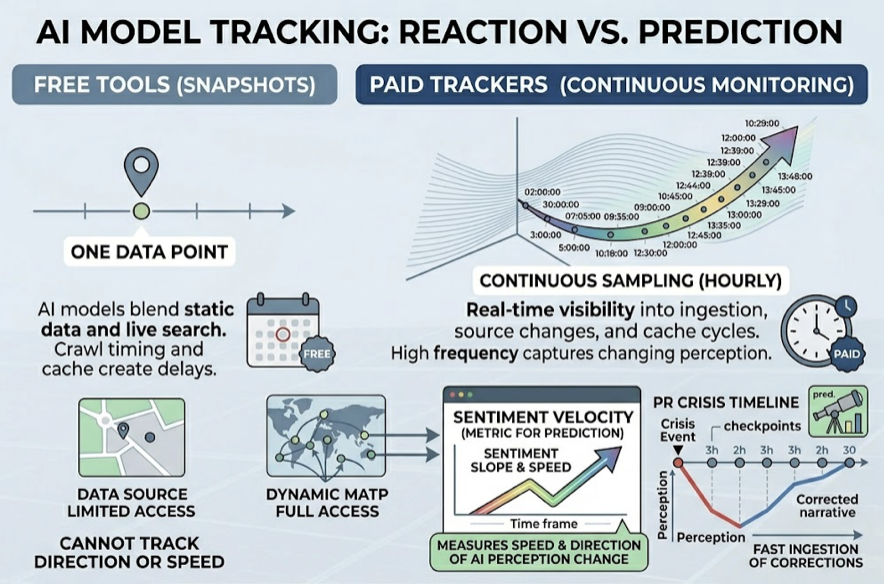
Snapshots vs. continuous monitoring. Free tools give you one data point. AI models aren’t static libraries: they combine training data with live web retrieval, subject to crawl timing, source selection changes, and cache cycles. During a PR crisis, you need hourly sampling to measure how quickly models ingest corrections. A free tool can’t tell you the direction or speed at which AI perception is changing. Paid trackers call this “Sentiment Velocity,” and it’s the metric that separates reaction from prediction.
Mention status vs. source forensics. A free tool can confirm “yes, you were mentioned.” A paid tracker reverse-engineers the citations, identifying exactly which third-party URLs the AI used to justify its response. This matters because AI models often favor third-party sources like Reddit, G2, and industry journals over brand-owned content. Between 82% and 85% of AI citations come from third-party domains. If the model is citing a five-year-old negative forum post, a free tool shows low sentiment but won’t tell you which URL to target for a content refresh.
One-platform bias vs. the multi-model reality. Most free tools only cover ChatGPT. But studies show only a 25% overlap in brand recommendations between ChatGPT and Perplexity. A brand can be dominant on one and invisible on the other. Only a multi-model tracker reveals that discrepancy.
You can’t optimize what you don’t continuously track.
What Paid AI Visibility Tracking Unlocks
Paid platforms shift the conversation from “am I mentioned?” to “why, where, how, and relative to whom?” Topifypioneered a seven-metric framework designed for this:
| Metric | What It Tells You | Traditional SEO Equivalent |
|---|---|---|
| Visibility Rate | Mention frequency across target prompts | Page Impressions |
| Sentiment Score | How AI frames your brand: positive, neutral, or critical | Brand Reputation |
| Position Score | Your rank within a multi-brand AI response | Keyword Rankings |
| Source Citation Share | Which URLs influence what AI says about you | Backlink Profile |
| AI Query Volume | Monthly demand for specific prompts across AI platforms | Search Volume |
| Intent Coverage | Visibility across informational, comparative, and transactional queries | Search Intent Alignment |
| CVR | Conversion probability from AI citations | Organic Sessions / ROI |
This isn’t just more data. It’s data that closes the loop between measurement and action. Early data suggests that visitors arriving from an AI recommendation convert at roughly 5x the rate of traditional organic search visitors. That conversion premium exists because the AI has pre-qualified the user before they ever click.
The cost of not tracking is rising, too. Global business losses from AI hallucinations were estimated at $67.4 billion in 2024, with 47% of executives making major decisions based on unverified AI content. Paid tools like Topify include hallucination detection that flags pricing errors, outdated claims, and inaccurate brand descriptions before they cost you deals.
How Topify Bridges Free and Paid AI Visibility Tracking
Most platforms force a binary choice: free diagnostic or full subscription. Topify is built around a progression path.
It starts with the free GEO Score Checker. No signup required. You get an instant audit of AI bot access, structured data, and content signals. If your robots.txt is blocking GPTBot or your Schema markup is missing, you’ll know within seconds. That’s the “is the foundation broken?” question, answered in under a minute.
Once you’ve confirmed a baseline problem, the paid tiers unlock the full monitoring and optimization stack:
Basic ($99/mo): 100 prompts tracked across ChatGPT, Perplexity, Gemini, and AI Overviews. Four projects, four seats. Includes a 30-day trial. Best for individual marketers or small teams establishing their first AI visibility baseline.
Pro ($199/mo): 250 prompts, full sentiment suite, competitor Share of Voice benchmarking, and 10 seats. Designed for agencies and mid-market teams managing multiple brands.
Enterprise (from $499/mo): Dedicated account manager, custom prompt volume, and API integration for brands embedding AI visibility data into internal dashboards.
The differentiator isn’t just the data. It’s Topify’s One-Click GEO Execution. When the analytics flag a visibility gap or a negative citation source, the system generates a prioritized roadmap: which pages to update, which schema to add, which content angles to pursue. That’s the bridge most platforms are missing, the step between “here’s your problem” and “here’s the fix.”
A Side-by-Side Look at Free vs Paid AI Visibility Tracking
| Dimension | Free Trackers | Paid Trackers (Topify) |
|---|---|---|
| Platform Coverage | 1-2 engines, usually ChatGPT | ChatGPT, Gemini, Perplexity, DeepSeek, AI Overviews, and more |
| Update Frequency | Single snapshot, ad-hoc | Daily or hourly continuous monitoring |
| Metric Depth | Mention yes/no, simple score | Visibility, Sentiment, Position, Volume, Source, Intent, CVR |
| Competitor Tracking | Rare or very limited | Head-to-head Share of Voice by prompt category |
| Source Analysis | None | Traces mentions to specific URLs and authoritative domains |
| Actionability | Data without context | Prioritized fix roadmap with one-click execution |
| Price | $0 | $99/mo to $499+/mo |
The price difference is a reflection of information completeness. In an environment where 83% of searches are resolved within the AI interface, the cost of being invisible on a high-intent query far exceeds a monthly subscription.
When Free Is Enough, and When It’s Not
Not every team needs a paid tracker on day one. The decision depends on competitive risk and customer lifetime value.
Free tools are the right choice when you’re running a personal brand, an early-stage startup still validating product-market fit, or a team doing its first exploratory audit. If the goal is a quick check to ensure crawlers aren’t blocked, a free diagnostic like Topify’s GEO Score Checker is the right starting point.
Paid tracking becomes necessary when the stakes get higher. Agencies managing multi-brand portfolios need a unified dashboard across client entities. High-LTV B2B SaaS companies can’t afford a hallucinated pricing error to break a deal. Brands aiming for category leadership need to capture at least 25-30% Share of Voice to dominate AI recommendations. And marketing teams reporting to the board need to prove that AI-driven traffic converts at documented rates to justify budget allocation.
The pattern across competitive categories is consistent: the #1 ranked brand in AI mentions captures an average of 62% of total AI Share of Voice. The gap between #1 and #3 is typically 5x. There’s no page two in AI search. You’re either in the answer or you’re not.
Conclusion
Free and paid AI visibility trackers aren’t competing products. They’re different stages of the same journey. Free tools answer “do I have a problem?” Paid tools answer “what’s causing it, how bad is it, and what do I do next?”
The practical path: start with a free GEO score check to confirm your foundation is intact. If you find gaps, or if you’re operating in a category where AI recommendations influence buying decisions, move to continuous monitoring. The brands that treat AI visibility tracking as an ongoing discipline, not a one-time audit, are the ones building a durable advantage in how AI recommends, describes, and ranks them.
GEO Score Checker
FAQ
What’s the difference between free and paid AI visibility tracking?
Free tools provide a point-in-time diagnostic of technical readiness and a simple mention score. Paid tools provide continuous multi-platform monitoring, sentiment analysis, historical trends, and source forensics that identify which third-party URLs are influencing the AI’s response.
Can free AI visibility tools track multiple platforms?
Most can’t. Free tools typically focus on ChatGPT, creating a “one-platform bias.” Since brand presence varies significantly across engines, with only 25% overlap between ChatGPT and Perplexity recommendations, single-platform data creates blind spots that only multi-model trackers can fill.
How often should I check my brand’s AI visibility?
Because only 30% of brands maintain consistent visibility across query regenerations, a single snapshot is insufficient. Professional teams typically monitor daily or weekly, with high-priority brands using hourly tracking during PR events or product launches.
Is AI visibility tracking worth paying for?
For brands in competitive or high-LTV categories, yes. AI-referred traffic converts at roughly 5x the rate of traditional search, and global losses from AI hallucinations reached $67.4 billion in 2024. Paid tracking is both a growth channel and a reputation insurance policy.

