

Two dashboards, two scores for the same brand. One platform says your AI visibility is 72. Another says 48. Your quarterly review is next week, and you can’t explain to leadership which number is real, because each tool defines “visibility” differently and none of them show their math. Meanwhile, AI engines keep reshaping how they describe your brand, and last month’s snapshot is already stale. The problem isn’t a lack of scores. It’s that a score without a transparent measurement method behind it is just a number on a screen.
What an AI Visibility Score Actually Measures
An AI visibility score is a normalized, composite metric, typically on a 0 to 100 scale, that quantifies how present your brand is inside the synthesized answers of ChatGPT, Gemini, Perplexity, and other generative engines. An AI visibility score tracker is the system that produces and updates that number over time.
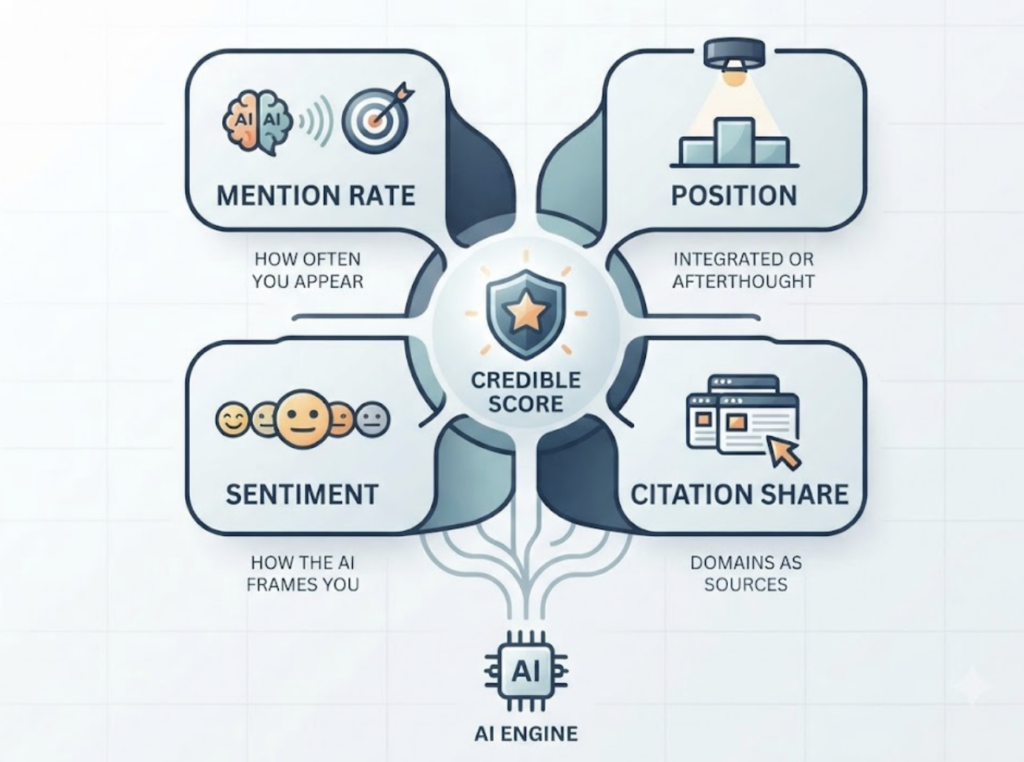
Unlike a Google ranking, there’s no static list of blue links to track. AI answers are written fresh each time. So a credible score is a weighted function of four components: mention rate (how often you appear across a set of prompts), position (whether you’re woven into the recommendation or dropped in as an afterthought), sentiment (how the AI frames you), and citation share (how often your domains are the sources behind the answer).
Here’s the part most teams miss: AI visibility and Google rankings measure different things. Industry research in 2026 points to a ranking–mention separation. Holding the #1 organic spot on Google doesn’t predict whether an AI answer will mention you at all, because generative engines weigh entity authority and source extractability over classic ranking signals.
Your SEO dashboard can look perfect while your brand stays invisible to AI.
How an AI Visibility Score Tracker Works Under the Hood
Every serious AI visibility score tracker runs the same four-step pipeline, and the quality of the score depends on how rigorously each step is executed.
Step 1: Prompt universe design. The tracker defines a consistent set of queries reflecting real buyer intent: branded prompts, category prompts, and comparison prompts. This set stays fixed so scores are comparable over time.
Step 2: Multi-engine sampling. The same prompts run across multiple LLMs. Each engine has its own citation logic, so single-engine data tends to mislead.
Step 3: Parsing and interpretation. NLP models extract entity presence, cited URLs, and tonal markers from each synthesized answer.
Step 4: Weighted scoring. Data points aggregate into a trend line, not a one-off snapshot.
Why does sampling depth matter so much? Because LLMs are stochastic. Ask the same question twice and you can get two different answers. A single spot-check is statistically meaningless, which is why professional-grade setups typically run 100+ prompts across at least four engines with high-frequency updates.
A score built on 10 prompts isn’t a score. It’s a coin flip.
How to Measure Your AI Visibility Score Step by Step
You don’t need an enterprise budget to establish a baseline. You need a repeatable method.
Start with a free baseline check. A tool like Topify‘s GEO Score Checker gives you a zero-cost snapshot of where your brand stands, and a broader set of options is collected in this GEO free tools reference. Free checkers are useful for establishing a starting point, though they lack the longitudinal, high-frequency data that trend analysis requires.
Build your prompt set. Cover three layers: branded (“Is [brand] good for X”), category (“best tools for X”), and comparison (“[brand] vs [competitor]”). The category layer matters most, since that’s where AI-influenced discovery actually happens.
Pick your engine coverage. At minimum, track ChatGPT, Perplexity, and Google AI Overviews. If your audience spans markets, engines like Gemini and DeepSeek behave differently enough to justify inclusion. A practical walkthrough of the ChatGPT side is covered in how to track AI search visibility and rankings in ChatGPT.
Set a re-measurement cadence. Weekly is the professional standard. Model updates ship fast, and monthly snapshots miss the citation shifts that happen in between.
Add competitor benchmarks. An 80 means nothing on its own. If your top three competitors sit at 90, that 80 is a warning, not a win.
Tracking Brand Reputation Across Generative Engines
Visibility is necessary but not sufficient. You can rank high on mentions and still lose, because a brand that’s mentioned often but framed negatively is building the wrong kind of presence. That’s why teams that track brand reputation across generative engines treat sentiment and source attribution as first-class metrics, not add-ons.
Engine discrepancy is the pattern to watch. It’s common for a brand to be warmly recommended in ChatGPT while Perplexity, which leans heavily on real-time review sites, cites it with caveats or negative framing. Same brand, same week, two different reputations.
The fix starts with source attribution analysis: knowing exactly which domains each engine pulls from when it talks about you. If a low-authority review site is shaping how Perplexity describes your product, that’s a digital PR problem you can actually act on. On Topify’s side, this maps to its Sentiment Analysis (a 0 to 100 tonal score per engine) combined with citation source tracking, so a sentiment drop can be traced back to the specific domain that caused it.
That trace-back is the difference between a dashboard and a decision.
How to Improve Your AI Visibility Score
Improving the score means influencing what generative engines read, trust, and extract. Four levers consistently move the needle, roughly in this order of impact.
1. Get present on domains AI already cites. Reverse-engineer which URLs the engines reference for your category prompts, then earn placement there. If AI never reads the sources you publish on, your content can’t enter the answer.
2. Structure your content for extraction. Organization and product schema (JSON-LD), clear headings, and direct answer-style formatting make it easier for models to pull correct entity information instead of guessing.
3. Publish comparison content. Pages that objectively lay out “Brand A vs Brand B” give AI clean, synthesizable material, and brands that provide it tend to control how the comparison gets framed.
4. Close the loop between insight and action. This is where most workflows stall: the tracker flags a visibility drop, and the fix sits in a backlog for a month. Topify’s approach connects reverse-engineered citations with One-Click Execution, so identifying a gap and deploying the content response happen inside the same platform. For a deeper strategic framework, the complete guide to generative engine optimization walks through the full playbook.
Best Tools for AI Visibility Score Tracking
Before comparing products, fix the evaluation criteria. Four dimensions separate a usable tracker from a vanity dashboard:
| Dimension | Why it matters |
|---|---|
| Engine coverage | Each model (ChatGPT, Gemini, Perplexity, DeepSeek) has distinct citation logic; single-engine data misleads |
| Sampling volume | Determines whether a trend is real or statistical noise |
| Metric decomposability | A score you can’t drill into sentiment and position is unactionable |
| Competitive benchmarking | Absolute scores are vanity; relative standing is strategy |
Topify covers all four. It tracks brand presence across ChatGPT, Gemini, Perplexity, DeepSeek, Doubao, Qwen, and other major engines, and decomposes the score into seven metrics: visibility, sentiment, position, volume, mentions, intent, and CVR. Competitor benchmarking is built in, with automatic detection of emerging rivals. Pricing starts at $99/month for the Basic plan, which includes 100 tracked prompts, 9,000 AI answer analyses, and a 30-day trial, putting it at the entry point of the professional SaaS tier.
Other options exist across the market. Platforms like Profound and Peec AI offer AI visibility monitoring with their own strengths, and enterprise solutions add custom prompt sets and advanced attribution modeling at higher price points. The market roughly splits into three tiers: free checkers for baselines, SaaS platforms in the $99 to $499/month range for professional sampling and benchmarking, and enterprise deals above that.
For most marketing teams, the SaaS tier is where measurement becomes reliable enough to report on.
Common Mistakes That Make Your Score Meaningless
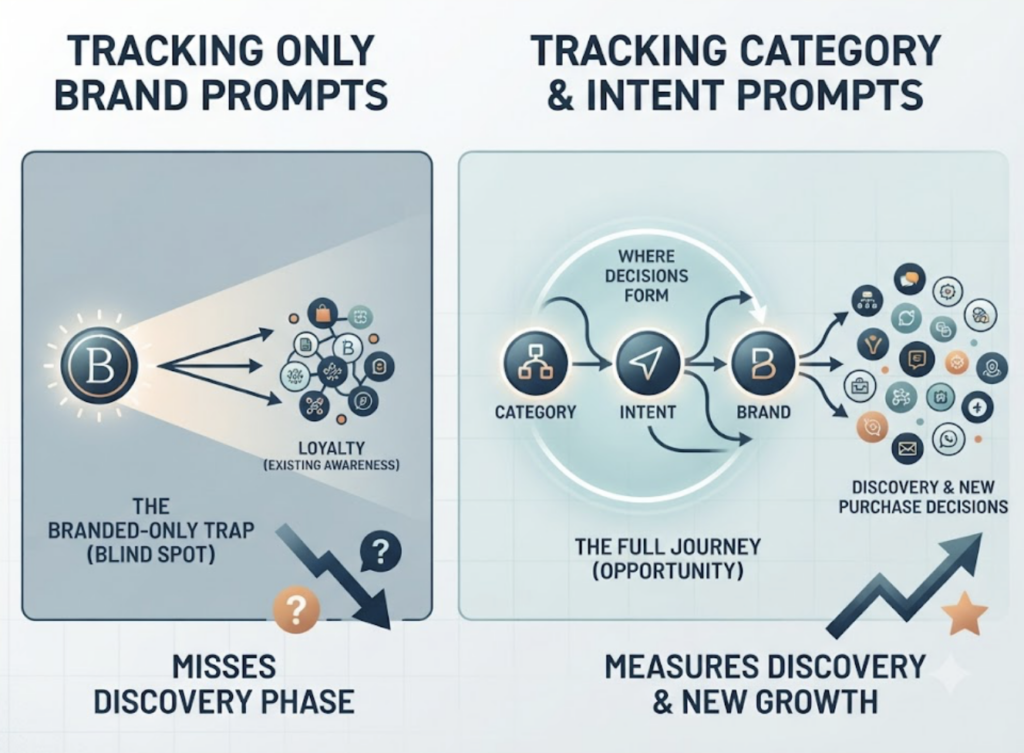
The branded-only trap. Tracking only prompts that contain your brand name misses the category and intent phase, which is where most AI-influenced purchasing decisions actually form. If your prompt set is 100% branded, your score measures loyalty, not discovery.
Treating a snapshot as a trend. LLM output is volatile. One measurement tells you what the model said that day, not where you’re heading. Monthly checks miss shifts caused by weekly model updates.
Reading the total, ignoring the parts. A stable composite score can hide a visibility gain that’s masking a sentiment decline. Always decompose.
Skipping competitor context. An 80 with rivals at 90 and an 80 with rivals at 60 are opposite situations wearing the same number.
Quick checklist before you trust any score: 100+ prompts covering branded, category, and comparison intent; at least three engines; weekly cadence; decomposable metrics; and top-three competitor benchmarks in the same view.
Conclusion
The reason two trackers give you a 72 and a 48 for the same brand isn’t that one is lying. It’s that scores are derivatives of sampling architecture, and different architectures produce different numbers. So stop chasing an absolute figure. Pick one methodology with enough sampling depth, hold it constant, and read the trend line and the competitor gap instead.
The practical path: run a free baseline check first, then move to continuous tracking once you’ve confirmed the gap is worth closing. You can get started with Topify on a 30-day trial and have your first weekly trend line before your next reporting cycle.
FAQ
Q: What are some examples of AI visibility score trackers?
A: Free options include Topify’s GEO Score Checker for one-off baselines. Paid platforms include Topify (from $99/month, seven-metric decomposition across ChatGPT, Gemini, Perplexity, DeepSeek and more), plus alternatives like Profound and Peec AI. Enterprise solutions add custom prompt sets and API access.
Q: How much does an AI visibility score tracker cost?
A: Free checkers cost nothing but only provide snapshots. Professional SaaS platforms generally run $99 to $499/month; Topify’s Basic plan sits at the $99 entry point with 100 prompts and 9,000 monthly answer analyses. Enterprise tiers with dedicated support start around $499/month and up.
Q: How often should you re-measure your AI visibility score?
A: Weekly is the professional standard. AI models update frequently enough that monthly measurement misses meaningful citation shifts, and daily sampling within a weekly reporting cadence gives the cleanest trend lines.
Q: Can you track brand reputation in generative engines with the same tool?
A: Yes, if the tracker decomposes its score. Reputation tracking requires per-engine sentiment scoring plus source attribution, since the same brand often reads positively in ChatGPT and negatively in Perplexity depending on which domains each engine cites.

