

Your monthly performance report has a page for organic traffic, a page for keyword rankings, and a page for conversions. It doesn’t have a page for AI search. Meanwhile, Similarweb’s 2026 consumer research found that over 60% of high-intent purchase research now happens inside AI-native interfaces like ChatGPT and Perplexity, not on traditional results pages. Most teams “measure” this by occasionally typing a prompt into ChatGPT and screenshotting the answer. That’s not a metric. It’s a mood. An AI visibility score dashboard turns those scattered spot-checks into a number you can baseline, benchmark, and report, the same way you’ve reported rankings for the past decade.
What an AI Visibility Score Dashboard Actually Measures
An AI visibility score dashboard aggregates your brand’s performance across multiple AI engines into a composite, trackable score. Instead of asking “where does my URL rank,” it asks “when someone in my category asks an AI for a recommendation, do I show up, how prominently, and in what tone.”
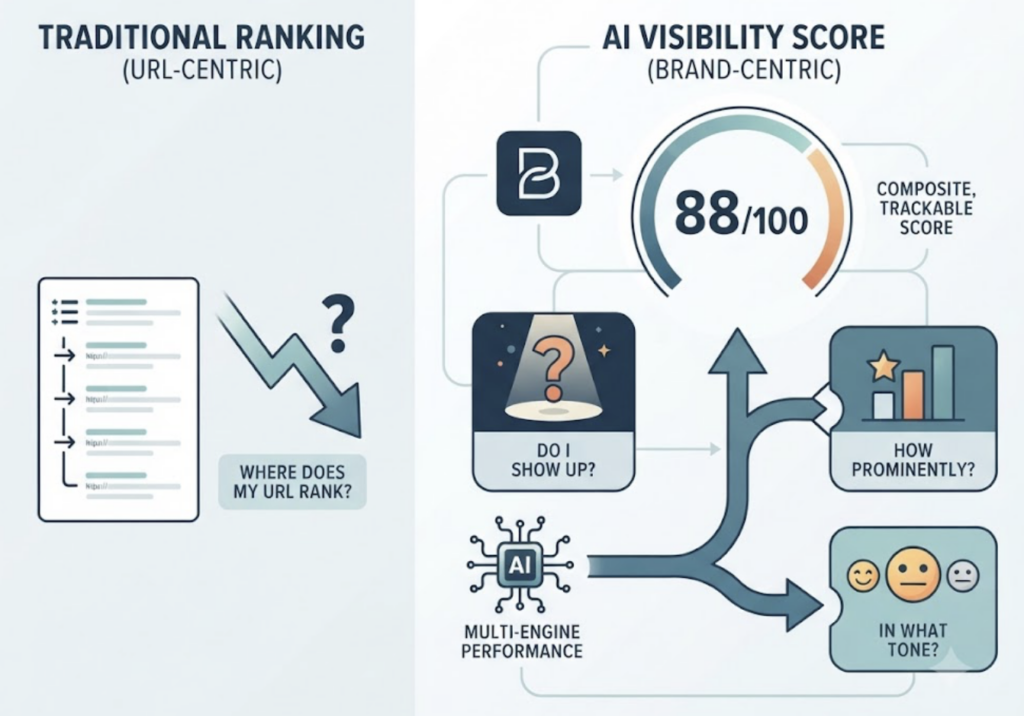
That’s a bigger shift than it sounds. Traditional SEO dashboards track URL-based positions. AI visibility systems track what Conductor’s research calls entity presence: whether the model knows your brand exists as an answer, independent of any single page.
A credible score decomposes into four raw signals:
| Signal | What it tells you |
|---|---|
| Mention rate | How often your brand appears across a defined set of prompts |
| Position | Whether you’re the lead recommendation or an afterthought |
| Sentiment | Whether the AI frames you as a recommendation or a caveat |
| Citation share | What percentage of category answers cite your domain as a source |
Here’s the thing about composite scores: a single number is only useful if you can drill beneath it. A score of 62 that can’t be traced to specific prompts, engines, and sources isn’t analytics. It’s decoration.
How an AI Visibility Score Dashboard Works Behind the Scenes
Large language models are stochastic. Ask the same question twice and you’ll often get two different answers, which means one query proves nothing. Stanford HAI’s 2026 work on measurement standards in generative models makes the same point: single-sample observations of a probabilistic system aren’t data.
A professional AI visibility score system solves this with a four-step pipeline:
- Fixed prompt universe. Curate a set of queries that mimic real buyer intent in your category, like “best expense software for mid-size finance teams.”
- Longitudinal sampling. Run those prompts across multiple engines at regular intervals, not once.
- Parsing and interpretation. Decode each answer: was the brand mentioned, where in the answer, in what tone, and with an attributable link?
- Trend aggregation. Normalize the raw results into a 0-100 score that tracks movement over time.
The score itself isn’t the product. The sampling methodology is.
Two dashboards can both show you a “visibility score” and mean completely different things, depending on how many prompts they run, how often, and across how many engines. When you evaluate any AI visibility score software, the first question isn’t what the dashboard looks like. It’s what’s feeding it.
The Metrics That Belong on Your Dashboard, and the Ones That Don’t
A dashboard earns its place in your reporting stack when every metric on it answers a business question. The most complete AI visibility score analytics setups track seven dimensions. This framework maps directly to how Topifystructures its Comprehensive GEO Analytics view:
| Metric | Business question it answers |
|---|---|
| Visibility rate | Is our brand reaching potential customers in AI answers? |
| Position | Are we the primary recommended solution, or option number six? |
| Sentiment | Does the AI present us favorably? |
| Mentions | What’s our total reach across the prompt universe? |
| Volume | How much buyer intent is flowing through AI in our niche? |
| Intent | Are we appearing for high-converting queries, or just informational ones? |
| CVR | Are AI answers actually likely to send users toward our brand? |
Just as important is what to leave off. Single-platform mention counts, one-time snapshots, and vanity totals like “we appeared 400 times” don’t belong on a scorecard. They can’t distinguish between visibility and authority.
That distinction matters more than most teams realize. A brand can be mentioned constantly (visibility) while its domain is never cited as a source (authority). Systems that blur the two push teams to optimize for the wrong signal, usually chasing mentions in low-intent prompts while competitors quietly capture the citations that shape future answers.
How to Measure Your AI Visibility Score Step by Step
You can stand up a working measurement program in about two weeks. The sequence matters more than the tooling:
- Define your prompt set. Start with 25-50 queries a real buyer would ask, weighted toward commercial intent.
- Pick your engines. At minimum, track ChatGPT, Gemini, and Perplexity. Each uses different citation logic, so coverage gaps are real blind spots.
- Establish a baseline. Run the full prompt set for one to two weeks before drawing any conclusion. This is your starting score.
- Set competitor benchmarks. Identify your top three rivals and score them against the identical prompt set.
- Review on a cycle. Weekly for trend detection, monthly for reporting.
Step four is where most manual efforts quietly die. Scoring one brand by hand is tedious; scoring four brands across three engines and 50 prompts every week is roughly 600 answer reviews. That’s the workload an AI visibility score platform automates, and it’s why competitor benchmarking is usually the feature that justifies the subscription. Topify’s Dynamic Competitor Benchmarking handles this automatically, detecting emerging rivals in your prompt set and tracking your relative position without manual re-scoring.
A quick checklist before you trust your first score: prompt set covers commercial intent, at least three engines tracked, baseline period completed, competitors scored on identical prompts, and a recurring review cadence on the calendar.
Choosing an AI Visibility Score Tool: What Separates Software from Spreadsheets
Plenty of teams start with a spreadsheet and a rotation of interns pasting prompts into ChatGPT. It works for about a month. Then the sampling gets inconsistent, the scoring gets subjective, and the data stops being comparable week over week.
When you graduate to a dedicated AI visibility score tool, evaluate on actionability, not reporting polish. Four capabilities separate a real AI visibility score solution from a pretty chart:
Multi-engine coverage. Dageno AI’s cross-engine research found that citation behavior differs meaningfully between models, so a single-engine view systematically misleads. Topify tracks ChatGPT, Gemini, Perplexity, DeepSeek, Doubao, Qwen, and other major engines, which matters if any part of your audience sits outside the US market.
Prompt-level drill-down. When your score drops four points, you need to see which prompts moved, on which engine, and what the answer now says instead.
Source engineering. Scores change because citations change. Topify’s Source Analysis traces a decline back to the specific domain that stopped citing your brand, which converts “the number went down” into “this publication dropped us, here’s the content gap to fill.”
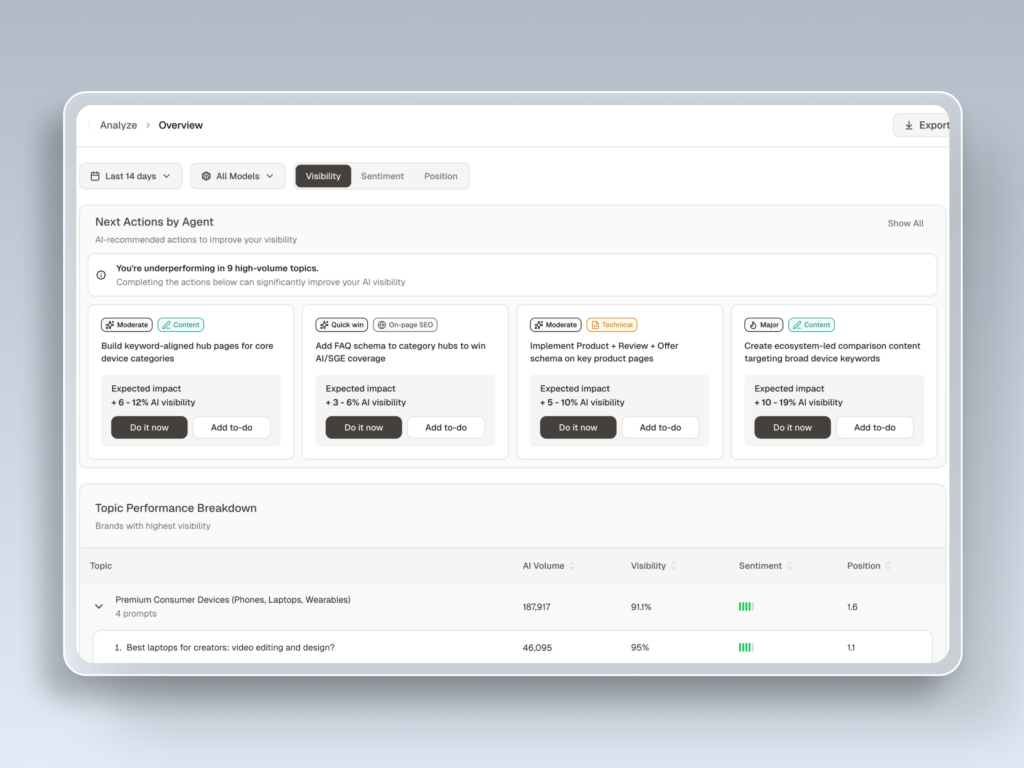
A closed action loop. Most tools stop at data. Topify pairs the dashboard with One-Click Execution: you define the goal in plain English, review the proposed GEO strategy, and deploy it without manual workflows. In practice, that’s the difference between a dashboard your team checks and a system that changes what your team does.
Other approaches exist, from enterprise SEO suites bolting on AI modules to lightweight single-engine checkers. They tend to fit teams with narrower needs: one engine, one brand, no competitive reporting. If that’s you, start small. If you’re reporting to leadership or clients, you’ll outgrow it in a quarter.
Common Mistakes That Make Your Dashboard Lie to You
Bad measurement is worse than no measurement, because it produces confident wrong decisions. Four errors show up constantly:
Small sample noise. Running fewer than 50-100 prompts per week means normal LLM randomness reads as trend. Fix: expand the prompt universe before you expand the conclusions.
Single-engine bias. A brand can score 80 on ChatGPT and near zero on Perplexity. One model is a blind spot, not a benchmark. Fix: track a minimum of three engines from day one.
No competitor baseline. A visibility score of 80 sounds great until you learn your top competitor holds an 85 on the same prompts. Fix: never report your score without the category context around it.
Static snapshotting. Passionfruit’s research on citation volatility shows AI answers shift week to week as models update their source preferences. A monthly check misses the movement entirely. Fix: weekly sampling, monthly reporting.
Notice the pattern: every mistake is a sampling problem, not a dashboard problem.
What an AI Visibility Score Dashboard Costs
AI visibility score dashboard pricing follows a fairly consistent three-tier structure across the market:
| Tier | Typical scope | Investment |
|---|---|---|
| Basic | Single project, baseline prompt tracking | ~$99/mo |
| Pro | Multi-brand tracking, deeper competitor benchmarking | ~$199/mo |
| Enterprise | Custom prompt sets, more seats, dedicated support | $499+/mo |
Pricing shown reflects typical market tiers and is subject to change; check each vendor’s current pricing page.
Topify’s plans map to this structure: Basic starts at $99/mo with a 30-day trial, 100 tracked prompts, 9,000 AI answer analyses, and coverage of ChatGPT, Perplexity, and AI Overviews. Pro at $199/mo raises that to 250 prompts and 22,500 analyses for teams tracking multiple projects.
The better way to evaluate cost isn’t the sticker price. It’s cost per actionable insight. A $99 dashboard that tells you which domain to pitch for a citation pays for itself with one recovered recommendation slot. If you want to test the water before committing, a set of free GEO tools can produce a rough first read on where your brand stands.
Conclusion
The blank “AI search” page in your monthly report is now a solved problem. AI visibility is measurable the same way rankings are: a fixed prompt set, longitudinal sampling across engines, a normalized score, and competitor context to make that score mean something.
Start with a benchmark of your top 25 high-intent buyer queries. Run them for two weeks, score your closest competitors on the same set, and you’ll have a defensible baseline before your next reporting cycle. Get started with Topify to automate the sampling and skip straight to the part where the data changes your strategy.
FAQ
Q: What is an AI visibility score dashboard?
A: It’s a monitoring system that aggregates how often, how prominently, and how favorably your brand appears in AI-generated answers across engines like ChatGPT, Gemini, and Perplexity, then converts that into a trackable 0-100 score with trend history.
Q: How can I improve my AI visibility score?
A: Start with the citation layer. Identify which domains AI engines cite in your category, fill the content gaps those sources cover, and earn presence on the pages models already trust. Score improvements typically follow citation improvements, not the other way around.
Q: How often should I check my AI visibility score dashboard?
A: Sample weekly, report monthly. AI answers fluctuate with model and index updates, so weekly sampling catches real movement while monthly aggregation smooths out normal stochastic noise.
Q: How much does an AI visibility score dashboard cost?
A: Entry plans typically run around $99/mo for single-project tracking, mid tiers around $199/mo for multi-brand and competitor benchmarking, and enterprise plans start near $499/mo. Free checkers exist for one-time assessments but don’t provide longitudinal scoring.

