

Your domain authority is solid. Your top pages are ranking. But organic traffic dropped 61% for informational queries between mid-2024 and late 2025. The rankings didn’t move. The CTR did. And the reason isn’t a Google algorithm update—it’s that the answer to your customer’s question is now living inside a ChatGPT or Perplexity response, not on your site.
Traditional KPIs can’t capture that. Here’s what to track instead.
Why CTR Can’t Tell You What AI Search Is Doing to Your Brand
CTR made sense when search was a list of blue links. Click a link, visit a page. Simple.
That model is broken now.
As of mid-2025, approximately 60% of all Google searches end without a single click to an external website. On mobile, that number hits 77.2%. When a Google AI Overview is present, the top organic result’s CTR can fall by roughly 79%. For paid search on queries that trigger AI Overviews, CTR dropped from 19.7% to 6.34% in just over a year.
This creates what researchers call a “visibility gap.” Your analytics platform reports impressions. It reports sessions. But it can’t tell you whether an AI engine cited your brand, recommended your competitor, or described your product in terms that contradict your positioning entirely.
That’s the gap your current KPI stack can’t see.
The 5 Core AEO KPIs That Actually Matter
Tracking AEO performance starts with shifting the measurement frame from “user actions on your site” to “brand influence inside AI responses.” These five metrics form the foundation.
1. AI Visibility Rate: Is Your Brand Even in the Answer?
AI Visibility Rate measures how often your brand appears in AI-generated responses for a set of target queries. It’s the AEO equivalent of organic ranking.
The formula is straightforward: divide the number of queries where your brand appears by the total queries tested, then multiply by 100. The harder number is the benchmark. Average brand visibility in AI answers sits around 0.3%, while top performers in competitive categories reach 12% to 30%. If you’re tracking 100 prompts and appearing in fewer than 10, there’s a structural content problem worth diagnosing.
2. AI Position: Where You Land in the Response
Being mentioned in an AI answer isn’t the same as being the first recommendation. Position tracking captures where your brand appears within the response, since a first-place mention carries significantly more trust-building weight than being listed fourth.
Because AI responses are probabilistic, brands often use a weighted Position Index. A first mention scores 1.0, second scores 0.5, and so on. This gives you a comparable, stable number across prompt sets, rather than a volatile “sometimes first, sometimes fifth” that’s hard to act on.
3. Share of AI Voice: You vs. Everyone Else
AI Share of Voice (AI SOV) measures what percentage of brand mentions your company captures relative to all brand mentions across a competitive query set.
The most accurate method is the “open denominator” approach: identify every brand mentioned in a response set, not just the ones you pre-defined as competitors. This prevents metric inflation and forces an honest look at who else AI is recommending. Leading SaaS companies achieve AI SOV rates up to 59.4% in their categories, highlighting just how uneven the distribution can be.
4. Citation Source Rate: Which Content Is AI Actually Pulling From?
Citation Source Rate tracks the domains and URLs an AI model uses to construct its answers. This is the most diagnostic metric in the AEO toolkit because it tells you why your visibility is high or low.
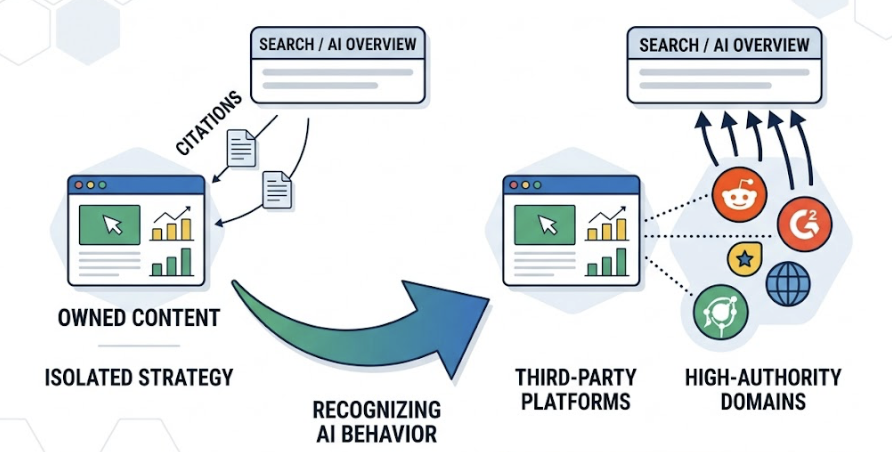
Research into 46 million citations shows AI models tend to favor a small cluster of high-authority domains. If AI Overviews for your category are pulling from Reddit threads or G2 reviews instead of your owned content, the strategy implication is clear: you need visibility on those third-party platforms, not just on your own site.
5. AI Sentiment Score: What Tone Does AI Use About Your Brand?
A brand can have 80% AI visibility and still be losing. If the AI consistently describes your product as “expensive and difficult to configure,” visibility becomes a liability.
Sentiment scores typically run on a 0-100 scale, evaluating the overall tone of AI responses, how that tone shifts across topics (product features vs. pricing vs. customer support), and the sentiment of the underlying sources influencing the AI’s language. Tracking sentiment over time tells you whether your content strategy is shaping the AI’s narrative about your brand, or whether someone else’s content is.
The Metric Most Teams Skip: Conversion Visibility Rate
There’s a sixth metric that most AEO dashboards don’t include yet. It’s the one most directly tied to revenue.
Conversion Visibility Rate (CVR) estimates the likelihood that an AI answer is driving users toward a brand interaction—even without a direct click. The logic: a user who arrives at your site via an AI citation has already been pre-qualified. They’ve compared options inside the AI interface and read about your value proposition before they ever hit your homepage.
The data supports this. AI-referred search converts at 14.2% compared to 2.8% for traditional organic search. For SaaS companies specifically, lead conversion from ChatGPT referrals reaches 15.9%, versus 1.76% for standard organic. That’s an 803% variance. Traffic volume is down; traffic quality is up. CVR is the metric that captures this shift.
Platforms like Topify track CVR as part of their seven-metric analytics framework—alongside Visibility, Sentiment, Position, Volume, Mentions, and Intent—to give marketing teams a full picture of downstream business impact from AI citations.
How to Build a Simple AEO Reporting Dashboard
The first thing to fix is your prompt library. Replace “keywords” with a prompt matrix: 25 to 100 conversational queries that simulate real buyer journeys. “Best project management tool for remote teams” instead of “project management software.”
From there, the reporting structure is straightforward:
| Dimension | Weekly Metric | Target |
|---|---|---|
| Visibility | AI Visibility Rate | >10% for category prompts |
| Authority | Share of AI Voice | Top 3 in competitive set |
| Trust | AI Sentiment Score | >80/100 |
| Conversion | Conversion Visibility Rate | High-intent prompt correlation |
| Branded Lift | Branded Search Volume | Month-over-month increase |
Weekly tracking catches model volatility and citation rotation. Monthly benchmarking gives you the competitor SOV comparison. Quarterly audits let you review the technical layer—structured data, schema markup, content extraction efficiency.
Topify automates this by querying AI platforms directly in real time, so the data reflects what ChatGPT and Perplexity are actually saying about your brand today, not what a crawler estimated last week. The High-Value Prompt Discovery tool surfaces the exact questions your audience is asking AI, which feeds directly back into content gaps.
The Platforms You Can’t Ignore in 2026
A single “AI search” number is misleading. Citation logic varies significantly across platforms, and treating them as interchangeable leaves blind spots.
| Platform | Retrieval Logic | Citation Behavior |
|---|---|---|
| ChatGPT | GPT training + Bing Search | Accounts for 87.4% of AI referral traffic |
| Perplexity | Retrieval-first (Sonar) | Cites 6+ sources per answer; over-indexes on Reddit/Quora |
| Google Gemini | Google Knowledge Graph | Favors Google properties (YouTube, Maps, Docs) |
| Google AI Overviews | Google Search Index | High correlation with top 10 organic rankings |
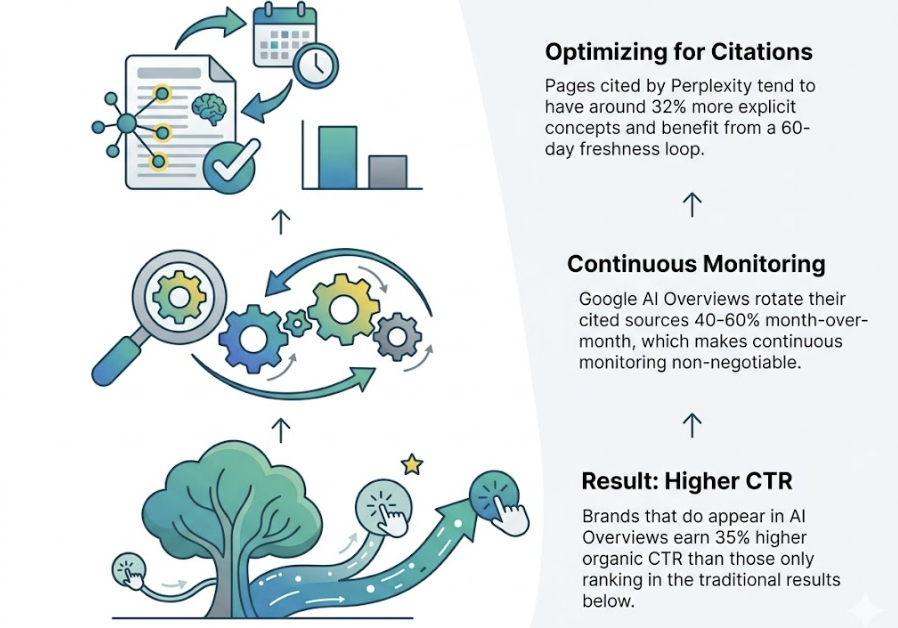
Perplexity rewards “semantic concept density”—pages cited by Perplexity tend to have around 32% more explicit concepts than uncited content and benefit from a 60-day freshness loop. Google AI Overviews rotate their cited sources 40-60% month-over-month, which makes continuous monitoring non-negotiable rather than a nice-to-have. Brands that do appear in AI Overviews earn 35% higher organic CTR than those only ranking in the traditional results below.
Optimizing for one platform without monitoring the others creates a false sense of coverage.
Conclusion
The shift from CTR to AI visibility metrics isn’t a trend to watch. It’s a structural change that’s already affecting revenue.
CTR measures what happens after a user sees your result. AEO KPIs measure whether your brand is in the result at all—and what the AI says about you when it is. The brands building these measurement systems now are accumulating a compounding advantage: higher AI visibility leads to more branded searches, which reinforces organic authority, which feeds back into AI citations.
Start with AI Visibility Rate and Share of Voice. Add Sentiment once you have baseline data. Build CVR tracking as the business case grows. The specific tools matter less than the habit of measuring what AI is actually saying about your brand, across all the platforms your customers are using.
FAQ
Q: How is AEO different from SEO when it comes to measurement?
A: SEO measures user actions—clicks, sessions, rankings in a list. AEO measures brand influence: how often you’re cited, where you appear within AI responses, and how the AI describes you. SEO asks “How do I rank for this keyword?” AEO asks “How do I become the source of the answer?”
Q: How often should I check my AEO KPIs for AEO?
A: Track core prompt visibility weekly. AI models are non-deterministic and update their crawl caches frequently, so weekly checks catch citation drops before they compound. High-volatility platforms like Google AI Overviews may need even more frequent monitoring given their 40-60% monthly source rotation.
Q: Can small brands realistically track KPIs for AEO without a big budget?
A: Yes. AI engines prioritize clarity and structured data, not ad spend. A small brand can build a list of 20-30 core prompts, test them weekly across ChatGPT, Gemini, and Perplexity, and track results in a spreadsheet. Adding FAQ schema markup and a clear “source of truth” page costs nothing but improves AI extraction meaningfully.
Q: What’s the most important AEO KPI for long-term brand authority?
A: Share of AI Voice across a broad set of category-level prompts is the closest equivalent to market share in generative search. It captures not just whether you’re mentioned, but how your presence compares to every other brand the AI considers relevant to your category.

