

Search “The Search Monitor alternatives” and you’ll find comparison lists that rank tools on the same criteria used five years ago: SERP coverage, ad compliance alerts, pricing tracker accuracy. That’s the wrong scorecard for 2026. The brands switching away from The Search Monitor today aren’t looking for another paid search surveillance tool. They’re looking for something that tells them what ChatGPT says about their brand, whether Perplexity is recommending a competitor instead, and why the AI’s description doesn’t match their positioning.
That’s a fundamentally different problem. And it needs a fundamentally different kind of tool.
The Search Monitor Was Built for a Search World That No Longer Leads
The Search Monitor was architected for a 2019-era internet. Its core capabilities: monitoring paid search ads, tracking competitor pricing on SERPs, flagging brand violations across affiliate channels. All of that made sense when Google’s ten blue links were where purchase decisions began.
That architecture has a technical ceiling. Traditional search monitoring tools rely on crawling static HTML pages. AI engines don’t have static pages to crawl. LLMs synthesize information from multiple sources and generate real-time conversational responses. There’s no “rank” to scrape, no ad slot to detect, no HTML structure to parse.
The result is a set of visibility blind spots that The Search Monitor can’t address:
- No tracking of brand mentions inside AI-generated answers
- No sentiment analysis to detect whether AI describes your brand accurately or inaccurately
- No GEO score to measure your citation probability across conversational search platforms
- No prompt-level data showing which user questions trigger (or exclude) your brand
User behavior has also shifted from keyword-based searching to intent-driven, natural language questioning. The questions your customers are now asking live inside ChatGPT, Gemini, and Perplexity, not in a Google search bar.
What a Real The Search Monitor Alternative Needs to Measure
Most comparison lists for the search monitor alternatives focus on which tool monitors more channels. That’s a reasonable starting point, but the more useful question is: does it measure what actually drives AI-era brand visibility?
Based on the evaluation framework that practitioners use when selecting AI visibility tools in 2026, the criteria that matter most are:
| Feature | Importance | Why It Matters |
|---|---|---|
| Multi-Platform Coverage | Critical | Visibility varies across ChatGPT, Gemini, Perplexity, and other AI engines |
| Prompt-Level Tracking | Critical | Metrics tied to specific user questions, not generic keywords |
| Citation Attribution | High | Understanding which URLs and domains trigger AI citations |
| Sentiment Analysis | High | Detecting AI-generated misinformation or negative brand framing |
| Competitive Benchmarking | Medium | Share-of-voice against rivals in AI-generated summaries |
The Search Monitor scores well on compliance and competitive pricing surveillance. On this AI-native checklist, it doesn’t register at all. That gap is why the alternatives conversation is happening in the first place.
The Search Monitor Alternatives, Ranked for AI Visibility
1. Topify — AI Search Visibility Built from the Ground Up
Topify is the clearest structural departure from tools like The Search Monitor. Where legacy platforms were built to monitor static SERP placements and ad compliance, Topify was built for the generative search era from day one.
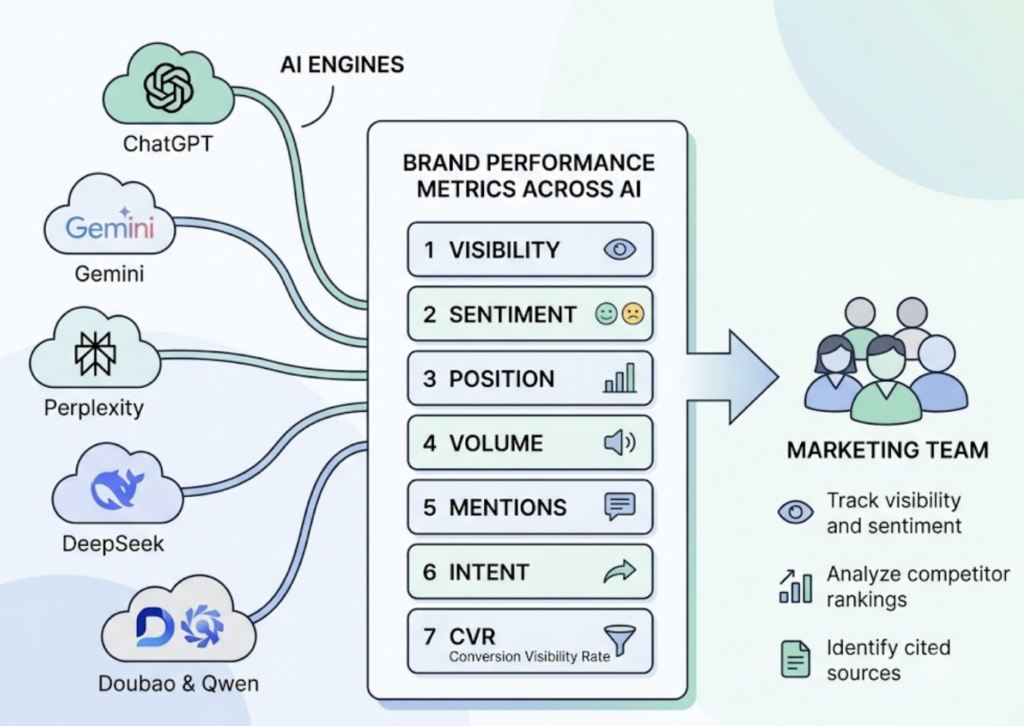
The platform tracks brand performance across ChatGPT, Gemini, Perplexity, DeepSeek, Doubao, Qwen, and other major AI engines, using seven key metrics: visibility, sentiment, position, volume, mentions, intent, and CVR (Conversion Visibility Rate). In practice, this means a marketing team can see not just whether their brand appears in AI responses, but how AI describes them, where they rank relative to competitors, and which domains AI is citing as sources.
A few things stand out as genuinely different from traditional monitoring tools:
Prompt-level discovery. Topify continuously surfaces high-volume AI prompts where your brand should appear but doesn’t. Most legacy tools report on keywords you’ve already defined. Topify finds the prompts you haven’t thought to track yet.
Reverse-engineered citations. The platform analyzes the exact URLs and domains that AI engines cite when answering questions in your category. This is how GEO strategy gets built: knowing which content types and sources influence AI outputs, not just which keywords rank.
One-click agent execution. Topify doesn’t stop at dashboards. Define your AI visibility goals in plain language, and the system builds and deploys an optimization strategy automatically. For teams without dedicated GEO resources, this closes the gap between insight and action.
Pricing starts at $99/month on the Basic plan, which includes 100 prompts, tracking across ChatGPT, Perplexity, and AI Overviews, and a 30-day trial. The Pro plan at $199/month scales to 250 prompts and 8 projects. Topify is trusted by 50+ enterprises and startups, with the platform built by researchers from OpenAI and practitioners with Fortune 500 SEO track records.
For teams making the switch from The Search Monitor specifically, the migration case is straightforward: The Search Monitor monitors what competitors are doing in paid search. Topify monitors what AI is saying about your brand.
2. Brandwatch — Broad Social Listening with Basic AI Add-Ons
Brandwatch remains the strongest option in the market for social media sentiment and crisis monitoring. It has introduced basic AI mention tracking as an add-on feature, but its core infrastructure is social-media-focused and was not built for conversational AI analysis.
For teams that need robust social listening first and are willing to accept limited AI search depth as a secondary capability, Brandwatch remains a strong enterprise option. It’s not a direct replacement for The Search Monitor’s paid search compliance features, but it does offer broader brand monitoring across news, social, and some AI surfaces.
Best for: Large enterprises already embedded in the Brandwatch ecosystem who have minor, not primary, AI tracking needs.
3. Mention — Lightweight Web Monitoring on a Budget
Mention excels at simplicity. Web mentions, news alerts, basic social tracking, all wrapped in a low-friction interface. The Frase 2026 ranking of AI visibility tools notes Mention as a solid entry point for SMBs, but its LLM-query simulation capabilities are limited for serious AI search visibility work.
If your primary use case is brand reputation monitoring across traditional web and social channels, and AI search visibility is not yet a priority, Mention covers the basics affordably.
Best for: SMBs with budget constraints that need high-level web reputation alerts, not AI engine analysis.
4. Semrush Brand Monitoring — SEO-Native, AI-Tracking Secondary
Semrush’s Brand Monitoring module works well for teams already living inside the Semrush ecosystem. Its AI tracking capabilities exist, but they’re built as extensions of an SEO-first platform, and the depth of AI-specific analysis reflects that priority ordering.
For SEO teams that want to bridge from traditional search monitoring to AI search visibility without changing platforms, Semrush offers a transitional path. Don’t expect the same prompt-level granularity or multi-LLM coverage you’d get from an AI-native tool.
Best for: SEO professionals who want to integrate AI mention data into an existing Semrush workflow.
5. Sprinklr LLM Insights — Enterprise-Grade, High Complexity
Sprinklr launched its LLM Insights product in June 2026, providing enterprise-grade visibility into how LLMs characterize brands across full-funnel scenarios. The capability depth is real. So are the implementation timelines and price points.
For large, global organizations that need AI search visibility as one component of a unified CX and social management platform, Sprinklr makes sense. For teams that need AI tracking capabilities quickly and affordably, the overhead is prohibitive.
Best for: Global enterprises requiring unified cross-channel CX management and willing to absorb a significant implementation process.
Which Alternative Fits Your Use Case
| Your Situation | Best Alternative |
|---|---|
| Need AI-first strategy: GEO tracking, mentions, sentiment across multiple LLMs | Topify |
| Enterprise social monitoring with basic AI visibility needs | Brandwatch |
| Limited budget, web and social mention alerts only | Mention |
| SEO team integrating AI data into existing Semrush workflow | Semrush Brand Monitoring |
| Large enterprise, full-stack CX platform with AI tracking included | Sprinklr |
How to Migrate from The Search Monitor to an AI-Native Platform
The migration process is less complicated than it sounds, but it requires one honest first step: separating what you actually use The Search Monitor for from what you assumed it covered.
Step 1: Requirement audit. The Search Monitor’s historical strength is compliance: catching brand violations, tracking competitor ad copy, monitoring price consistency across affiliates. If those are active use cases your team relies on daily, you’ll want to migrate that specific function to a tool that handles it. If you inherited The Search Monitor as part of a legacy stack and rarely use compliance features, this is a cleaner break than it looks.
Step 2: Run an AI visibility gap analysis. Before you decide on a replacement, know what you’re missing. Get started with Topify to run a baseline assessment of how your brand currently appears across ChatGPT, Perplexity, and Gemini. The results typically surface misrepresentation issues and competitor gaps that weren’t visible in any traditional monitoring dashboard.
Step 3: Parallel run for 30 days. Deploy an AI-native solution alongside your existing tools for one month. The goal isn’t to validate the new platform in isolation. It’s to see, side by side, what traditional search monitoring captures versus what it misses. The delta between those two datasets is usually the most persuasive evidence for accelerating the transition.
The gap between what AI says about your brand and what you think it says tends to be larger than expected. The sooner you have data on it, the sooner you can act on it.
Conclusion
The Search Monitor built its reputation as a compliance and paid search surveillance tool, and it earned that reputation. But the search environment has shifted in a direction its architecture can’t follow: conversational AI queries don’t produce HTML pages to crawl, and brand visibility in LLM outputs doesn’t map to any metric traditional tools were built to track.
The alternatives that matter in 2026 are the ones built for how search actually works now. For teams that need full-spectrum AI visibility, from prompt-level tracking to sentiment analysis to competitive benchmarking across multiple LLMs, Topify covers ground that legacy tools can’t. Start with a free assessment to see where your brand stands today.
FAQ
Q: What is The Search Monitor used for?
A: The Search Monitor is primarily a paid search compliance and competitive intelligence tool. It monitors brand violations in affiliate channels, tracks competitor ad copy and pricing on traditional SERPs, and alerts teams to trademark bidding issues. It was not designed for tracking brand visibility inside AI-generated search responses.
Q: Can The Search Monitor track AI search results like ChatGPT or Perplexity?
A: No. The Search Monitor’s architecture relies on crawling static HTML pages from traditional search engines. AI platforms like ChatGPT, Perplexity, and Gemini generate real-time conversational responses using LLMs, which don’t produce crawlable pages. This makes The Search Monitor structurally incompatible with AI search visibility measurement.
Q: What’s the best alternative to The Search Monitor for AI visibility?
A: For teams prioritizing AI search visibility specifically, Topify is the most purpose-built option available. It tracks brand mentions, sentiment, position, and citation sources across ChatGPT, Gemini, Perplexity, DeepSeek, and other major AI engines at the prompt level. For teams that also need social listening, Brandwatch is worth evaluating as a complement.
Q: How much does Topify cost compared to The Search Monitor?
A: Topify’s Basic plan starts at $99/month (with a 30-day trial) and includes tracking across ChatGPT, Perplexity, and Google AI Overviews for up to 100 prompts. The Pro plan is $199/month for 250 prompts. The Search Monitor’s pricing is not publicly listed and typically requires a custom quote for enterprise use.

