

Your domain authority is solid. Your keyword rankings are exactly where your team worked to put them. But none of that tells you what ChatGPT says when someone asks for a recommendation in your category.
That’s the gap most SEO professionals haven’t built a system for yet. Traditional metrics measure what Google indexes. They don’t measure what AI chooses to say. And those are two very different things.
AI Search Doesn’t Work Like Google. Most Brands Haven’t Caught Up Yet.
Traditional search runs on a crawl-index-rank logic. Google acts as a librarian: it retrieves relevant documents and serves them as a list of links. The brand’s job is to rank high enough that users click through.
AI search engines like ChatGPT, Perplexity, and Gemini work differently. They don’t return a list. They synthesize an answer. The model reads across thousands of sources, evaluates credibility and entity associations, and outputs a recommendation. If your brand isn’t part of that synthesis, you’re not on page two. You’re not in the conversation at all.
The numbers make this gap concrete. In the first half of 2025, the frequency of AI Overview appearances in search results more than doubled to 13.14%, while average click-through rates in those same results dropped by nearly half, from 15% to 8%. More searches, fewer clicks. Traffic that does arrive from AI platforms, however, converts at 23 times the rate of traditional organic search, because users have already done their evaluation before clicking through.
That 23x multiplier is why brands are paying attention. The challenge is figuring out how to actually show up.
What Is a GEO Agent, and What Makes It Different from a Regular AI Chatbot
A GEO Agent (Generative Engine Optimization Agent) is an autonomous AI system built to do one specific thing: get your brand cited, recommended, and represented accurately by AI engines like ChatGPT, Gemini, and Perplexity.
It’s not a chatbot. And that distinction matters more than most marketers realize.
A chatbot responds. You send an input, it generates an output, and the exchange ends there. An AI agent operates differently. It monitors its environment continuously, sets goals, makes decisions across multiple steps, and executes tasks without waiting to be prompted. The difference isn’t about interface. It’s about architecture.
Here’s where the two diverge at a structural level:
| Dimension | AI Chatbot | AI Agent |
|---|---|---|
| Logic | Pattern matching, scripted responses | Autonomous reasoning toward a goal |
| Execution | Text output only | Calls external tools, writes to systems |
| Autonomy | Passive, responds when prompted | Active, monitors and initiates action |
| Memory | Session-level only | Long-term and short-term combined |
| Learning | Static or fine-tuned | Adapts in real time from feedback loops |
A GEO Agent sits firmly in the Agent column. It doesn’t wait for you to ask what’s happening with your brand’s AI visibility. It’s already tracking it.
How an AI Agent Actually Works (Beyond the Buzzword)
The underlying logic of any agentic AI follows a Sense-Plan-Act-Learn cycle, and understanding it makes it easier to evaluate whether a platform is delivering real agent behavior or just repackaging a dashboard.
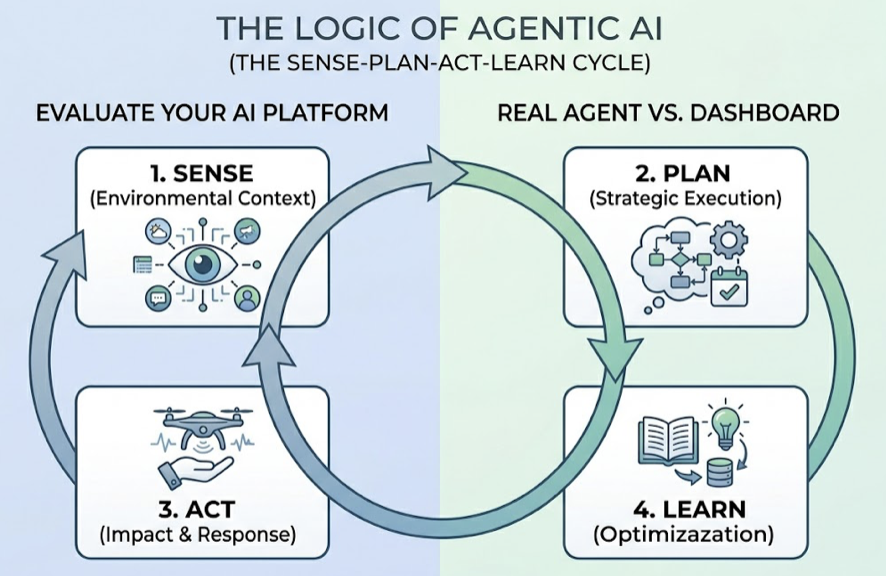
Sense: The agent continuously scans AI engine outputs across platforms, monitoring not just whether your brand appears, but how it appears. Sentiment tone, citation accuracy, source attribution, and share of voice in a specific query category.
Plan: Based on what it detects, the agent builds a strategy. If a competitor is being cited on “security” queries while your brand isn’t, the agent maps the entity gap and prioritizes a response.
Act: The agent executes. That means updating machine-readable schema on your website, generating content aligned to high-value AI prompts, or surfacing query gaps your team hasn’t addressed.
Learn: AI platforms adjust their retrieval logic regularly, often without public announcements. The agent tracks the effect of every action and modifies its approach accordingly.
This loop runs continuously, at a scale no human team can match.
The 3 Types of AI Agents That Matter for Brand Visibility
Not all GEO Agents operate the same way. In practice, most enterprise-level GEO strategies rely on three distinct agent types working in coordination.
The Sentinel (Monitoring Agent). This agent runs around the clock across every major AI platform, tracking where and how often your brand appears. It’s not just counting mentions. It flags when your brand appears in the wrong context, when sentiment shifts negative, or when a competitor gains ground on a query category you thought you owned. Think of it as a real-time early warning system for your AI presence.
The Strategist (Analytical Agent). Once you know there’s a gap, the Strategist figures out why. It runs comparative analysis against competitor citation patterns, evaluates your brand’s entity clarity score, and identifies which sources AI engines are trusting in your category. This is the layer that turns raw monitoring data into a prioritized action plan, rather than a spreadsheet of numbers with no direction.
The Architect (Execution Agent). The Architect does the actual work. It deploys machine-readable interfaces directly to your website, generates content aligned with high-value AI prompts, and pushes structured data updates to AI engines. It closes the loop between diagnosis and deployment without waiting on development backlogs.
A mature GEO Agent integrates all three functions. Monitoring alone tells you what’s wrong. Analysis tells you why. Execution is what actually moves the number.
Why GEO and AEO Are Now Inseparable from GEO Agent Strategy
GEO (Generative Engine Optimization) and AEO (Answer Engine Optimization) are related, but they target different scenarios.
AEO focuses on becoming the direct answer to a specific, clear question. It’s optimized for voice assistants and Google featured snippets: short, decisive, structured responses. GEO targets a more complex environment. It’s about earning brand citations inside the longer, synthesized answers that AI engines generate when users are doing research, comparing vendors, or asking for recommendations.
| AEO | GEO | |
|---|---|---|
| Primary Target | Voice assistants, featured snippets | ChatGPT, Perplexity, AI Overviews |
| Content Style | Short, direct answers | In-depth, multi-source authority |
| Conversion Logic | Builds initial brand awareness | Drives high-intent research decisions |
Here’s the operational reality: 76.4% of AI citations come from content updated within the past 30 days. AI engines heavily favor recency. A human team manually monitoring dozens of prompts per day can’t track that velocity across platforms. A GEO Agent can simulate thousands of brand queries across different contexts in minutes.
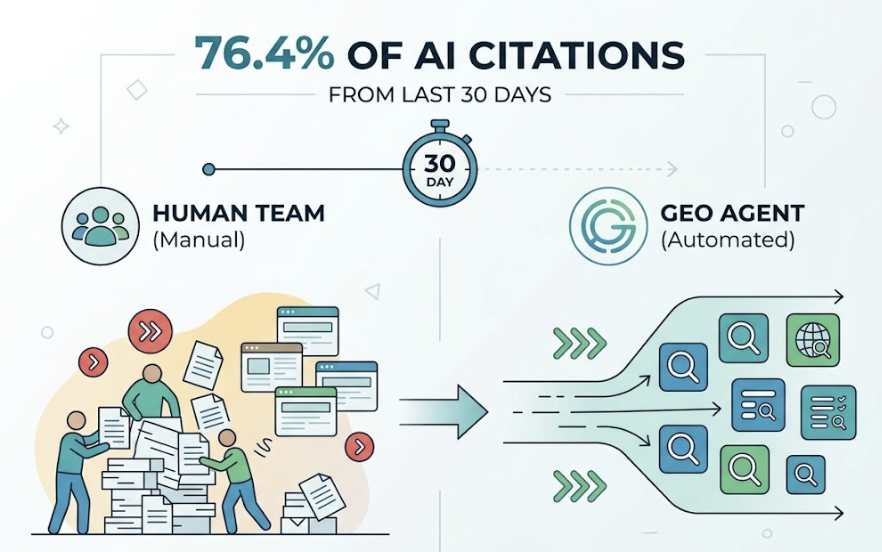
That’s not a minor efficiency gain. It’s the difference between having a GEO strategy and having one that actually runs.
What a GEO Agent Actually Does in Practice
The Sense-Plan-Act loop sounds abstract. Here’s what it looks like step by step.
Step 1: Prompt Discovery. The agent scans AI platforms to surface high-value queries in your category, not just keywords, but the specific prompts users submit to AI engines. “What’s the best CRM for a 50-person B2B sales team in fintech?” is a completely different input from “CRM software.” GEO operates at the prompt level, and finding the right prompts is where the work starts.
Step 2: Visibility Benchmarking. For each relevant prompt, the agent tracks your brand’s appearance rate, position, and sentiment across ChatGPT, Gemini, Perplexity, and other platforms. You get a clear picture of where you’re winning and where competitors are displacing you.
Step 3: Source Attribution. The agent identifies which external sources AI engines cite when generating answers in your category. A Reddit thread? An industry whitepaper? A competitor’s product comparison page? Knowing the citation sources tells you exactly where to invest.
Step 4: Automated Deployment. Based on the attribution data, the agent generates and deploys content and technical updates. This includes structured data, AI-readable sitemaps, and targeted content aligned with the specific prompts where your brand is underperforming.
Step 5: Feedback Loop. Every action gets measured. Visibility changes are tracked automatically, and the strategy adjusts based on what’s working.
Topify implements this workflow as a unified platform. Its One-Click Agent Execution system lets teams define their goals in plain English and deploy the full strategy without manual workflows. The platform tracks brand performance across ChatGPT, Gemini, Perplexity, DeepSeek, Doubao, Qwen, and other major AI engines, covering seven core metrics: visibility, sentiment, position, volume, mentions, intent, and CVR (Conversion Visibility Rate). Teams at both startups and enterprises use it to move from reactive brand monitoring to a systematic GEO operation. Get started with Topify to see where your brand currently stands across AI platforms.
3 Signs Your Brand Needs a GEO Agent Right Now
Three scenarios tend to make this decision obvious.
Scenario 1: Competitive displacement. You search ChatGPT for a recommendation in your category. Your main competitors appear. Your brand doesn’t. This isn’t random, and it’s not about quality. Those competitors have established entity associations in the AI engine’s model. Building that association manually is slow. A GEO Agent accelerates it.
Scenario 2: Citation inaccuracy. AI does mention your brand, but the information is wrong. It’s citing your pricing from three years ago or describing your product for an audience you’ve moved away from. This happens when AI can’t find a clean, machine-readable data source and defaults to scraping outdated third-party content. A GEO Agent deploys the structured interfaces that fix this directly.
Scenario 3: Human-speed GEO. Your team knows GEO matters. They’re writing FAQs, manually testing prompts, and trying to optimize content for AI recommendations. But they can’t quantify the impact, and they can’t scale the effort. The math doesn’t close: a person can test a few dozen prompts per day, while a GEO Agent covers thousands, across multiple platforms, simultaneously.
If any of these match your current situation, waiting makes the gap harder to close. AI citation patterns, once established, tend to reinforce themselves over time.
Conclusion
The shift from link-based search to answer-based search isn’t something brands can schedule around. AI Overviews, ChatGPT recommendations, and Perplexity citations are already shaping purchasing decisions at scale. The brands that get cited are capturing high-intent, high-converting traffic. The brands that don’t are losing visibility that won’t show up anywhere in a standard Google Analytics dashboard.
A GEO Agent is what makes GEO strategy actually executable at the speed AI platforms move. Not as a replacement for thinking, but as the infrastructure that runs the work. Track your brand’s AI visibility with Topify and see exactly where you stand, and what it takes to improve.
FAQ
Q: What is a GEO Agent?
A: A GEO Agent is an autonomous AI system that monitors, analyzes, and optimizes how a brand appears in AI-generated search results. It handles the full cycle from prompt discovery to content deployment, running continuously without requiring constant manual input.
Q: What is the difference between an AI agent and a chatbot?
A: A chatbot responds to inputs. An AI agent pursues goals. Chatbots generate text when prompted. Agents monitor environments, make decisions across multiple steps, call external tools, and execute tasks, often without waiting to be asked. The gap between them is architectural, not cosmetic.
Q: What types of AI agents are used in GEO?
A: GEO strategies typically rely on three agent types working together: monitoring agents (tracking brand mentions and sentiment across AI platforms), analytical agents (diagnosing why AI recommends competitors over your brand), and execution agents (deploying content and technical infrastructure to improve visibility).
Q: What’s the difference between GEO and AEO?
A: AEO (Answer Engine Optimization) targets direct, single-question answers suited for voice assistants and featured snippets. GEO (Generative Engine Optimization) targets brand citations inside longer AI-synthesized responses to research and comparison queries. Both matter for a complete AI search strategy, and a GEO Agent typically runs both simultaneously.

