
You’ve been using AI for months. You type a question, you get an answer. That’s how it works.
Except that’s not how AI agents work. An AI agent doesn’t wait for your next message. It receives a goal, breaks it into steps, calls external tools, checks the results, and adjusts its plan until the job is done. No prompting required after the first instruction.
That gap between “responds to input” and “acts on a goal” is what this guide is about.
Not a Chatbot: What Makes an AI Agent Different
Most people’s mental model of AI is still a chatbot: you ask, it answers. That model is already outdated.
A traditional chatbot is stateless. It has no memory of what happened before, no access to outside tools, and no ability to take action beyond generating text. Every response starts from scratch.
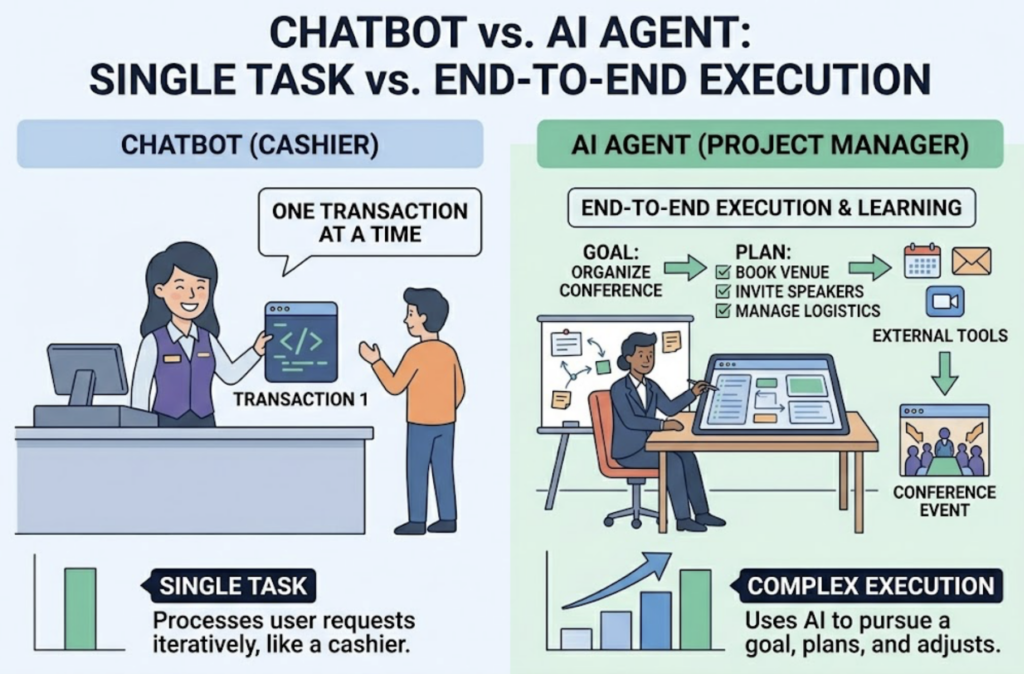
An AI agent is built around the opposite logic. It’s a software system that uses AI to pursue a specific goal, plan a sequence of actions, use external tools, and adjust based on what it learns along the way. The analogy used across the industry is useful: a chatbot is a cashier who processes one transaction at a time. An AI agent is a project manager who takes a goal (“organize the conference”) and handles end-to-end execution.
That’s not a marketing distinction. It’s a structural one.
The Four Things Every AI Agent Can Do
Understanding what sets agentic AI apart comes down to four capabilities, each building on the last.
Perceive. The agent reads its environment: text inputs, API data, search results, images, and more. It doesn’t just parse keywords. It interprets context, intent, and urgency. A brand monitoring agent, for example, doesn’t just scan for a company name. It reads the sentiment around it, the authority of the source, and whether the mention suggests a reputational risk.
Reason. This is where the agent uses an LLM (like GPT-4, Claude, or Gemini) to decompose the goal into steps. A common framework here is ReAct (Reason + Act), where the agent runs a continuous loop: identify what needs to happen next, take an action, observe the result, update the plan. It’s non-linear problem-solving, not a script.
Act. The agent executes. It can call APIs, search the web, update a CRM, generate content, publish to a CMS, or trigger emails. This is the part that makes agentic AI categorically different from anything that came before: it creates change in the world, not just text on a screen.
Learn. The agent analyzes the results of its actions and adjusts. If a strategy didn’t move the needle, it modifies the approach before the next cycle. This self-refinement loop is what allows agents to operate in dynamic environments where rigid automation would fail.
Agentic AI vs. Traditional AI: The Line Most People Miss
The difference isn’t just philosophical. It’s measurable across every dimension of how these systems operate.
| Dimension | Traditional Chatbot | AI Assistant (Copilot) | Agentic AI |
|---|---|---|---|
| Operational Logic | Rule-based scripts | Pattern recognition, content aid | Goal-oriented, self-directed workflow |
| Autonomy | Passive, prompt-by-prompt | Collaborative, assists on request | Independent, multi-step execution |
| Memory | Stateless | Limited session context | Persistent, evolving memory |
| Tool Access | Isolated | Limited integrations | APIs, web search, external software |
| Execution Style | Single response | Prompt-by-prompt | End-to-end process management |
The critical column is autonomy. A copilot still needs you to drive. An agent takes the wheel once you’ve set the destination.
That distinction is why enterprise adoption is accelerating: 79% of organizations have already implemented some form of AI agent, and 96% plan to expand their deployment in 2025. By 2028, an estimated 33% of all enterprise applications will feature integrated agentic AI, compared to less than 1% today.
Where AI Agents Are Already Working: 5 Real Use Cases
Agentic AI isn’t a prototype. Here’s where it’s running in production right now.
Customer support automation. Agents handle multi-stage processes like billing disputes and returns without human intervention, integrating directly with CRM and payment platforms. By 2028, they’re projected to handle 68% of all customer interactions for technology vendors.
Research and analysis. In financial services and legal, agents continuously monitor thousands of sources and summarize competitor activities, regulatory changes, or risk indicators into concise executive briefs.
Software engineering. Coding agents generate test cases, identify bugs, fix them, and manage deployment pipelines, freeing developers to work on architecture rather than maintenance.
Marketing content optimization. Agents manage the full content lifecycle: keyword research, topic planning, multi-language translation, and publishing, without a human touching each step.
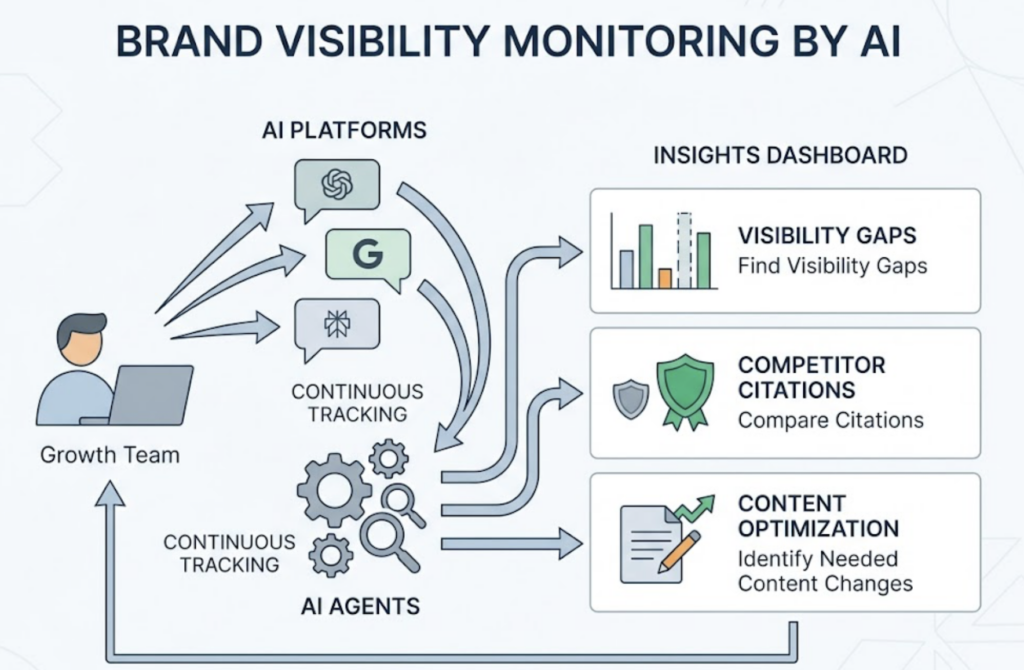
Brand visibility monitoring. This is where it gets relevant for marketing and growth teams. AI agents continuously track how often a brand is mentioned or recommended by ChatGPT, Gemini, and Perplexity. They identify visibility gaps, analyze which competitors are winning citations, and surface the content changes needed to improve a brand’s standing in AI-generated answers.
That last use case is where agentic AI intersects directly with how brands get discovered in 2025 and beyond.
How AI Agents Are Reshaping GEO and AEO
Traditional SEO optimized for Google’s blue links. That model is under pressure.
Over 57% of Google searches now end without a click, a number expected to climb as AI Overviews become the default interface. Two new disciplines have emerged to address this shift.
AEO (Answer Engine Optimization) focuses on getting your content extracted as a direct answer to a user query. It’s about being the answer, not the link.
GEO (Generative Engine Optimization) goes a layer deeper. It’s the practice of ensuring that when AI systems synthesize answers from multiple sources, your brand is one of the sources they trust and cite. Being mentioned isn’t enough. GEO is about being the reference.
| Focus | SEO | AEO | GEO |
|---|---|---|---|
| Primary Goal | Rank in search results | Appear in direct AI snippets | Be cited as a trusted source by LLMs |
| Key Tactic | Keywords, backlinks, site speed | Structured FAQs, direct answers | Original research, authority signals |
| Core Metric | SERP position, traffic | Answer retention, voice share | Citation frequency, brand mentions |
AI agents are central to executing GEO at scale. Manually running hundreds of prompts across ChatGPT, Gemini, and Perplexity every week to measure brand visibility isn’t realistic. Agents do this automatically, tracking Share of Voice against competitors, identifying which content gaps are costing citations, and flagging when sentiment around your brand shifts.
Topify is built specifically for this workflow. Its AI agent continuously monitors brand performance across ChatGPT, Gemini, Perplexity, and other major platforms, tracking seven metrics: visibility, sentiment, position, volume, mentions, intent, and conversion visibility rate. The one-click execution feature means you set the goal in plain English, review the proposed GEO strategy, and the agent deploys it. That’s agentic AI applied to a real marketing problem, not a demo.
For teams that want to see what this looks like in practice before committing to a full strategy, the Basic plan at $99/month includes a 30-day trial with 100 prompts and 9,000 AI answer analyses across ChatGPT, Perplexity, and AI Overviews.
Your First Step Into Agentic AI: What to Actually Do Next
Don’t start by building a custom agent. That’s the wrong entry point for most teams.
The learning curve for custom agentic architectures is steep, and most internal builds fail due to architectural complexity before they deliver value. The faster path is to start with a specialized tool that already has agentic logic built in, observe how it works, and build intuition from there.
For marketing and growth teams, the most natural starting point is brand visibility. The question “Is our brand showing up when AI recommends solutions in our category?” has a measurable answer, and finding it requires exactly the kind of multi-step, cross-platform monitoring that AI agents handle well.
From there, you can expand. The enterprise data on ROI is consistent: organizations deploying agentic systems report an average return of 171%, with productivity gains of 20-60% across functions. But those numbers start with a clear, bounded first use case, not a broad platform overhaul.
Pick the pain point where your current tools are most brittle. Start there.
Conclusion
AI agents aren’t a more sophisticated chatbot. They’re a different category of system, and the distinction matters for anyone whose job involves how brands get discovered, how customers get served, or how work gets done.
The shift is already underway. The global agentic AI market was valued at $5.25 billion in 2024 and is on track to reach $199 billion by 2034. That trajectory isn’t driven by hype. It’s driven by the 171% average ROI organizations are seeing when they move from reactive AI tools to goal-driven, autonomous systems.
The practical starting point for most marketing and growth teams is GEO visibility: understanding how AI systems currently represent your brand, and using agents to close the gap between where you are and where you need to be. Get started with Topify to see how your brand is showing up in AI-generated answers today.
FAQ
Q: What’s the difference between an AI agent and a chatbot?
A: A chatbot is a reactive system that waits for your input and returns a single response. An AI agent is a goal-driven system that plans a sequence of steps, uses external tools like APIs and search, and executes tasks autonomously with minimal ongoing input. The core difference is autonomy: a chatbot responds, an agent acts.
Q: Do I need to know how to code to use AI agents?
A: Not for most professional tools. Most agentic platforms, including GEO and brand visibility tools, offer no-code or low-code interfaces where you set a goal in plain English and the agent handles execution. Coding is only required if you’re building custom agent architectures from scratch.
Q: What is agentic AI, and why does it matter for marketers?
A: Agentic AI refers to AI systems that can take independent, multi-step action to achieve an objective. For marketers, it matters because the way audiences discover brands is shifting from Google search to AI-generated answers. Agentic AI is the infrastructure for monitoring and optimizing a brand’s presence in that new landscape, what’s known as GEO (Generative Engine Optimization).
Q: How does an AI agent help with GEO or AEO?
A: AI agents automate the labor-intensive parts of GEO and AEO: running hundreds of natural language prompts across platforms like ChatGPT, Gemini, and Perplexity to measure brand visibility; identifying which competitors are winning citations; pinpointing content gaps; and executing updates to improve citation rates. This work is continuous and cross-platform, which is exactly the kind of task agents handle efficiently.