

You run a free GEO score checker. Your brand scores a 42.
Now what?
That’s the moment most tools abandon you. You’ve got a number, a vague sense of underperformance, and zero clarity on what to actually change. The score isn’t the problem. The missing roadmap is.
This comparison breaks down the leading free GEO tools across four dimensions that matter: what they detect, whether they tell you what to fix, whether they track changes over time, and whether they show you what your competitors are doing differently.
Your GEO Score Is 42. Here’s Why That Tells You Almost Nothing
A score of 42 doesn’t tell you why you’re invisible to AI.
There are at least three distinct root causes behind a low GEO score, and each one requires a completely different fix:
The technical parsing gap. Your content might be authoritative, but structured in a way that AI crawlers and RAG systems can’t extract effectively. Heavy JavaScript, missing heading hierarchy, no FAQ schema.
The authority deficit. Your site looks great, but AI models verify “truth” through third-party signals. If you’re not mentioned on Reddit, G2, or industry publications, the model has no external validation to cite.
The semantic mismatch. You’re optimizing for keywords with high traditional search volume, but those aren’t the conversational prompts people actually type into ChatGPT or Perplexity.
A score of 42 could mean any of these three things. Or all of them at once. A tool that only shows the number gives you nothing to act on.
What a GEO Score Actually Measures
The most useful GEO scoring frameworks evaluate at least five dimensions simultaneously:
| Dimension | What It Measures | Why It Matters |
|---|---|---|
| Visibility (Presence Rate) | How often your brand appears across AI responses for tracked prompts | Determines whether you enter the model’s consideration set at all |
| Sentiment | Emotional tone and framing when the AI describes your brand | Affects recommendation probability and long-term model trust |
| Position | Your rank order in AI-generated comparison lists | AI summaries give disproportionate depth to the top 3 results |
| Source Credibility | Authority of third-party domains that cite your brand | Models prioritize publisher consensus and community validation |
| Structural Integrity | H-tags, FAQ schema, tables that enable easy data extraction | Fundamental for RAG systems to “clip” relevant information |
Research by Aggarwal et al. found that the strongest GEO improvements come from adding statistics and expert quotations to content, not from keyword variations. Traditional SEO tactics like keyword stuffing have negligible impact on AI visibility. The ranking logic has fundamentally shifted.
That’s why a single composite score, without dimension-level breakdown, is a diagnostic dead-end.
The Blind Spots Most Free GEO Tools Share
The surge in free checkers has made GEO scoring accessible. It’s also created a new kind of problem.
The one-platform bias. Many free tools only test ChatGPT. But ChatGPT, Perplexity, Gemini, and Claude don’t “read the same internet.” Perplexity, for instance, pulls heavily from Reddit, which accounts for 46.7% of its top citations. A brand that appears consistently in ChatGPT responses may be completely absent on Perplexity. A score based on one model is a partial picture at best.
Output without advice. Most tools give you a total score and stop there. If your Sentiment Score is 50 out of 100, you need to know which specific third-party source is dragging it down. Without that, you’re left guessing between a PR campaign, a schema fix, or a content rewrite.
The snapshot problem. Research shows that only about 30% of brands maintain consistent visibility across multiple regenerations of the same query. Model drift and stochastic variation in token generation mean a score captured in the morning can be meaningless by afternoon. A single-point snapshot isn’t a strategy input.
These aren’t minor gaps. They’re the reason teams spend weeks debating where to start while their competitors keep picking up citations.
Free GEO Tools, Compared Across Four Dimensions
Here’s how the leading tools stack up on the criteria that actually matter for decision-making:
| Tool | Multi-Platform Coverage | Fix Recommendations | Competitor Citations | Continuous Tracking |
|---|---|---|---|---|
| HubSpot AEO Grader | ChatGPT, Gemini, Perplexity | General written interpretation | Limited | No |
| Mangools AI Search Grader | 8+ models (incl. Claude, Llama) | Low, focus on visibility scores | Basic ranking comparison | No |
| Geoptie GEO Audit | Multi-engine readiness | High, 6-dimension breakdown | No direct tracking | No |
| Frase GEO Score Checker | ChatGPT, Perplexity, Claude | Specific (citability, key takeaways) | No | No |
| Topify GEO Score Checker | Full ecosystem (incl. DeepSeek, Doubao) | Prioritized action feed | Deep, source URL analysis | Yes |
Each tool occupies a different niche. HubSpot’s AEO Grader works well for a one-time “board-ready” overview of how AI characterizes your brand, whether as a market leader or a traditional player. Mangools functions as the rank tracker of the AI era: broad model coverage, simple visibility signals, no execution layer. Geoptie offers the most technically thorough free audit for structural readiness, though it doesn’t track changes or surface competitor data. Frase focuses specifically on URL-level citability, useful for optimizing individual pieces of content.
The pattern across all four: they diagnose. They don’t prescribe.
What Topify’s GEO Score Checker Does Differently
The core gap in most free tools is what happens after the score. Topify’s GEO Score Checker is built around closing that gap specifically.
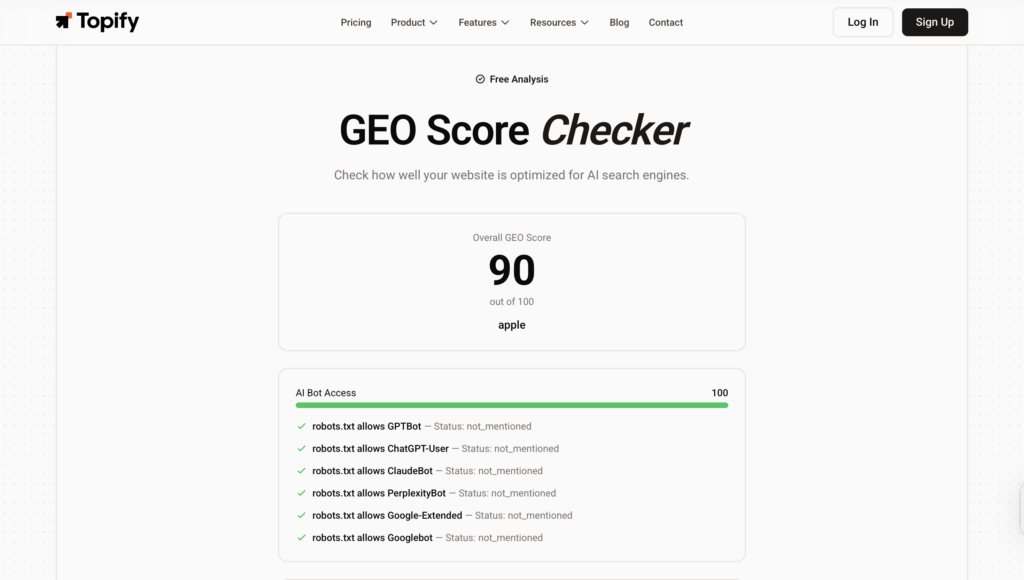
It starts with broader coverage. The tool evaluates brand visibility across ChatGPT, Gemini, Perplexity, DeepSeek, Doubao, and other major AI platforms. That matters because a visibility gap on one platform and not another usually points to a specific type of fix, whether that’s structured data, third-party mentions, or content format.
The more significant difference is the action layer. When Topify detects a gap, it doesn’t just flag it. Its Source Analysis identifies the exact URLs and domains AI platforms are citing when they answer queries in your category. For a B2B SaaS brand, this might reveal that 85% of citations come from Reddit, G2, and industry publications, not from brand-owned content. That’s not a content quality problem. It’s a citation network problem, and it calls for a specific outreach strategy, not more blog posts.
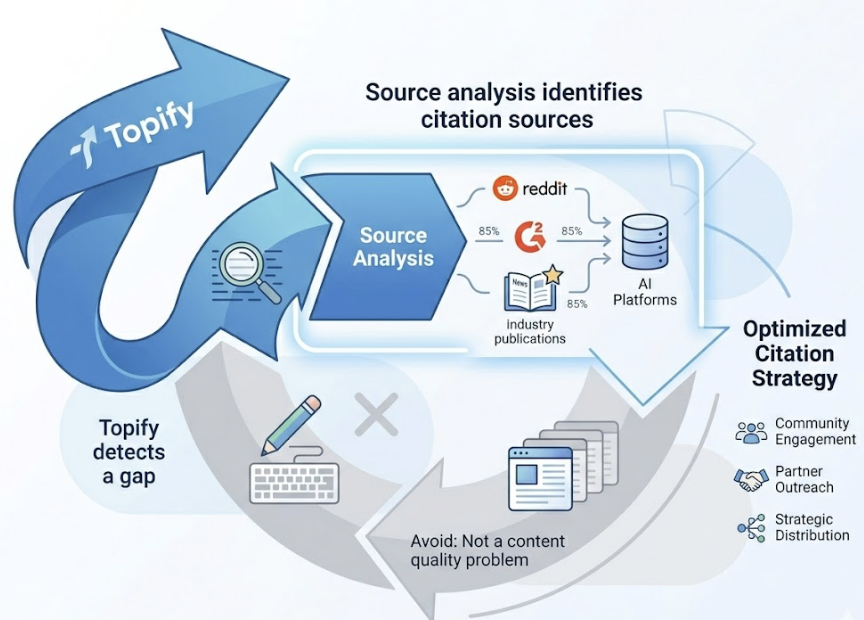
The platform tracks changes over time. Every content update or new citation feeds back into the visibility metrics, so you can see whether a specific fix actually moved the score before deciding to scale it. The optimization loop is closed, not open-ended.
Topify’s seven-metric framework (visibility, mentions, sentiment, position, volume, intent, and CVR) connects AI search data to downstream revenue signals. That’s the bridge most free tools don’t build.
Scores without a fix roadmap are just noise.
The Right Tool Depends on Where You’re Trying to Go
Not every team needs an execution platform. Here’s a straightforward way to think about the decision:
If you want situational awareness: Any free tool gives you a baseline. HubSpot or Mangools work fine for understanding where you stand before a strategy conversation or a leadership review.
If you’re trying to move the number: You need something that tells you which fix produces the fastest score improvement, tracks whether it worked, and shows you what competitors are doing to earn the citations you’re missing. Free snapshot tools can’t do that.
The gap between these two scenarios is the difference between knowing your brand scores a 42 and knowing that fixing your schema on three specific pages would push you past a competitor who’s currently getting cited for 68% of the queries in your category.
Who Gets the Most Value from Topify’s GEO Score Checker
B2B SaaS brands where AI search is already influencing pipeline. Buyers are using ChatGPT and Perplexity to evaluate software before they ever visit a vendor site. Topify helps SaaS teams maintain a coherent semantic footprint across feature pages, comparison content, and documentation, so AI systems understand exactly what the product does and who it’s built for.
Marketing and SEO agencies managing multiple clients. Daily prompt testing across dozens of models doesn’t scale manually. Topify’s multi-project management and one-click execution give agencies a way to deliver measurable AI visibility improvements without adding headcount.
SEO teams transitioning from traditional search. Teams moving from “ten blue links” to “AI citations” need a tool that bridges both worlds. Topify integrates technical signals like schema and crawlability with AI-native signals like sentiment and source citation patterns, which means one platform instead of a fragmented stack.
FAQ
What is a GEO score and how is it calculated? A GEO score measures how visible and trustworthy a brand is within AI-generated answers. Most professional tools calculate it as a weighted average across visibility (frequency of appearance), sentiment (tone of description), position (rank in AI-generated lists), and source credibility (authority of cited URLs).
Are there any truly free GEO score checkers? Yes. HubSpot AEO Grader, Geoptie GEO Audit, Mangools AI Search Grader, and Frase all offer free tiers that work well for baseline audits. Topify also offers a free GEO Score Checker at topify.ai/tools/geo-score-checker with prioritized fix recommendations, which goes further than the purely diagnostic tools.
How often should I check my GEO score? More often than most teams think. Research suggests only about 30% of brands maintain consistent AI visibility across multiple regenerations of the same query, due to model drift. A practical cadence: weekly for top-priority prompts, monthly for citation trends and sentiment shifts, quarterly to connect GEO metrics to pipeline and branded search lift.
What’s the difference between a GEO score and an SEO score? SEO scores measure demand capture through backlink volume, crawlability, and link rankings. GEO scores measure demand influence: how likely an AI is to cite your content based on its factual density, authoritative tone, and structural clarity. Different signals, different optimization strategies.
Can a GEO tool tell me which fixes to prioritize? Most diagnostic tools, like HubSpot or Mangools, can tell you your score is low but can’t tell you what to change first. Tools with an execution layer, like Topify, analyze visibility gaps against competitor citation data to surface a prioritized action feed, showing exactly which changes move the score fastest.
Conclusion
A GEO score is the start of a conversation, not the end of one. The question isn’t whether your score is 42. It’s whether your tool can tell you what to do about it, in what order, and how to verify it worked.
Free tools are genuinely useful for establishing a baseline or building the case for a GEO investment. But if you’re tasked with actually improving AI search visibility, you need something that closes the loop between data and execution.
Topify’s GEO Score Checker is worth starting with, specifically because it doesn’t stop at the number.

