

How to measure, compare, and improve your brand’s presence across ChatGPT, Perplexity, and AI Overviews
Your SEO dashboard is lying to you. Not because the data is wrong, but because it’s measuring the wrong thing.
When someone asks ChatGPT “what’s the best project management tool for remote teams,” your ranking on page one of Google doesn’t matter. What matters is whether you show up in the generated answer. And right now, most brands have no idea if they do.
That’s the gap this article addresses. Below are the 7 best AI search visibility tools available in 2026, evaluated on what actually matters: platform coverage, tracking precision, competitor benchmarking, and whether the tool can help you dosomething about what it finds.
Most Tracking Tools Are Built for a Search Engine That’s Losing Ground
Before picking a tool, it helps to understand why traditional SEO platforms miss this entirely.
Organic click-through rates in queries that trigger AI summaries have dropped from 1.76% to 0.61%, a decline of over 62%. That’s not a trend. That’s a structural shift. Users get their answer directly from the AI, and they never click through.
The deeper problem is architectural. Traditional search uses inverted indexes where the unit is a “page.” AI search uses vector retrieval where the unit is a “passage” or fragment. Around 60% of AI Overview citations come from URLs that don’t even rank in the top 20 organic results. Your backlink profile and domain authority, the things your current tools are optimized around, are increasingly less relevant to whether AI recommends you.
That’s why a new category of tools exists. Here’s how the best ones stack up.
The 7 Best AI Search Visibility Tools, Ranked
1. Topify
Best for: In-house marketing teams and agencies that need end-to-end execution
Topify isn’t just a monitoring dashboard. It’s built around a seven-metric framework: visibility, mentions, sentiment, position, volume, intent, and CVR (Conversion Visibility Rate). Most tools give you two or three of these. Topify connects all of them and links them to downstream revenue signals.

The feature that separates Topify from everything else is one-click GEO execution. When the platform detects a visibility gap, it doesn’t just flag it. It proposes a fix, such as restructuring your article’s opening into an “answer-first” format that’s easier for RAG systems to extract, and lets you deploy it with a single click.
Topify’s Source Analysis is equally distinct. It reverse-engineers the exact domains and URLs that AI platforms are citing in your category, so you can see which third-party media, Reddit threads, or review platforms are driving your competitors’ recommendations. That turns a passive monitoring tool into an active competitive intelligence system.
Platform coverage includes ChatGPT, Perplexity, Gemini, DeepSeek, and AI Overviews. The team behind it includes founding researchers from OpenAI and experienced Google SEO practitioners.
Pricing: Basic starts at $99/mo (100 prompts, 9,000 AI answer analyses, 4 projects). A Shopify-focused entry plan is available at $9.99/mo for product-level optimization.
Verdict: The most complete option in the market for teams that need both intelligence and execution. Worth evaluating first.
2. Profound
Best for: Enterprise brands in regulated industries (finance, healthcare)
Profound is a pure intelligence platform. It processes over 5 million citation analyses per day and is built for organizations where data accuracy and compliance matter as much as the insight itself.
Its standout feature is the Conversation Explorer, which captures real-time AI interaction data, revealing demand trends before they show up in any traditional keyword database. The sentiment analysis goes deep on how AI describes your brand, including tone, framing, and source attribution.
The limitation is clear: Profound has no execution layer. It tells you what’s happening; it doesn’t help you fix it. Starter plans ($99/mo) only cover ChatGPT. Multi-engine monitoring across 10+ platforms requires a higher-tier plan.
If you’re a large brand that already has a content team to act on insights, Profound is a strong data foundation. If you need a full-stack solution, you’ll need to pair it with something else.
3. Quattr
Best for: Mid-to-large B2B SaaS companies with high content volume
Quattr’s GIGA agent is the most automated execution engine on this list. It reads signals from Google Search Console and LLM citation patterns simultaneously, then generates CMS-ready HTML to fix content gaps without any manual intervention.
The predictive scoring model is genuinely useful: it estimates the probability that a piece of content will be selected as an AI answer before you publish it, allowing front-loaded optimization rather than reactive fixes.
The downside is complexity. Quattr is designed for teams managing large-scale content operations. For smaller brands or agencies with fewer than 50 pages under active management, the feature set creates overhead rather than efficiency. Pricing is custom and typically enterprise-level.
4. Peec AI
Best for: Global brands and agencies managing multilingual campaigns
Peec AI supports tracking across 115+ languages, which makes it the strongest option for brands with meaningful non-English audiences. Its technical approach is also worth noting: rather than simulating API calls, it uses UI-based scraping to capture the exact output users actually see, including regional differences and hidden citations.
The Share of Voice benchmarking is straightforward and actionable. You can see, at a glance, how much of the AI recommendation space in your category your brand occupies versus competitors.
Pricing starts at €89/mo with no seat limits, which is genuinely cost-efficient for agencies billing across multiple clients. The trade-off is that it’s a monitoring-only tool with lighter actionability compared to Topify or Quattr.
5. Scrunch AI
Best for: Enterprise brands concerned with brand safety and AI misrepresentation
Scrunch addresses something most tools ignore: how AI agents (not just human users) perceive and represent your brand. Its Agent Experience Platform (AXP) monitors whether AI systems are misreading your content or propagating inaccurate brand information, a real risk as autonomous AI agents increasingly handle purchasing and discovery workflows.
The persona-based monitoring is novel. You can see how a “technical expert” versus a “general consumer” asking the same question gets different AI-generated recommendations, which reveals audience-specific visibility gaps.
At $250/mo entry pricing, Scrunch is squarely in the enterprise tier. It’s the right tool if brand consistency and AI hallucination risk are primary concerns. It’s overkill if you’re still establishing basic AI visibility.
6. Otterly AI
Best for: Solo founders and small teams getting started with AI visibility
Otterly AI covers 6 major platforms, runs basic GEO audits, and automatically converts traditional SEO keywords into conversational prompts suited for AI tracking. It also flags technical visibility blockers like robots.txt blocking or missing Schema markup.
The Lite plan at $29/mo is the lowest entry point for a professional-grade AI tracking tool on this list. For teams that need baseline data before committing to a more comprehensive platform, it’s a practical starting point.
Don’t expect execution capabilities or deep competitive intelligence. Otterly is a monitoring foundation, not a growth platform.
7. Semrush AI Visibility Toolkit
Best for: SEO teams already embedded in the Semrush ecosystem
If your team already runs Semrush, the AI Visibility Toolkit adds meaningful capability with zero additional learning curve. Its database of 200M+ prompts provides strong benchmarking for brand mentions in AI Overviews and ChatGPT.
The most useful distinction it makes: separating “brand mentions” from “cited page” attribution. That tells you whether AI is recommending you based on brand reputation or specific content quality, which points to very different optimization strategies.
At $99/mo per domain, it’s not cheap as a standalone product. As an extension of an existing Semrush investment, the integrated workflow justifies the cost. As an independent AI visibility solution, dedicated native platforms typically offer more depth.
Side-by-Side: Features That Actually Matter
| Tool | AI Platforms Covered | Competitor Tracking | Sentiment Analysis | Citation Source Analysis | Starting Price |
|---|---|---|---|---|---|
| Topify | ChatGPT, Perplexity, Gemini, AIO, DeepSeek + more | Deep, with one-click GEO execution | 0-100 real-time scoring | Full source URL mapping | $99/mo |
| Profound | 10+ engines (full coverage on higher plans) | Real-time demand detection | Deep contextual analysis | Strong attribution | $99/mo |
| Quattr | Comprehensive | Predictive scoring model | Included | Internal link optimization | Custom |
| Peec AI | Core engines, 115+ languages | Share of Voice benchmarking | Included | Lightweight | €89/mo |
| Scrunch AI | Core engines (AXP-focused) | Brand safety monitoring | Misrepresentation detection | Machine-readability diagnostics | $250/mo |
| Otterly AI | 4-6 major platforms | Basic monitoring | Basic | Technical gap analysis | $29/mo |
| Semrush | Core + AIO | Historical trend benchmarking | Included | Brand vs. page citation split | $99/mo |
5 Things Most AI Visibility Tools Still Can’t Fully Solve
Knowing the limits of your tools is part of using them well.
The persistence problem. Research shows only 30% of brands maintain consistent visibility across multiple regenerations of the same AI query. Most tools report a statistical frequency, not a guarantee of presence in any given user conversation. Treat your visibility score as a probability, not a fixed position.
The earned media gap. Between 82% and 85% of AI citations come from third-party sources: media coverage, Reddit, G2, review platforms, industry forums. Most tools can tell you you’re not being cited. Few can help you build the external signal network that would change that. Topify’s Source Analysis gets closest by identifying exactly which third-party domains are driving competitor citations.
Model drift. As large language models retrain and update, the way AI describes and recommends your brand can shift without warning. Current tools are better at post-hoc detection than prediction.
The attribution gap. When AI Overviews answer a question directly, traffic falls. Tracking “mentions” is useful, but measuring the downstream behavioral impact (like branded search lift) remains difficult. You’ll need to accept that some AI influence is unmeasured by design.
Execution without strategy. Automation tools can deploy changes at scale. They can’t tell you whether the underlying positioning is right. The best tools (Topify, Quattr) accelerate execution. Strategic judgment still sits with your team.
Which Tool Fits Your Use Case?
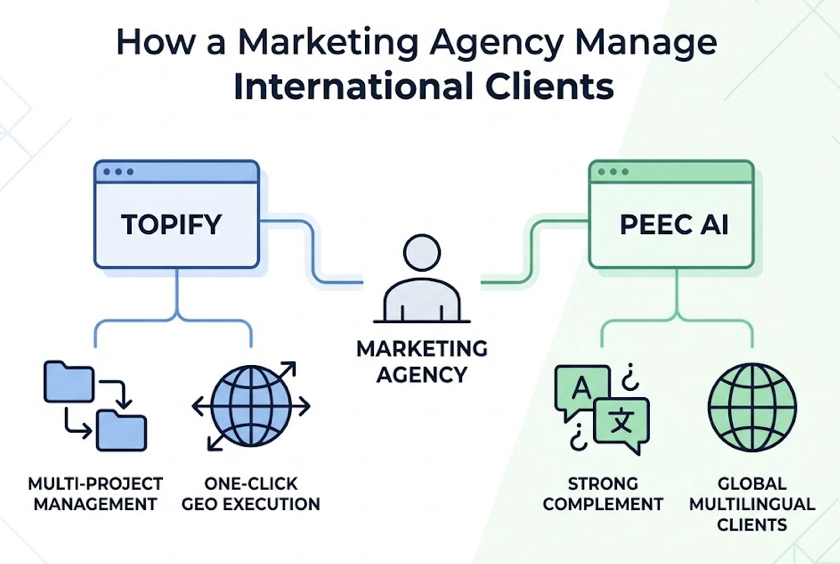
Marketing agencies: Topify handles multi-project management with one-click GEO execution across client accounts. Peec AI is a strong complement for agencies with global multilingual clients.
In-house brand teams: Topify’s end-to-end platform, from tracking through execution, makes it the most efficient single-platform option. You don’t need a separate content team to act on what it finds.
Enterprise and regulated industries: Profound for data depth and compliance sensitivity. Quattr for teams managing 100+ pages of content requiring systematic optimization.
Solo founders and small teams: Otterly AI at $29/mo gives you enough baseline data to understand where you stand. Once you’ve established that AI search is a real channel for your category, upgrading to Topify’s Basic plan ($99/mo) gives you the execution layer to actually move the needle.
Competitive intelligence specialists: Topify’s Competitor Monitoring combined with Source Analysis is the most precise way to reverse-engineer why your competitors are getting recommended and what you need to do to displace them.
Conclusion
AI search visibility tracking is no longer optional. If your brand appears in ChatGPT, Perplexity, or AI Overviews for high-intent queries in your category, it matters to your business. If it doesn’t appear, that also matters, and most traditional dashboards won’t tell you either way.
The tools on this list represent different points on the spectrum from basic monitoring to full-stack optimization. For teams that want to move quickly and see results beyond a dashboard, Topify is the most complete starting point. For teams with more specific constraints (budget, language coverage, ecosystem integration), the comparison above gives you a clear framework.
The bottom line: pick a tool, establish your baseline, and start measuring. The brands that know where they stand in AI search today will have a meaningful head start by the end of 2026.
FAQ
What’s the actual difference between AEO and GEO?
AEO (Answer Engine Optimization) focuses on extraction precision, structuring content so machines can pull a specific answer directly. GEO (Generative Engine Optimization) is about synthesis, getting your brand recommended when AI models aggregate information from multiple sources to form a response. AEO is about becoming the answer. GEO is about being the recommended brand in a broader conversational context. In practice, the tactical overlap between the two is over 95%.
Can these tools track ChatGPT and Perplexity at the same time?
Most of the main platforms on this list (Topify, Profound, Otterly) support simultaneous multi-platform tracking. That said, each AI engine has different citation logic. Perplexity, for example, places significant weight on Reddit data and content freshness (typically within 30 days). Tracking them on the same dashboard doesn’t mean optimizing for them is the same process.
How often should I check AI search visibility?
Given the non-deterministic nature of AI outputs and the frequency of model updates, weekly reviews of core metrics are a reasonable baseline. For active campaigns or product launches, daily monitoring is worth it. AI outputs can shift faster than traditional rankings.
Do I need a dedicated AI visibility tool if I already use Ahrefs or Semrush?
Traditional SEO platforms are built around link indexes and keyword rankings. AI visibility tools are built around semantic vector spaces and citation pattern analysis. Semrush’s AI Visibility Toolkit bridges this gap for existing users, but its execution depth typically doesn’t match native platforms like Topify. If AI search is a meaningful channel for your category, a dedicated tool gives you more precise data and, in the case of platforms with execution layers, faster path to improvement.

