

A 5-step optimization playbook to get your brand recommended by ChatGPT, Gemini, and Perplexity.
Your domain authority is solid. Your keyword rankings haven’t moved in months. But when a potential buyer asks ChatGPT for a recommendation in your category, your brand doesn’t show up. That’s not a ranking problem. It’s an AI search visibility problem, and traditional SEO metrics weren’t built to detect it.
Roughly 73% of brands that rank on page one of Google receive zero mentions in the corresponding AI-generated responses. The gap between being indexed and being recommended is widening every quarter, and most marketing teams don’t have a system to close it.
Here’s how to build one, step by step.
Most Brands Are Still Optimizing for the Wrong Search Engine
The disconnect isn’t subtle. When an AI Overview appears on a search results page, traditional organic links see their click-through rate drop by roughly 34.5%. For high-traffic informational keywords, some sites have lost up to 64% of their traffic as AI-generated answers satisfy user intent directly on the page.
Why? Because generative engines like ChatGPT, Perplexity, and Gemini don’t rank pages. They synthesize answers. They pull “chunks” of information from across the web using Retrieval-Augmented Generation (RAG), cross-reference claims against what researchers call a “Consensus of Truth,” and assemble a single response. If your content isn’t structured to be extracted and cited by that process, your page-one ranking is irrelevant.
That means the playbook has to change. Here’s what replaces it.
Step 1: Audit Your Current AI Search Visibility
Before optimizing anything, you need a baseline. And in 2026, that baseline can’t come from Google Search Console alone.
AI responses are non-deterministic. A single prompt can return different results depending on the model’s temperature setting and recent data refreshes. Leading frameworks recommend running each priority query at least 10 to 20 times to establish a statistical baseline for visibility. Manually testing five prompts takes about 20 minutes. Tracking a thousand prompts across multiple AI platforms? That’s not a manual job.
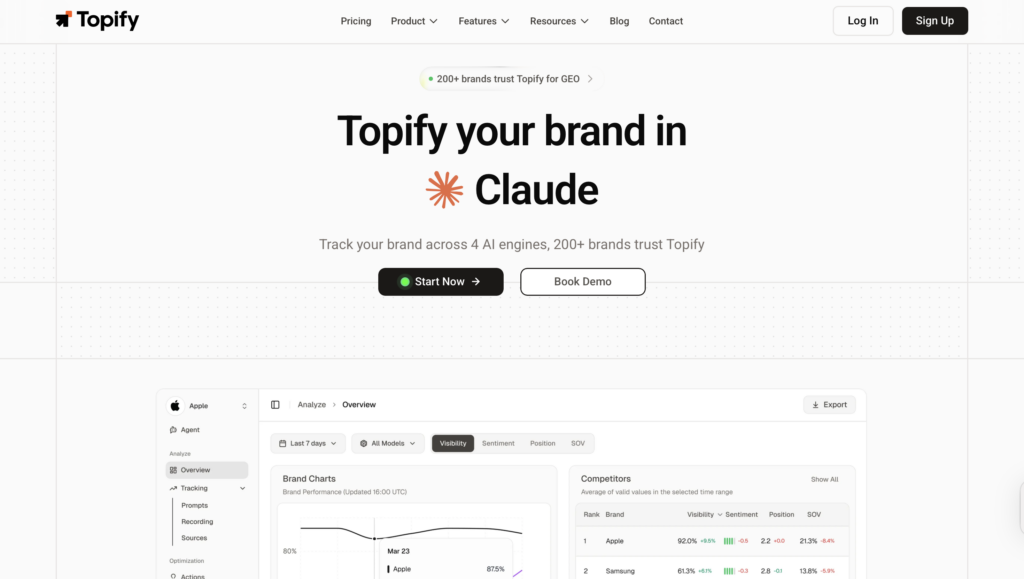
This is where automated tracking changes the equation. Topify runs real-time monitoring across 1,000+ prompts simultaneously on ChatGPT, Gemini, and Perplexity. Instead of guessing whether your brand showed up in a single test, you get a Visibility Score: mention frequency weighted by recommendation position and sentiment, tracked over time.
The audit should cover four dimensions:
| Dimension | What to Look For |
|---|---|
| Mention Presence | Does your brand appear at all in AI answers for category prompts? |
| Position | Are you the first recommendation, or buried at the end of a list? |
| Sentiment | Does the AI describe your brand accurately, or frame it incorrectly? |
| Source Attribution | Which URLs is the AI citing to justify mentioning (or ignoring) you? |
If your Visibility Score is below 10, the issue is likely technical. Check whether your site uses server-side rendering. JavaScript-heavy sites see roughly 60% less visibility in AI citations because AI bots prioritize the initial HTML return.
Step 2: Find the Prompts That Drive AI Recommendations
In traditional SEO, you research keywords. In GEO, you research prompts.
The difference matters. The average keyword is about four words long. The average AI query runs closer to 23 words, packed with specific qualifiers: budget constraints, industry verticals, company size, use-case scenarios. These qualifiers are what push an AI from “explanation mode” into “recommendation mode,” and that transition is where brands either get cited or get ignored.
The methodology starts with what your audience is actually asking. Pull language from sales transcripts, support tickets, and community forums like Reddit and Quora. Map those prompts to the buyer’s awareness stage: problem-unaware users ask different questions than solution-aware users already evaluating vendors.
Then validate which prompts actually have volume. Topify’s AI Volume Analytics shows which conversational clusters are active and provides a “Share of Model” indicator, revealing where competitors are currently capturing the narrative. Its High-Value Prompt Discovery feature continuously surfaces new opportunities as AI recommendations evolve, so you’re not optimizing for last month’s conversation.
Step 3: Reverse-Engineer What AI Cites and Trusts
Here’s the part most brands get wrong: AI systems don’t derive trust primarily from your own website.
Empirical data suggests that approximately 85% to 91% of the citations used to ground an AI’s brand recommendation come from third-party platforms. Your product page matters for specific specs and pricing. But the recommendation itself is anchored by what Reddit threads say, what industry reports conclude, and whether vertical aggregators like G2 include you in their shortlists.

The source hierarchy looks like this:
| Source Type | Role in AI Discovery |
|---|---|
| Community platforms (Reddit, Quora) | Provide authentic “experience” signals, especially high-weight for Perplexity |
| Authority media (Forbes, WSJ) | Establish broad legitimacy in training data, favored by Gemini and ChatGPT |
| Vertical aggregators (G2, Capterra) | Drive comparison and shortlist inclusion for transactional queries |
| Official sources (.gov, .edu) | Factual grounding for YMYL topics |
| Your own website | Technical base for specific product data |
Topify’s Source Analysis function reverse-engineers this ecosystem, identifying exactly which URLs the AI is citing for your competitors. This often reveals a “Visibility Gap”: a competitor may have lower Google rankings but higher AI visibility because they’re mentioned in a specific Reddit thread or niche industry report that the AI model treats as high-confidence.
Once you know what the AI trusts, you know where to invest your content and PR efforts.
Step 4: Optimize Content for AI Recommendation Signals
Now you’ve got the data: your visibility baseline, the prompts that matter, and the sources the AI trusts. Time to rebuild your content to match.
The academic framework here comes from Princeton and Georgia Tech researchers who identified nine specific methods that statistically improve AI visibility. The gains aren’t marginal.
| GEO Strategy | Estimated Visibility Lift |
|---|---|
| Cite credible sources | +115.1% for position-5 sites |
| Add statistics | +37% to +40% |
| Include expert quotes | +30% |
| Use precise technical terms | +28% |
The structural principle behind all of these: make your content easy to extract. AI systems prioritize content that can be “chunked” into a 50-word summary without complex logical leaps. That means leading every section with the answer (the BLUF format), then backing it with evidence.
Two more signals that matter in 2026:
Modular content architecture. Generative engines use “query fan-out,” decomposing a complex prompt into multiple sub-queries. A user asking for the “best limited-ingredient dog food for stomach issues under $60/month” triggers at least three sub-queries. Your page needs to answer each fragment independently, which means every section should function as a standalone response.
Digital provenance. AI models favor “ownable authority.” Publish original research with year-specific titles. Share case studies with concrete metrics, not abstract success stories. Attribute every article to a verifiable human expert with external credentials. Anonymous bylines get de-prioritized.
For teams that want to move fast, Topify’s One-Click Execution feature identifies the exact content change needed when it detects a visibility gap, like adding a comparison table or a specific definition, and deploys it directly to your CMS.
Step 5: Track, Measure, and Iterate on AI Visibility
AI search visibility isn’t a project. It’s a loop.
Models get updated. Knowledge graphs refresh. Competitors optimize their own footprints. Content that’s more than three months old sees a sharp decline in citation frequency due to recency bias. A strategy that worked in Q1 may not hold in Q3.
The monitoring system needs to track seven core metrics simultaneously:
| Metric | What It Tells You | When to Act |
|---|---|---|
| Visibility Score | Overall brand presence in the category | Score below 10: audit technical SSR |
| Mention Frequency | Brand share within AI results | Declining: refresh statistics and data |
| Sentiment | How the AI “frames” your brand | Negative: identify the source URLs driving it |
| Recommendation Position | Trust ranking vs. competitors | Position above 2: add expert quotations |
| Prompt Volume | Demand for specific conversational topics | Shift content focus to high-volume prompts |
| Citation Share | Your sources vs. competitor sources | Low: pitch to the third-party domains being cited |
| CVR | ROI of the AI discovery journey | Adjust content to drive branded search |
Topify’s Comprehensive GEO Analytics dashboard monitors all seven across ChatGPT, Perplexity, and Gemini in a single view. When the system detects a competitor securing a new citation in a “best of” prompt, it flags the gap and identifies the content change needed to close it.
That’s the difference between reacting to lost visibility and staying ahead of it.
3 Mistakes That Tank Your AI Search Visibility
Even well-resourced teams fail when they carry legacy thinking into GEO. Three errors show up repeatedly.
Mistake 1: The “Google-Only” optimization trap. Traditional SEO ranking factors like backlinks and keyword density have a weak or neutral correlation with AI recommendations. Brands that focus solely on outranking competitors in the blue links often find themselves omitted from the AI Overview entirely. The fix: optimize for parseability and synthesis potential. Your goal isn’t to be found by a human. It’s to be extracted by an AI.
Mistake 2: Ignoring how AI frames your brand. In traditional search, a ranking is a ranking. In generative search, the AI synthesizes an opinion. If training data includes outdated pricing, negative reviews, or competitor comparisons that position you as the “budget option,” the AI will present that framing as fact. The fix: monitor your Sentiment Score weekly and ensure your brand data is consistent across 50+ business directories.
Mistake 3: Treating content as “evergreen.” AI models exhibit strong recency bias. Static pages that once drove reliable traffic are being replaced by newer content with 2026-specific data points. The fix: implement a quarterly freshness audit. Update statistics, refresh tool recommendations, and make sure “last updated” timestamps are schema-encoded.
Conclusion
AI search visibility in 2026 comes down to a five-step loop: audit your current state, discover the prompts that matter, reverse-engineer what the AI trusts, optimize your content for extraction, and monitor everything continuously.
The brands winning this shift aren’t the ones with the highest domain authority. They’re the ones who’ve built their online presence as a modular knowledge graph designed for AI synthesis. The starting point is measurement. You can’t optimize what you can’t see. Tools like Topify give marketing teams the data layer to turn AI visibility from a guessing game into a structured growth channel. The earlier you start tracking, the harder it becomes for competitors to catch up.
FAQ
Q: What is AI search visibility?
A: AI search visibility measures how frequently and favorably your brand is mentioned, cited, or recommended within the synthesized responses of generative AI platforms like ChatGPT, Perplexity, Gemini, and Google AI Overviews. It’s distinct from traditional search rankings because it reflects whether AI systems choose to include your brand in their answers, not just whether your pages are indexed.
Q: How is AI search visibility different from traditional SEO?
A: Traditional SEO focuses on ranking a specific URL on a results page to drive clicks. AI search visibility (often called GEO or AEO) focuses on being included in the AI’s final synthesized answer. The emphasis shifts from keyword volume and backlink profiles to “extractability,” factual density, and entity consensus across third-party sources.
Q: How long does it take to improve AI search visibility?
A: Brands typically see measurable lift in AI citations and visibility within 4 to 12 weeks of implementing structured data, answer-first content formatting, and entity resolution tactics. The timeline depends on how much existing content needs restructuring and how active competitors are in the same category.
Q: Which AI platforms should I optimize for first?
A: For general audience reach, ChatGPT is the priority due to its dominant market share. For niche, technical, or research-heavy categories, Perplexity tends to be the most accessible entry point because of its democratic citation behavior and high source-attribution rate. Gemini matters for audiences already embedded in Google’s ecosystem.

