


Your team spent six months building domain authority, earning backlinks, and climbing to Google’s top three for your primary keyword. Then a prospect typed that same keyword into ChatGPT and got a list of five recommendations. Your brand wasn’t on it.
That disconnect isn’t a glitch. It’s structural. Generative AI traffic grew by 796% between January 2024 and December 2025, and the visitors it sends convert at 1.2x the rate of traditional organic search. The brands showing up in those AI answers are capturing pipeline you can’t even see in your analytics dashboard. The ones that aren’t are losing deals before the first click ever happens.
Google Rankings and AI Search Visibility Run on Different Logic
A top-three Google ranking used to mean your brand was visible where it mattered. That assumption no longer holds.
Traditional SEO optimizes for keyword relevance, backlinks, and technical health. Generative engines like ChatGPT, Perplexity, and Gemini operate on a completely different retrieval model. They don’t rank pages. They synthesize answers by pulling “citation-worthy” chunks from a small set of trusted sources, then weave those into a single response.
The result is a growing zero-click environment. By mid-2025, roughly 60% of Google searches ended without a click to any website. On mobile, that figure hit 77.2%. When AI Overviews appear, click-through rates for traditional organic results drop by up to 47%.
HubSpot, widely considered an SEO benchmark, experienced a 70-80% decline in organic traffic between 2024 and 2025 as AI summaries began satisfying the top-of-funnel queries that once drove millions of blog visits. If a brand with that level of domain authority can lose visibility overnight, the traditional SEO playbook alone isn’t enough anymore.
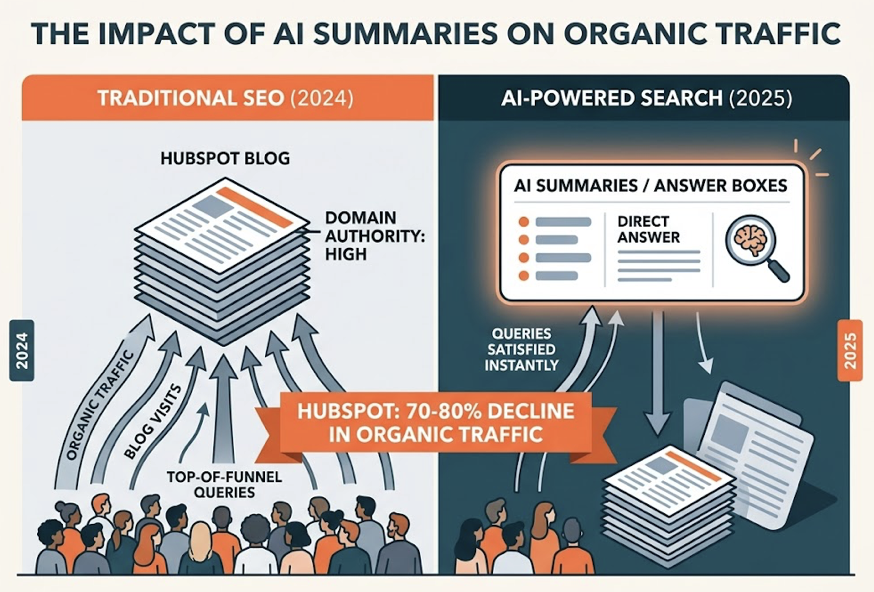
That’s the core shift: AI search visibility isn’t about ranking pages. It’s about whether an AI engine can identify, trust, and recommend your brand as a specific solution. Google ranks URLs. AI surfaces entities.
3 Reasons AI Engines Skip Your Brand
Brand invisibility in AI answers typically traces back to three structural gaps, not random algorithmic variance.
Your Brand Falls Outside the AI’s Citation Radius
AI engines don’t crawl the entire web equally. They rely on a specific set of high-authority, “citation-ready” sources to ground their responses. If your presence is limited to your own website and social channels, you’re likely outside that radius entirely.
The data is stark: brands are cited 6.5 times more often through third-party sources than through their own domains. ChatGPT leans heavily on news publishers (38%) and niche authority sites (31%). Perplexity shows an even stronger bias toward publishers (42%) and community platforms like Reddit.
A brand can rank #1 on Google for its primary keyword but remain invisible to ChatGPT simply because it’s never mentioned on Reddit, Wikipedia, G2, or major industry portals.
Your Brand Narrative Is Fragmented
AI models need what researchers call “Model Consensus,” consistent signals from multiple independent sources confirming what your brand is and what it does. When your description, pricing, or feature set varies across directories, review sites, and social platforms, the AI encounters “Semantic Drift.”
The symptoms are specific. ChatGPT and Perplexity describe your brand differently. The AI confuses you with a similarly named company. It invents features you don’t have because the training data is contradictory. Each of these signals tells you the retrieval layer hasn’t reached a stable entity definition for your brand.
Your Content Isn’t Built for AI Extraction
Traditional SEO content is designed for human dwell time and keyword density. AI engines don’t read content that way. They chunk and extract.
Content buried in long narrative introductions or padded with qualitative prose provides nothing for an AI to synthesize. What LLMs need instead: modular structures with autonomous blocks that can be quoted standalone, explicit statistics and expert citations that provide verifiable data points, and technical accessibility that lets AI crawlers actually parse the page.
If your site blocks GPTBot or PerplexityBot via robots.txt, or relies heavily on client-side JavaScript rendering, your content may be invisible to the retrieval layer before any quality assessment even happens.
How to Check Your AI Search Visibility Right Now
The fastest way to start is manual. Open ChatGPT, Perplexity, and Gemini. Type 10-20 high-intent prompts relevant to your category. Document whether your brand appears, where it ranks in the recommendation list, and how it’s described.
That manual audit answers three questions. First, mention rate: does your brand show up at all? Second, framing: is the AI describing you accurately, or is it hallucinating old pricing and features? Third, source forensics: which URLs is the AI citing, your own pages or third-party sites?
The limitation is scale. Manual checks can’t track trends over time, cover enough prompts to be statistically meaningful, or account for the randomness baked into generative responses.
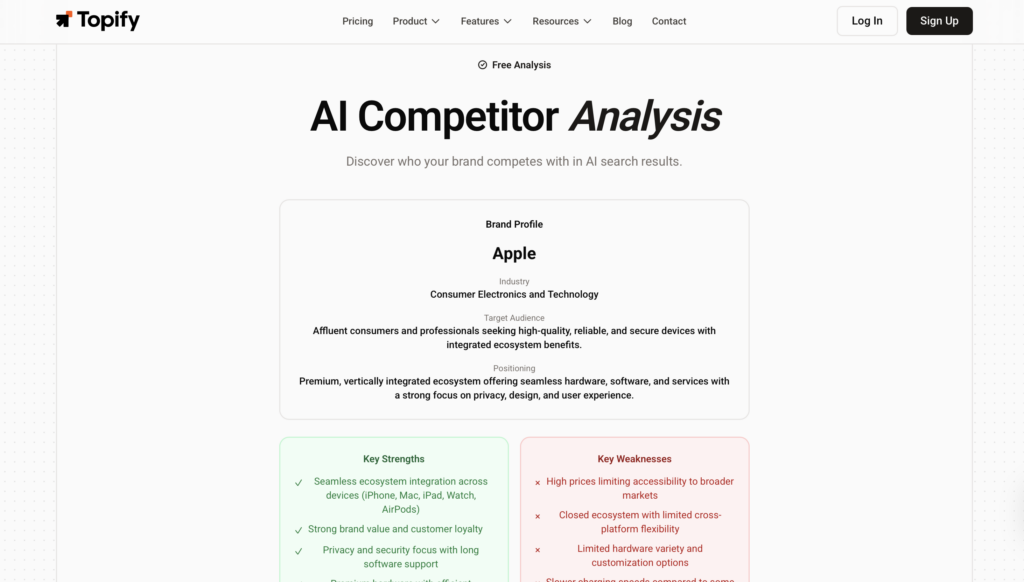
Topify automates this across ChatGPT, Perplexity, Gemini, and other major AI platforms simultaneously. Its Visibility Tracking monitors brand mentions across thousands of prompts, calculates a composite AI Visibility Score, and benchmarks your performance against competitors in real time. Instead of a one-time snapshot, you get a continuous measurement loop that shows whether your content strategy is actually moving the needle.
What Makes AI Recommend One Brand Over Another
Understanding the retrieval-augmented generation (RAG) process is the key to getting cited. When a user asks a question, the AI retrieves relevant data chunks, evaluates their credibility, and synthesizes an answer. Not all content is treated equally in that process.
Research published by Princeton University and Georgia Tech (KDD 2024) identified nine content optimization strategies and measured their impact on AI visibility. The top performers share a common trait: they provide concrete, verifiable units of information.
Adding direct quotations from domain experts boosted visibility by 41%. Citing authoritative sources added 40%. Including specific statistics contributed a 37% lift. Technical terminology aligned with semantic embeddings added 28%. On the flip side, legacy SEO tactics like keyword stuffing showed zero or negative impact.
Content freshness matters too, but unevenly across platforms. Perplexity cites content updated within the last 30 days at an 82% rate, dropping to 37% for content older than six months. ChatGPT is more tolerant of older content, particularly from established authority sources like Wikipedia and major news outlets.
That platform-specific behavior means a single optimization approach won’t work everywhere. Topify’s Source Analysisreverse-engineers which domains and URLs each AI platform is actually citing for your category. If a competitor is winning citations because of a specific industry report or niche blog mention, you can see that and target the same sources. The Competitor Monitoring feature tracks where rivals appear and you don’t, turning competitive gaps into a prioritized action list.
5 Steps to Get Your Brand Into AI Answers
Moving from invisible to cited requires a systematic shift, not a single content update.
Step 1: Establish Your AI Visibility Baseline
Test high-intent prompts across multiple AI platforms. Document mention rate, sentiment accuracy, and source attribution. If manual testing isn’t scalable for your team, Topify’s dashboard provides a real-time baseline with competitive benchmarking built in.
The free GEO Score Checker is a practical starting point. It evaluates your site across four dimensions: AI bot access, structured data, content signals, and overall visibility, with no signup required.
Step 2: Restructure Content for AI Extractability
The first 200 words of every key page should deliver a direct, concise answer to the user’s primary question. No narrative filler.
Use H2/H3 headings phrased as questions (e.g., “What is the ROI of GEO?”) followed by 40-60 word paragraphs that work as standalone extractions. Deploy JSON-LD structured data to help LLMs identify authors, pricing, and FAQ pairs without consuming excessive tokens. Sites using schema markup see up to a 40% increase in click-through rates and higher AI citation rates.
Step 3: Saturate Third-Party Authority Signals
Since 85% of brand mentions in AI answers come from external sources, your off-domain strategy is where most of the leverage sits.
Publish on high-authority platforms like LinkedIn and Tier 1 industry media to create a positive retrieval cushion. Engage in relevant Reddit threads and niche forums, which Perplexity and Google AI Overviews prioritize for “real person” perspectives. Ensure consistent entity information (name, description, category) across Wikipedia, directories, and review platforms to prevent the AI from confusing your brand with a competitor or a generic term.
Step 4: Run a Competitor Gap Analysis
AI search visibility is close to zero-sum. Responses rarely cite more than seven sources, creating a winner-take-all dynamic within each prompt.
Identify the high-volume prompts where AI is recommending three competitors but omitting your brand. Those “missed prompts” become your immediate content priority. Topify’s High-Value Prompt Discovery surfaces these opportunities automatically as AI recommendations evolve.
Step 5: Monitor Continuously and Iterate
AI visibility shifts faster than organic rankings. A 30-day recheck cadence is the minimum. Weekly monitoring is recommended for competitive categories.
Topify’s One-Click Execution bridges the gap between insight and action. Its AI Agent analyzes visibility gaps and generates a prioritized action feed. If your sentiment score drops due to a new negative review thread, the system flags it and suggests a specific content response. Marketing teams can publish GEO-optimized content directly to their CMS with a single click.
The Numbers Behind a GEO Turnaround
In a 2026 study of the accounts payable software sector, one brand implemented a targeted GEO strategy focused on extractable content and third-party consensus. They rewrote category landing pages into answer-first formats with comparison tables, integrated original survey data into technical guides, and actively managed mentions across LinkedIn and niche forums.
Within 30 days, their visibility rate jumped from 3.2% to 22.2% across ChatGPT and Perplexity. Two optimized pages earned over 300 new AI citations. Their sales team reported a measurable increase in prospects who discovered the brand through AI during early-stage research.
That’s the speed at which GEO operates. Traditional SEO takes 6-12 months to show results. GEO improvements can yield impact in 4-8 weeks when content is correctly structured for retrieval.
Conclusion
AI search visibility isn’t an extension of SEO. It’s a separate dimension of digital strategy that runs on different logic, rewards different content structures, and moves on a different timeline.
The brands that continue to rely solely on Google rankings are effectively invisible in the interfaces where a growing share of buyers now start their research. The fix isn’t complicated, but it is specific: establish a baseline, restructure content for extraction, build third-party authority, close competitive gaps, and track everything continuously.
The gap between “indexed by Google” and “cited by AI” is where pipeline is being won and lost right now.
FAQ
What is AI search visibility?
AI search visibility measures how frequently, prominently, and accurately a brand appears in answers generated by AI platforms like ChatGPT, Perplexity, and Gemini. Unlike traditional SEO, which tracks link positions on a results page, AI visibility focuses on “Share of Model”: the degree to which a brand is integrated into the AI’s synthesized responses when users ask relevant questions.
How is AI search visibility different from traditional SEO?
Traditional SEO targets ranking a specific URL through keywords and backlinks. AI search visibility targets being cited and recommended in AI-generated responses through entity clarity, extractable content structures, and consistent third-party validation. The two systems measure different things, and performing well in one doesn’t guarantee results in the other. Only about 38% of AI citations overlap with Google’s top 10 results.
Can I improve my ChatGPT visibility without paid tools?
Yes, through manual effort. You can run a visibility audit by asking ChatGPT 10-20 high-intent questions about your category and documenting the results. You can then optimize content by adding statistics, expert quotes, and structured headings based on the Princeton GEO research. The limitation is scale: tracking sentiment trends, competitive movements, and cross-platform citation variations over time requires automated monitoring.
How long does it take to appear in AI search results?
GEO improvements can yield measurable impact in 4-8 weeks, significantly faster than traditional SEO’s 6-12 month timeline. Perplexity can index and cite well-structured content within days of publication. Consistent visibility growth across all major platforms typically requires 3-6 months of sustained optimization.

