

Your domain authority is solid. Your keyword rankings are holding. But none of that tells you whether Perplexity is recommending your competitor when a buyer asks which tool to use in your category. Traditional SEO metrics were built for blue-link rankings, not for the synthesized answers that now resolve 82% to 93% of AI search queries without a single click to your site. AI search monitoring is how you close that gap.
Most Brands Are Invisible in AI Search and Don’t Know It
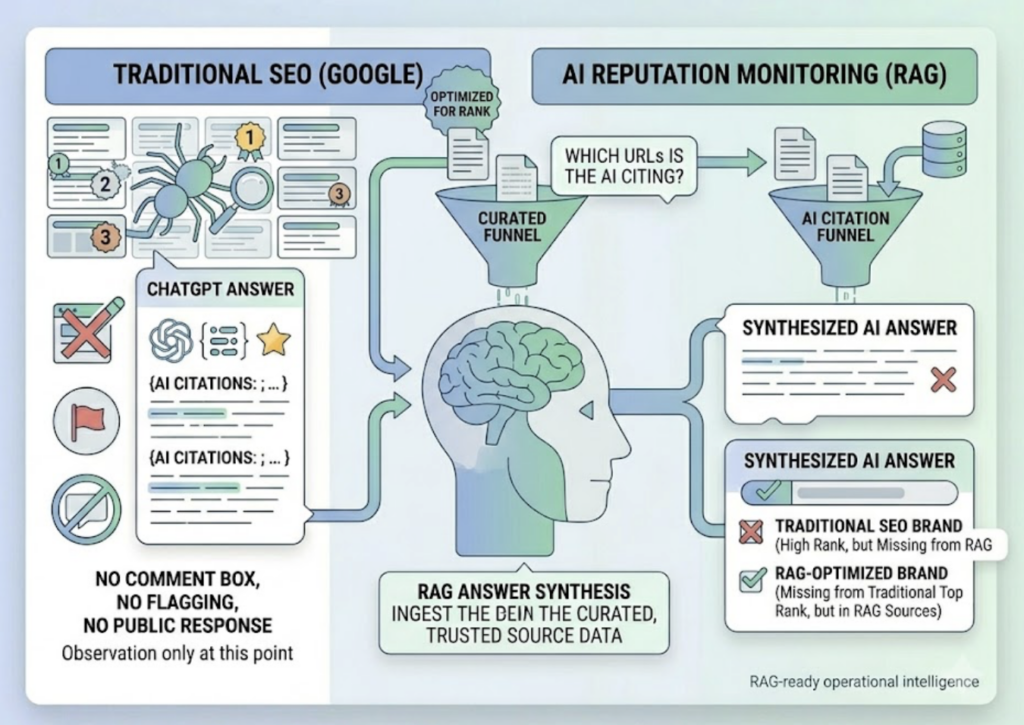
A brand can hold the top organic ranking on Google and still be completely absent from an AI-generated answer for the same query. This isn’t a ranking problem, it’s a visibility problem of a different kind.
AI platforms like ChatGPT, Perplexity, and Gemini use Retrieval-Augmented Generation (RAG) to build their responses. They don’t crawl and rank pages the way Google does. They ingest content from a curated set of trusted sources, synthesize it, and produce a single answer. If your brand isn’t in those sources, it doesn’t appear in the answer, regardless of how well you’ve optimized for traditional search.
The consequence is real. Users who rely on AI assistants for commercial research and product recommendations are forming opinions and making decisions based on answers that may not mention your brand at all.
What AI Search Monitoring Actually Means
AI search monitoring is the systematic process of tracking a brand’s presence, narrative, and citation status within AI-generated responses across major platforms.
It’s different from traditional SEO monitoring in a fundamental way. SEO monitoring tells you where your page ranks in a list. AI search monitoring tells you whether your brand is mentioned in an answer, how it’s described, which sources the AI used to form that description, and how your position compares to competitors in the same answer.
The underlying mechanism matters here. Because AI responses are synthesized from multiple sources rather than pulled from a single ranked result, optimizing for AI search visibility requires a different framework entirely. The goal shifts from “rank for this keyword” to “be cited as a trusted entity for this category of query.”
This is the foundation of AI search optimization as a discipline.
The 5 Metrics That Actually Matter in AI Search Monitoring
According to AI search visibility benchmarks, teams that measure AI performance successfully tend to pivot away from legacy metrics like clicks and keyword rank. Here’s what replaces them:
| Metric | What It Measures | Why It Matters |
|---|---|---|
| Visibility Rate | % of tracked prompts where brand is mentioned | Establishes baseline share of voice in AI |
| Sentiment Score | 0–100 score of brand portrayal in responses | Detects brand misrepresentation or drift |
| Citation Share | % of AI answers linking to your domain as a source | Measures domain authority within LLM indices |
| Position in Answer | Where your brand appears relative to competitors | Higher positions command greater trust |
| Competitor Co-occurrence | How often your brand appears alongside rivals | Shows whether you’re positioned as primary or secondary |
These five metrics together give you an accurate picture of your brand’s AI entity footprint, a concept that’s becoming as important as domain authority once was in traditional SEO.
Topify surfaces all five of these, along with AI Volume (the actual query volume for a given prompt in AI search), in a single dashboard across ChatGPT, Gemini, Perplexity, DeepSeek, and other major platforms.
How to Build an AI Search Monitoring Workflow
Scalability is the primary barrier here. Manual prompt testing is unreliable at any real volume. What you need is an automated pipeline built around four steps.
Step 1: Define your prompt set. Curate 50–100 high-intent queries that matter to your category. Include brand queries (“brand + review”), category queries (“best tool for X”), and competitor comparison queries (“brand vs competitor”). This mix gives you coverage across the full buyer journey.
Step 2: Monitor across platforms simultaneously. ChatGPT, Perplexity, and Google AI Overviews cite different source indices and apply different weighting models. A brand can rank well in one and be absent from another. Cross-platform AI search visibility tracking is non-negotiable if you want an accurate picture.
Step 3: Establish a baseline. Run your initial prompt set to capture current visibility, sentiment, and position levels before making any changes. Without a baseline, you can’t measure whether your optimization efforts are working.
Step 4: Close the source analysis loop. Identify which domains the AI platforms are citing for your category, whether that’s Reddit threads, G2 reviews, industry publications, or news coverage. These are the content surfaces that actually influence AI recommendations. Prioritize them in your content distribution strategy.
This workflow is the core of what AI search intelligence platforms automate, turning a manual, error-prone process into a repeatable growth operation.
5 Common Mistakes That Break Your AI Search Monitoring
Most teams that struggle with AI search monitoring aren’t measuring the wrong platforms. They’re measuring the wrong things, or measuring the right things badly.
Metric misalignment. Tracking success through traffic and clicks when AI search is largely zero-click by design is the most widespread mistake. Visibility Rate and Citation Share are the right proxies.
Single-platform bias. Monitoring only Google AI Overviews while ignoring Perplexity or ChatGPT misses where high-research, high-intent queries actually land. Different platforms, different indices, different answers.
Keyword-first strategy. Attempting to optimize for keywords rather than entity authority and structured content is a carryover from traditional SEO that doesn’t translate. AI platforms recommend brands, not pages.
No baseline data. Starting optimization efforts without establishing a baseline first means you can’t attribute any change in visibility to a specific action. You’re flying blind.
Static monitoring. Treating AI visibility as a one-time audit ignores that AI models update dynamically. A source that was driving citations last quarter may not be this quarter. Ongoing AI search analytics is the only reliable approach.
That’s not a subtle distinction. Brands that treat AI monitoring as a recurring channel rather than a one-off diagnostic tend to compound their visibility gains over time.
Tools That Make AI Search Monitoring Scalable
At the Basic tier, you’re looking at around $99/month for entry-level coverage. At that price point, what separates useful tools from noisy ones is whether they actually close the loop between monitoring data and optimization action.
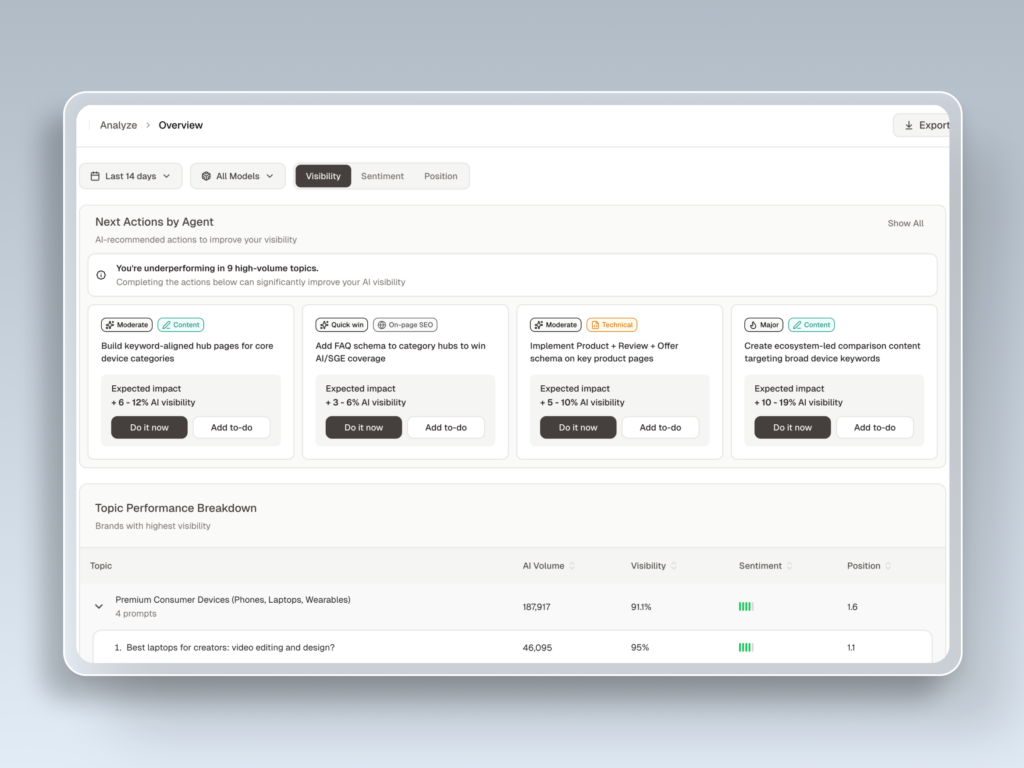
Topify tracks brand performance across ChatGPT, Gemini, Perplexity, DeepSeek, and several other platforms via seven key metrics: visibility, sentiment, position, volume, mentions, intent, and CVR (Conversion Visibility Rate). The Source Analysis feature identifies which domains the AI platforms are citing in your niche so you can prioritize content contribution where it actually moves the needle.
The One-Click Agent execution feature is worth noting separately. Once Topify surfaces an opportunity or gap, you can define your optimization goal in plain English and deploy a strategy without building a manual workflow.
Topify pricing starts at $99/month (Basic, 100 prompts, 9,000 AI answer analyses) and scales to $199/month (Pro, 250 prompts) for larger teams. Enterprise plans start at $499/month with dedicated account management.
For teams that want to start without a paid commitment, Topify’s free tools offer a starting point for checking baseline AI visibility before investing in full-scale monitoring.
Conclusion
AI search monitoring isn’t an SEO add-on. It’s a distinct channel with its own metrics, its own optimization logic, and its own compounding returns for brands that treat it seriously.
The starting point is always the same: define your prompt set, pick a platform that covers the AI engines your buyers actually use, and establish a baseline before you change anything. From there, the source analysis data tells you where to invest your content effort. That’s not a complex strategy. But without the monitoring infrastructure, you’re optimizing without knowing whether anything is working.
FAQ
Q: What is AI search monitoring?
A: AI search monitoring is the process of systematically tracking how a brand appears in AI-generated responses across platforms like ChatGPT, Perplexity, and Gemini. It covers presence (whether the brand is mentioned), positioning (where it appears relative to competitors), sentiment (how it’s described), and citation sources (which domains the AI uses to form its answer).
Q: How does AI search monitoring work?
A: Automated tools send predefined prompts to AI platforms and parse the generated responses. They extract structured data: brand mentions, position in the answer, sentiment signals, and which source domains were cited. Over time, this data builds a performance baseline that teams can track and optimize against.
Q: How do I measure AI search monitoring results?
A: The core metrics are Visibility Rate (how often your brand appears across tracked prompts), Sentiment Score, Citation Share, and Position in Answer. These replace traditional SEO metrics like clicks and keyword rank, which don’t translate to AI search behavior.
Q: What’s the difference between AI search monitoring and SEO monitoring?
A: SEO monitoring tracks your position in a ranked list of links. AI search monitoring tracks your brand’s presence and narrative within a synthesized answer. The underlying mechanism is different (RAG vs. keyword ranking), so the metrics and optimization strategies are also different. A brand can rank first on Google and be absent from AI search simultaneously.

