

Your SEO team is hitting every benchmark. Rankings are up, traffic is growing, and your domain authority keeps climbing. Then a potential customer opens ChatGPT, types “what’s the best [your category] solution,” and gets a confident, synthesized answer. Your brand isn’t in it.
That gap, between where you rank and what AI says, is exactly what an AI brand intelligence service is built to close.
Your Google Rankings Don’t Follow You Into AI Search
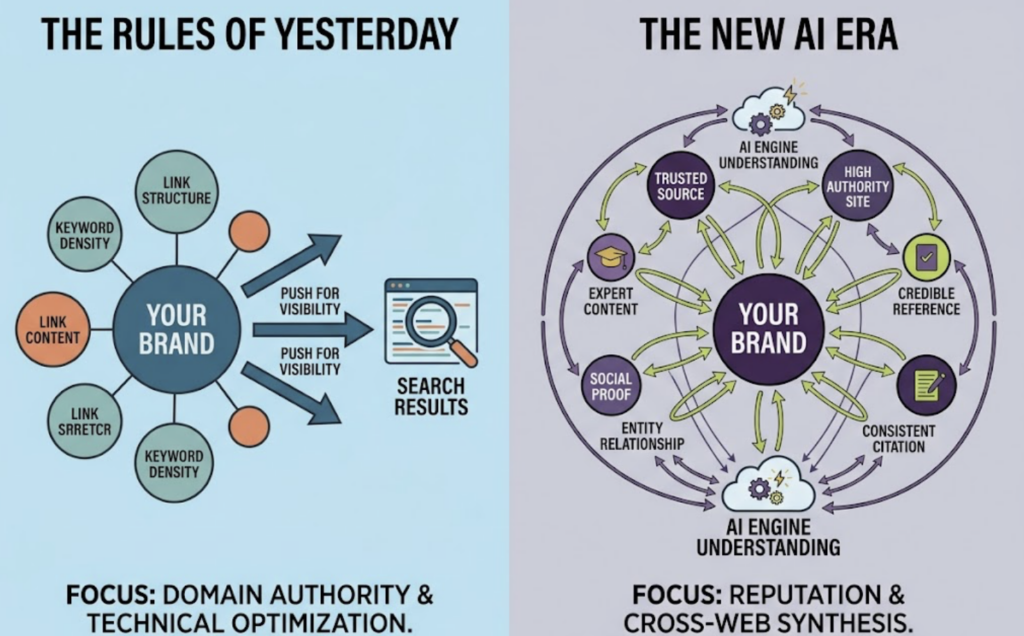
Traditional SEO and AI search operate on fundamentally different logic. Google ranks pages. AI systems synthesize narratives. A user who Googles a category sees ten blue links and chooses which to click. A user who asks ChatGPT the same question gets a single, authoritative-sounding answer that already made the choice for them.
The distinction matters because the mechanisms are completely different. Google rewards link structure and keyword density. AI engines form their “opinions” based on entity authority, source trust, and how consistently your brand is cited as a credible reference across the web. A brand with strong technical SEO can still be invisible to AI, or worse, misrepresented by it.
That’s not a hypothetical. It’s the default state for most brands that haven’t actively worked on their AI presence.
What an AI Brand Intelligence Service Actually Does
An AI brand intelligence service (sometimes called an AI brand intelligence platform or AI brand intelligence software) is a systematic solution for monitoring, measuring, and optimizing how your brand is represented inside LLM-generated responses.
The core capabilities break down into five distinct functions:
Prompt tracking simulates the kinds of queries your buyers actually type into AI platforms, across ChatGPT, Gemini, Perplexity, and others, then captures exactly how each model responds. This gives you a ground-level view of what AI is saying about your brand in real time.
Sentiment analysis goes beyond mention counts. It scores the tone, accuracy, and framing of how AI describes your brand, flagging whether you’re being positioned as a leader, a budget option, or something to avoid.
Source attribution maps the third-party domains that AI models draw on when forming their view of your brand. This is the layer most platforms miss entirely. Knowing which sources AI trusts tells you exactly where to publish to shift the narrative.
Competitive benchmarking tracks how your brand stacks up against rivals in “best-of” and “compare” queries, the prompts with the highest commercial intent.
Strategic advisory closes the loop: it translates monitoring data into content and authority-building actions that actually change what AI says about you over time.
The word “service” is meaningful here. A pure AI brand intelligence tool gives you data. A service, whether a platform with built-in execution or an agency-backed offering, gives you the data plus a path to act on it.
The 5 Metrics That Actually Matter for AI Brand Visibility
Traditional web analytics weren’t designed to measure this. Here’s the framework that AI brand intelligence solutions use instead:
Visibility Rate is the percentage of category-intent prompts where your brand gets mentioned. Think of it as Share of Voice, but for AI answers instead of ad impressions.
Sentiment Score quantifies the tone of those mentions on a normalized 0 to 100 scale. A brand with high visibility but low sentiment is being mentioned for the wrong reasons.
Citation Authority measures how often your brand is treated as a primary source for category-specific facts, not just referenced in passing.
Competitor Position is a comparative delta: when you and a rival are both mentioned, who comes first? In AI responses, order implies hierarchy.
Prompt Coverage looks at the breadth of intent types you’re present for. Showing up in “what is” prompts but not “best” or “pricing” prompts means you’re visible in awareness searches but absent at the decision layer.
Topify tracks all five of these, plus two additional dimensions (Volume and CVR, Conversion Visibility Rate) across ChatGPT, Gemini, Perplexity, and other major AI platforms in a single dashboard.
How to Measure AI Brand Intelligence, Step by Step
Measuring AI brand intelligence requires a shift from passive monitoring to active Generative Engine Optimization (GEO). Here’s what a structured approach looks like in practice.
Step 1: Build a prompt library. Create 50 to 100 prompts that mirror how your buyers actually research, spanning brand queries, category comparisons, pain-point searches, and pricing questions. This library becomes your measurement baseline.
Step 2: Run a cross-platform audit. Test those prompts across ChatGPT, Gemini, and Perplexity to capture your current visibility and sentiment scores. Don’t assume the results are consistent. The same query often produces meaningfully different responses across platforms.
Step 3: Identify the data gaps. Where is AI pulling inaccurate or outdated information? Which sources is it citing that you don’t control? Which competitor content is dominating the references? This analysis determines where authority-building effort will have the most impact.
Step 4: Execute source-level content. Develop content on the high-authority third-party domains that AI platforms consistently treat as sources of truth: industry publications, review platforms like G2, and relevant news outlets. Publishing on your own site is necessary but not sufficient. AI engines weight external, verified signals more heavily than owned channels.
Step 5: Track weekly shifts. AI citation patterns change constantly as models update and retrieval sources evolve. A monthly audit cycle is too slow. Set up continuous monitoring to catch drops early and confirm when optimization efforts are working.
This is where an AI brand intelligence system earns its value: not in running the initial audit once, but in maintaining visibility into a signal that never stops moving.
4 Mistakes That Distort Your AI Brand Intelligence Data
Most brands new to AI monitoring make at least one of these errors. They’re worth knowing before you build your measurement framework.
Assuming Google rankings transfer. High organic rankings and strong AI presence are correlated in some cases, but they’re not the same thing. An AI model doesn’t crawl your site the way a search engine does. It forms its view of your brand from the aggregate of what authoritative sources say about you. Ranking #1 for a keyword doesn’t mean you’ll appear when someone asks ChatGPT the equivalent question.
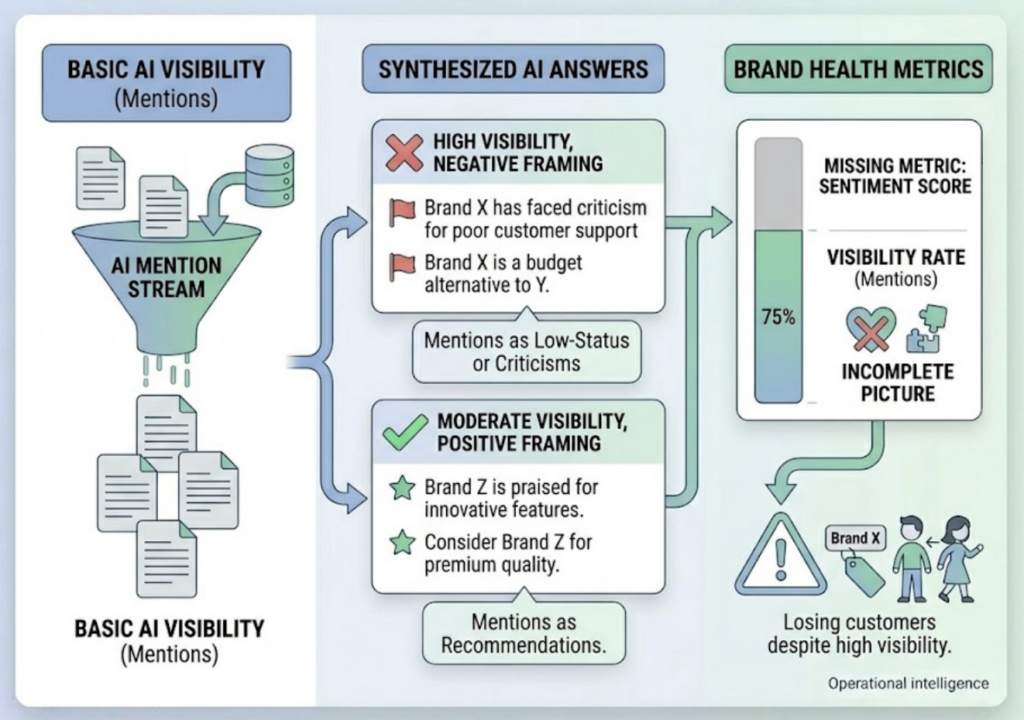
Treating mentions as recommendations. A brand can be highly visible in AI responses and still be losing customers. If AI is saying “Brand X has faced criticism for poor customer support” or “Brand X is a budget alternative to Y,” those are mentions with negative or low-status framing. Visibility rate without sentiment score gives you an incomplete picture.
Publishing mass-produced AI content on your own site. AI engines tend to deprioritize owned content in favor of external, third-party signals when forming citations. A brand that invests entirely in site-side content while ignoring its presence on external authoritative domains is optimizing the wrong layer.
Running static audits. AI training data and RAG retrieval sources change constantly. A snapshot from three months ago tells you very little about your current position. Effective AI brand intelligence requires continuous monitoring, not periodic check-ins.
Choosing the Right AI Brand Intelligence Platform
When evaluating AI brand intelligence tools or platforms, there are four criteria that distinguish serious solutions from surface-level dashboards.
Platform coverage. A tool that only tracks ChatGPT is measuring one slice of a multi-platform behavior. Your audience is distributed across ChatGPT, Gemini, Perplexity, and increasingly specialized AI assistants. Platform-agnostic visibility is a baseline requirement.
Source attribution depth. Most tools show you that your brand was mentioned. Fewer show you why, which domains AI is using to form that view and how you can influence those sources. Source attribution is the layer that connects monitoring to action.
Sentiment nuance. Coarse positive/negative scoring misses context. A brand described as “effective but difficult to implement” needs a different response than one described as “cheap.” Look for platforms that capture framing and accuracy, not just tone polarity.
Execution capability. Data without a path to action creates reporting work without marketing impact. The best AI brand intelligence solutions close the loop between what the data shows and what your team does next.
Topify covers all four. The platform’s seven-metric monitoring dashboard tracks visibility, sentiment, position, volume, mentions, intent, and CVR across all major AI engines. The Basic plan starts at $99/month, making structured AI brand intelligence accessible without enterprise-level commitment. For teams that need full execution, managed service plans scale from $3,999/month and include prompt tracking, content production, and continuous optimization.
For a deeper comparison of how AI monitoring platforms handle the citation layer specifically, this breakdown covers the key differences in methodology.
Conclusion
AI search has introduced a new layer in the customer journey, one that happens before a user ever visits your website. An AI brand intelligence service gives you visibility into that layer: what AI is saying about your brand, how it compares to competitors, and which specific changes will shift the narrative.
The brands that will win in AI search aren’t the ones with the highest domain authority. They’re the ones that know what AI is saying about them and have a system to act on it. Get started with Topify to see where your brand stands across ChatGPT, Gemini, and Perplexity today.
FAQ
Q: What is an AI brand intelligence service?
A: An AI brand intelligence service is a monitoring and optimization system that tracks how AI platforms like ChatGPT, Gemini, and Perplexity represent your brand in generated responses. It covers visibility, sentiment, source attribution, and competitive positioning, giving marketing teams the data they need to manage their brand narrative in AI-driven search.
Q: How does an AI brand intelligence service work?
A: It simulates high-intent user queries across AI platforms, captures the resulting responses, and analyzes them for brand presence, sentiment accuracy, and source reliability. Most AI brand intelligence platforms run this process continuously, since AI citation patterns shift frequently as models update and retrieval sources change.
Q: What’s the difference between an AI brand intelligence tool and a service?
A: A tool provides the software interface for monitoring: dashboards, metrics, and reports. A service typically adds the strategic advisory layer, helping teams interpret the data and execute content or authority-building actions that improve how AI represents the brand. Some platforms like Topify combine both in a single offering.
Q: How much does an AI brand intelligence service cost?
A: Pricing varies by scope. Automated AI brand intelligence platforms typically start around $99/month for core visibility tracking. Full-service offerings that include managed content production and continuous optimization generally start at $3,999/month and scale based on prompt volume and output.

