


You asked a simple question: “What does ChatGPT say about my brand?”
The answer wasn’t what you expected. The AI called your product “overpriced.” It recommended a competitor instead. And the source it cited? A blog post from 2022 that you’d long forgotten about.
That moment is where AI reputation monitoring begins. Not as a nice-to-have, but as a gap in your brand strategy you didn’t know existed.
Your Brand Has a Reputation in AI Search. You’re Probably Not Monitoring It.
Traditional reputation tools weren’t built for this. Google Alerts crawls static pages. Social listening tracks what humans write. Neither can intercept what a large language model synthesizes when a user asks, “Is [Your Brand] worth it?”
That’s the core problem.
Research from Gartner and Search Engine Land shows that AI-assisted search is steadily reducing reliance on traditional “ten blue links” results, shifting where top-of-funnel brand discovery actually happens. When a user asks an AI platform a question about your brand, they typically accept the AI’s answer without clicking through to verify sources. The AI’s verdict becomes the truth.
What makes this harder is the synthesis gap. Even if your recent reviews are strong, an AI might still pull from a high-authority article published years ago and generate a summary that doesn’t reflect your current reality. You can’t monitor what you can’t see. And most brands still can’t see this.
What AI Reputation Monitoring Actually Means
AI reputation monitoring (AIRM) is the practice of tracking and analyzing the narratives that AI platforms generate about your brand.
It’s not the same as traditional ORM. Here’s where they diverge:
| Feature | Traditional ORM | AI Reputation Monitoring |
|---|---|---|
| Content Source | User reviews, social posts, articles | LLM-generated summaries, synthesized answers |
| Interaction Model | Response-driven (reply to reviews) | Content-driven (optimize source authority) |
| Measurement | Review volume, star ratings | Sentiment score, source domain authority |
| Feedback Loop | Direct user engagement | Training data and retrieval optimization |
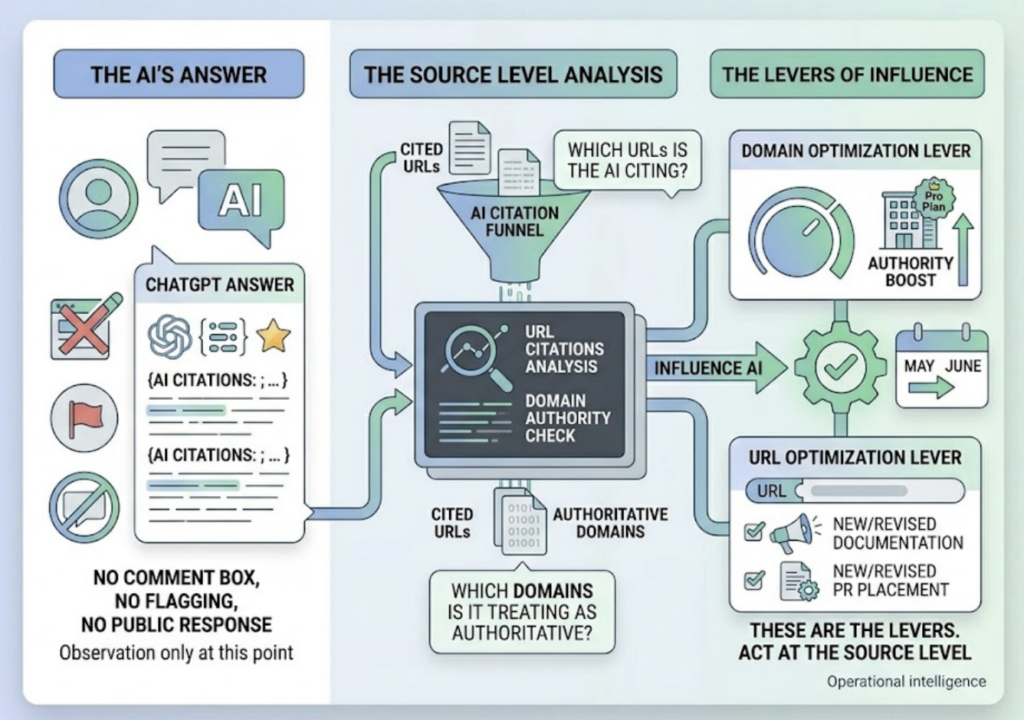
The practical implication: you can’t reply to a ChatGPT answer. There’s no comment box, no flagging system, no public response field. Influencing what AI says about your brand requires working at the source level. Which URLs is the AI citing? Which domains is it treating as authoritative? Those are the levers.
Why AI Sentiment Doesn’t Always Match Your Reality
AI sentiment isn’t drawn from truth. It’s drawn from probability.
LLMs retrieve and synthesize content based on what they’ve indexed or retrieved from the web. A negative incident covered by a high-domain-authority publication in 2022 may still dominate an AI’s context window in 2026, regardless of everything your brand has done since. Recency doesn’t automatically win.
The echo chamber effect makes this worse. If a handful of high-authority sources frame your brand as “expensive” or “complex to onboard,” that label tends to stick in AI outputs across platforms, even if your pricing changed 18 months ago and your onboarding NPS is now 72.
Then there’s hallucination. AI models sometimes synthesize data from disparate sources and arrive at a brand characterization that didn’t exist in any single article. It’s not a malicious misrepresentation. It’s a probabilistic artifact. But the user reading it doesn’t know that.
That’s why monitoring matters. You need to know what the AI is saying before your customers do.
How to Measure AI Reputation Monitoring: The Four Key Signals
There’s no single number that captures AI reputation, but four signals give you a working picture:
Sentiment Score
A 0-100 normalized score that quantifies the emotional valence of the AI’s brand summary. A score of 75+ typically reflects net-positive framing. Below 50 is a flag worth investigating. This gives you something trackable across time and across platforms.
Mention Frequency and Context
How often is your brand mentioned in AI responses, and what attributes does the AI associate with you? “Affordable,” “reliable,” and “easy to use” carry very different weight than “complex,” “expensive,” or “niche.” Frequency alone doesn’t tell you much. Context does.
Source Domains
This is where AI reputation monitoring gets actionable. Identifying which specific URLs and domains the AI draws on to form its brand profile tells you exactly where the problem lives. Is the AI consistently citing an outdated competitor-sponsored comparison post? A Reddit thread from three years ago? A low-accuracy review aggregator? Once you know the source, you know where to intervene.
Competitor Sentiment Delta
Your score only matters relative to your market. If your brand scores 68 and your top competitor scores 81, the AI is likely framing them more favorably in head-to-head queries. Tracking that gap over time shows you whether you’re closing ground or losing it.
Common Mistakes That Tank Your AI Reputation
Most brands make one of these errors before they find a better approach.
The response fallacy. Posting public replies to reviews, responding to Reddit threads, updating your Trustpilot listing. All of this matters for human-facing ORM. None of it directly influences what AI synthesizes. AI is an indexing and synthesis engine, not a social media comment section.
Frequency blindness. Getting excited that your brand “appears in ChatGPT” without looking at how you’re framed. Being mentioned as “an alternative to consider” is not the same as being recommended. Appearing in a list of brands with “mixed reviews” is not a win.
Ignoring competitor intelligence. The AI might be actively suggesting your competitor as the better option because their technical documentation has a stronger backlink profile from industry publications. You’d never know unless you were tracking competitor sentiment alongside your own.
Treating AI monitoring as a one-time audit. AI responses change as models update, as new content gets indexed, as competitors publish new material. A snapshot from Q1 may not reflect what the AI is saying in Q3.
How to Build an AI Reputation Monitoring Strategy
The five-step framework below works whether you’re starting from scratch or formalizing an existing, informal process.
Step 1: Choose your platforms. Start with ChatGPT, Perplexity, Gemini, and Google AI Overviews. These four cover the majority of AI-assisted brand discovery queries in most markets.
Step 2: Build your prompt set. Think like your customer. What are they actually asking? “Is [Brand] reliable?” “[Brand] vs [Competitor].” “Best [category] tools for [use case].” These are your monitoring prompts. Aim for 20-50 to start.
Step 3: Track sentiment and source domains. Run your prompts regularly and log the AI’s outputs. What’s the sentiment direction? Which domains keep showing up as the AI’s basis for its opinion? Topify’s Source Analysis automates this step, mapping the exact URLs that AI platforms are drawing on to form their brand profile.
Step 4: Address the source-level problems. Once you know which domains are driving a negative or outdated AI narrative, you have a content strategy target. Publish authoritative, updated content on your own channels. Pursue guest placements on the publications the AI already trusts. The goal is to displace the outdated content with material that reflects your current reality.
Step 5: Monitor continuously. Sentiment drift is gradual. An AI reputation monitoring dashboard gives you a running view of how your scores move over time across platforms, so you catch negative shifts before they compound.
Topify supports this entire workflow from a single platform. Its Prompt Discovery feature surfaces the specific questions being asked about your brand across AI engines. Sentiment Analysis delivers a 0-100 score updated over time. Source Analysis identifies the domains driving the AI’s narrative. Competitive Benchmarking shows you where rivals stand in the same AI responses.
AI Reputation Monitoring Tools: What to Look For
Not every tool marketed as an “AI monitoring” solution actually tracks what LLMs say about your brand. A few things to verify before committing:
Multi-platform coverage. A tool that only pulls from one AI engine is incomplete. Your customers use ChatGPT, Perplexity, Gemini, and AI Overviews. Your AI reputation monitoring software should cover all of them.
Sentiment analysis depth. A binary positive/negative signal isn’t sufficient. You need a scored metric you can track over time, one that tells you whether sentiment is improving or declining across a quarter.
Source tracking. This is the differentiator. Most basic tools tell you whether you’re mentioned. A proper AI reputation monitoring platform tells you why the AI has the opinion it does, by showing you the source domains it’s pulling from.
Competitor benchmarking. Your sentiment score in isolation doesn’t tell you much. What matters is your position relative to competitors in the same AI responses. An AI reputation monitoring system that excludes competitor data leaves half the picture blank.
Dashboard and reporting. Ongoing monitoring requires a usable interface. Look for an AI reputation monitoring dashboard that surfaces trend data without requiring manual data extraction.
Topify covers all five. It tracks brands across ChatGPT, Gemini, Perplexity, DeepSeek, and other major AI platforms via seven core metrics: visibility, sentiment, position, volume, mentions, intent, and CVR. Plans start at $99/month, with the Basic tier supporting 100 prompts and 9,000 AI answer analyses per month. Pro scales to 250 prompts at $199/month. Enterprise plans start at $499/month for teams with custom requirements.
It’s built by researchers with roots in OpenAI and practitioners from Google’s SEO team. That lineage matters when the product’s core function is understanding how AI systems form brand opinions.
Conclusion
AI reputation monitoring isn’t about brand vanity. It’s about the gap between what you think AI says about you and what it actually says.
Most brands don’t know what ChatGPT, Perplexity, or Gemini says about them. Fewer still know which sources are driving those narratives, or how their sentiment score compares to their top competitors. That information gap has a cost, even if it’s hard to quantify until a customer mentions the AI recommended someone else.
Start small. Pick one platform. Build a set of 20 core prompts. Run them. See what comes back.
If what you find surprises you, Topify gives you the monitoring infrastructure to track it, diagnose it, and fix it over time.
FAQ
What is AI reputation monitoring?
It’s the practice of tracking and analyzing the narratives that AI platforms like ChatGPT, Gemini, and Perplexity generate about your brand. Unlike traditional ORM, which monitors human-written content, AI reputation monitoring focuses on what large language models synthesize and present as their “answer” when users ask about your brand.
How does AI reputation monitoring work?
Dedicated tools simulate user queries across major AI platforms, capture the generated responses, and analyze them for sentiment, brand attributes, source domains, and competitive positioning. The outputs give brands a structured view of how AI currently perceives and represents them.
How do you measure AI reputation monitoring?
The four core signals are: sentiment score (0-100), mention frequency and context, source domain mapping, and competitor sentiment delta. Together, these four metrics give you both a snapshot and a trend line.
What are the best tools for AI reputation monitoring?
Look for platforms that cover multiple AI engines, deliver scored sentiment analysis, track source domains, and include competitor benchmarking. Topify covers all four from a single dashboard.
What’s the difference between AI reputation monitoring and traditional ORM?
Traditional ORM manages how humans describe your brand in reviews and social posts. AI reputation monitoring manages how machines synthesize your brand in generated answers. The intervention strategies are completely different. You can reply to a review. You can’t reply to ChatGPT.
What are examples of AI reputation monitoring in practice?
A SaaS brand discovers that ChatGPT consistently recommends a competitor in “best project management tools” queries because a high-authority tech publication from 2023 ranks the competitor’s onboarding as superior. Using an AI reputation monitoring platform, the brand identifies that source, publishes an updated comparison piece, and tracks whether sentiment shifts over the next 60 days.
AI reputation monitoring pricing: what should I expect?
Entry-level AI reputation monitoring software typically starts around $99/month for access to multi-platform tracking and basic sentiment analysis. Mid-tier plans with expanded prompt volumes run $199/month. Enterprise-grade solutions with custom configurations start around $499/month.
What’s a checklist for AI reputation monitoring?
Cover these bases: define target AI platforms, build a prompt set, establish baseline sentiment scores, identify source domains, map competitor sentiment, and set a regular monitoring cadence (weekly or bi-weekly at minimum).

