

You’ve spent two years positioning your product as enterprise-grade. Then you discover Perplexity describes it as “a budget alternative.” Gemini calls it “great for small teams.” Neither matches your messaging. The problem isn’t that AI got it wrong. It’s that nobody was tracking what AI was saying in the first place.
That’s the gap a proper AI reputation monitoring dashboard is built to close.
Your Google Alerts Don’t Work in AI Search. Here’s What Does.
Traditional brand monitoring tools, including Google Alerts, Mention, and Brandwatch, were built on a simple premise: crawl indexed pages, flag mentions, send alerts. That logic worked when brand perception lived in articles, forums, and review sites.
It doesn’t work anymore.
When a user asks ChatGPT “Which CRM is best for my sales team?”, the model generates a unique, synthesized response. That response isn’t indexed anywhere. No crawler ever sees it. According to the research on AI monitoring inadequacy, standard monitoring tools miss up to 70% of brand mentions that occur inside AI-generated answers, because they simply can’t access the citation layer of AI.
This is what researchers call the “black box” problem of RAG (Retrieval-Augmented Generation). A brand could be repeatedly recommended, or systematically misrepresented, by a major AI platform. The brand manager would never receive a single notification from their existing tool stack.
An AI reputation monitoring dashboard solves this by querying AI engines directly, at scale, and capturing what the models actually say about your brand.
The 7 Metrics a Real AI Reputation Monitoring Dashboard Should Show
Not all dashboards are built the same. The difference between a useful AI reputation monitoring analytics system and a vanity metrics board comes down to which signals it actually captures.
Here’s the framework that matters:
| Metric | What It Measures | Why It Matters |
|---|---|---|
| Visibility | How often your brand appears in AI answers | Top-of-funnel reach across AI channels |
| Sentiment | The emotional tone AI assigns your brand | AI bias directly affects conversion intent |
| Position | Where your brand ranks in a list or recommendation | Prime placement correlates with user trust |
| Volume | Number of unique queries surfacing your brand | Measures thematic authority across topics |
| Mentions | How your brand is defined in AI summaries | Tracks whether AI’s “knowledge” aligns with positioning |
| Intent | Alignment with high-value transactional queries | Filters signal from noise, focuses on revenue-relevant prompts |
| CVR | Estimated conversion rate from AI-driven recommendations | Connects reputation data directly to revenue |
Most platforms cover one or two of these. A complete AI reputation monitoring system tracks all seven together, so you’re not running blind on any single dimension.
Sentiment Score: Not Just Positive or Negative
Sentiment analysis in AI monitoring is more nuanced than social media listening. It’s not just about whether the AI “likes” your brand. It’s about what language the AI uses when it describes you, and whether that language aligns with your positioning.
Topify scores sentiment on a 0-100 scale, tracking shifts across ChatGPT, Gemini, Perplexity, and other platforms. A drop from 74 to 61 over two weeks often signals a source-level change worth investigating.
Position Tracking: Where You Rank in AI Answers
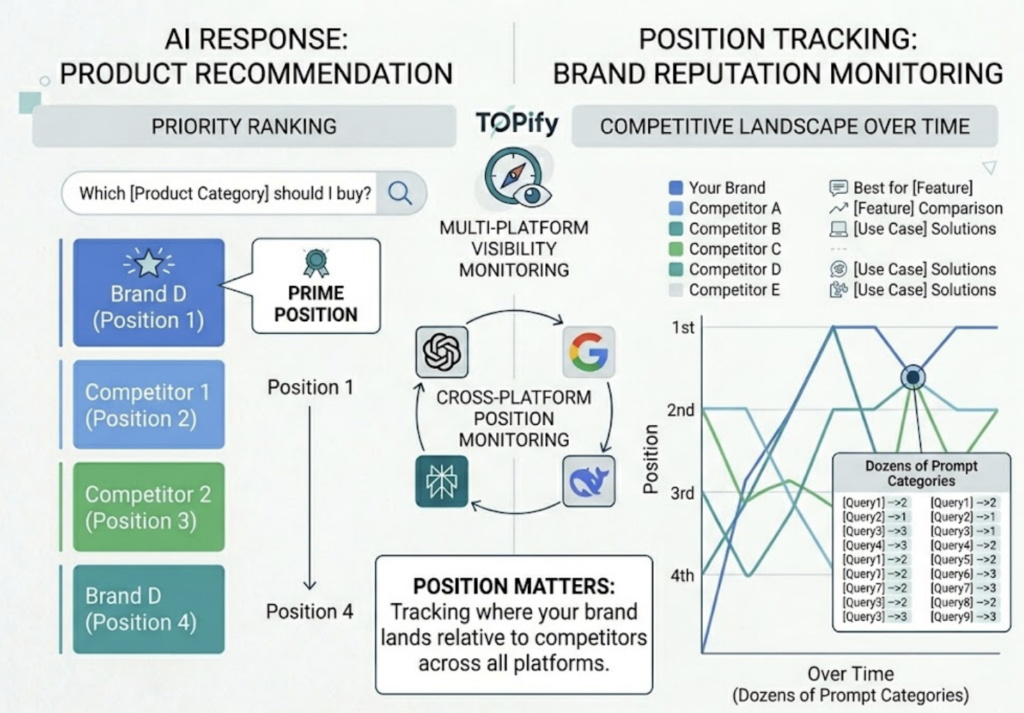
There are no page one rankings in AI search. But there is a “prime position” problem. When an AI engine lists four products in response to a recommendation query, being listed first versus third matters. Position tracking in an AI reputation monitoring tool monitors exactly that: where your brand lands relative to competitors, across dozens of prompt categories, over time.
What Makes an AI Reputation Monitoring Tool Actually Useful
The data is only half the job. The other half is knowing what to do with it.
Here’s where most AI reputation monitoring software falls short. They deliver weekly reports packed with visibility scores and sentiment trends, but stop before telling you what actually changed, or why. You’re left doing the diagnostic work yourself.
Four criteria separate actionable platforms from data-heavy reports:
Multi-platform coverage. Your audience doesn’t use only one AI engine. An AI reputation monitoring solution that only covers ChatGPT misses Gemini, Perplexity, DeepSeek, Doubao, and a growing list of specialized models. Each platform has different citation patterns and source preferences.
Prompt granularity. The ability to test specific user personas and query phrasing matters. Generic keyword tracking won’t show you that your brand is visible when users ask “best enterprise CRM” but completely absent when they ask “CRM with the best onboarding.” That gap is a content strategy issue, and you can’t fix what you can’t see.
Competitive benchmarking. Knowing your own visibility score is less useful than knowing how it compares to competitors on the same prompt cluster. Real-time competitor monitoring shows you not just where you’re losing ground, but which specific topics are driving the gap.
Source tracking. This is the one most platforms miss. AI engines don’t generate opinions from nothing. They pull from a set of cited domains and content assets. An AI reputation monitoring platform with source tracking shows you exactly which URLs and domains are shaping the AI’s view of your brand, so you can prioritize those in your content strategy.
Voice Search and AI Answer Engines: A New Reputation Blind Spot
Voice is where the “winner-take-all” problem gets most pronounced.
When a user types a query into Google, they get ten links to evaluate. When they ask Siri a brand question powered by ChatGPT, they get one synthesized response. According to research on voice-integrated AI models, user reliance on AI-synthesized answers for product discovery has grown 3x compared to standard search. That ratio is not evenly distributed. Brands with strong AI visibility get the single recommended slot. Everyone else gets brand erasure.
Voice search AI answer engine visibility tools are still an emerging category, but the monitoring logic is the same: simulate the queries voice users are likely to ask, track what AI engines respond, and identify where your brand is included or excluded from those truncated, high-stakes answers.
This isn’t a future concern. It’s already happening in every product category where voice-first users are common. Healthcare, travel, SaaS productivity tools, and consumer electronics are all early-impact verticals.
How Topify’s AI Reputation Monitoring Platform Works in Practice
Here’s what a weekly monitoring workflow looks like when it’s set up correctly.
A brand manager starts by defining a prompt library: 80 to 100 queries that represent how the target audience actually searches for products in their category. In Topify’s Basic plan at $99/month, you can run up to 100 prompts across ChatGPT, Perplexity, and AI Overviews simultaneously, generating 9,000 AI answer analyses per month.
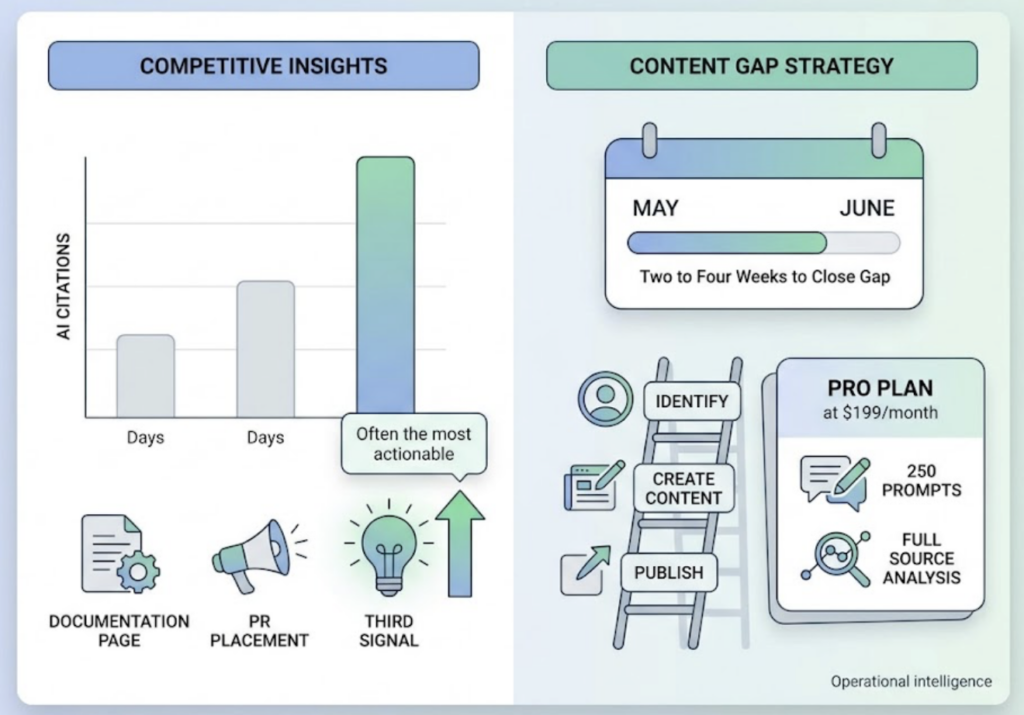
Each week, the AI reputation monitoring platform surfaces three things automatically: which prompts showed sentiment shifts, which competitor gained or lost position on specific clusters, and which source domains are newly influencing AI citations for your category.
That third signal is often the most actionable. If a competitor’s documentation page or PR placement suddenly starts appearing in AI citations, that’s a content gap you can close in two to four weeks. On the Pro plan at $199/month, you get 250 prompts and full source analysis, which is where competitive intelligence becomes operational rather than just observational.
The workflow structure follows a clear loop:
- Define high-intent prompts that map to purchase decisions in your category
- Monitor daily sentiment and position shifts across AI platforms
- Trace visibility changes back to specific source domains
- Update content strategy to reinforce definitional anchoring: ensuring AI associates your brand with the right attributes, in the right context
Most teams run this cycle monthly. The brands gaining ground in AI search are running it weekly.
Conclusion
Brand reputation used to be managed through earned media, review platforms, and search rankings. Those channels still matter. But AI engines now synthesize that information into a single confident recommendation, and most brands have no visibility into what that recommendation says or why.
An AI reputation monitoring dashboard doesn’t replace your existing PR and SEO stack. It shows you what your existing stack can’t: how AI engines define your brand, where competitors are outranking you in AI-generated answers, and which content investments will actually move the needle in model-driven discovery.
Get started with Topify to see where your brand stands in AI search before your next quarterly review.
FAQ
Q: What is an AI reputation monitoring dashboard?
A: An AI reputation monitoring dashboard is a centralized interface that tracks how your brand appears in AI-generated search answers across platforms like ChatGPT, Perplexity, and Gemini. Unlike traditional brand monitoring tools that crawl indexed pages, it queries AI engines directly to capture sentiment, position, visibility, and citation sources in real time.
Q: How is AI reputation monitoring different from traditional brand monitoring?
A: Traditional tools flag mentions in indexed content. AI reputation monitoring captures synthesized responses that are never indexed. When an AI engine recommends your competitor in response to a transactional query, no standard tool will alert you. AI-specific monitoring fills that gap by simulating user queries and analyzing model outputs directly.
Q: What AI platforms should I monitor for brand reputation?
A: At minimum, ChatGPT, Perplexity, and Google AI Overviews cover the majority of AI search volume for most markets. Depending on your target audience, DeepSeek, Doubao, and Gemini are also worth including. Enterprise brands with global operations typically monitor eight or more platforms to capture regional variation in AI citation behavior.
Q: Can I track voice search AI answer engine visibility with these tools?
A: Yes, though the coverage varies by platform. Voice search AI answer engine visibility tools work by simulating the short, conversational queries that voice interfaces typically process. Since voice responses are often pulled from the same underlying LLMs powering text search, tracking AI answer quality on text queries gives you a strong proxy for voice performance as well.

