

Your brand is #1 on Google. That feels solid.
But when someone types “best [your category] software” into ChatGPT, Perplexity, or Gemini, your name might not appear at all. No algorithm penalty. No bad reviews. You’re just not in the answer.
That’s not an SEO problem. It’s an AI reputation problem. And a tracker built for traditional search won’t catch it.
AI Reputation Monitoring Lives in a Different Layer Than SEO
Traditional brand monitoring tools like Google Alerts or Brandwatch were designed for a specific kind of internet: indexed pages, crawlable links, social posts. They’re good at capturing what happens after a buyer finds you through a search result or news mention.
AI reputation monitoring tracks something earlier in the funnel.
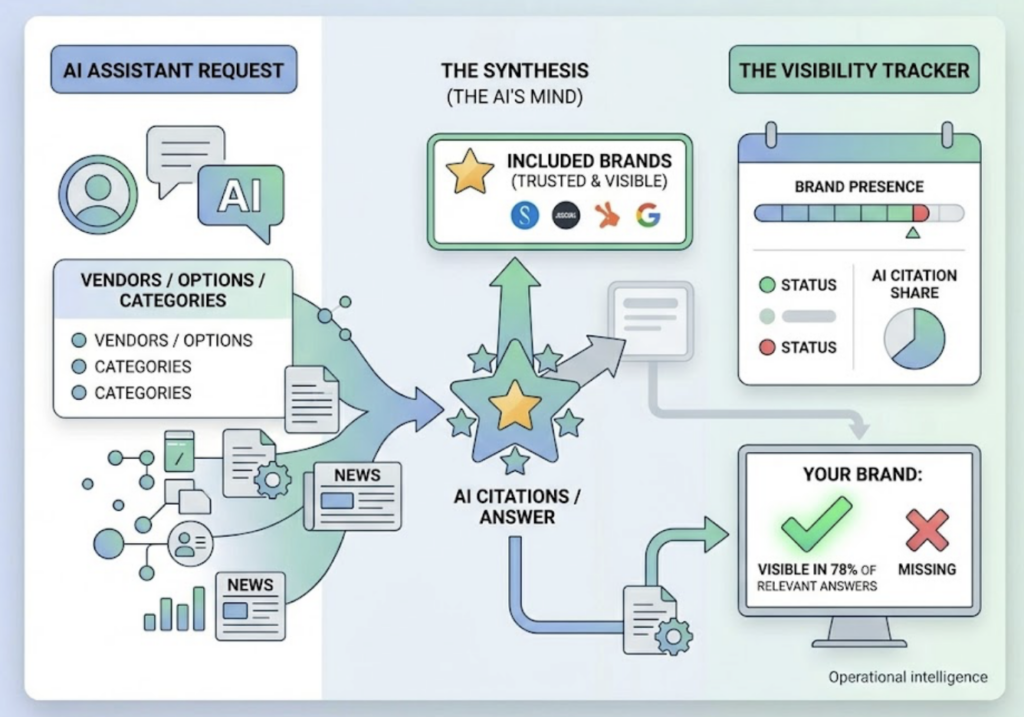
When someone asks an AI assistant to recommend a vendor, compare options, or explain what a product category looks like, the AI synthesizes an answer from its training data and real-time retrieval. Your brand either makes it into that synthesis or it doesn’t. An AI reputation monitoring tracker is the system that tells you which way it’s going.
| Dimension | Traditional Monitoring | AI Reputation Monitoring |
|---|---|---|
| Data Source | Indexed web pages, social media, news | Dynamically generated AI responses |
| Mechanism | Web crawling + keyword matching | Direct prompting + LLM output analysis |
| Output Type | Static links and articles | Synthesized summaries and recommendations |
| Key Value | PR and social sentiment tracking | Brand discovery and vendor evaluation |
Why Your Search Rankings Tell You Almost Nothing About AI Visibility
A brand can rank on page one of Google and be completely absent from a ChatGPT response on the same topic. These two systems don’t share the same logic.
SEO is deterministic: better links, better metadata, better rankings. AI search is probabilistic. The same query asked twice on the same day can return different results depending on the model’s retrieval weighting and how it composes its answer that particular moment. There’s no “rank 1” to chase. There’s only whether you’re in the answer or not, and what the AI says about you when you are.
That’s the core gap. Traditional monitoring tools are blind to it because AI-generated conversations are often private, non-indexed, and generated fresh every time. No crawler catches that.
The 5 Metrics a Reliable AI Reputation Monitoring Tracker Should Cover
Most teams start by asking “is our brand mentioned?” That’s necessary but not sufficient. A tracker worth using covers five dimensions:
Visibility Rate is the percentage of relevant queries where your brand appears in the AI’s answer. It’s your baseline, the starting point for everything else.
Sentiment Score measures how the AI frames your brand when it does mention you. Not just positive or negative, but contextual framing: are you described as a leader, a budget option, a legacy tool, a risky choice? The label matters more than the score.
Position tracks where in the AI’s answer your brand appears. First in a list carries more user trust than a buried mention in paragraph four.
Citation Source tells you which domains the AI is using to validate what it says about your brand. This is often the most actionable metric: once you know what content the AI trusts, you know exactly where to invest.
CVR (Conversion Visibility Rate) estimates your brand’s ability to convert within the AI environment itself, whether the AI’s framing is likely to drive a user toward your product or away from it.
No single number summarizes AI reputation. The value is in how these five metrics move together.
Four Mistakes That Make Your Tracker Useless
Getting the setup wrong is more common than not having a tracker at all.
Monitoring only one AI platform. ChatGPT, Perplexity, Gemini, and Claude each have different citation behaviors and retrieval logic. A brand that’s well-represented in one may be invisible in another. Platform silos in your tracking produce an incomplete picture.
Treating sentiment as a single vanity score. A 7/10 sentiment score tells you almost nothing. What matters is the contextual framing: how does the AI describe your product in the context of a specific use case or buyer persona? That’s the actionable layer.
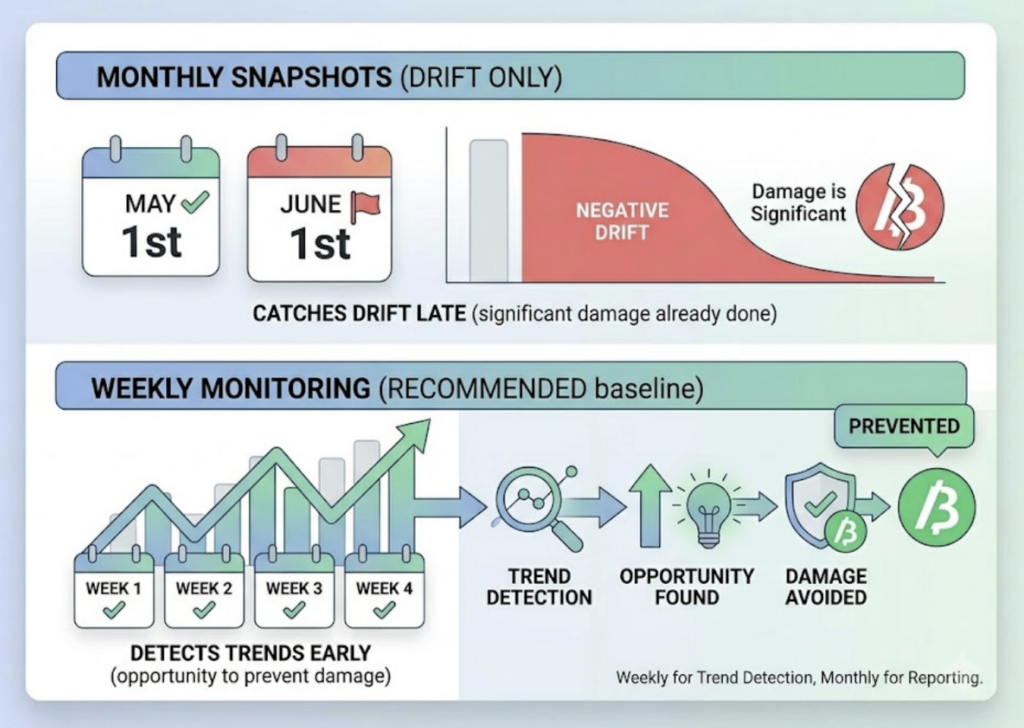
Running monthly snapshots. AI model updates, shifts in training data, and competitor content activity can change how your brand is represented within days. Monthly reporting catches the drift only after significant damage is done. Weekly monitoring is the recommended baseline for trend detection.
Ignoring competitor positioning. AI visibility is relative. If a competitor appears in 30% of category-level prompts and your brand appears in 10%, your absolute mention rate doesn’t matter. The competitive gap does.
Building an AI Reputation Monitoring Strategy in Three Steps
Start with your query set. Identify 50 to 100 high-intent prompts that represent how your target buyers actually ask AI for recommendations in your category. These prompts are the anchor for all your tracking. If they’re off, every metric downstream will be misleading.
Set a tracking cadence. Weekly scans catch directional trends; monthly deep reviews are for strategic pivots. The key is consistency, since a single data point is noise, but a trend line across eight weeks starts to tell you something real.
Then build an actionability loop. The most useful output from an AI reputation monitoring tracker isn’t a dashboard number. It’s a “visibility gap”: a query where a competitor is cited and you’re not. That gap is your content backlog. Fix the source the AI trusts, and you fix the gap.
What to Look for in an AI Reputation Monitoring Tool
The market for AI reputation monitoring software has grown fast, and the feature lists can look similar. The differences show up in four areas.
Platform breadth. Does the tool track your brand across ChatGPT, Gemini, Perplexity, DeepSeek, and other major AI engines? Or does it cover one or two and call it “multi-platform”?
Prompt granularity. Can you run queries that simulate specific buyer personas and use cases, or are you limited to generic category searches? The more specific the prompt, the more useful the data.
Competitive context. Can the dashboard benchmark your visibility against specific competitors, head-to-head? Absolute metrics without competitive framing are hard to act on.
Insight-to-action connection. Some tools report data. The better ones surface specific recommendations: which sources to optimize, which content gaps to address, which prompts are losing ground.
Topify is an AI search optimization platform built specifically for this. Its AI reputation monitoring dashboard tracks visibility, sentiment, position, and citation sources across major AI platforms, with built-in competitor benchmarking and source analysis that maps exactly which domains the AI is pulling from to describe your brand. The Basic plan starts at $99/month and covers 100 prompts across 9,000 AI answer analyses, which is enough for most mid-market teams to establish a meaningful baseline.
The platform’s source analysis feature is particularly useful for teams trying to close visibility gaps: it shows not just whether you’re cited, but which specific URLs the AI treats as authoritative for your brand, so content investment goes toward the right places.
Conclusion
AI reputation monitoring isn’t a replacement for traditional brand management. It’s a layer that traditional tools can’t reach.
Search rankings tell you where you appear in a list. An AI reputation monitoring tracker tells you what AI systems say about you when no list exists, just a synthesized answer to a buyer’s question. That’s the space where vendor shortlists are formed, comparisons are made, and decisions are influenced before anyone clicks a link.
If you’re not tracking that, you’re managing the visible half of your brand’s reputation and leaving the other half completely unmonitored.
FAQ
What is an AI reputation monitoring tracker?
It’s a system that tracks how AI platforms like ChatGPT, Perplexity, and Gemini describe, recommend, and reference your brand in response to relevant user queries. Unlike traditional monitoring tools, it captures dynamically generated AI responses rather than indexed web content.
How does an AI reputation monitoring tracker work?
The tracker sends predefined prompts to major AI platforms, captures the generated responses, and analyzes them for brand mentions, sentiment framing, position in the answer, and citation sources. Results are aggregated into a dashboard that shows how your AI reputation is trending over time and relative to competitors.
How do I measure AI reputation monitoring performance?
Focus on five core metrics: Visibility Rate (how often you appear), Sentiment Score (how you’re framed), Position (where in the answer you appear), Citation Source (what content the AI trusts), and CVR (your conversion potential within the AI environment).
What are examples of AI reputation monitoring tracker use cases?
A SaaS brand tracking which competitor appears first in “best [category] software” prompts. A B2B company monitoring whether its product description in AI answers matches its actual positioning. A marketing agency running weekly scans to catch model-driven drift in client brand narratives.
How do I improve my AI reputation monitoring tracker results?
Start by identifying visibility gaps: queries where competitors are cited and you’re not. Then trace which sources the AI uses to describe your brand and optimize those specific URLs for definitional clarity rather than keyword density. Consistency in tracking cadence matters as much as the actions you take.
What’s the typical pricing for an AI reputation monitoring tool?
Pricing varies significantly by platform coverage and prompt volume. Entry-level plans typically start around $99/month for teams running 100 tracked prompts. Enterprise-level systems with custom prompt sets, dedicated support, and multi-market tracking generally start above $499/month.
What’s the difference between an AI reputation monitoring tool and an AI reputation monitoring platform?
The terms are often used interchangeably, but platform typically implies a broader feature set: not just tracking data, but also competitive benchmarking, strategy recommendations, and content execution capabilities. A standalone tool usually handles only data collection and reporting.

