


Your brand has a Domain Authority. You probably track keyword rankings weekly. But if someone asks ChatGPT to recommend a tool in your category right now, do you know what it says?
Most brands don’t. That’s not a content problem. It’s a measurement problem.
An AI visibility score service exists to close that gap. It turns what was previously a black box into a structured set of metrics you can track, benchmark, and act on.
Your Brand Has a Google Rank. It Probably Has No AI Score.
Traditional search and generative search are built on completely different mechanics. In Google, visibility is deterministic: your page ranks or it doesn’t, and the position is relatively stable.
AI search is probabilistic. A large language model synthesizes a response from its training data and retrieval context, and your brand is either included or omitted. As research on brand visibility in AI-mediated markets describes it, this creates a “binary inclusion-exclusion dynamic” where there’s no page two. Either you’re cited or you’re not.
That changes what “visibility” means. It’s no longer about link equity or crawl frequency. It’s about how effectively your brand’s identity clusters with relevant search attributes inside an LLM’s latent space.
Standard SEO metrics don’t capture any of this. A DA score tells you nothing about whether Perplexity mentions you when a user asks for a product recommendation in your category.
What an AI Visibility Score Actually Measures
Because AI outputs vary by prompt, session, and model version, a single number isn’t enough. The more useful frameworks evaluate brand presence across multiple dimensions simultaneously.
Here’s what a well-structured AI visibility scoring system typically covers:
| Dimension | What It Measures | Why It Matters |
|---|---|---|
| Visibility (Impression) | How often your brand appears in synthesized responses | Top-of-funnel brand awareness in AI channels |
| Sentiment | Emotive tone associated with your brand (positive/neutral/negative) | Brand reputation and AI-generated framing |
| Position | Where you appear in the citation list or response flow | Higher position correlates with higher trust |
| Volume (Mention Rate) | Number of distinct queries triggering a brand mention | Breadth of topical authority |
| Intent Alignment | Semantic relevance to the user’s specific query | Ensures you’re cited for high-value queries |
| CVR (Agent Execution) | Rate at which an AI agent acts on or selects your brand | Direct correlation with transactional outcomes |
| Stability | Consistency across repeated prompts | Identifies whether visibility is reliable or random |
One caveat worth noting: research by Aggarwal et al. (2024) found that relying on mention rate alone can be misleading because of the stochastic nature of token generation. A brand can show up in 70% of responses on Monday and 40% on Friday, with no change in content strategy. That’s not a campaign problem. That’s normal AI variance, and it’s exactly why single-metric snapshots fail.
Service vs. Tool vs. Dashboard: What You’re Actually Buying
The terminology in this space is loose, and vendors use it interchangeably. Here’s a working distinction:
| Type | What It Does | What It Lacks |
|---|---|---|
| Tool | Single-point function (e.g., mention tracking) | No cross-platform synthesis |
| Software / Dashboard | Visualizes raw data | May lack strategic interpretation |
| Platform | Multi-dimensional data, integrated view | Varies in actionability |
| Service | Data plus strategic execution advice | Higher cost, higher output |
The critical variable is not which label a vendor uses. It’s whether the AI visibility score tool supports continuous monitoring or only generates point-in-time reports.
A one-off score is useful once. A tracked score over time is what drives decisions.
Why Continuous Monitoring Is the Part Most Teams Underestimate
AI search outputs don’t sit still. They shift with model fine-tuning, training data updates, and prompt variations that no brand controls.
Academic research using the Jaccard similarity coefficient has found that source sets for identical queries can change by up to 65% in consecutive days. A brand that appeared consistently in Perplexity’s top recommendations this week may be systematically absent next week. This phenomenon, which researchers call “brand erasure,” can happen without any visible trigger on your end.
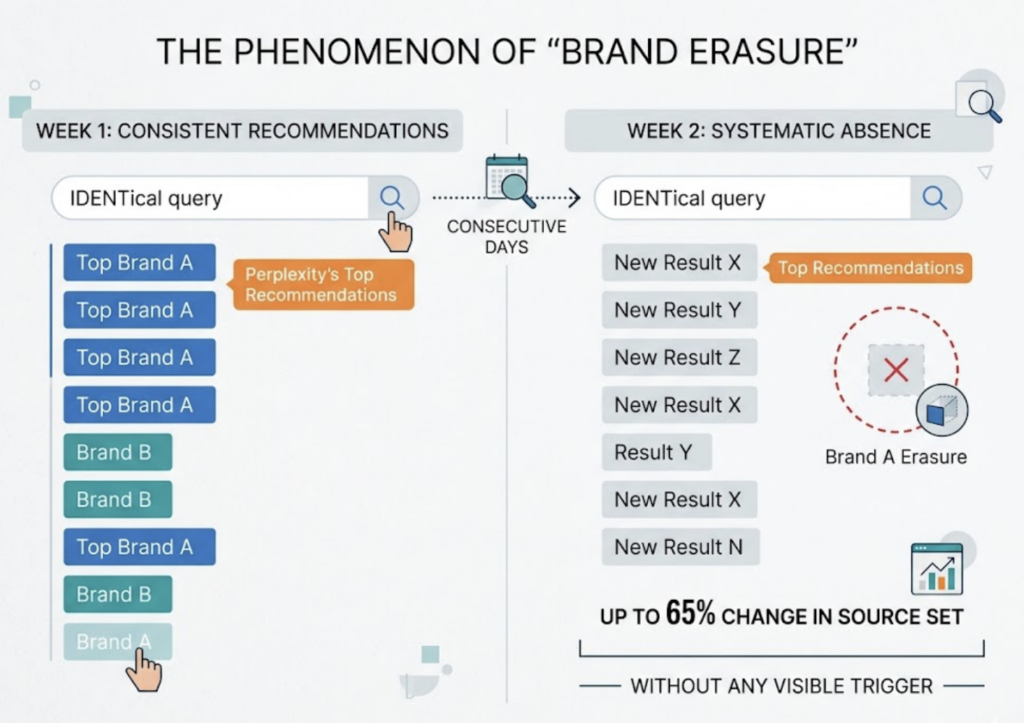
That’s the core argument for tools for continuous monitoring of AI search visibility. It’s not about obsessive data collection. It’s about detecting drift early enough to respond.
In practice, continuous monitoring catches two things that snapshots miss: the gradual erosion of visibility as AI model weights shift, and sudden drops triggered by changes in which sources an AI platform chooses to cite. Both require time-series data to diagnose.
A static report tells you where you stood. A monitoring system tells you where you’re heading.
Five Things to Look for in an AI Visibility Score Service
The market for AI visibility score software and platforms has expanded quickly, and the capability differences between vendors are significant. Here’s a practical evaluation framework:
1. Platform breadth. A service that only tracks ChatGPT misses how your brand performs on Perplexity, Gemini, DeepSeek, and regional AI platforms. Coverage should span the major models where your audience actually searches.
2. Update frequency. Given that source sets can shift by up to 65% day-over-day, weekly or monthly snapshots create blind spots. Look for platforms that run tracking at a frequency that matches how fast AI outputs change.
3. Dimensional depth. A single visibility percentage isn’t enough. You need sentiment, position, intent alignment, and source data in the same view. A score without context is noise.
4. Competitive benchmarking. Your AI visibility score only matters relative to your category. An AI visibility score dashboard that shows your metrics without showing where competitors sit gives you an incomplete picture.
5. Actionable output. The best AI visibility score solutions don’t stop at data. They surface which content gaps are costing you citations and which source domains you need to be featured on to improve your position.
How Topify Structures AI Visibility Scoring
Topify is built around the premise that AI visibility has to be measurable before it can be managed. The platform tracks brand performance across seven core metrics: visibility, sentiment, position, volume, mentions, intent, and CVR.
What makes this more than a dashboard is coverage depth. Topify monitors brand presence across ChatGPT, Gemini, Perplexity, DeepSeek, Doubao, Qwen, and other major AI platforms. That matters because visibility on one platform doesn’t predict visibility on another. A brand can be consistently cited by Perplexity while being largely absent from Gemini’s responses for the same query category.
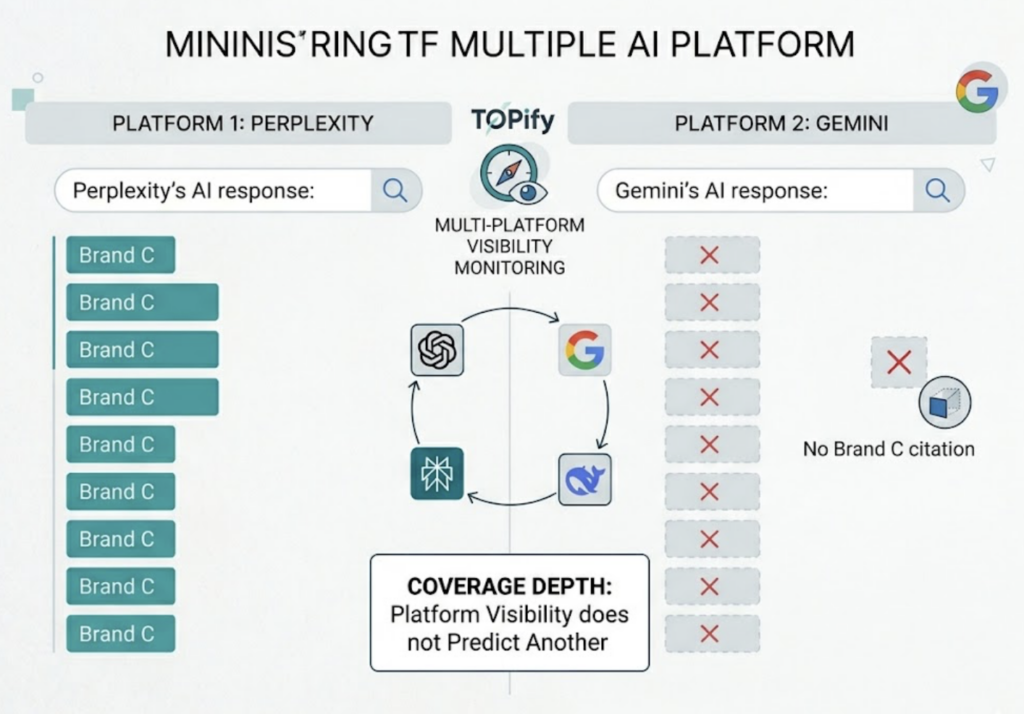
The AI visibility score platform also surfaces competitive data automatically. You can see which competitors appear in the same AI responses as your brand, track their position relative to yours, and identify when new rivals are emerging in AI recommendations before they show up in traditional marketing reports.
For source analysis specifically, Topify traces which domains AI platforms cite when recommending brands in your category. This makes it possible to identify content placement priorities at the domain level, rather than guessing which publications influence AI training and retrieval.
Pricing starts at $99/month on the Basic plan, which covers 100 prompts across ChatGPT, Perplexity, and AI Overviews. The Pro plan at $199/month expands to 250 prompts and 10 seats. Get started with Topify with a 30-day trial.
Conclusion
An AI visibility score is the equivalent of a Domain Authority for generative search, except it moves faster, changes more often, and reflects a completely different set of signals. Brands that rely on traditional SEO metrics to gauge their AI search presence are measuring the wrong channel with the wrong ruler.
The right AI visibility score service does three things: tracks multiple dimensions rather than a single score, monitors continuously rather than generating static reports, and connects data to action by identifying which changes will move the needle. If a service you’re evaluating can’t do all three, it’s a dashboard, not a strategy system.
FAQ
Q: What’s the difference between an AI visibility score and a GEO score?
A: They’re often used interchangeably, but there’s a useful distinction. A GEO score typically refers to your brand’s overall optimization posture for generative search. An AI visibility score is more specific: it measures how often and how favorably your brand actually appears in AI-generated responses, based on live tracking data. One is about readiness; the other is about outcomes.
Q: How often should an AI visibility score be updated?
A: Research indicates that AI source sets can change by up to 65% day-over-day for identical queries, which means weekly or monthly snapshots create significant blind spots. For brands in competitive categories, continuous monitoring with at least daily tracking frequency is worth the investment.
Q: Can a small brand benefit from an AI visibility score service?
A: Yes, and often more than larger brands. Smaller brands typically have more room to move on AI visibility metrics, especially in niche categories where LLMs have fewer established references to draw on. Knowing you’re absent from AI recommendations early, before category leaders solidify their position, gives smaller brands a strategic window to act.
Q: What AI platforms should a visibility score service cover?
A: At minimum, ChatGPT, Perplexity, and Google AI Overviews. These represent the highest-traffic AI search touchpoints for most B2B and B2C audiences. Depending on your target markets, DeepSeek, Doubao, and Gemini coverage matters too, particularly for brands with international or enterprise audiences.

