

Your brand name shows up in a ChatGPT answer, and the team calls it a win. Then you read the rest of the response. The link under the claim points to a competitor’s blog. The “here’s what I’d recommend” line names them, not you. You were in the room, but someone else closed the deal. Being seen by an AI model, being used as its evidence, and being named as its pick are three separate outcomes. Most tracking collapses them into one, which is why so many brands look visible and still lose the answer.
Being Seen by AI Isn’t One Thing
For years, visibility had a simple test: did you rank, yes or no. AI search broke that binary. A model can name your brand, cite a competitor’s page as its source, and recommend a third option, all inside the same paragraph.
Researchers have started separating these signals. One widely used framework splits AI brand presence into three types: a mention is a plain reference with no evaluation, a citation is a source attribution that signals authority, and a recommendation is an active endorsement. Each one reflects a different decision the model made about you.
That’s the gap most dashboards still can’t see.
The three form a funnel. Reach at the top, proof in the middle, endorsement at the bottom. Move up a level and the commercial value climbs with it. The trouble is that the layers don’t move together, so a brand can be strong at one and absent at the next.
Level 1: Mentions, Where AI Visibility Starts
A mention means the model knows your brand exists and will say your name when the topic comes up. It’s the floor, not the ceiling.
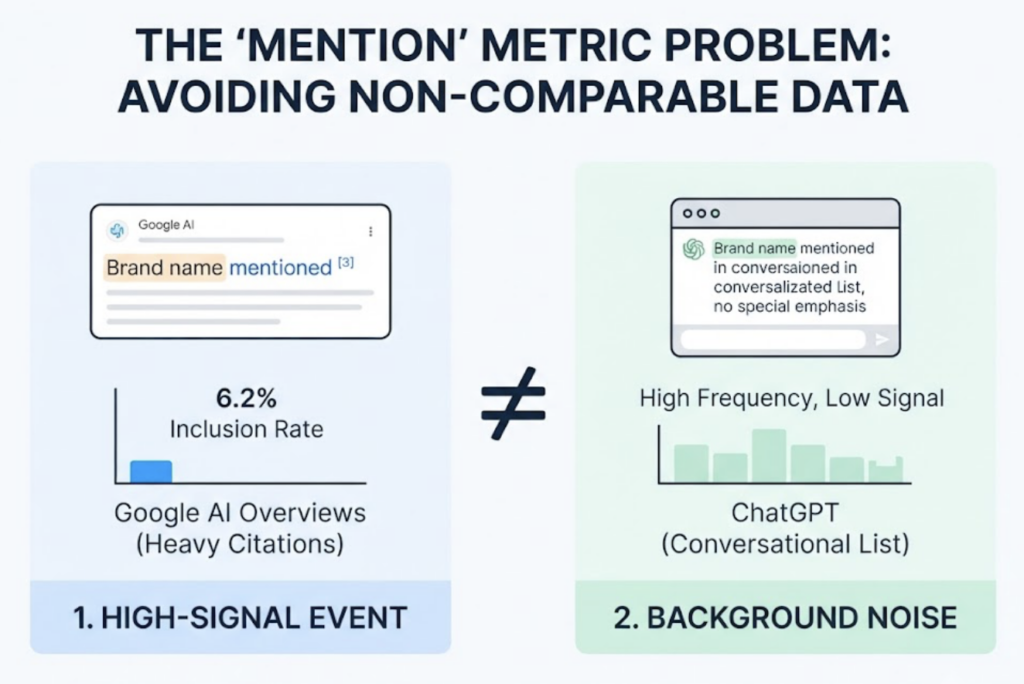
The problem is that mentions are cheap. On ChatGPT, nearly every ecommerce brand gets named, around 99.3% inclusion in one analysis, which makes appearing in an answer a low-signal event. When almost everyone shows up, showing up proves nothing.
A mention on one engine also isn’t the same data type as a mention on another. Google’s AI Overviews include a brand in only about 6.2% of responses and lean citation-heavy, so inclusion there is a high-signal event, while inclusion on ChatGPT is close to background noise. Counting both as one “mention” metric compares things that aren’t comparable.
Mentions also tend to come from training data rather than live retrieval, so they rarely drive traffic and carry no proof the model trusts you. A brand can rack up thousands of neutral mentions and still convert nobody.
Reach gets you noticed. It doesn’t get you chosen.
Level 2: Citations and Your AI Citation Share
A citation is a different kind of signal. Here the model actively pulls your domain in as a source, footnotes it, links it, and stakes part of its answer on your content. That’s a decision about trust, not just recognition.
The metric for this layer is AI citation share: the percentage of AI answers, across a defined query set, that cite your domain relative to all citations in the pool. The term was coined as the replacement for share of voice and framed as the AI-era market share metric. “Share of citation” and “citation share” point to the same thing.
The math is straightforward. Citation slots earned divided by total slots tracked, times 100. Run 30 queries across four engines, earn 14 citations while competitors earn 52, and your citation share lands at 21%.
What counts as a strong number depends on the category. In emerging categories with a handful of credible brands, 20 to 30% is leadership territory, while in crowded categories 5 to 10% can be solid if the query set is large. The trend line matters more than the absolute figure.
AI Citation Share vs. Share of Voice
Old share of voice counted impressions, and multiple brands could sit on the same magazine page without displacing each other. Citation share doesn’t work that way.
AI answers typically cite between three and eight sources per query, so the field is narrow. If you’re cited, a competitor usually isn’t. That makes citation share a zero-sum, competitive metric, not a vanity count.
It also decouples from search rank. One analysis found 80% of the sources AI cites don’t appear in Google’s top 10 for the same query, which means your SERP position and your AI citation rate measure different realities. Ranking well and being cited well are two separate jobs.
Level 3: Recommendations, When AI Picks You First
The top of the funnel is the recommendation. Ask “what’s the best tool for X” and the model names you, unprompted, as the answer. This is the highest-intent signal, because the user asked for a decision and the AI made one.
The commercial gap between layers is real. AI-referred traffic in one dataset converted at 14.2% versus 2.8% for standard organic, roughly a 5x premium, and that premium accrues to recommended brands, not merely mentioned ones.
Recognition and recommendation also aren’t the same. An athleisure analysis put it bluntly: New Balance was identified correctly 100% of the time but recommended in only 3.4% of “best athleisure” answers, while Lululemon, with a far weaker Knowledge Graph, appeared in 92.5%. The difference came from third-party citations, not brand recognition.
Position inside the answer matters too. First-position citations earn four to five times the click-through of fifth-position ones. Being recommended last is closer to being mentioned than being chosen.
Why AI Citation Share Is the Layer Most Brands Skip
Recommendations are the goal, but they’re a lagging indicator. You can’t optimize an endorsement directly. Citation share is the lever you can actually pull.
Here’s the mechanism. Once a model consistently cites your domain as evidence, the odds it promotes you to a recommendation climb. Proof compounds into preference. Skip the citation layer and you’re trying to earn endorsements with nothing underneath them.
The data backs the sequence. Adding statistics to content improved AI visibility by 41% in the Princeton and Georgia Tech GEO study, the single most effective technique they tested. Pages built on original research get cited at 38 to 65% versus 6 to 15% for standard posts. And branded web mentions correlate 0.66 to 0.71 with AI citation rates, which is why earned authority tends to move the middle layer more than on-page tweaks.
There’s also a timing argument. Citation concentrates around a small set of sources, so early movers who lock in citation share build positions that compound while later entrants face an established base the engines already trust.
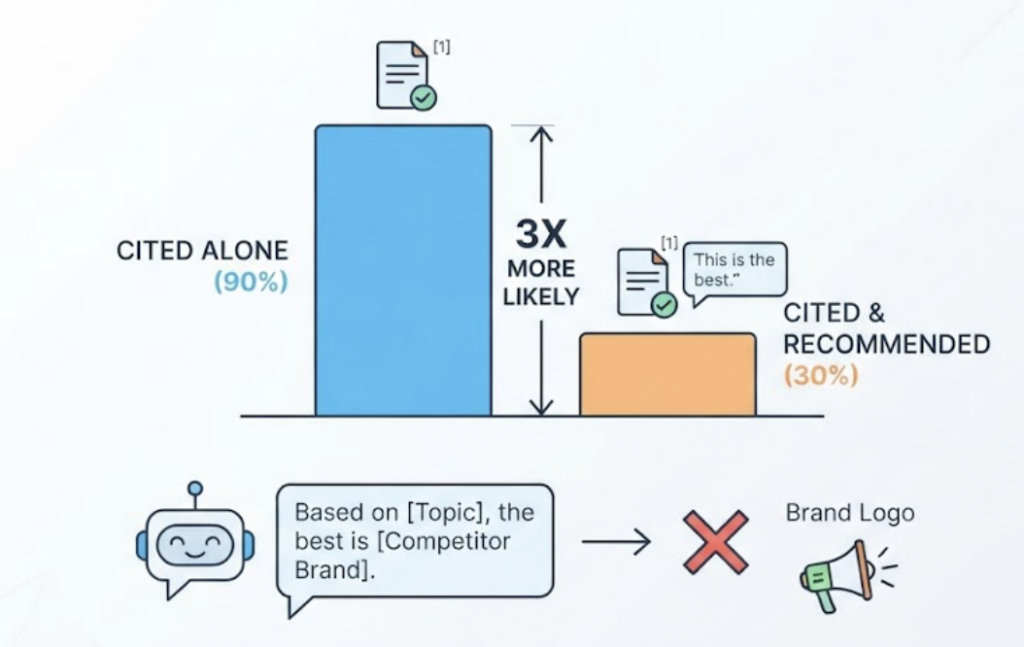
Most tools stop at Level 1. They report mention counts and call it visibility, which leaves the citation layer, where the real leverage lives, unmeasured. Brands are three times more likely to be cited alone than to earn both a citation and a recommendation, a split that’s invisible if you only track one signal. A brand with strong citations but weak mentions is quietly feeding evidence to answers that recommend someone else.
How to Track All Three Levels of AI Visibility
Measuring the funnel means capturing all three signals at once, per platform, and watching how they move against competitors. A single blended number hides more than it reveals.
That’s the job Topify is built for. Its Comprehensive GEO Analytics reports seven metrics side by side, including mentions, position, and CVR, so the awareness layer, the recommendation layer, and the conversion signal sit in one view instead of three tools. You see not just whether you appear, but whether you’re cited and whether you’re picked.
For the middle layer specifically, Topify reverse-engineers the exact domains and URLs AI platforms pull from. In practice, that means you can watch your citation share in a category, spot the competitor domain absorbing the authority you’re missing, and trace a drop in ChatGPT mentions back to a source that stopped referencing you.
Coverage spans ChatGPT, Gemini, Perplexity, DeepSeek, and other engines, which matters because citation patterns diverge sharply across platforms. A 40% share on one engine and 5% on another isn’t noise. It’s an authority gap on a specific model’s evaluation, and it tells you exactly where to spend.
Start by tracking 15 to 25 buyer-intent queries, run each more than once, and read the trend rather than any single snapshot. Get started with Topify and build the baseline before you optimize anything.
Conclusion
Being named by AI is where visibility starts, not where it ends. Mentions give you reach, citations give you proof, and recommendations give you the sale, in that order. AI citation share is the metric sitting between recognition and endorsement, and it’s the one you can influence directly by making your content the source AI trusts. Audit where you stand across all three levels before you decide what to fix. If your brand shows up but never gets cited, you already know which layer needs the work.
FAQ
Q: What is AI citation share?
A: It’s the percentage of AI-generated answers, across a defined query set, that cite your domain as a source relative to all citations in that set. It’s the AI-era replacement for share of voice, measuring whether engines trust your content enough to build answers on it rather than just naming your brand.
Q: How is AI citation share different from a mention?
A: A mention names your brand with no attribution. A citation means the AI actively used your content as evidence and linked to it. Mentions signal awareness; citations signal authority, and only citations reliably show the model treats your content as trustworthy.
Q: How do you measure AI citation share across ChatGPT and Perplexity?
A: Track a fixed set of 15 to 25 category queries, run each more than once per engine, then divide your brand’s citation slots by the total slots earned across every response. Measure per platform, since engines cite very differently and a blended average hides the gaps.
Q: Which level matters most, mentions, citations, or recommendations?
A: Recommendations carry the most commercial value, but they’re a result you can’t optimize directly. Citation share is the leading indicator you can move, and it’s what tends to pull a brand up into recommendations over time.

