


You can open ChatGPT, type your category question, and count how many times your brand name shows up. That number feels like progress. It isn’t. A mention count tells you AI noticed your brand. It says nothing about whether AI trusted your content enough to use it as a source, or how that stacks up against every other source the model pulled from. Without a denominator, a raw count is a vanity metric. AI citation share is the number that survives a stakeholder review.
What AI Citation Share Actually Measures
AI citation share is the percentage of AI citations that point to your domain, measured across a defined set of category-relevant prompts. In plain terms, it’s your slice of the evidence AI engines rely on when they assemble an answer.
The word “citation” carries the weight here. A citation is a source the model links to or draws from as verifiable evidence. That’s an evidence check, not a recognition check. It’s a different event from your brand name appearing in a sentence.
Here’s the distinction that trips up most teams. An AI answer can name your brand in prose without citing your website, or cite your URL without naming the brand in the body. These are separate outcomes, and lumping them together hides what’s actually happening in the answer.
Mentions tell you AI noticed you. Citations tell you AI trusted you.
AI Citation Share vs. Share of Voice vs. Mention Count
These three metrics get used interchangeably, and that’s a mistake. Each answers a different question.
| Metric | What it tracks | Strategic goal |
|---|---|---|
| Mention Count | How often your brand name appears | Building awareness and presence in the conversation |
| Share of Voice | Your footprint relative to competitors in the text | Measuring dominance across brand mentions |
| AI Citation Share | How often your domain is used as evidence | Establishing your site as a trusted source |
Share of voice is competitive and mention-based. You divide your brand mentions by total mentions across your brand and a chosen competitor set. Citation share is different. Its denominator isn’t mentions, it’s the total pool of sources cited across all domains for your prompt set.
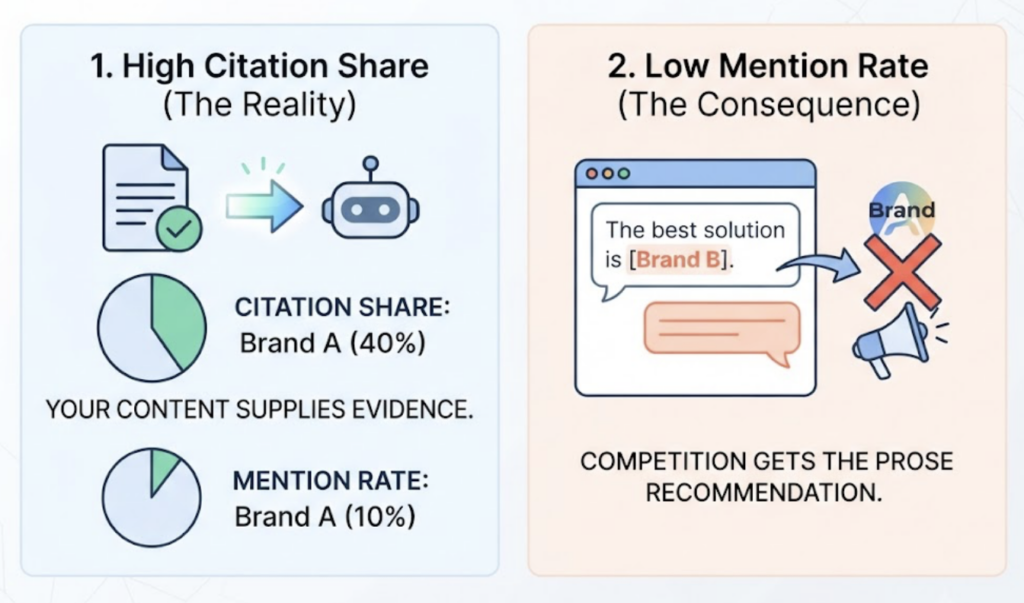
That gap matters more than it looks. A brand can carry high citation share and low mention rate at the same time. When that happens, you’re effectively subsidizing the competition: your content supplies the evidence, and the model recommends someone else in the prose. Tracking only mentions would leave you blind to that leak.
Why Citation Share Is the Metric Worth Tracking
Discovery is moving into the answer itself. AI search visits grew an estimated 42.8% year over year between Q1 2025 and Q1 2026, climbing from 15.6 billion to 27.4 billion. Yet only 14% of marketers track AI citations, even as 43% call AI search optimization a core 2026 priority. The work has outrun the measurement.
Citation share also connects to money in a way mention counts don’t. AI-referred visitors convert 4.4x better than standard organic traffic, because a user who arrives after an AI cited you as a source has already been pre-qualified. The model answered their question and pointed at your page.
There’s a structural reason to care too. A CXL study of 100 AI Overview citations found that 55% of cited snippets came from the top 30% of a page. Citations aren’t random. They reward specific, extractable content, which means citation share is a metric you can actually move.
The Step-by-Step Framework to Measure AI Citation Share
Measuring AI citation share well means trading one-time snapshots for a repeatable protocol. Here’s the framework.
Step 1: Define Your Prompt Perimeter
Select 30 to 50 high-intent, category-specific prompts. The goal is to mirror how buyers actually phrase questions to an LLM, which tends to be conversational and long-tail, not the short-tail keywords you’d feed a traditional rank tracker.
Anchor these prompts to real buyer questions: comparisons, “best tool for,” alternatives, and how-to queries in your category. This prompt set becomes part of the metric’s definition, so lock it down before you start counting.
Step 2: Track Every Platform That Matters
Different engines have different sourcing personalities, and a single-platform view is a biased one. ChatGPT tends to behave like an encyclopedia curator, favoring institutional and well-structured sources. Perplexity leans toward community and real-time validation. Google AI Overviews prioritizes structured, front-loaded answers.
Your share will move from one engine to the next, so measure each separately, then roll them up. A blended number that hides a zero on one platform is worse than no number at all.
Step 3: Capture Citations, Not Mentions
For every answer, log the actual cited domains and URLs, not just whether your brand name appeared. This is where the mention-citation gap becomes visible.
Record each cited source, tag whether it belongs to you, a competitor, or a third party, and note which prompt produced it. That raw log is what makes the next step possible.
Step 4: Calculate Share Against the Total Citation Pool
The formula is straightforward:
AI Citation Share = (Total citations to your domain ÷ Total citations across all domains in your prompt set) × 100
A quick example. Say you run 40 prompts across three platforms and collect 500 total citations. Your domain accounts for 60 of them. Your AI citation share is 12%. If your top competitor holds 90 citations, theirs is 18%, and you now have a like-for-like gap to close.
Normalize against the total citation pool rather than raw counts, since answer lengths and citation density vary across platforms. A percentage keeps the number comparable.
Step 5: Benchmark Against Competitors and Track Over Time
A single reading is a snapshot of a moving target. Cited domain sets drift 40% to 60% month over month in active categories. The volatility runs deeper than most teams expect: one citation dataset found that the typical brand loses half its AI citations in about 31 days.
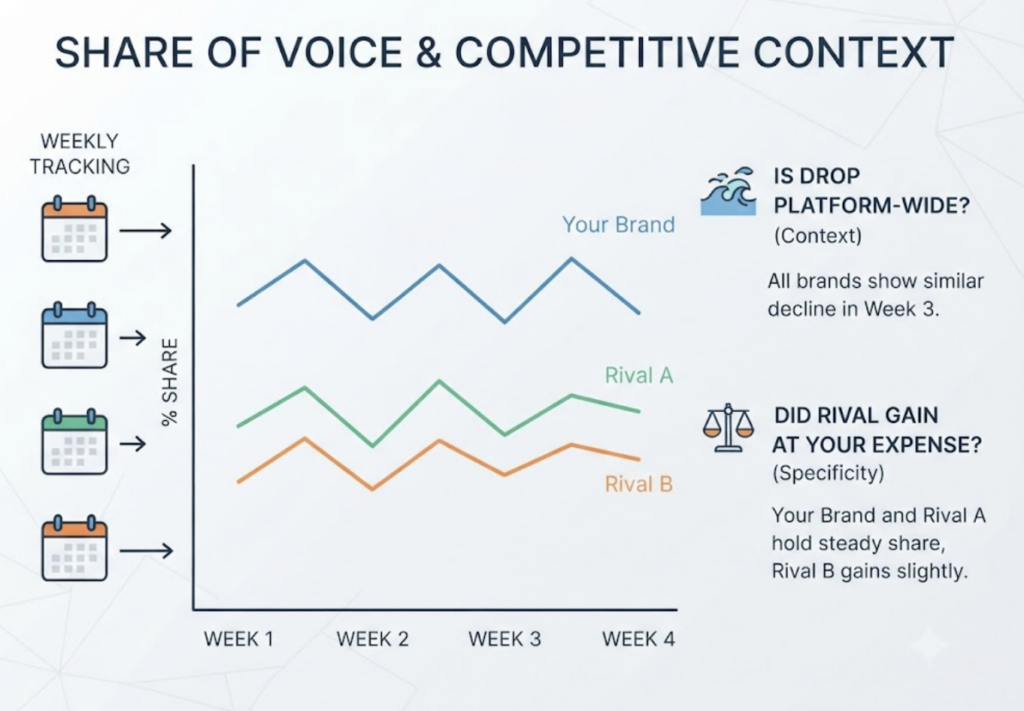
Always measure your share alongside your top three competitors. That context tells you whether a drop is platform-wide or specific to you, and whether a rival’s gain came at your expense. Weekly tracking is the practical minimum for spotting real trends instead of noise.
Common Mistakes That Distort Your AI Citation Share
Even a good framework gets undone by a few recurring errors.
Platform isolation. Measuring one engine (usually ChatGPT) and calling it “AI” gives you a skewed picture. Multi-platform coverage isn’t optional.
The mention fallacy. Treating unlinked brand names as citations inflates your perceived authority. A name in prose and a linked source are different events, and only one of them signals trust.
Small sample sizes. Tracking fewer than 20 prompts produces statistically unreliable data. Aim for 30 to 50 to get a representative read.
Static snapshots. A one-time audit ignores the fact that AI sourcing is probabilistic and shifts fast. The number you pulled last month is likely already stale.
Scaling AI Citation Share Measurement with Topify
Manual tracking works until it doesn’t. Once you’re running 40-plus prompts across three or four engines every week, logging citations by hand hits a complexity ceiling fast. That’s the point where most teams either give up or automate.
Topify is built for that automation layer. Its Reverse-Engineer AI Citations feature analyzes the exact domains and URLs that AI platforms cite, then shows whether your brand or your competitors dominate those references across a prompt set. In practice, you can see a drop in your citation share, trace it to a specific competitor page that started getting cited instead of yours, and act on the gap, all in one view.
The competitor benchmarking runs on the same prompt set, so your share always sits next to your rivals’ rather than floating in isolation. And because coverage spans ChatGPT, Gemini, Perplexity, and other major engines, you avoid the single-platform bias that quietly distorts hand-tracked numbers.
For teams moving from spreadsheets to a repeatable system, that’s the difference between a monthly guess and a weekly trend line. You can get started and baseline your citation share before your next reporting cycle.
Conclusion
Counting brand mentions feels productive, but it measures the wrong thing. AI citation share tells you how much of the evidence layer you actually own, which is what decides whether AI recommends you or your competitor. Start by defining a 30 to 50 prompt set, track citations across every engine your buyers use, calculate your share against the full citation pool, and watch the trend rather than any single reading. The brands that win AI search aren’t the ones mentioned most. They’re the ones cited most, consistently, over time.
FAQ
Q: How do you calculate AI citation share?
A: Divide the total citations pointing to your domain by the total citations across all domains in your prompt set, then multiply by 100. If your domain earns 60 of 500 total citations, your AI citation share is 12%. Always normalize as a percentage so the metric stays comparable across platforms.
Q: What’s the difference between AI citation share and share of voice?
A: Share of voice is usually mention-based, measuring how often your brand name appears relative to competitors. AI citation share is source-based, measuring how often your domain is cited as evidence relative to the total citation pool. A brand can score high on one and low on the other, which is why they should be tracked separately.
Q: How many prompts do I need to measure AI citation share reliably?
A: Aim for 30 to 50 category-relevant prompts. Anything under 20 tends to produce statistically unreliable data, since AI answers fluctuate by phrasing, model version, and sampling randomness.
Q: How often should I measure AI citation share?
A: Weekly at minimum. Cited domain sets drift 40% to 60% month over month, and the typical brand loses half its citations within about a month, so a one-time audit goes stale quickly. Continuous tracking is what turns the metric into a usable trend.

