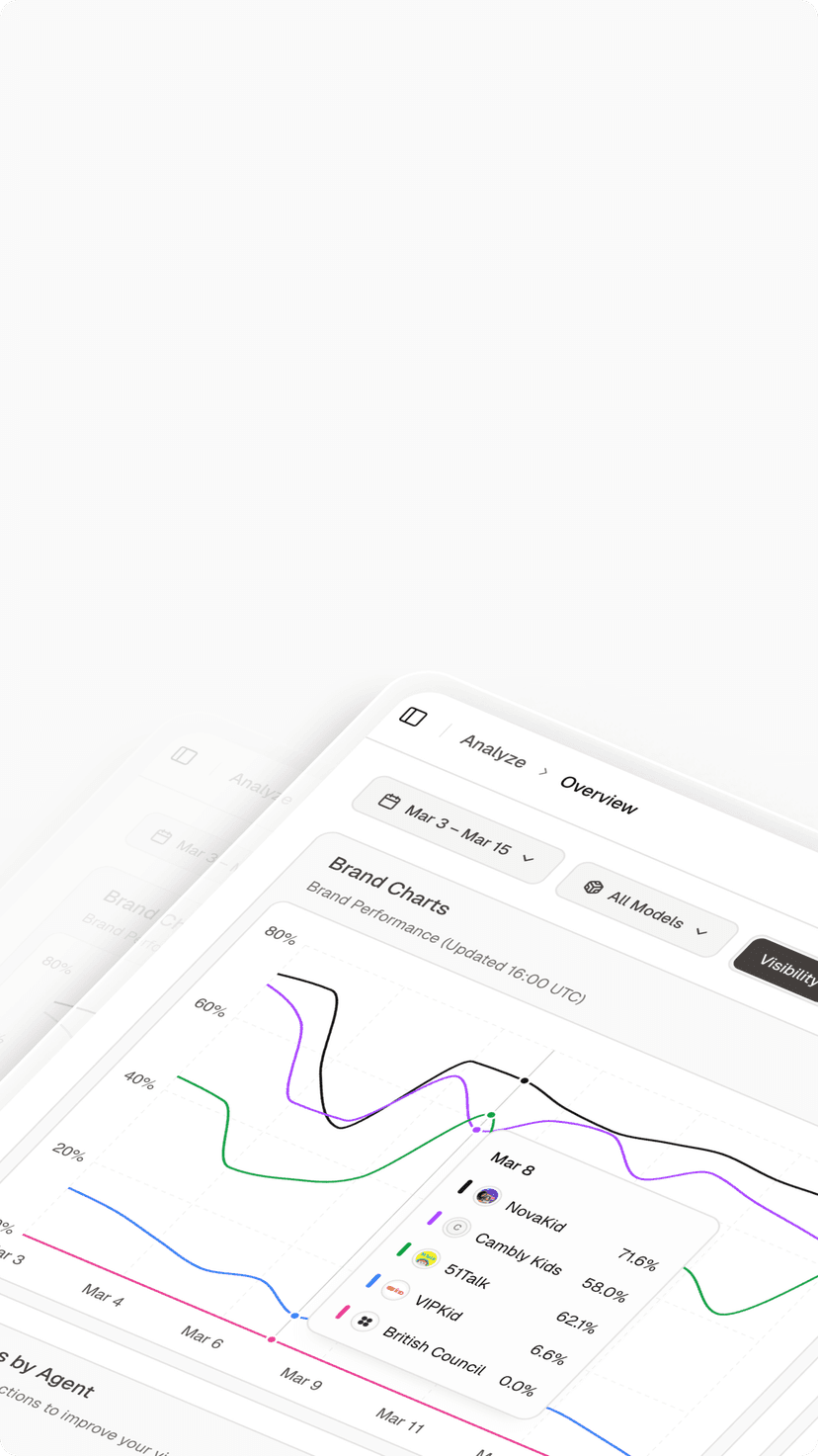

Your share of voice report looks healthy. Brand mentions are up, social reach is climbing, and the quarterly deck practically writes itself. Then a buyer opens ChatGPT, asks for the top option in your category, and reads back three competitor names. Yours isn’t one of them. The dashboard says you’re winning. The AI answer in front of your customer says otherwise, and nothing in your share of voice report explains the gap. That gap has a name: AI citation share, and it measures something your legacy metrics were never built to catch.
Share of Voice Told You Who Was Loudest, Not Who AI Trusts
Share of voice was built for a media world. It measured your brand’s slice of the total conversation: ad impressions, press mentions, social buzz, all tallied against competitors. The logic held up as long as attention and influence moved together. Louder usually meant more remembered, and more remembered usually meant more considered.
That link is breaking in AI search. Large language models don’t tally who’s loudest. They synthesize an answer and pick a handful of sources to ground it, and a brand can dominate social feeds while getting passed over entirely when the model assembles its response.
The data on this gap is hard to ignore. Across ChatGPT, Perplexity, and Copilot, only about 12% of cited URLs rank in Google’s top 10 for the same query, which means roughly 88% of AI citations come from a layer traditional rankings and voice metrics never touch. On Google’s own AI Overviews, the share of citations pulled from top-10 pages fell from 76% to 38% in eight months.
Loud doesn’t mean cited. And cited is what shows up in front of your buyer.
What AI Citation Share Actually Tracks
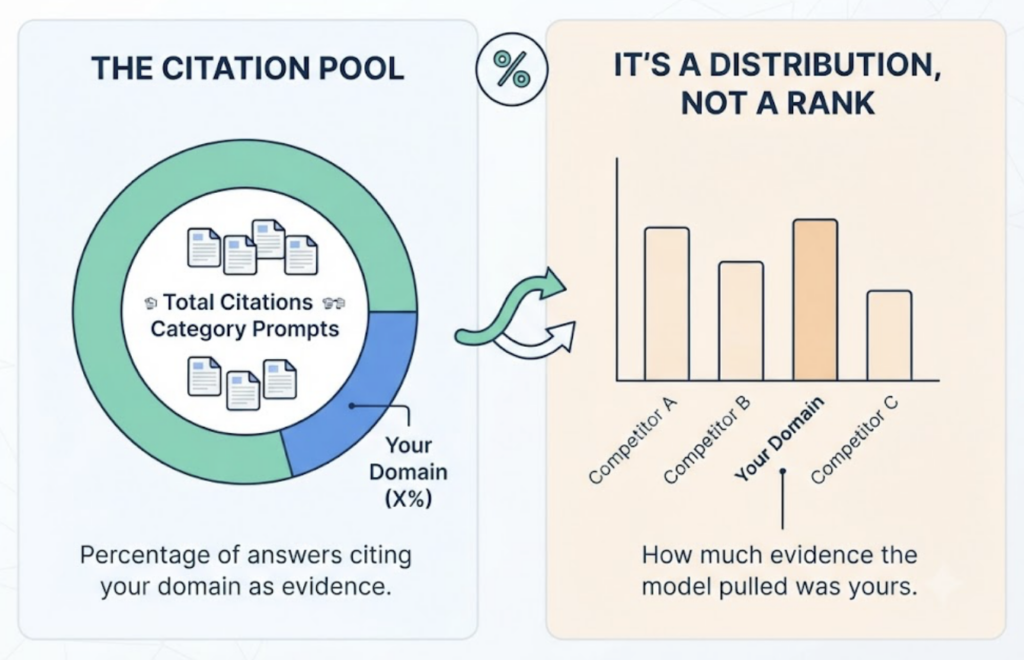
AI citation share is the percentage of AI-generated answers that cite your domain as a source, measured against every citation across a defined set of category prompts. It’s a distribution, not a rank. You’re not asking where you place, you’re asking how much of the evidence the model pulled was yours.
The distinction that trips up most teams is mention versus citation. A mention is your brand name showing up in the model’s conversational text, often pulled from training data. A citation is a linked, formal reference the model leans on to back a factual claim.
Citations carry more weight because they clear a higher bar. When a model cites your domain, it’s signaling that your content passed its reliability check for that specific claim. That’s the grounding layer of the answer, the part the model treats as evidence rather than filler.
For a marketing team, the shift is from measuring presence to measuring authority. Presence asks whether you were seen. Citation share asks whether you were believed.
AI Citation Share vs Share of Voice: Where the Two Metrics Split
The two metrics aren’t a before-and-after upgrade. They measure different things, and reading one as a proxy for the other is where reporting goes wrong.
Share of voice measures reach. AI citation share measures whether the model treats you as a trustworthy source. You can score high on one and zero on the other, and plenty of brands do.
| Dimension | Share of Voice | AI Citation Share |
|---|---|---|
| Primary unit | Brand mentions, media impressions | Domain-level citations |
| Data source | Social, media, and ad monitoring | AI retrieval and answer citations |
| Question it answers | Who has the loudest reach | Who does the AI trust as evidence |
| Main blind spot | Visibility without grounding | Recommendation quality and intent |
| Optimization goal | Market saturation | Extractability and authority |
The gap between them is widening, not closing. As models pull from broader source pools, single-keyword rankings and raw volume matter less, and structured, citable content matters more.
Why Marketing Teams Can’t Read AI Visibility Through a Share of Voice Lens
Here’s the practical risk. If your reporting still runs on share of voice, your dashboard can look healthy while your real influence in AI answers quietly erodes.
Three things make this harder to catch than a normal metric blind spot.
First, AI visibility is platform-specific. A brand can hold strong citation share in Perplexity and stay nearly invisible in Gemini. Google’s own AI Mode and AI Overviews overlap on cited URLs only 13.7% of the time, so a single number can’t represent your standing across engines.
Second, the attribution trail is broken. A buyer reads your brand cited in an AI answer, closes the app, and lands on your site directly days later. Standard analytics files that under direct traffic, so the AI answer that actually drove the decision never gets credit.
Third, the stakes climb as AI answers shape decisions more directly. When a user gets a synthesized answer, the AI’s top pick becomes their pick about 74% of the time, and most users accept the shortlist without checking other sources. The visitors who do click through tend to convert at notably higher rates than standard organic traffic, because they arrive already informed and high-intent.
That’s the gap most dashboards still can’t show.
How to Measure AI Citation Share Without Guessing
Getting a real number takes more than asking ChatGPT about yourself once and eyeballing the result. Single runs are noisy. The model’s answer shifts with phrasing, session, and timing, so one test tells you almost nothing.
Reliable measurement treats AI visibility as a probability, sampled repeatedly. You run a consistent set of category-relevant prompts across each platform, capture which domains get cited, and calculate your share of those citations against competitors. Do that on a schedule and you get a baseline you can actually track.
The higher-value move is source analysis: reverse-engineering exactly which domains and pages a model prefers for each intent. Once you can see the sources a model keeps returning to, you can spot the content gaps that keep you out of the answer, from missing FAQ structure to thin third-party coverage on places like Reddit and review sites.
This is where a dedicated platform earns its place. Topify tracks citation share across ChatGPT, Gemini, Perplexity, and other major engines, running a standardized prompt set so the number reflects a real distribution rather than a single lucky pull. Its Reverse-Engineer AI Citations feature surfaces the specific domains and URLs each model favors, then benchmarks your share against direct competitors so you can see who the AI is citing and why.
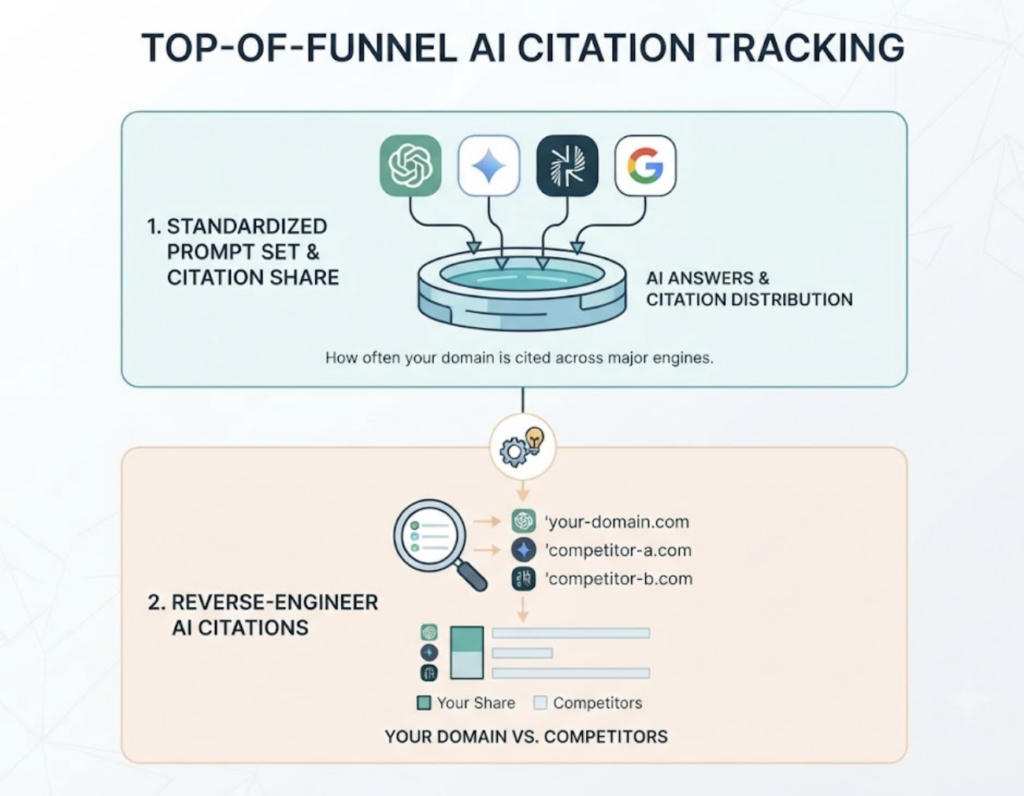
In practice, that means you can watch a drop in your citation share, trace it to a competitor page the model started preferring, and know which content gap to close, all from the same view. When you’re ready to set a baseline, you can get started with Topify and pull your first citation share report across engines.
Track the distribution. Find the gaps. Close them. That loop is the work.
Conclusion
Share of voice was the right metric for an era measured in impressions. In AI search, the currency is different. If the model isn’t citing you, you’re effectively absent from the research your buyer is doing, no matter how loud your brand is everywhere else. The move for any marketing team isn’t to add citation share as one more chart. It’s to shift the question from how much noise you make to how often the AI treats you as the answer. Start by establishing your citation share baseline today, then optimize from a number you can trust.
FAQ
Q: What is AI citation share?
A: It’s the proportion of your brand’s citations in AI-generated answers relative to all citations across a defined category prompt set. Instead of measuring how often you’re mentioned, it measures how often a model picks your domain as a source it trusts.
Q: How is AI citation share different from share of voice?
A: Share of voice measures reach and volume across media and social channels. AI citation share measures factual authority inside an AI’s retrieval process, tracking whether the model actually cites you when it builds an answer. High reach doesn’t guarantee high citation share.
Q: How do you measure AI citation share across ChatGPT, Perplexity, and Google AI Overviews?
A: Each engine sources differently, so you run one standardized prompt set across all of them at the same time, capture the cited domains, and aggregate the results. Repeated sampling matters, since a single run is too noisy to trust.
Q: Does a high share of voice mean a high AI citation share?
A: No. A brand can hold 90% share of voice on social and still land near 0% AI citation share in AI answers if its content lacks the structure or factual depth a model’s retrieval layer looks for.