

Your CMO just presented the quarterly marketing report. SEO rankings are solid. Paid campaigns are on target. Then someone on the board asks, “Are we showing up when buyers ask ChatGPT for recommendations?” and the room goes quiet. Nobody knows, because nothing in the report measures it.
That silence has a price tag. With half of B2B buyers now starting their research inside AI chatbots, and conversion rates from AI referrals running 4x to 5x higher than traditional search, the AI brand visibility gap is becoming the most expensive blind spot on the balance sheet.
Your Brand Might Be Invisible Where 40% of Buyers Now Search
The shift isn’t coming. It’s here. By late 2025, AI platforms had captured 12% to 15% of global search market share, up from roughly 5% to 6% at the start of the year. ChatGPT alone grew from 400 million weekly active users in early 2024 to over 800 million by October 2025, processing more than 1 billion queries per day by early 2026.
That’s not a niche channel. That’s a structural shift in how buyers discover vendors.
The numbers are even more striking in B2B. 87% of B2B software buyers say AI chat is fundamentally changing how they research vendors. 50% now start their buying journey in an AI chatbot, a figure that jumped 71% in just four months during late 2025. Among Gen Z buyers entering the workforce, nearly 80% use generative AI tools as part of their default research process.
Here’s what this means for the CFO: your marketing team could be winning in traditional search while losing an entirely separate discovery channel that’s growing faster than any paid media platform in history.
What Low AI Brand Visibility Actually Costs
Traditional search operated on a simple contract. A search engine provided links, and users clicked through to websites. AI search breaks that contract entirely by delivering synthesized answers that satisfy the user’s intent without ever sending them to your site.
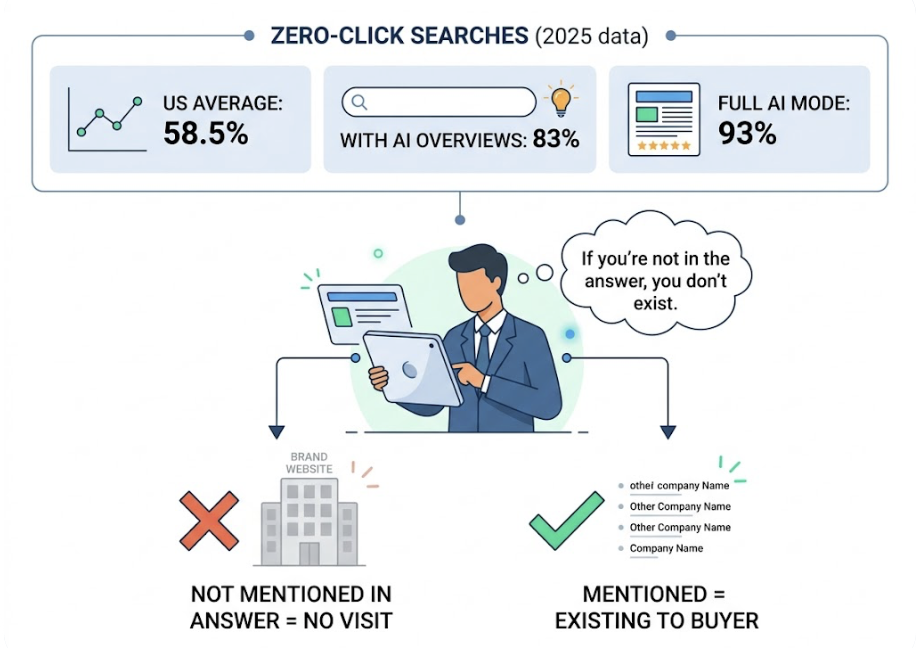
Zero-click searches hit 58.5% in the U.S. in 2025. When Google’s AI Overviews appear, that number jumps to 83%. In Google’s full AI Mode, it reaches 93%. For the vast majority of queries, the brand’s website is never visited. If you’re not mentioned in the AI’s answer, you don’t exist to that buyer.
The conversion math makes this even more urgent. AI-referred visitors convert at 12.4% to 14.2%, compared to 2.8% for traditional organic search. That’s a 4.4x to 5.1x intent multiplier. On some platforms, the numbers are higher: Claude referrals convert at 16.8%, and Perplexity referrals in B2B/SaaS contexts reach 20% to 30%.
These aren’t casual browsers. By the time someone clicks a citation link inside a ChatGPT response, they’ve already consumed a summary of your value proposition. They’re validating a decision they’ve partially made.
The “Citation Moat” Problem
94% of buying groups now rank their vendor shortlist before they ever contact a sales team. The vendor ranked first on that AI-generated shortlist wins the contract approximately 80% of the time.
This creates what analysts call a “Citation Moat.” Every time an AI model cites your competitor, it reinforces that competitor’s authority in the model’s training. Once a rival secures a dominant share of AI recommendations in your category, reclaiming that ground costs 3x to 5x more than securing it early.
That’s not a marketing metric. That’s a capital allocation problem.
Why Traditional Marketing Metrics Miss the AI Brand Visibility Gap
Most executive dashboards are still tuned to the metrics of 2019: SEO rankings, website sessions, and ad-click ROAS. In the AI era, these numbers aren’t just incomplete. They’re actively misleading.
Consider this: analysis of 34,000+ AI responses found that only 11% of the domains cited by ChatGPT were also cited by Google AI Overviews for the same query. Only 17% to 32% of sources cited in AI results also rank in the organic top 10 on Google.
A brand can rank #1 on Google and still be completely invisible in ChatGPT for the same query.
The reason is structural. AI models don’t browse links. They extract meaning. LLMs use retrieval-augmented generation to find the most relevant chunks of information across the web, Reddit, G2, and trade publications. If your content isn’t structured for that extraction, it gets skipped, regardless of domain authority.
The Attribution Blind Spot
There’s a second problem that’s harder to spot. When a buyer sees your brand recommended by an AI, they’re 3.2x more likely to perform a direct search for your brand afterward. This inflates direct traffic with stripped attribution. Without the right tools, the marketing team attributes this growth to “brand building” when it’s actually the downstream effect of AI visibility.
| Traditional Metric | Why It Fails in AI Era | AI Visibility Metric |
|---|---|---|
| SEO Keyword Rankings | Doesn’t reflect inclusion in AI answers | Answer Inclusion Rate |
| Organic Website Sessions | Ignores the 83% who get answers without clicking | AI Visibility Score |
| Paid Ad ROAS | High-intent users bypass the ad layer entirely | Conversion Visibility Rate |
| Click-Through Rate | Collapses 61% when AI Overviews appear | Citation Share of Model |
This isn’t a failure of your marketing team. It’s a failure of the measurement toolset.
Three Questions Every CFO Should Ask About AI Brand Visibility
You don’t need to understand prompt engineering or LLM architecture. You need three numbers.
Question 1: What’s our Answer Inclusion Rate across ChatGPT, Gemini, Perplexity, and Claude?
The average brand currently sits at 0.3% AI visibility. Market leaders in competitive categories reach 12% to 45%. If your marketing team can’t provide this number, you’re flying blind in the fastest-growing discovery channel.
The financial implication: near-zero visibility means the company is invisible to the 30% to 40% of buyers who’ve already migrated their research to AI platforms.
Question 2: When AI mentions us, is the sentiment aligned with our positioning?
AI doesn’t just rank you. It describes you. If ChatGPT calls your enterprise software “a budget alternative” when your positioning is premium, that’s a reputation liability your sales team has to overcome on every call. A Sentiment Score below 40 on a 0-100 scale typically means you’re losing deals to algorithmic mispositioning.
Question 3: What’s our Citation Share compared to our top three competitors?
If a competitor holds 45% of citations in your category while you hold 5%, they’re capturing the earliest consideration moments in the funnel at near-zero marginal cost. A widening gap in Citation Share is a leading indicator of future market share loss and rising blended CAC.
How to Measure AI Brand Visibility with Real Numbers
The core challenge is that AI responses are probabilistic. Different users can get different answers for the same query. Manual checking doesn’t scale. This is where purpose-built platforms fill the gap.
Topify breaks AI brand visibility into four metrics that translate directly into financial outcomes:
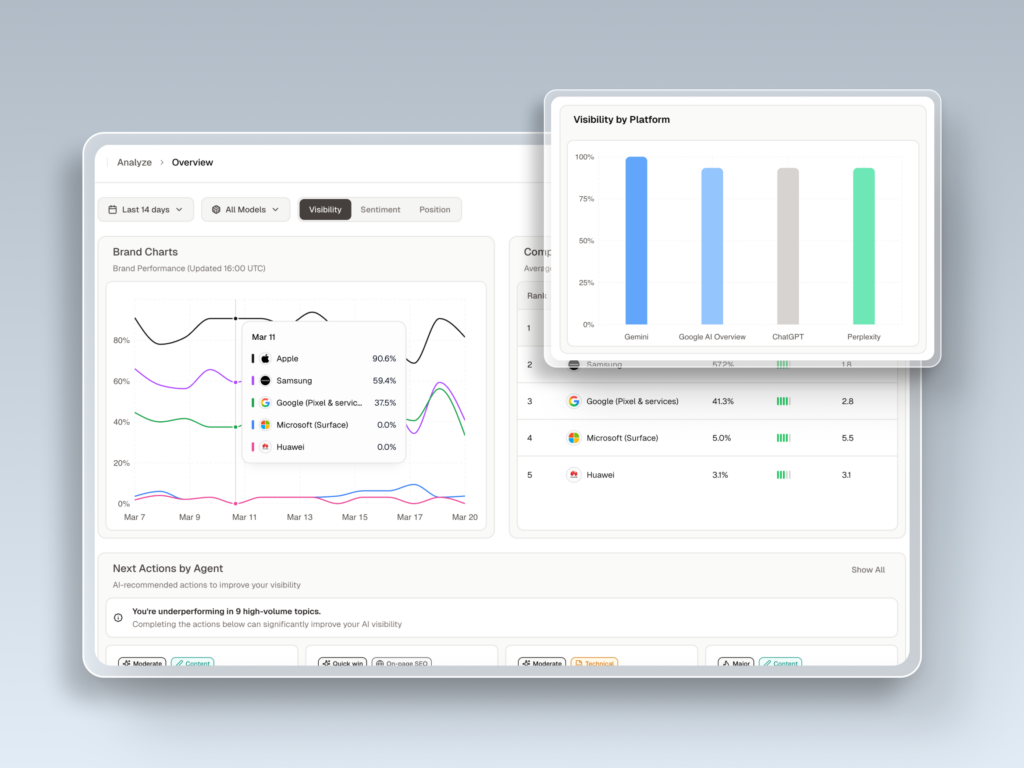
Mention Frequency. How often your brand appears per 1,000 relevant AI queries. This is your baseline: the AI equivalent of impression share, but for answers instead of ads.
Recommendation Position. Whether you’re the primary recommendation (named in the first paragraph) or buried under “other options.” Users overwhelmingly trust the first recommendation, and position correlates directly with downstream conversion.
Trigger Keywords and Intent Alignment. The specific conversational prompts (e.g., “Which CRM integrates best with Slack for a 50-person team?”) that cause AI to mention your brand. This tells you which buyer intents you’re winning and which you’re losing.
Conversion Visibility Rate. A predictive measure of the likelihood that AI visibility will drive downstream action. AI citation traffic converts at rates up to 12.9x higher than traditional search, so even small improvements in CVR can move revenue numbers.
Beyond raw metrics, Topify tracks Sentiment Velocity, the direction the AI’s attitude toward your brand is trending. A downward shift is a leading indicator of future sales decline. And Hallucination Alerting notifies your team if an LLM starts generating false claims about your product, giving PR and content teams time to respond before damage compounds.
| Metric | Business Outcome | Strategic Value for CFO |
|---|---|---|
| Answer Inclusion Rate | Pipeline Growth | Measures penetration into the discovery phase |
| Sentiment Score | Trust and Brand Equity | Identifies reputation risks before they hit the P&L |
| Citation Share vs. Competitor | Market Share | Benchmarks competitive resilience |
| CVR | Revenue Potential | Justifies investment in AI search optimization |
From Blind Spot to Budget Line: Making AI Brand Visibility Measurable
The action plan doesn’t require a massive budget reallocation. It requires the right sequence.
Month 1: The AI Search Audit. Use a platform like Topify to simulate thousands of prompts across ChatGPT, Gemini, Perplexity, and Claude. Identify where your brand is completely absent from category-leading questions. One B2B SaaS company ran this audit and discovered they appeared in only 8% of relevant buyer queries.
Month 2: Structural Optimization. Shift content strategy from keyword optimization to citation optimization. That means adding statistics, expert quotes, and self-contained answer blocks (150 to 300 words) that LLMs can easily extract. Pages with structured data see 2x to 3x higher citation rates. Content updated within the last 90 days is 2.3x more likely to be cited by ChatGPT.
Month 3: Expand the Citation Footprint. AI draws roughly 65% of its data from third-party sources like Reddit, trade journals, and affiliate sites. Your marketing team needs to land mentions on the specific domains that AI is currently citing for your competitors. Topify’s Source Analysis feature identifies exactly which domains those are.
The results can be fast. That same B2B SaaS company increased its citation rate from 8% to 24% in 90 days, generating 47 AI-referred leads converting at 18.7%, a 288% return on investment in the first quarter.
Conclusion
The question for CFOs in 2026 isn’t whether AI search matters. It’s whether the company’s measurement infrastructure can see what’s happening there. Low AI brand visibility is a revenue leak that doesn’t show up in traditional dashboards, and by the time it surfaces in pipeline reports, competitors have already built a citation advantage that costs 3x to 5x more to overcome.
The fix starts with three numbers: your Answer Inclusion Rate, your Sentiment Score, and your Citation Share vs. competitors. Get those on the quarterly report, and the rest of the strategy follows. Get started with Topify to turn “Are we showing up in AI?” from an unanswerable boardroom question into a measurable budget line.
FAQ
Q: What is AI brand visibility?
A: AI brand visibility measures how often, in what context, and in what position your brand is mentioned or recommended in synthesized answers from platforms like ChatGPT, Gemini, Perplexity, and Claude. Unlike traditional SEO rankings, it captures whether AI systems actively cite your brand when buyers ask questions in your category.
Q: How does AI brand visibility affect revenue?
A: Being invisible in AI search means exclusion from the vendor shortlists that 94% of B2B buyers create through AI research. Brands that are cited in AI answers see referral traffic converting at 12.4% to 14.2%, which is 4x to 5x higher than traditional organic search. The vendor ranked first in an AI-generated recommendation wins the contract roughly 80% of the time.
Q: Can you measure AI brand visibility like SEO?
A: Traditional SEO metrics like rankings and click-through rates don’t apply because of the 83% to 93% zero-click rate in AI search. AI brand visibility requires new metrics: Answer Inclusion Rate, Sentiment Velocity, Citation Share of Model, and Conversion Visibility Rate. Platforms like Topify track these across multiple AI engines in a single dashboard.
Q: How much does low AI visibility cost a company?
A: The cost includes lost high-intent leads (AI referrals convert at up to 14.2%), rising CAC as paid channels compensate for the visibility gap (up 40% to 60% since 2023), and the long-term expense of displacing a competitor who’s already built a Citation Moat, which costs 3x to 5x more than securing the position early.

