

Your domain authority is 70. Your keyword rankings are climbing. Your team just spent six months earning backlinks and optimizing meta tags. Then someone asks ChatGPT for a product recommendation in your category, and your brand doesn’t show up.
Not buried. Not ranked low. Just absent.
The gap between what your SEO dashboard reports and what AI platforms actually say about your brand is growing every quarter. That gap has a name: AI brand visibility. And your current toolkit wasn’t built to measure it.
Your SEO Dashboard Tracks Rankings. AI Brand Visibility Tracks Recommendations.
Traditional search engines rank URLs. They sort pages by link-based authority signals like PageRank, and serve users an ordered list of external links. Success means being the first result in a vertical list.
AI search works differently. Platforms like ChatGPT, Perplexity, and Gemini don’t rank pages. They retrieve content, synthesize it, and generate a conversational answer. The user never sees a list of ten blue links. They see a paragraph that either mentions your brand or doesn’t.
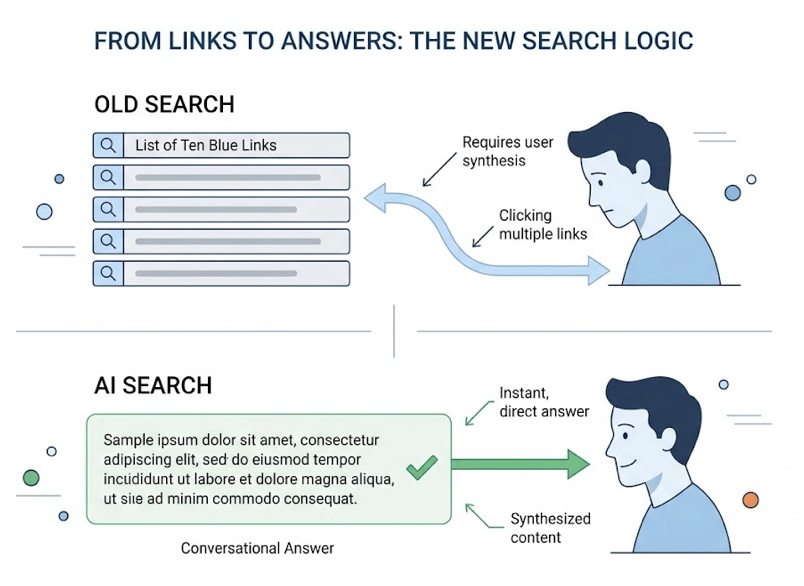
That’s the core distinction. SEO visibility is positional. AI brand visibility is referential.
| Dimension | Traditional SEO | AI Brand Visibility |
|---|---|---|
| Primary Unit | URL and Page | Entity and Passage |
| Core Logic | Index and Rank | Retrieve and Generate |
| Algorithm Basis | Link-based Authority | Semantic Vector Proximity |
| Output | Ordered list of links | Synthesized natural language |
| Success Goal | Traffic acquisition | Mention and recommendation |
Here’s the part that catches most teams off guard: generative models don’t look for the “most authoritative” page. They look for the most reliable, easy-to-parse answer that’s corroborated by multiple third-party sources. This explains why smaller, well-structured sites often appear in AI answers while high-DA pages get ignored. The AI prioritizes clarity and directness over legacy authority signals.
Why Google Rankings Don’t Translate to AI Mentions
The data makes the disconnect hard to ignore. Research shows that only 12% of AI citations overlap with the top 10 organic results in Google. Around 80% of the sources AI platforms cite don’t rank anywhere on the first or second page of traditional search for the same query.
Why? AI models evaluate “entity clarity” rather than “page authority.” If your website wraps its value proposition inside narrative-heavy prose, an AI crawler may never extract your brand as a relevant solution. Meanwhile, a competitor who gets mentioned frequently on Reddit, in trade publications, and across comparison lists becomes more “known” to the LLM’s training data and retrieval system.
Three factors drive what AI chooses to cite:
Third-party consensus. LLMs lean heavily toward earned media. Mentions on Reddit, Wikipedia, trade blogs, and industry journals carry more weight than self-published content. Roughly 82.9% of AI citations come from third-party sources, not brand-owned pages.
Information gain. AI prioritizes sources that offer unique data points, statistics, or perspectives not duplicated by other cited sources. Repeating what everyone else says doesn’t help.
Factual consistency. Brands with fragmented or contradictory narratives across the web send mixed signals. AI tends to default to “legacy” brands with more stable data profiles when the signal is unclear.
The Five Metrics That Define AI Brand Visibility
Traditional metrics like DA, keyword rank, and organic traffic are blind to the generative layer. To measure AI brand visibility, you need a different framework entirely.
Platforms like Topify have standardized a multi-dimensional approach to tracking how a brand appears across the AI ecosystem. Here are the five metrics that matter most:
Visibility (Mention Rate). The percentage of priority queries where your brand is named in the AI’s response. SEO tools track rankings. This tracks whether you exist in the answer at all.
Sentiment Score. An NLP-driven rating of how favorably AI describes your brand. High Google rankings can still lead to negative AI summaries if the prevailing discussion around your brand skews critical.
Position Index. Where your brand appears in recommendation lists within AI answers. AI responses are often non-linear, but when they do list options, order matters.
Source Attribution. The specific domains AI cites as evidence when mentioning your brand. SEO focuses on backlinks to your site. AI cites other sites about you.
AI Volume. The monthly query demand inside AI platforms for topics related to your brand. Traditional keyword tools only see search engine traffic. They miss the 780 million monthly queries on Perplexity alone.
None of these show up in Google Analytics. None of them appear in Ahrefs or Semrush. That’s the blind spot.
What Happens When You Can’t Measure AI Brand Visibility
Ignoring AI brand visibility doesn’t mean nothing is happening. It means something is happening without you knowing.
Your brand gets described incorrectly. AI generates text based on statistical probability, not verified facts. One widely covered case involved a theme park where an AI Overview incorrectly claimed a major ride was closing, based on a single Reddit fan’s speculative post. In another case, a Canadian tribunal ruled that Air Canada was liable for a chatbot that fabricated a refund policy. The airline had to honor a policy that never existed.
These aren’t edge cases. Brands regularly discover that AI describes pricing plans or product features that were discontinued years ago, simply because outdated information remains in the model’s training data.
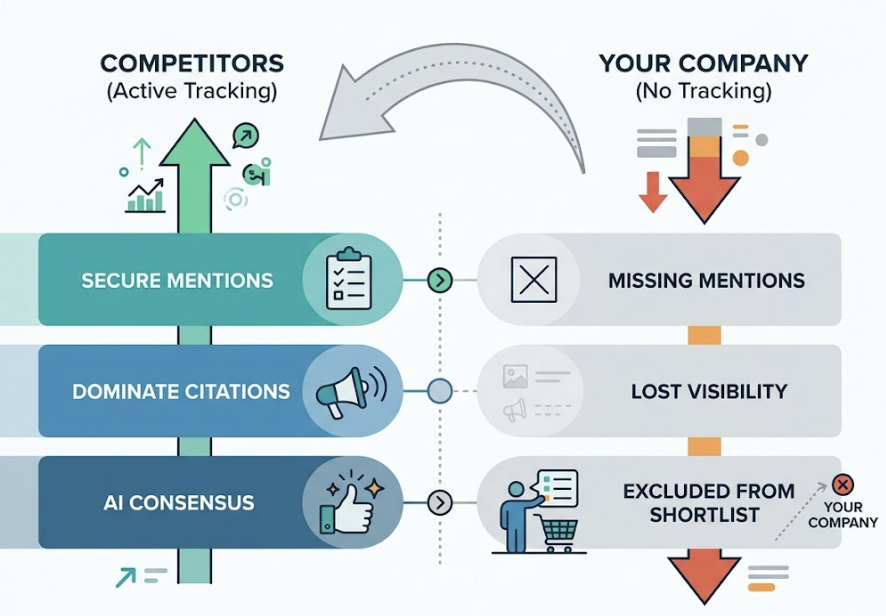
Competitors take your recommendation share. When you don’t track AI visibility, competitors can quietly dominate the “citation share.” If a competitor secures mentions across comparison lists and review sites, AI begins to treat them as the consensus choice. By the time a buyer starts their traditional search, they’ve already formed a mental shortlist that excludes you.
The stakes are high because AI now influences the full purchase journey. 43% of consumers discover new brands through AI tools. 57% use AI to narrow down choices. And 50% have made a purchase after using AI during their research.
That’s not a future trend. That’s current behavior.
How to Start Tracking AI Brand Visibility Today
You don’t need a six-month initiative to get started. But you do need to stop relying on tools that were built for a different system.
Step 1: Run a manual audit. Open ChatGPT, Perplexity, and Gemini. Ask 20 to 30 prompts that a buyer in your category would ask. Record whether your brand is mentioned, where it appears in the answer, and what the AI says about you. This takes an afternoon and gives you a baseline.
Step 2: Identify “dark queries.” AI tools create “query fan-out,” where a single user question triggers multiple internal sub-queries. Many of these high-intent conversational phrases don’t appear in traditional keyword research tools. Topify’s Prompt Discovery feature automates this process, surfacing the exact questions buyers are asking AI engines.
Step 3: Make your content extractable. AI prefers content that’s modular and easy to parse. Start every key page with a 40 to 60 word direct answer to a core question. Use structured tables and bulleted lists for comparisons. Implement JSON-LD schema (FAQ, Product, Organization) as a machine-readable translation layer.
Step 4: Build external authority. Because the vast majority of AI citations come from third-party sources, off-page authority is the strongest predictor of visibility. Sites with over 32,000 referring domains see AI citations nearly double compared to those with lower domain counts. Digital PR and earned media aren’t optional in the AI era.
Step 5: Refresh on a 90-day cycle. AI engines show a strong preference for content updated within the last 13 weeks. Unlike traditional SEO, which can take months to show results, AI retrieval systems can pick up new content in days. Monthly monitoring and quarterly content refreshes are the baseline.
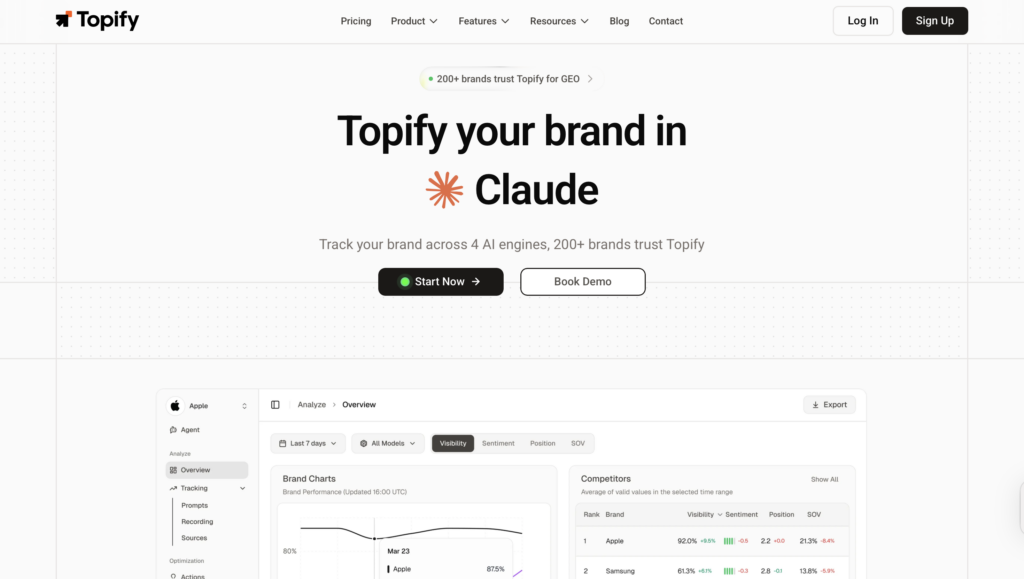
For teams tracking visibility across multiple AI platforms, Topify tends to stand out by combining Visibility, Sentiment, and Position data into a single view. In practice, this means you can spot a drop in ChatGPT mentions and trace it back to a specific source that stopped citing your brand, all within the same dashboard. Plans start at $99/mo with coverage across both Western models (ChatGPT, Gemini, Perplexity) and the APAC ecosystem (DeepSeek, Qwen, Doubao).
Conclusion
Your SEO dashboard tells you where your pages rank. It doesn’t tell you whether AI recommends your brand, how it describes you, or which competitors are quietly taking your share of AI-generated answers.
AI brand visibility isn’t a new column in an existing spreadsheet. It’s a separate discipline with its own metrics, its own optimization logic, and its own competitive dynamics. The shift from the link economy to the citation economy is already underway, and brands that establish a baseline now will have the clearest advantage when the next wave of AI-driven buyers arrives.
FAQ
Q: What is AI brand visibility?
A: AI brand visibility measures how frequently and favorably your brand appears in AI-generated responses across platforms like ChatGPT, Gemini, and Perplexity. It covers mention rate, sentiment, position in recommendation lists, and which sources the AI cites when referencing your brand.
Q: How is AI brand visibility different from SEO?
A: Traditional SEO optimizes for a URL’s position in a list of links. AI brand visibility optimizes for an entity’s inclusion in a synthesized answer. SEO focuses on keyword matching and link authority. AI focuses on semantic intent, third-party consensus, and content extractability.
Q: Can I track AI brand visibility with Google Analytics?
A: Standard GA4 can’t directly track AI mentions because those interactions happen on third-party AI platforms. However, tools like Topify can connect AI citation data to referral traffic and revenue signals in your existing analytics setup.
Q: How often should I check my brand’s AI visibility?
A: At minimum, monthly. AI models and retrieval systems update rapidly, and citation logic is probabilistic. Key commercial content should be refreshed every 90 days to maintain the “freshness” signal that AI engines prioritize.

