

You’ve spent two years positioning your product as the category leader. Then you type your brand name into Perplexity and read: “a solid option, though competitors tend to offer more enterprise-grade support.” That’s not a review from a disgruntled customer. That’s what AI is telling everyone who asks.
The problem isn’t what was written about you. It’s that nobody was watching what AI was saying in the first place.
Brand Visibility Has a New Blind Spot
For the past decade, brand monitoring meant tracking mentions in media, reviews on G2, and sentiment in social feeds. Tools like Google Alerts or Brand24 were built to catch what people wrote about you in existing content.
That model doesn’t apply to AI search.
When a user asks ChatGPT “what’s the best CRM for a 50-person sales team,” the model synthesizes a response on the spot. It doesn’t link to an article you can monitor. It generates an opinion, sometimes with a recommendation, sometimes with a characterization of your brand, and delivers it directly to the user. No click. No trail. No attribution gap you can spot in your analytics.
This is what practitioners call the “silent” competitor problem: a brand can rank on page one of Google and still be absent from every AI-generated recommendation in its category. Traditional monitoring tools have no mechanism to detect this, because they weren’t built to query AI engines and parse responses.
What “AI Brand Intelligence” Actually Means
The phrase gets used loosely, so it’s worth pinning down.
AI brand intelligence is not “AI helping you analyze your brand.” It’s the practice of systematically monitoring, analyzing, and acting on how AI models synthesize and present your brand, your category, and your competitors to users.
The research firm Typeface defines it as the shift from backward-looking metrics to proactive AI-driven intelligence: instead of asking “what did people say about us last month,” you’re asking “what is AI saying about us right now, across which platforms, and why.”
That distinction matters for tool selection. Most social listening platforms are listening tools. An AI brand intelligence tracker is a response-monitoring system. It queries AI engines with prompts relevant to your category, captures what comes back, and turns that output into structured data you can act on.
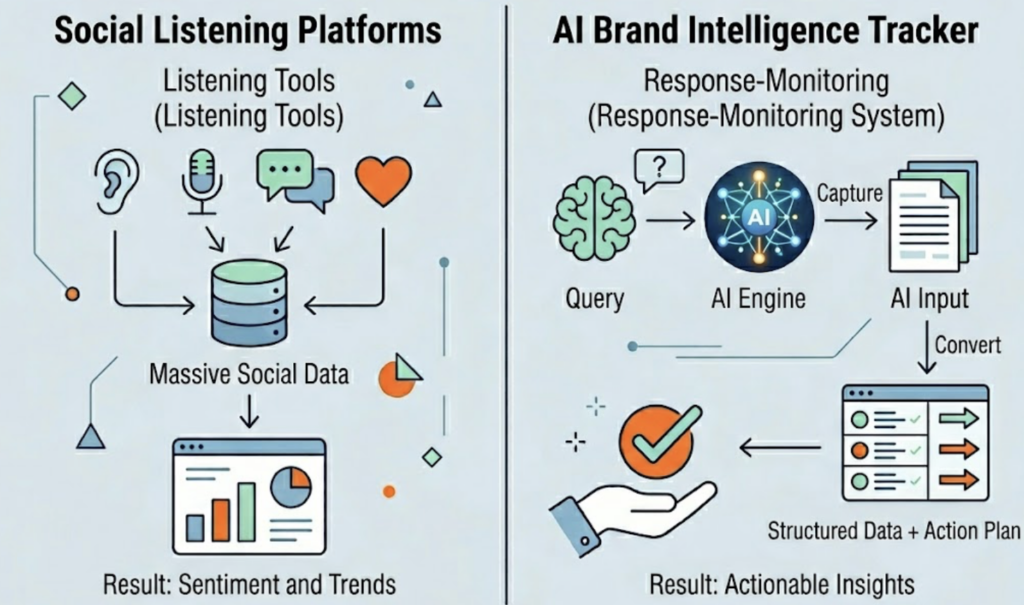
The core pillars that define the practice: visibility (does your brand appear?), sentiment (how is it characterized?), competitive positioning (relative to whom?), and citation authority (which sources is AI using to build its answers?).
5 Signals an AI Brand Intelligence Tracker Must Capture
Not all trackers are equal, and the gap usually shows up in what they measure.
A mention count is a starting point, not an intelligence layer. Advanced AI brand intelligence systems track five distinct signals:
Visibility Rate is the percentage of commercially relevant queries where your brand appears in the AI response. A tracker that only tells you “your brand was mentioned” without showing you which prompt types triggered that mention, and which didn’t, isn’t actionable.
Sentiment Scoring measures how the AI characterizes your brand. There’s a meaningful difference between “a popular choice” and “a budget-friendly alternative.” The Visiblie framework for stress-test prompts specifically designs queries to surface hidden AI perceptions, where neutral queries produce neutral language, but comparison prompts often reveal how AI weights your brand against competitors.
Competitor Relative Positioning answers the question brands actually care about: not just “are we there,” but “where are we compared to them.” This requires tracking head-to-head comparison prompts, not just category queries.
Source Attribution traces which domains AI platforms cite when they describe your brand or your category. This is the mechanism behind AI answers. If a forum thread or a two-year-old review article is shaping how Gemini describes your pricing, you need to know that before you can do anything about it.
Prompt Coverage measures breadth: how many of the query types that matter to your audience actually surface your brand. A brand might appear frequently in “best of” prompts but be absent from evaluation or trust queries.
That’s the gap most teams don’t know they have.
Why Continuous Tracking Beats a One-Time Audit
An audit gives you a point-in-time snapshot. AI brand intelligence tracking gives you a feedback loop.
The distinction matters because AI models are non-deterministic. The same prompt can yield different responses based on the model version, the user’s location, and updates to the model’s underlying data. An audit you ran in January is likely describing a different AI environment than what your customers are experiencing in June.
The operational value of continuous tracking is in the feedback loop it creates. Low visibility on “best X” prompts signals a need to update comparison content or build authority on the topics AI is citing for competitors. Negative sentiment on pricing means AI is pulling characterizations from sources that misrepresent your value proposition. Identifying the specific source driving that framing is the first step to changing it.
Without a tracker, you find these problems after the damage is done. With one, you catch them before they compound.
How Topify Approaches AI Brand Intelligence
Most tools in this space stop at data collection. Topify was built to close the gap between measurement and execution.
The platform tracks brand performance across seven metrics: visibility, sentiment, position, volume, mentions, intent, and CVR (Conversion Visibility Rate). CVR is worth calling out specifically: it’s a proprietary metric that estimates the likelihood an AI response actually drives a user toward a brand interaction, which is closer to what most marketing teams actually care about than raw mention counts.
On platform coverage, Topify monitors across ChatGPT, Gemini, Perplexity, DeepSeek, and several other major AI engines. The breadth matters because citation patterns vary significantly across platforms. A brand that ranks well in Perplexity responses may be underrepresented in Google AI Overviews, and vice versa.
The execution layer is where Topify diverges from pure analytics tools. Rather than presenting a dashboard and leaving strategy to the user, the system surfaces specific prompts driving competitor performance, identifies the domains being cited in those responses, and proposes content actions to close the gap. The entire workflow runs on plain-language goal-setting and one-click deployment.
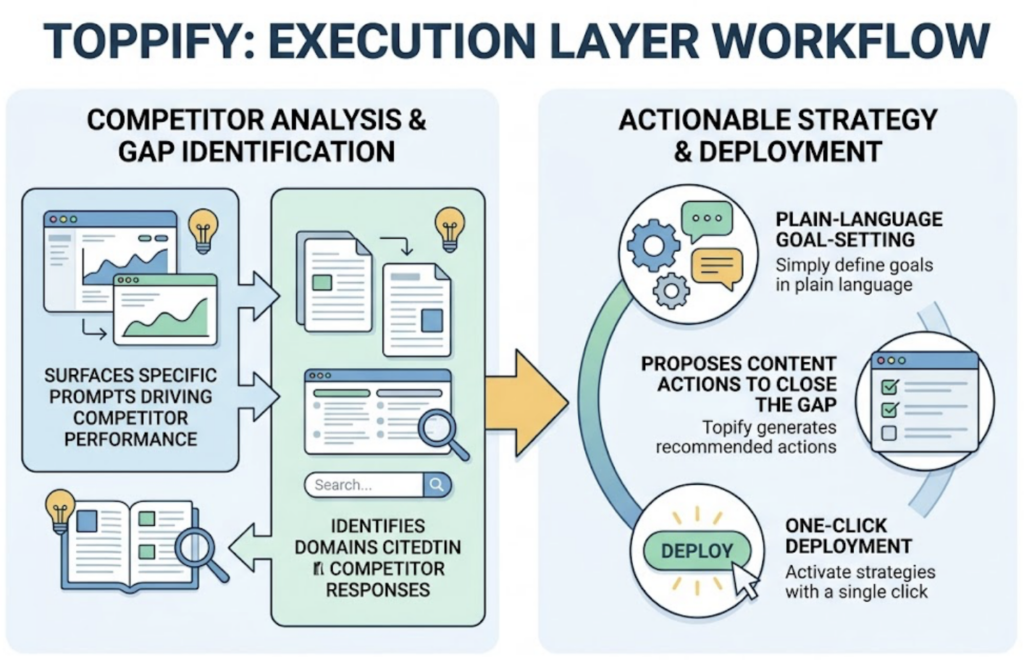
For teams tracking 100+ prompts across multiple AI platforms, that operational layer is the difference between having data and doing something with it.
Topify’s Basic plan starts at $99/month and covers 100 prompts and 9,000 AI answer analyses across four projects. For teams that need to get started quickly, there’s a 30-day trial included.
Choosing the Right AI Brand Intelligence Solution
The framework from your external research stands up well in practice. Evaluate any AI brand intelligence tool on three dimensions:
| Dimension | What to Ask |
|---|---|
| Platform Breadth | Does it cover more than ChatGPT? Does it include the platforms your audience actually uses? |
| Metric Depth | Does it go beyond mention volume to sentiment, position, and source attribution? |
| Execution Layer | Does it tell you what to do, or just show you what’s happening? |
A tool that covers one platform and reports mention counts is a monitor. A tool that covers multiple platforms, measures qualitative sentiment, tracks competitor positioning, and surfaces actionable recommendations is an AI brand intelligence system.
The HubSpot research on Answer Engine Optimization draws the same conclusion: teams that treat AI visibility as a monitoring problem get reports. Teams that treat it as an intelligence problem get strategy.
Also worth noting: the Pulsar Platform distinction between social listening and social intelligence maps directly here. Listening tells you what happened. Intelligence tells you what to do about it.
Conclusion
AI search isn’t a future trend. It’s where a meaningful portion of your potential customers are already forming opinions about your brand, your category, and your competitors. What they hear is shaped by systems you can’t influence until you start monitoring them.
An AI brand intelligence tracker turns that blind spot into a feedback loop: what’s being said, on which platforms, driven by which sources, and what changes would shift the outcome. If your current monitoring stack doesn’t include that layer, it’s not covering the full discovery journey. Topify’s AI search optimization platform is one structured way to close that gap.
FAQ
Q: What’s the difference between AI brand intelligence and social listening?
A: Social listening monitors mentions in existing content: articles, posts, forums. An AI brand intelligence tracker monitors responses AI engines generate in real time when users query your category. The input for social listening is what people write. The input for AI brand intelligence is what AI says, which is often derived from different sources entirely.
Q: How often does an AI brand intelligence tracker update?
A: The better platforms run continuous or near-daily monitoring because AI model outputs shift frequently. A monthly cadence is typically too slow to catch meaningful changes in citation patterns or sentiment, especially after a model update or a major shift in competitor content strategy.
Q: Can a small team use an AI brand intelligence platform without dedicated resources?
A: Yes, provided the platform includes an execution layer. Tools that only surface data require a strategist to interpret and act on it. Platforms that translate data into specific content recommendations or automated workflows are more accessible to lean marketing teams.
Q: What does an AI brand intelligence dashboard typically show?
A: A well-designed AI brand intelligence dashboard shows visibility rate by prompt type, sentiment scoring, competitor positioning across AI platforms, source attribution data, and trend lines over time. The most useful dashboards also flag which prompt categories saw the biggest changes week-over-week, which is where most teams should start their weekly review.

