

Your brand has a reputation inside ChatGPT, Perplexity, and Gemini. You didn’t write it. You didn’t approve it. And until recently, you couldn’t read it.
That’s the core problem AI brand intelligence monitoring is designed to solve. As more purchase decisions start with an AI query rather than a Google search, the narrative these platforms construct about your brand has real commercial weight. But most marketing teams are still measuring what’s happening on the web, not what’s happening inside the answer.
This guide breaks down what AI brand intelligence monitoring actually tracks, why traditional tools can’t do it, and how to build a system that gives you genuine visibility into your AI-generated reputation.
Your Brand Has an AI Reputation. You Just Can’t See It Yet.
When a user asks ChatGPT “what’s the best project management software for remote teams,” the AI doesn’t search the web in the way Google does. It draws on a combination of training data, cached retrieval, and source weighting to construct a synthesized answer. Your brand either appears in that answer, or it doesn’t. If it does appear, it’s described in a specific way, positioned at a specific rank, and cited from specific sources.
That’s not SEO. That’s something new: a black box narrative that AI platforms generate about you independently.
The shift from search engines to answer engines changes the fundamental unit of brand exposure. Traditional search delivers “ten blue links.” AI search delivers one synthesized answer, usually one to three paragraphs, where only two or three brands get named. If you’re not in that shortlist, you don’t get a consolation ranking on page two. You simply don’t exist for that user, in that moment.
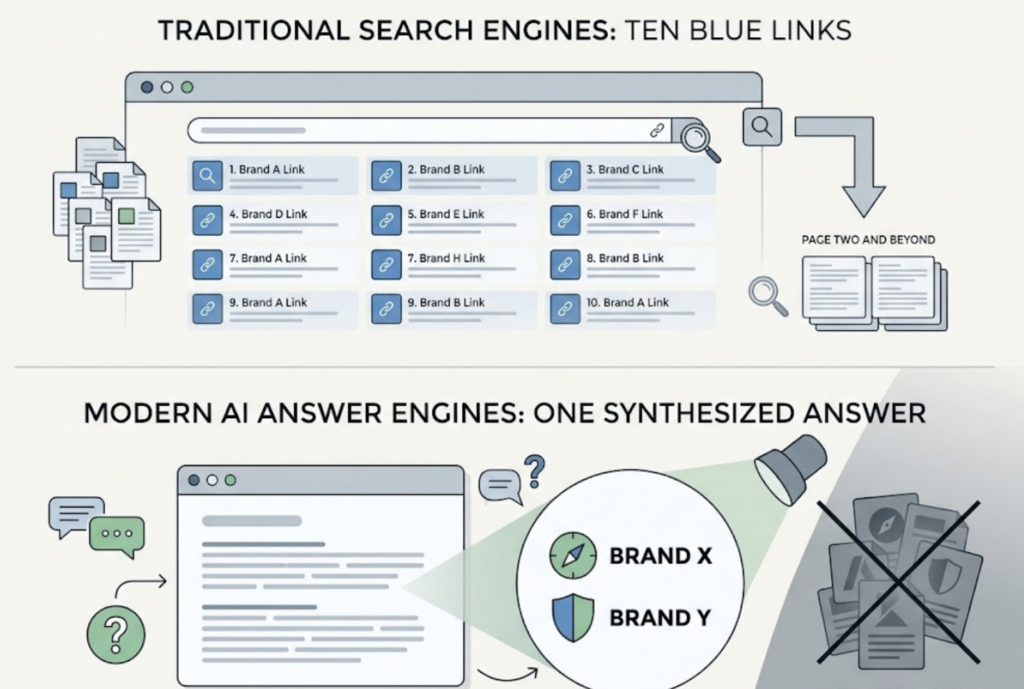
AI brand intelligence monitoring is the practice of systematically measuring that synthetic narrative: what the AI says about you, how it frames you relative to competitors, and which sources are driving those outputs.
What AI Brand Intelligence Monitoring Actually Tracks
Effective AI brand intelligence monitoring goes well beyond counting how often your brand gets mentioned. The metrics that matter are more specific, and more actionable.
Visibility Rate
This measures the percentage of commercial-intent queries where your brand appears in an AI response. Think prompts like “best [category] software for [use case]” or “top [category] tools in 2026.” Visibility rate is the baseline metric: it tells you whether the AI “knows” your brand well enough to recommend it at all.
A brand with high Google rankings but low AI visibility rate has a real problem. The two don’t automatically correlate.
Sentiment Scoring
This is where AI brand intelligence gets qualitative. The AI doesn’t just mention your brand; it describes it. “Trusted by enterprise teams” is a different narrative than “has a learning curve” or “users report pricing concerns.” Sentiment scoringmeasures the qualitative framing the AI applies to your brand across a sample of prompts.
This is not social media sentiment. It’s the AI’s internal narrative, constructed from training data and retrieved sources.
Competitive Position
AI platforms regularly generate comparative answers: “How does [Brand A] compare to [Brand B]?” Your competitive position tracks how often you appear in these head-to-head comparisons, and whether you’re framed as the recommended option, the runner-up, or simply omitted. High share of voice in category prompts is a strong signal of LLM-level market dominance.
Source Attribution
AI models ground their answers in specific domains. If Perplexity cites TechCrunch and a competitor’s case study library for “best CRM tools,” and your website doesn’t appear in that citation pool, you’ve identified exactly where the gap is. Source attribution tracking tells you which domains are being referenced as the “evidence” for your brand. That directly informs your content strategy.
Prompt Coverage
Not all queries are equal. Prompt coverage measures the breadth of user intents your brand appears across: evaluation queries (“is [Brand] reliable?”), comparison queries, feature-specific queries, and trust queries (“does [Brand] have good customer support?”). A brand with high visibility on one prompt type but zero coverage on others has a significant blind spot.
Why Traditional Brand Monitoring Tools Miss the Signal
The gap between traditional brand monitoring and AI brand intelligence monitoring isn’t a feature gap. It’s a structural one.
Tools like Brandwatch, Mention, and Google Alerts are built to monitor what’s being said across the public web. They crawl pages, track indexed content, and flag keyword mentions. That worked when the web was the primary surface where brand narratives lived.
But AI brand intelligence requires a different approach: monitoring how the AI summarizes the web, not just what’s on it. There are three specific failure points.
Reactive vs. active. Traditional tools wait for content to be published and indexed. AI brand intelligence monitoring requires actively querying AI platforms with evaluation prompts and analyzing the responses in real time.
Non-deterministic outputs. AI responses aren’t static. A brand might appear prominently in a ChatGPT answer at 9 AM and be omitted by 10 AM due to shifts in prompt context or model updates. You need large-scale sampling to identify statistical trends, not spot-checking.
The attribution gap. In traditional search, click-through rate is the primary KPI. In AI Overviews and conversational AI, the user often gets what they need without visiting your site. Citation tracking becomes the new proxy for influence, and traditional tools don’t measure it at all.
The Platforms That Drive AI Brand Intelligence
Not all AI platforms carry the same monitoring priority. Here’s how to think about the landscape.
Perplexity and search-integrated LLMs are the highest priority for citation tracking. These platforms actively surface their sources, making citation rate a direct proxy for your brand’s authority signal in AI-powered search.
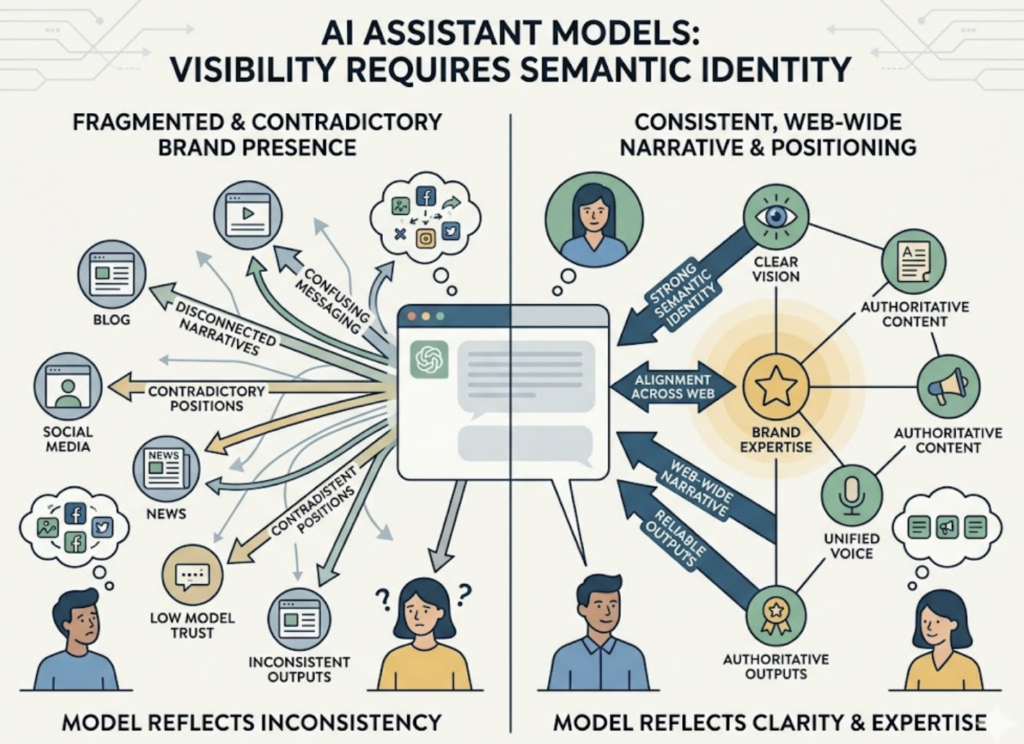
ChatGPT and similar assistant-layer models rely heavily on training data and cached knowledge. Visibility here requires what researchers call a “semantic identity”: a consistent, web-wide narrative about your brand’s expertise and positioning. If your brand’s presence online is fragmented or contradictory, these models will reflect that inconsistency in their outputs.
Google AI Overviews remain the most commercially significant surface for brands with existing SEO investment. Monitoring here focuses on “extractability”: whether your site’s content is structured in a way that AI can parse, summarize, and cite. Tracking your AI Overview performance is now a core part of any SEO workflow, not a niche add-on.
Each platform has different weighting logic, different retrieval mechanisms, and different user bases. A brand that monitors only one is making decisions from an incomplete data set.
How to Build a Functioning AI Brand Intelligence System
Building an AI brand intelligence system from scratch takes three components working together.
Design an evaluation prompt library. Start with the queries your target customers actually use. “What’s the best [category] tool for [specific use case]?” “Is [Brand] a good choice for [company type]?” “How does [Brand] compare to [Competitor]?” These evaluation prompts become the inputs for your monitoring system. Aim for 30 to 100 prompts covering different intent types and customer segments.
Automate data aggregation at scale. Manual testing doesn’t produce statistically reliable results. The non-deterministic nature of AI responses means you need to run each prompt multiple times, across multiple platforms, over extended periods. That’s where an AI brand intelligence platform becomes necessary rather than optional.
Topify is built specifically for this. It tracks brand performance across ChatGPT, Gemini, Perplexity, Google AI Overviews, and other major AI platforms via seven key metrics: visibility, sentiment, position, volume, mentions, intent, and CVR. You define the prompts; the AI brand intelligence dashboard handles the sampling, aggregation, and trend analysis automatically.
Build feedback loops into your content strategy. The data from your AI brand intelligence system should feed directly into content decisions. If the AI consistently cites a competitor for “pricing transparency” but not you, that’s a signal to update your pricing documentation with clearer structured data. If your sentiment score dips on “customer support” queries, that’s a flag to create more credible third-party content on that topic.
The intelligence is only as valuable as the actions it drives.
Reading Your AI Brand Intelligence Dashboard
Once you have data flowing, the next challenge is interpreting it correctly.
Visibility rate benchmarks vary significantly by category. In highly competitive categories, appearing in 20-30% of relevant prompts is meaningful. In less crowded verticals, that number should be much higher. The more useful benchmark is your share relative to competitors on the same prompt set.
Sentiment scores tell you the direction of your AI narrative. A score trending positive on “reliability” and negative on “ease of use” is a specific, actionable signal. It’s not enough to know that sentiment is “mixed.” You need the breakdown by attribute.
Position data reveals your LLM-level competitive standing. If you’re the third brand named in every head-to-head comparison, that’s a different problem than being absent entirely. Both require different responses.
Source attribution data is often the most operationally useful. Understanding which domains AI platforms are citing as the evidence for your brand tells you exactly where to invest content resources. If Reddit threads are driving your AI citations, that’s a different content strategy than if industry reports and case studies are doing the work.
Topify’s AI brand intelligence software surfaces all of these signals in a single dashboard, with competitor benchmarking built in. You can see how your visibility rate, sentiment, and position compare to specific competitors across the same prompt set, which is the comparison that actually matters.
Conclusion
AI brand intelligence monitoring isn’t a future concern. It’s a present one. Every time a user asks an AI platform to recommend a product, compare two vendors, or explain what a brand stands for, the AI generates an answer that influences that decision. The brands that understand what those answers say about them, and why, have a material advantage.
The gap between “we check our Google rankings” and “we monitor our AI brand intelligence” is the gap between managing last decade’s discovery channel and this decade’s one. Start with your evaluation prompt library, automate the monitoring, and treat the dashboard data as a live input into your content strategy. That’s how AI brand intelligence monitoring becomes a growth function rather than a reporting exercise. Get started with Topify to see where your brand stands across AI platforms today.
FAQ
Q: What is AI brand intelligence monitoring?
A: AI brand intelligence monitoring is the practice of systematically tracking how AI platforms like ChatGPT, Perplexity, and Gemini describe, position, and recommend your brand in response to user queries. It measures metrics like visibility rate, sentiment scoring, competitive position, and source attribution across AI-generated answers.
Q: How is AI brand intelligence different from social listening?
A: Social listening tracks what people are saying about your brand on public platforms like X, Reddit, and news sites. AI brand intelligence monitoring tracks what AI systems are saying about your brand when users ask them questions. The inputs are different, the measurement methodology is different, and critically, the outputs directly influence purchase decisions at the point of AI-assisted discovery.
Q: How often should I check my AI brand intelligence dashboard?
A: Weekly monitoring is a reasonable baseline for most brands. AI outputs can shift with model updates, changes in source authority, or new content entering the retrieval pool. High-stakes periods, such as product launches or competitor activity, warrant daily monitoring across key prompt clusters.
Q: Can small brands benefit from AI brand intelligence tools?
A: Yes, and in some ways more directly than large brands. Smaller brands often compete in less saturated AI visibility landscapes, meaning that targeted content improvements and prompt-specific optimization can produce visible changes in visibility rate faster. An AI brand intelligence tool helps smaller teams identify exactly which prompts and sources to prioritize rather than spreading effort across a broad content program.

