

Your keyword tool says “best CRM for startups” gets 2,400 searches a month. You built a page around that number, and it ranks. Then a new lead tells you they found your competitor by asking ChatGPT a 30-word question about CRMs for a five-person sales team stuck in a messy spreadsheet migration.
That conversation never showed up in your keyword data. It never will.
Keyword volume counts what people type into a search bar. It says nothing about what they ask an AI model. Tools that promise to let you see AI search volume are trying to close that gap. The trouble is that most marketers read those numbers the same way they read keyword volume.
Keyword Volume Was Always an Estimate. AI Search Volume Is an Estimate of an Estimate.
Most SEO teams treat keyword volume as ground truth. It never was.
Google Keyword Planner rounds numbers into buckets and merges near-identical queries. Variations like “compare vpn,” “vpn comparison,” and “vpns compared” don’t get their own counts; Keyword Planner reports one combined figure for the group. In Ahrefs’ accuracy test, Keyword Planner drastically overestimated volume 54% of the time and was roughly accurate in only 45% of cases. And if you’re not running ads, Google only shows you a handful of extremely wide volume ranges, as Authoritas documented across 60 million keywords.
Still, keyword volume has one real advantage: the raw data comes from Google. Third-party tools refine it, but they start from a first-party source.
AI search volume has no such anchor. AI answer engines are closed systems with no public keyword planner or search API, so data providers have to buy clickstream panel data from third parties to estimate prompt volume. That’s the core of AI search volume vs keyword volume. One is a noisy measurement. The other is a model.
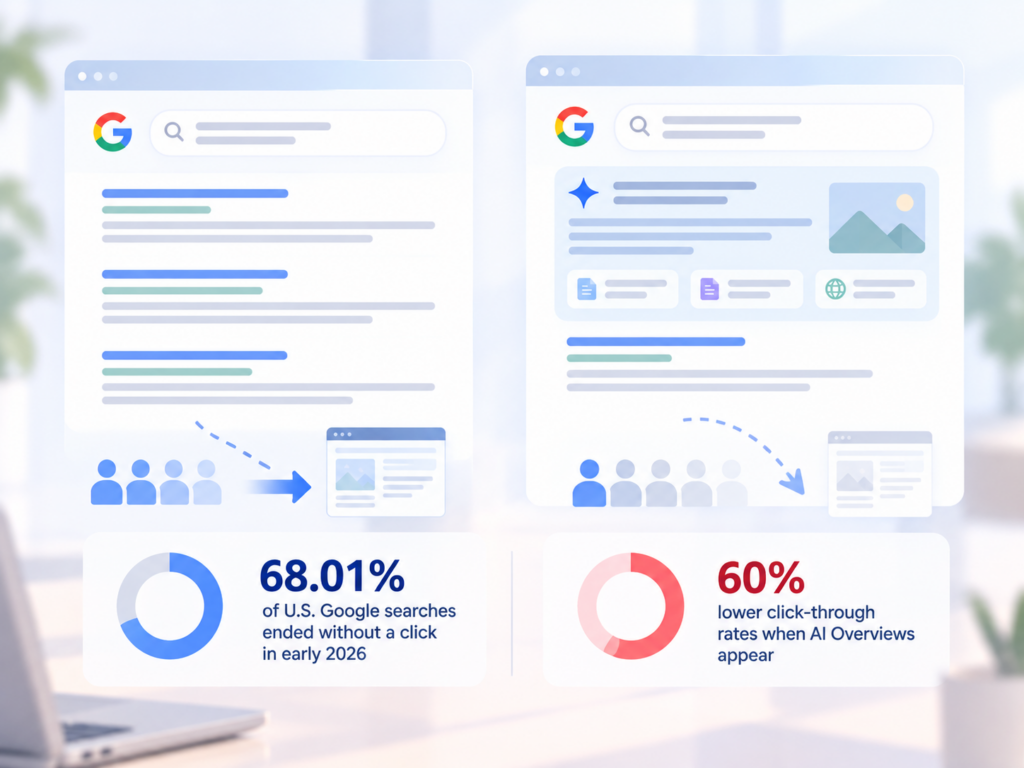
Keyword volume is also losing value on its own terms. SparkToro found that 68.01% of U.S. Google searches ended without a click in the first four months of 2026, and that when AI Overviews appear, click-through rates fall by nearly 60%, according to Search Engine Land’s coverage. A keyword can hold steady volume while the clicks behind it quietly vanish.
AI Search Volume vs Keyword Volume, Side by Side
| Metric | Data source | What gets counted | Typical query | Error margin | Best used for |
|---|---|---|---|---|---|
| Keyword volume | Google data, refined with clickstream | Exact or grouped search strings | 3 to 4 words | Moderate, often inflated by grouping | Sizing Google demand and click potential |
| AI search volume | Opt-in panels and browser-extension clickstream, then modeled | Intent clusters of conversational prompts | 15 to 25+ words | High, can swing 2x in either direction | Ranking topics by relative AI demand |
The last column matters most. These metrics answer different questions, so swapping one for the other in a content plan tends to produce confident decisions built on the wrong number.
A 23-Word Prompt Doesn’t Have a Search Volume
Query length is where the two metrics split for good.
Semrush puts the average U.S. Google search at 3.4 words. Conversational prompts run far longer. ChatGPT prompts can average 23 words or more depending on the use case, compared with the 3 to 4 words typical of Google, per ALLMO’s analysis. SimilarWeb’s data goes further: measured from October 2023 to September 2025, ChatGPT prompts ran about seventeen times longer than an average Google search.
Length changes the math. Nobody types the exact same 23 words. People add team size, budget, existing tools, and deal-breakers. Two prompts can share an intent while having almost no words in common.
The model side adds more fragmentation. One breakdown of prompt volume notes that ChatGPT rewrites 91% of its search queries uniquely.
The unit of AI demand isn’t the keyword. It’s the intent cluster.
So when a tool shows “1,200 prompts/month” next to a sentence, it’s really reporting volume for a topic. How the tool drew that topic’s boundaries shapes the number as much as user behavior does. Two vendors can cluster the same prompts differently and report very different totals, and neither is lying.
The Clickstream Blind Spot Behind Every AI Volume Number
Start with scale. OpenAI told Axios that ChatGPT receives about 2.5 billion prompts per day, around 330 million of them from the U.S. No third party sees more than a sliver of that.
What they do see is skewed. Panel data depends heavily on Chrome extensions that capture users’ sessions, which leaves out the native mobile apps, Safari, and API-driven usage. Jäckert & O’Daniel point out that people who install browser plugins lean tech-savvy, male, and work-focused, so the panel isn’t a cross-section of society. Metaflow adds that when sample coverage is well under 1% of total prompts, small skews in who gets measured can swing results dramatically, which produces wide variance between vendors.
The practical result is a wide error band. A reported 4,800 prompts per month could plausibly be 2,400 or 9,600. Brainlabs warns that panel-based estimates carry a meaningful margin of error, especially in niche verticals or B2B categories where panels are small. That’s exactly where most SaaS and B2B brands live.
A precise-looking number on a dashboard isn’t precise data.
None of this means you should ignore AI search volume. It means you should read it as a directional signal, not a count.
What It Really Means to See AI Search Volume
When marketers say they want to see AI search volume, they usually picture one number. In practice, AI demand shows up in three layers, and only one of them can be measured directly.
Layer 1: Demand, or How Often a Topic Gets Asked
This is what prompt volume tools estimate: how much attention a topic cluster gets inside AI assistants. It’s modeled, it’s noisy, and it’s still useful for deciding where to look first.
Layer 2: Retrieval, or What the Model Searches For
When an AI model goes to the web, it writes its own queries. Nectiv’s study of 8,500+ prompts found 31% of prompts triggered at least one search, with ChatGPT averaging 2.17 searches per prompt. Those searches averaged 5.48 words, and 77% ran five words or longer.
This is where keyword data becomes useful again. Fan-out queries are short enough to overlap with the terms you already track, which is why understanding query fan-out connects your SEO keyword list to AI answers.
Layer 3: The Answer, or Who Gets Recommended
This is the only layer you can measure directly. You run a fixed set of prompts across AI platforms on a schedule and record which brands get named, in what order, and with what framing.
Think of it this way. Layer 1 tells you a room is full. Layer 3 tells you who’s doing the talking. A cluster with modest estimated volume where you’re named in 8 of 10 answers is often worth more than a huge cluster where you never appear, because the first one is already converting attention into consideration. Most teams read Layer 1 and stop, which is like sizing a market without checking whether anyone in it has heard of you.

How to Read AI Search Volume Numbers Without Fooling Yourself
Rank Topics, Don’t Forecast Traffic
Use volume to sort clusters against each other. A 3x gap between two topics is meaningful. A 20% gap is noise, so don’t build a quarterly forecast on it.
Cluster Before You Compare
Compare intents, not phrasings. “CRM for small sales teams” and “simple CRM for a five-person startup” belong in one bucket. Splitting them makes both look smaller than the real demand.
Cross-Check Against Your Keyword Data
Put AI volume next to Google volume for the same topic. Rising AI demand with flat Google volume often signals early migration to AI assistants. High numbers on both mean you need to defend both surfaces. Search Console impressions for fan-out-style queries give you a first-party check on Layer 2.
Pair Every High-Volume Cluster With Answer Tracking
Volume without answer data is half a picture. For each priority cluster, track your mention rate, position, and the sources AI cites. That turns an estimate into a decision.
Watch Trends Over Weeks, Not Single Readings
Modeled numbers bounce between refreshes. A consistent direction over 8 to 12 weeks tells you far more than any single monthly figure.
Where Topify Fits Into an AI Demand Workflow
For SEO teams that want all three layers in one place, Topify takes a practical approach. Its AI Volume Analytics surfaces demand at the topic level. It sits alongside visibility, position, sentiment, mentions, intent, and CVR, so estimated volume is never read in isolation. High-Value Prompt Discovery keeps finding new prompt clusters as AI recommendations shift. Source Analysis shows which domains and URLs AI platforms cite when they answer those prompts.
In practice, the workflow looks like this. You spot a cluster like “CRM for small sales teams” with strong estimated demand. You track it across ChatGPT, Gemini, Perplexity, and AI Overviews, and find a competitor named in 7 of 10 answers while you appear in 2. Source Analysis then shows that most of those answers cite the same two comparison pages and a Reddit thread. Now the volume number has a job: it tells you the gap is worth closing, and the answer data tells you how.
Topify’s volume figures are estimates too, like every tool’s in this category. The value is in keeping modeled demand and measured answers side by side, so you’re not making calls on Layer 1 alone. Coverage extends to DeepSeek, Doubao, and Qwen for teams with audiences in those markets. The Basic plan starts at $99/month with 100 tracked prompts and a 30-day trial, and you can get started with Topify on a small prompt set before scaling up.
Conclusion
Your keyword tool was never showing you all of search demand, and in 2026 it shows you less every quarter. The 30-word question that sent a lead to your competitor is real demand. It just doesn’t fit the keyword volume format.
To see AI search volume clearly, stop treating it as a replacement for keyword volume. Read it as a directional signal for which topics deserve attention. Then check it against the part you can actually measure: what AI assistants say when people ask.
Start with 20 to 50 prompts in your core category. Track them for a month. You’ll learn more from the answers than from any single volume estimate.
FAQ
Q: Can I see AI search volume for a specific prompt?
A: Not reliably. Prompts rarely repeat word for word, so credible tools report volume for intent clusters rather than individual sentences. Treat any exact-prompt number as a topic-level estimate.
Q: What’s the main difference between AI search volume vs keyword volume?
A: Keyword volume starts from Google’s own data and counts short search strings. AI search volume is modeled from third-party panels and counts conversational prompts grouped by intent. The first is a noisy measurement, the second is a statistical estimate.
Q: How accurate is AI prompt volume data?
A: It’s directional, not exact. Panels miss mobile apps and underrepresent many user groups, so a reported figure can be off by half or double. Use it to compare topics, not to forecast traffic.
Q: Should I stop using keyword research for AI search?
A: No. The queries AI models send to the web are usually five to six words long, which overlaps with traditional keyword research. The strongest approach combines keyword data, AI volume estimates, and direct tracking of AI answers.

