

Your paid team just got access to a new channel with a $25 daily minimum. The first question from leadership is whether buying placement will lift your organic mentions too. It’s a fair assumption: on Google, spend and organic visibility have blurred together for years.
With ChatGPT ads self serve now open to U.S. businesses, that assumption is getting tested at scale. The early data says the paid card and the cited answer barely touch. What changes is quieter and harder to see: what sits next to your citation, and who gets to put it there.
ChatGPT Ads Self Serve: The Gate Dropped From $200K to $25 a Day
OpenAI’s beta self-serve Ads Manager lets businesses register as advertisers, add payment details, set budgets, bids and pacing, upload ads, launch campaigns, and view performance in one portal. The announcement from OpenAI also added cost-per-click bidding and expanded measurement.
The price of entry is what really changed. According to a breakdown from cloro, the pilot required $200,000 per advertiser, while Ads Manager lets eligible businesses start from a $25 daily budget, with reported average CPCs of $2 to $5.
The ad surface is small. Each ad is a single Sponsored card placed below the response and its sources, with a brand name, favicon, a headline of roughly 30 characters, and a body of about 100 to 120 characters. Targeting doesn’t run on keywords. As WebFX explains, campaigns use conversational targeting built on context hints, and every campaign goes through review before it serves.
One card, under the answer. That’s the whole paid surface.
Buying the Sponsored Card Doesn’t Buy the Answer
OpenAI’s position is that the two layers stay apart. Partners handle budgeting, bidding, and creative, but OpenAI’s ads system makes every delivery decision, and the company says ads remain clearly separate from ChatGPT’s answers.
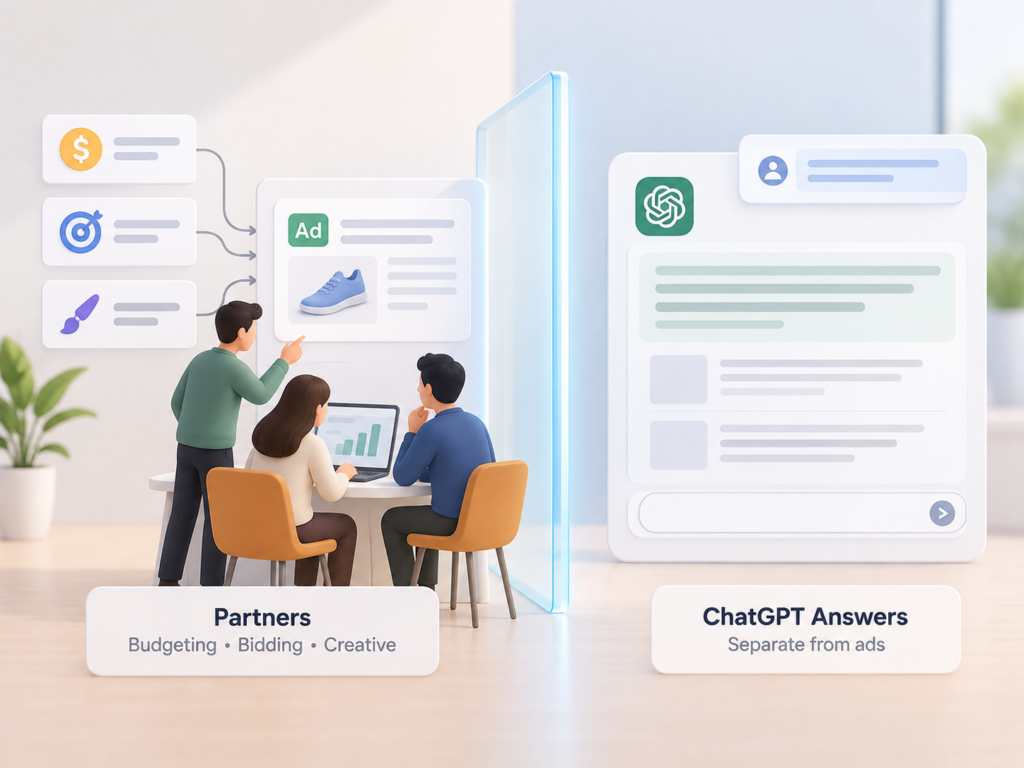
The third-party data backs that up so far. In Seer Interactive’s early tracking, the advertiser showed up in ChatGPT’s actual response for only 5.4% of 3,697 ads and was cited as a source 3.3% of the time, and both figures fell further by July 9.
A larger sample tells the same story. SE Ranking’s study analyzed 50,006 commercial prompts across 20 U.S. niches and found that ChatGPT displayed a paid placement on 25.94% of commercial prompts, from 1,159 unique advertisers, while the advertiser was also cited organically in just 3.63% of placements.
Here’s the thing. Those numbers describe two largely separate populations of brands. The companies buying the card and the companies earning the citation are mostly not the same companies, which tends to suggest that many early advertisers are buying their way into prompts they can’t win organically.
Organic citations do move, just not because of ads. AirOps measured a 41% drop in brand-query citations in early 2026 followed by a recovery to about 90% of baseline, and analysts closest to the data attribute that swing to model releases rather than advertising. Seer also found that ChatGPT’s algorithm shifted 46 days before ads were announced, with 55.8% of brands losing visibility before any public statement. Timing like that is worth noting. It isn’t proof that ads bought anything.
What Paid Placement Really Does to Organic Citations: It Changes the Neighbors
If ads don’t displace citations, what do they do? They change what surrounds them.
Seer describes the moment clearly: ChatGPT recommends a brand, and right below that recommendation sits an ad for a different company offering an alternative. Traditional search never put a competitor’s pitch directly under an endorsement. In ChatGPT, your strongest organic moment is now ad inventory, and anyone with a $25 budget and a well-chosen context hint can bid on it.
The neighbor isn’t always a direct rival, either. A Seer analysis of 55,000 responses found only 38% of ads were in the same product or service class as the prompt, 58% were category-adjacent, and 4% had no meaningful connection, while SE Ranking found 14.35% of ads had no topical link. In practice, that means the card under your citation might come from a company you’ve never tracked as a competitor.
That’s the gap most citation reports still can’t see.
Four Positions Your Brand Can Hold When the Auction Opens
Every brand sits somewhere on this grid for each high-intent prompt. The right move depends entirely on which cell you’re in.
| Organic status | Running ads? | What the user sees | What to do first |
|---|---|---|---|
| Cited and recommended | No | Your recommendation, often with someone else’s card underneath | Defend: find out who’s buying your best prompts |
| Cited and recommended | Yes | Your recommendation plus your own card | Test incrementality: you may be paying for clicks you’d already earn |
| Not cited | Yes | An answer endorsing a competitor, then your card | Fix organic first: you’re paying to argue with the answer |
| Not cited | No | Nothing | Start with the sources ChatGPT cites for that prompt |
The third row is where budgets tend to leak. Seer flagged a case where competitors owned every position in the AI responses, so running ads on top would have hurt the brand and wasted spend.
The second row isn’t automatically a win, either. Showing up twice in one answer can reinforce trust. It can also mean your CPC budget is buying traffic the organic citation would have delivered for free.
Ads Manager Shows the Click. It Won’t Show You the Answer Beside It.
Native reporting covers the paid side only. As Geoptimizer notes, OpenAI’s ad reporting includes impressions, clicks, CTR, CPC and conversions, but not the prompt that triggered an impression or your organic impression share.
That’s a problem, because the answer next to your ad isn’t static. Seer points out that the response beside your ad is generated in real time from everything the model knows about your brand, personalized to the user, and you may not know what it says until a buyer is reading it.
So you need a second instrument. That means a fixed prompt set that mirrors your context hints, run on a schedule, recording whether your brand is mentioned, whether it’s cited, where it ranks against competitors, and which domains supply the citations. Paid presence, organic mention, and source citation are three separate events. Report them separately.
The stakes justify the effort. In one Seer client study, ChatGPT-referred traffic converted at 15.9% versus 1.76% for Google organic. Traffic that valuable deserves more than a click report.
Signals That Answer Independence Is Starting to Slip
OpenAI’s commitment is public, but the internals aren’t. No public documentation describes whether advertising signals affect retrieval, source selection, or ranking logic. You don’t need to assume bad faith to keep watching. You just need baselines.
Start with the overlap rate. Seer’s 5.4% mention rate and 3.3% citation rate are useful reference points. If, in your category, the brands in the ad slot start appearing in the answer body far more often, the layers are converging.
Next, watch citation counts on commercial prompts. Starting around December 1, 2025, citations per response rose 81%, from an average of 5.7 to 10.4, before anyone outside OpenAI knew ads were coming. Structural shifts like that tend to reshuffle which brands get cited, and they don’t come with a press release.
Also, track advertiser domains in your source lists. A sponsor’s landing pages suddenly appearing among cited sources on prompts where it’s also buying is exactly the pattern you’d want to catch early.
Mapping Organic Citations Before You Set a Bid
The sequence matters: organic diagnosis first, bid second. That way every dollar in Ads Manager is assigned to a known position on the grid above, not a guess.
For teams that want this without building a scraper, Topify tends to fit the organic side of that workflow. Its Visibility Tracking runs your prompts across ChatGPT, Perplexity, and Google AI Overviews and shows whether your brand is mentioned, how it’s positioned relative to competitors, and how sentiment reads. The citation layer is where it earns its keep: Topify reverse-engineers the exact domains and URLs AI platforms cite, so you can see whether a prompt you’re about to bid on is won by your pages, a competitor’s pages, or third-party review sites you could still influence.
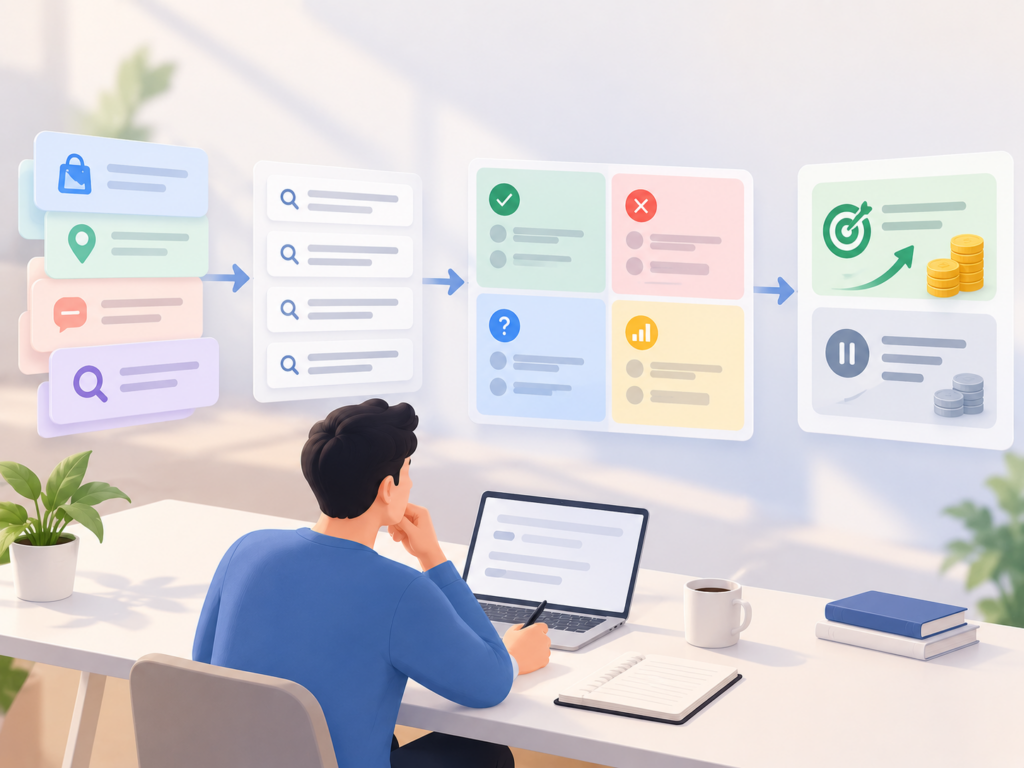
A practical workflow looks like this. Take the context hints you plan to target, turn each into three or four real prompts, and track them for a couple of weeks. Classify every prompt into one of the four cells. Then spend where you’re absent but the cited sources are winnable, and hold back where competitors own the answer outright.
Topify’s Basic plan starts at $99/month with 100 prompts and a 30-day trial, which covers the core prompt set of most single-brand teams. It focuses on the organic layer, so teams that also want to log which advertisers appear on each prompt can pair it with a dedicated ads tracker. You can get started with Topify and have your first baseline before your first campaign clears review.
Conclusion
ChatGPT ads self serve didn’t break the organic layer. On current evidence, paid placement and cited answers run as separate systems, and buying one doesn’t buy the other.
What it did change is the context. Your best citations now have a sponsored slot underneath them, and the cheapest entry point in ad-platform history means anyone can compete for it. Your weakest prompts, meanwhile, now come with a paid shortcut that can quietly waste money if the answer above the card endorses someone else.
Bottom line: measure the organic layer before you bid, keep paid and organic reporting separate, and set baselines now while the auction is still thin.
FAQ
Q: Does running ChatGPT ads improve my brand’s organic citations?
A: Current data says no. Seer Interactive and SE Ranking both found the advertiser appears in the organic answer or source list in only a small single-digit share of ad placements, and OpenAI states ads don’t influence responses.
Q: What’s the minimum budget for ChatGPT ads self serve?
A: Reports on the Ads Manager beta put the entry point at a $25 daily budget, down from the $200,000 minimum of the managed pilot. CPC and CPM bidding are both available.
Q: Can competitors run ads on prompts where ChatGPT recommends my brand?
A: Yes. Targeting uses context hints, not your brand’s organic status, so a rival’s Sponsored card can appear directly under an answer that recommends you. Tracking your recommended prompts is the only way to see how often that happens.
Q: How do I track organic citations and paid placements in ChatGPT separately?
A: Use Ads Manager for impressions, clicks, and conversions, and a GEO platform such as Topify for prompt-level mentions, position, and cited sources. Report paid presence, organic mention, and citation as three distinct metrics.

