

Your keyword list has 300 terms in it. Every one earned its place because a tool showed it had volume. Then an AI engine cites one of your pages, and you go looking for which term did it. Nothing matches. The query that surfaced your page was something like “NCLEX pass rates by nursing school,” a phrase no user typed and no keyword tool tracks. In one analysis of AI citations, 95% of the sub-queries that produced a citation had zero traditional search volume. The queries doing the work are the ones nobody targeted.
What Prompt Search Actually Means Inside an AI Engine
Prompt search is what happens when a person hands an AI system a full request instead of a search phrase. The difference isn’t length. It’s who does the decomposition.
In keyword search, the user breaks a messy need into a short query, scans ten links, and reassembles the answer. In prompt search, the user states the whole need at once and the engine does the breaking apart, the retrieval, and the reassembly. That shift moves the work from the person to the model, and it moves the query from your keyword tool into a black box.
The numbers make the gap concrete. ChatGPT’s internal searches average about 5.5 words, roughly 60% longer than a typical Google query, and they lean commercial rather than navigational.
| Dimension | Keyword search | Prompt search |
|---|---|---|
| Input | 2 to 4 word phrase | Full sentence with constraints |
| Who decomposes intent | The user | The model |
| Queries issued per request | One | Two to eleven, sometimes hundreds |
| Output | Ten ranked links | One synthesized answer with citations |
| Visible to your tools | Yes | Almost never |
Query Fan-Out: How One Prompt Turns Into Nine Searches
Google gave the mechanism its name at I/O 2025, describing how AI Mode breaks a question into subtopics and issues a set of queries simultaneously on the user’s behalf. Perplexity, ChatGPT, and Gemini all run some version of the same loop.
The sequence has four stages. The model parses the prompt for intent and complexity. It generates sub-queries covering different facets. It dispatches them in parallel across web results, knowledge graphs, and specialized indexes like Google’s Shopping Graph. Then it merges the returns into one answer.
Fan-out depth varies a lot by how the question is framed. Across a dataset of 15,000 prompts, 89.6% triggered two or more follow-up searches, and the total query set expanded to 43,233, close to a threefold multiplier. Discovery-style prompts average around 3.63 sub-queries, while some published studies put the range closer to nine or eleven for complex buying questions. Google’s Deep Search sits at the far end, capable of issuing dozens or even hundreds of background queries before it responds.
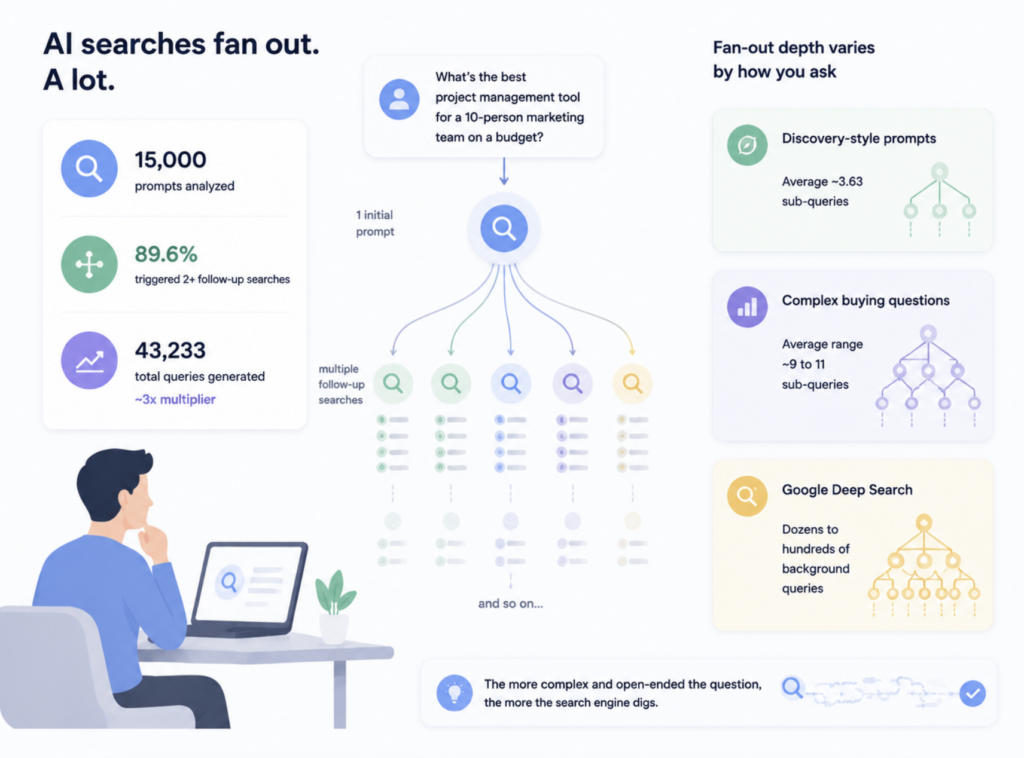
Simple factual prompts skip the process entirely. “Capital of Spain” gets one lookup. “What’s the best project management tool for a 12-person creative agency” gets a swarm.
The Fan-Out Queries You Won’t Find in Any Keyword Tool
Here’s the part that breaks conventional keyword strategy. In the same 15,000-prompt dataset, 32.9% of all cited pages appeared in fan-out results only. They were never discovered through the original prompt.
Pair that with the 95% zero-volume finding and the picture gets uncomfortable. Roughly a third of citation opportunities live in queries that a keyword tool will never show you, because they aren’t demand. They’re the model’s internal questions: “NCLEX pass rates by nursing school,” “project management tools for creative teams comparison,” “vegan breakfast Paris hotel.”
Your keyword list isn’t just incomplete. It’s a sampling frame that structurally excludes the queries responsible for a third of your AI citations.
That’s the gap most reporting still can’t see.
Not Every Prompt Triggers a Search
Fan-out only matters when the model decides to retrieve at all, and a lot of the time it doesn’t. The Nectiv study found 31% of prompts triggered at least one search. Clickstream analysis puts the figure at 34.5% as of February 2026, down from around 46% in late 2024.
The rest comes from what the model already knows. One replication study attributes roughly 68% of ChatGPT citations to training data rather than live retrieval, with about 27% traceable to Bing’s index.
Intent predicts the split fairly reliably. In a capture of 48 SaaS buying prompts, every “best X for Y” and “alternatives” question triggered a search, while definitional questions and most two-way comparisons were answered from memory. Gemini leaned hardest on memory. Perplexity searched every time.
So there are two surfaces to optimize, not one. Retrieval-layer visibility responds to content you publish this quarter. Training-layer visibility responds to how widely and consistently your brand was described across the web months or years ago. Different levers, different timelines.
Why Keyword Rankings Can’t Measure Prompt Search Performance
Three measurement gaps show up as soon as a team tries to report on prompt search using existing tooling.
The queries aren’t enumerable. Two users asking for the same thing will phrase it differently, and each phrasing spawns a different fan-out set. There’s no finite list to rank against.
There’s often no click. A prompt returns one answer. Being the cited source matters more than being the tenth blue link, and your analytics won’t record the difference.
Prompt volume estimates carry wide error bars. Most figures come from browser-extension panels, which skew toward desktop, Chrome, and tech-forward users, then get extrapolated. Industry practitioners have argued that prompt volume works as a directional signal, not a demand count, and analysts have raised similar concerns about panel representativeness. That’s a fair critique, and it’s worth holding onto.
What replaces the ranking number isn’t a single metric. It’s a set: whether you’re mentioned, where you sit in the answer, how the model characterizes you, and which domains it cited to get there. That last one is the most actionable, because citation sources are observable in a way that fan-out queries usually aren’t.
How to Make Content Survive Query Fan-Out
Fan-out rewards breadth over single-keyword depth. Your page enters the candidate pool through whichever sub-query happens to match it, so covering one angle well gets you one entry ticket.
In practice that means treating a topic as a set of facets rather than a keyword. Features, pricing, integrations, comparisons, use cases, alternatives, and limitations each pull a different sub-query. A product page that only sells is invisible to the sub-query asking about pricing tiers or migration paths.
Self-contained passages help too. Models retrieve and quote at the passage level, so a paragraph that depends on three paragraphs of prior setup tends to lose to one that answers a question outright.
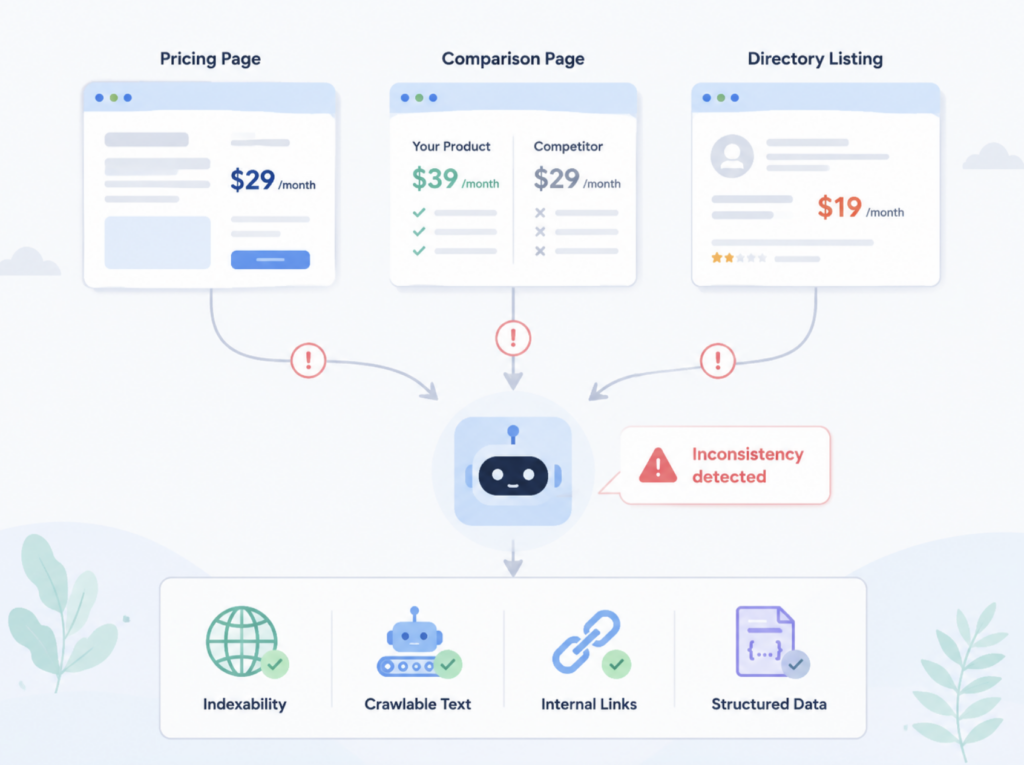
Consistency across assets matters more than it used to. Fan-out gives an answer several independent ways to find a contradiction. If your pricing page says one thing, your comparison page says another, and a directory listing is two years stale, the model has three chances to notice and route around you. The same foundations Google documents for AI Modestill apply: indexability, crawlable text, internal links, and structured data that matches what’s visible on the page.
And getting retrieved isn’t the finish line. In that 15,000-prompt dataset, ChatGPT cited only about 15% of the pages it pulled into the process. Discoverability and selectability are two separate problems, and most advice only addresses the first.
Tracking Prompt Search at the Prompt Level
If the unit of AI search is the prompt, the unit of measurement has to be the prompt as well. That means running the questions your buyers actually ask, across the engines they actually use, on a schedule, and recording what comes back.
Topify is built around that unit. Its High-Value Prompt Discovery keeps surfacing new prompts as recommendation patterns shift, which addresses the enumeration problem directly: rather than guessing which fan-out queries exist, you widen the prompt set and watch which ones return your brand. Its citation analysis reverse-engineers the exact domains and URLs AI platforms reference, so when a competitor starts appearing in a category answer, you can trace which source moved and decide whether that’s a content gap, a review-site gap, or a Reddit gap. Seven metrics run underneath: visibility, sentiment, position, volume, mentions, intent, and conversion visibility rate, tracked across ChatGPT, Gemini, Perplexity, and other engines.
Coverage is where prompt-level tracking earns its keep. Entry pricing starts at $99 per month for 100 tracked prompts across ChatGPT, Perplexity, and AI Overviews, which is enough to baseline a category and see whether the pattern holds before scaling the prompt set. Teams that want the mechanics behind the tracking can start with how AI search visibility is measured in ChatGPT, then get started with their own prompt list.
Conclusion
Prompt search doesn’t invalidate SEO. It changes the unit of analysis from a phrase you chose to a question the model asked itself. Query fan-out is why: one prompt becomes a handful of parallel lookups, most of them invisible to keyword tooling, and roughly a third of your citations come from queries you’d never have targeted.
Three things worth doing this month. Write down the twenty questions your buyers actually ask, in their words, not in keyword form. Check which of those trigger retrieval versus memory, because the fix differs. Then audit whether your content covers the facets a fan-out would probe, pricing and comparisons and alternatives included, or only the one angle your keyword research pointed at.
FAQ
Q: What is query fan-out in simple terms?
A: It’s the technique AI search engines use to answer one question by silently running several related sub-queries in parallel, then merging the results into a single answer. Google introduced the term with AI Mode, but ChatGPT and Perplexity use comparable approaches.
Q: How is prompt search different from keyword search?
A: Keyword search asks the user to compress a need into a short phrase and reassemble the answer from links. Prompt search takes the full request and lets the model decompose it, retrieve across sources, and return one synthesized answer. The decomposition work moves from the person to the engine.
Q: Can I see the fan-out queries an AI engine ran on my prompt?
A: Partially. Perplexity and Google AI Mode surface some of the sub-queries in the interface, and reasoning traces occasionally expose them. Most remain hidden, which is why teams approximate them by tracking a wide prompt set and observing which brands and sources appear.
Q: Should I build pages for fan-out queries that have zero search volume?
A: Not one page per query. Fan-out queries are facets of a topic, not standalone demand, so the better move is deepening existing pages to cover pricing, comparisons, use cases, and limitations. Breadth on one strong page usually beats thin pages chasing phantom volume.

