

Your keyword list is sorted by search volume. It always has been. The top rows get the content budget, the bottom rows wait until next quarter, and nobody questions the ordering because the numbers come from a tool everyone trusts.
Then you run those same top-row keywords through ChatGPT and the answers come back about something adjacent. Not wrong, just different. The prompts people actually type look nothing like the four-word strings in your spreadsheet.
There are two demand numbers for the same topic now. One is measured and familiar. The other, AI search volume, is estimated, invisible to keyword tools, and moving in a direction the first one can’t predict. Closing that gap is what a geo rank tracker exists to do.
The Same Keyword Has Two Demand Numbers, and They Don’t Move Together
Start with how differently people phrase the same need. Semrush found the average AI Mode query runs 7.22 words against 4.0 words for a traditional Google query, and full ChatGPT prompts average around 23 words when the search interface is off.
That isn’t noise around a shared average. It’s a different input format producing a different retrieval path.
What the model does with that input widens the gap further. Nectiv analyzed 8,500 prompts and found ChatGPT triggered a search in 31% of them, averaging 2.17 searches per prompt at about 5.48 words each. Nearly 77% of those internal queries ran five words or longer.
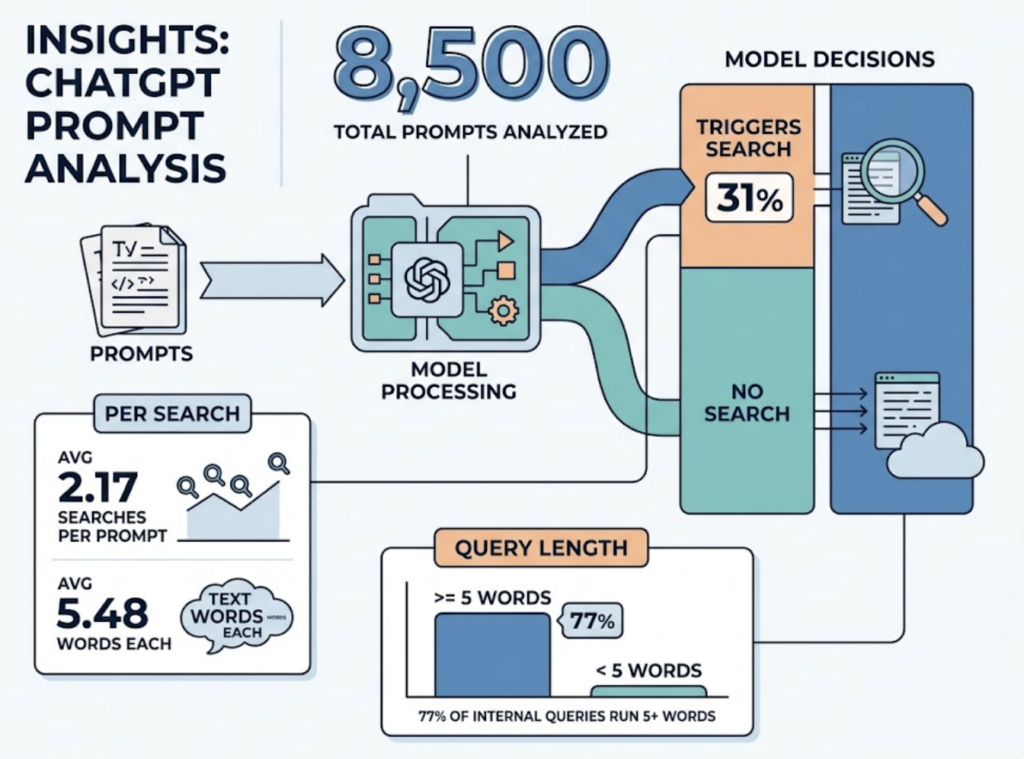
So a single prompt fans out into two or three machine-written queries that were never in anyone’s keyword database. Your Google volume figure describes none of that.
Why Keyword Tools Can’t See AI Search Volume at All
The blind spot is structural, not a lag in tool development. Keyword Planner, clickstream panels, and search console exports all measure queries typed into a search engine. Prompt data sits inside OpenAI, Anthropic, and Google, and none of them publish it.
The scale of what’s missing is the uncomfortable part. AI assistants now generate an estimated 45 billion monthly sessions globally, roughly 56% of traditional search engine volume, with the genuinely search-equivalent share closer to 28%. None of that activity registers in a keyword tool.
Ahrefs framed the measurement problem cleanly: AI breaks the three assumptions rank tracking was built on. Results are probabilistic rather than deterministic, positions aren’t fixed, and prompt volume is hidden demand that no one can query directly.
Here’s the practical read. AI search volume, wherever you get it, is a sampled estimate rather than a census. That’s a real limitation, and it’s still more information than an empty column.
Head Terms Are Shrinking Exactly Where AI Search Volume Is Growing
The structure of keyword demand is shifting underneath the numbers you already have. Brainlabs pulled 1.35 million keywords across nine UK categories and found head terms in structural decline in seven of the nine, with longtail growing.
Pair that with what Semrush saw in 260 billion rows of clickstream data: users who adopted ChatGPT showed no statistically significant drop in daily Google sessions. People didn’t leave Google.
They changed what they ask it.
That combination is the one most teams miss. If session counts hold steady while head terms decay and longtail expands, the loss isn’t traffic volume in aggregate. It’s the predictive power of the specific metric your priority list is sorted by.
Rankings Break the Same Way Volume Does
Volume isn’t the only SEO signal that stops transferring. Ahrefs ran 15,000 long-tail queries through Google, Bing, and four AI assistants and measured an average citation overlap of about 11% with the top 10. Looked at from the other direction, roughly 12% of AI-cited URLs rank in Google’s top 10 for the original prompt.
Longitudinal data points the same way. Research summarized by 5WPR tracked the overlap between top-ranking pages and AI-cited sources falling from around 70% to under 20%, and still declining.
At the brand level it gets concrete. An analysis of 150 SaaS companies across 120 keywords found 44% of Google top-10 brands received zero ChatGPT citations for the same keywords, and organic traffic correlated with ChatGPT citations at only r = 0.23.
One caveat worth keeping, because the picture isn’t uniform across platforms. Ahrefs’ study of AI Overview citations found 76.1% of cited pages rank in Google’s top 10. Google’s own answer layer still leans heavily on Google’s index. ChatGPT is the outlier, and it’s also where most of the prompt volume sits.
Treat “AI search” as one channel and you’ll average away the differences that matter.
What a GEO Rank Tracker Measures That a Keyword Tool Doesn’t
The unit of measurement has to change before the metrics mean anything. Keyword tools count queries and positions. A geo rank tracker samples prompts and measures how often a brand shows up inside the answer.
| Dimension | Traditional rank tracker | GEO rank tracker |
|---|---|---|
| Unit tracked | Keyword string | Prompt and its query fan-out |
| Result type | Fixed position, 1 to 100 | Mention, order within answer, cited or not |
| Demand signal | Google search volume | Estimated AI search volume across platforms |
| Coverage | One engine’s index | ChatGPT, Gemini, Perplexity, AI Overviews and others |
| Stability | Deterministic, repeatable | Probabilistic, needs repeated sampling |
| Competitive view | Who outranks you | Who gets recommended instead of you |
The sampling requirement is the part teams underestimate. One prompt run once tells you almost nothing, because the same prompt can return different brands on the next call. Directional accuracy comes from running many prompts repeatedly and reading the aggregate, which is why prompt count and refresh frequency matter more in AI visibility tracking than they ever did in rank tracking.
How to Rebuild Your Keyword Priority List Around AI Search Volume
Four steps, in order.
Sample real prompts before estimating anything. Pull the questions your sales team, support tickets, and community threads actually contain, then compare them against synthetic prompt lists. Real user phrasing tends to be longer and more problem-shaped than what a keyword-to-prompt converter produces.
Run both numbers side by side. Keep Google volume in the sheet. Add estimated AI search volume as a second column rather than a replacement, and sort by the gap between them. Keywords where AI search volume runs high and your mention rate runs low are the underpriced ones.
Don’t apply this to every keyword. Intent decides. NP Digital’s analysis found navigational queries account for 34.6% of search volume but trigger AI Overviews only 1.5% of the time, while informational queries make up 49.6% of volume and trigger them 45.9% of the time. Branded and navigational terms still behave like classic SEO. Informational and comparison terms are where AI search volume changes the ranking of your priorities.
Recheck weekly, not quarterly. Prompt phrasing and citation patterns move faster than SERPs do. A priority list built on a single snapshot ages out in about a month.
Where a Platform Fits in This Workflow
Running the loop manually across four platforms is where most teams stall out. Topify tends to fit here because volume isn’t a standalone report inside it. Prompt-level volume sits in the same view as visibility, mentions, position, sentiment, intent, and CVR, so a keyword with strong AI demand and a zero mention rate surfaces as one row rather than as a manual join between two exports.
Its prompt discovery works on the hidden-demand problem directly, surfacing high-volume prompts in a category as AI recommendations shift, then tracking whether the content you publish against them actually changes the citation pattern. Competitor benchmarking runs on the same prompt set, which answers the question rank tracking can’t: not who outranks you, but who the model names when you aren’t mentioned. You can get started on a single project before rolling it across a full keyword library.
Conclusion
Google search volume and AI search volume describe two different populations asking two differently shaped questions, and the published data gives no reason to expect the first to predict the second. Keyword demand is shifting toward longtail while head terms decay, and citation overlap with Google’s top 10 keeps falling. The fix isn’t abandoning search volume. It’s stopping the practice of using one number to price both channels. Add AI search volume as a second column, sort by the gap, and let a geo rank tracker tell you which of your best-ranked keywords the models have never heard you associated with.
FAQ
Q: What is AI search volume?
A: An estimate of how often a given prompt or topic gets asked across AI platforms like ChatGPT, Gemini, and Perplexity. Since none of those platforms publish prompt data, every AI volume figure is modeled from sampling rather than reported directly, which makes it useful for ranking priorities and unreliable as an absolute count.
Q: Does Google search volume predict AI visibility?
A: Weakly at best. Research on 150 SaaS brands found organic traffic correlated with ChatGPT citations at r = 0.23, and 44% of brands ranking in Google’s top 10 got no ChatGPT citations at all for the same keywords. Google AI Overviews are the exception, since they still pull most citations from top-10 pages.
Q: How do I find high-volume AI prompts?
A: Start with real user language from sales calls, support tickets, and community threads, then expand it with prompt discovery that samples live AI answers. Converting existing keywords into questions is a reasonable starting point, though it tends to produce shorter and more generic prompts than what users actually type.
Q: How is a geo rank tracker different from a traditional rank tracker?
A: A traditional rank tracker returns a fixed position for a keyword in one index. A geo rank tracker samples prompts repeatedly across several AI platforms and reports whether your brand is mentioned, where it falls in the answer, and which sources the model cited. The output is a share of answers over time rather than a single number.

