

Export your keyword list, sort by monthly volume, delete every row that reads zero. SEO teams have run some version of that cleanup for a decade, and it worked fine when Google was the only front door.
Then the questions moved into chat. Seer Interactive tracked 501 prompts through Gemini 3 and found that 95% of the queries the model generated had zero global search volume. The rows you deleted are the ones AI engines are actually running, and AI search volume is the metric that finally puts a number on them.
Keyword Volume Comes From Google. AI Search Volume Doesn’t Exist There.
Keyword volume is built from clickstream data and Google’s own reporting. AI platforms don’t publish prompt counts, so nothing that happens inside ChatGPT, Gemini, or Perplexity flows back into your keyword database.
Demand didn’t disappear. It fragmented.
When someone types “best CRM” into Google, that phrase aggregates across millions of users and registers as volume. When the same person asks an AI assistant which CRM fits a ten-person sales team that lives in Gmail, that sentence may never be typed the same way twice. Seer found only 1% overlap across its full fan-out dataset, meaning almost every query the model wrote was unique.
There’s a second problem, and it’s on the tracking side. AirOps analyzed 245,000 prompts its customers were monitoringand found the list peaked at six to seven words, with very little coverage past ten. Teams that have started tracking AI prompts are still tracking keywords with extra words attached.
Real prompts run longer, carry constraints, and end in a question mark.
What AI Search Volume Measures That Keyword Volume Can’t
The two metrics answer different questions. One tells you how many people typed a string. The other tells you how often a question gets asked in a chat window, and whether your brand survives the answer.
| Keyword Search Volume | AI Search Volume | |
|---|---|---|
| Data source | Clickstream and search engine reporting | Prompts run directly against AI platforms, modeled from panels and APIs |
| Query length | 3 to 4 words | 15 to 30 words, often multi-turn |
| Precision | Reported with reasonable accuracy | Directional, with wide error bars |
| What a win looks like | Position in a list of 10 links | Being named in one synthesized answer alongside two or three rivals |
| Refresh logic | Monthly averages | Answers change between runs, so tracking has to be continuous |
That fourth row is the one that reframes strategy. A search results page gives ten brands a shot at the click. An AI answer names three, maybe five, and the rest of the category is invisible for that prompt.
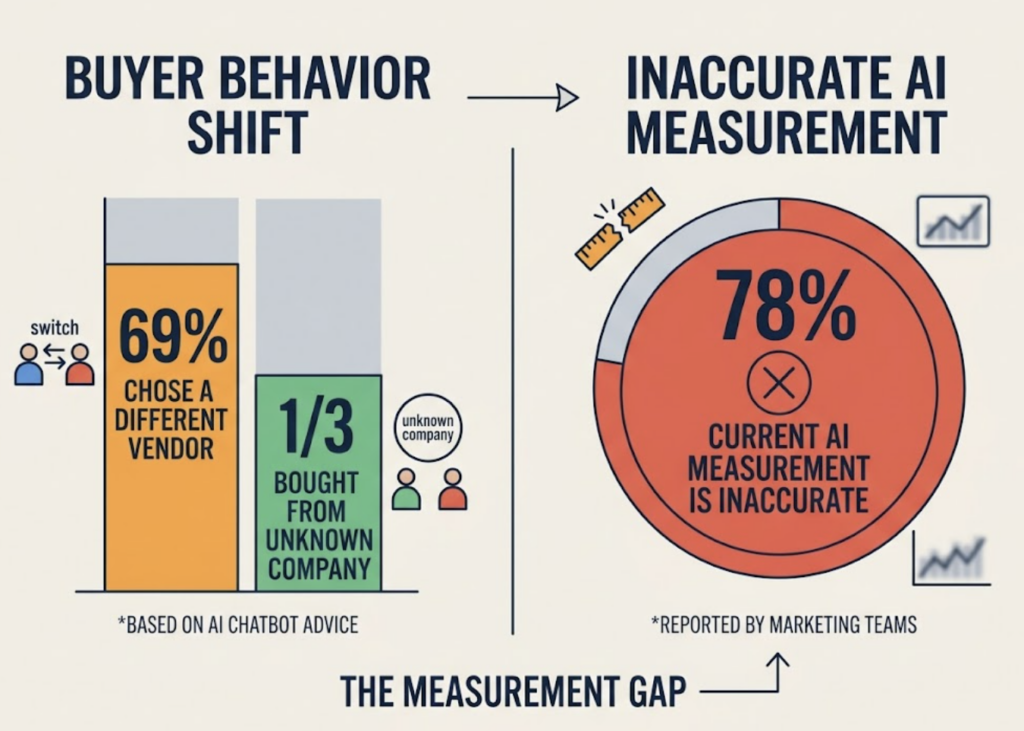
The stakes show up in buyer behavior. In G2’s March 2026 survey of 1,076 B2B software buyers, 69% chose a different vendor than they originally planned based on what a chatbot told them, and a third bought from a company they’d never heard of. Measurement hasn’t kept pace: 78% of marketing teams say their current approach to measuring AI visibility is inaccurate.
12 Prompts With Zero Google Volume but Real AI Search Volume
Every prompt below returns a brand recommendation from at least one major AI platform. None of them will show meaningful volume in a standard keyword tool, because nobody types sentences like these into a search box.
B2B SaaS
- “Which CRM works for a 10-person sales team that already lives in Gmail and doesn’t want a paid onboarding package?”
- “We’ve outgrown our help desk tool but the support team hates migrations. What should we shortlist?”
Software is where the shift is furthest along. G2 found that 51% of B2B software buyers now start research in an AI chatbot more often than in a search engine, up from 29% a year earlier. It’s also the vertical where models work hardest: software prompts fan out into more sub-queries than any other category, which means more chances for a competitor’s comparison page to get pulled in ahead of yours.
Ecommerce and Retail
- “I need a winter coat that handles a Chicago commute and weekend hikes, under $300, not too bulky.”
- “My kid’s school banned peanut products. Which lunchbox snack brands are actually safe?”
Roughly 2% of ChatGPT queries involve shopping, which works out to about 50 million shopping queries a day against an estimated 2.5 billion daily prompts. Retail prompts stack constraints the way shoppers actually think: use case, budget, climate, dietary restriction. Category pages built around head terms rarely satisfy all four at once.
Healthcare
- “My mother is 78 and on blood thinners. Which home blood pressure monitors are easiest for her to read and use?”
- “Is there a dermatology clinic near me that takes my insurance and does mole mapping?”
Healthcare buyers arrive with context they’d never put in a search bar. That context is exactly what makes the prompt convert. ChatGPT referral traffic in healthcare converts at about 4.5%, well above typical site baselines, because the model has already filtered for age, condition, and constraint before the visitor lands.
Travel and Hospitality
- “Where should we stay in Kyoto with a stroller and no car, walking distance to a train station?”
- “We have 26 hours in Doha on a layover. Is it worth leaving the airport, and where would we stay?”
Travel leads every industry in AI adoption. 47% of travel and hospitality customers now use ChatGPT somewhere in their purchasing journey, ahead of retail and CPG at 36% and IT services at 34%. Hotels and resorts also post the highest AI referral conversion rate in First Page Sage’s dataset, near 7.0%. A property either makes the model’s three-hotel list or it doesn’t exist for that trip.
Legal and Professional Services
- “My landlord kept my deposit after I moved out of a Chicago apartment. Do I need a lawyer or can I handle this myself?”
- “We’re a 12-person agency hiring our first employee in another state. What do we need to get right?”
Legal prompts almost never match a keyword, because the facts of the situation are the query. They also convert unusually well, around 5.6% from ChatGPT traffic, since anyone describing their own dispute to a model is already past the browsing stage.
Finance and Fintech
- “I’m self-employed with irregular income. Which business checking accounts don’t charge fees for low balances?”
- “We have $40K in savings and a 6.8% mortgage. Should we refinance or pay down principal first?”
Financial prompts carry numbers, timelines, and eligibility conditions in a single sentence. That’s four or five retrieval dimensions from one question, and each dimension pulls its own set of sources. Brands that publish only rate tables tend to lose these answers to explainer content from someone else.
Why These Prompts Never Show Up in Search Volume Data
Three structural reasons, and none of them are going away.
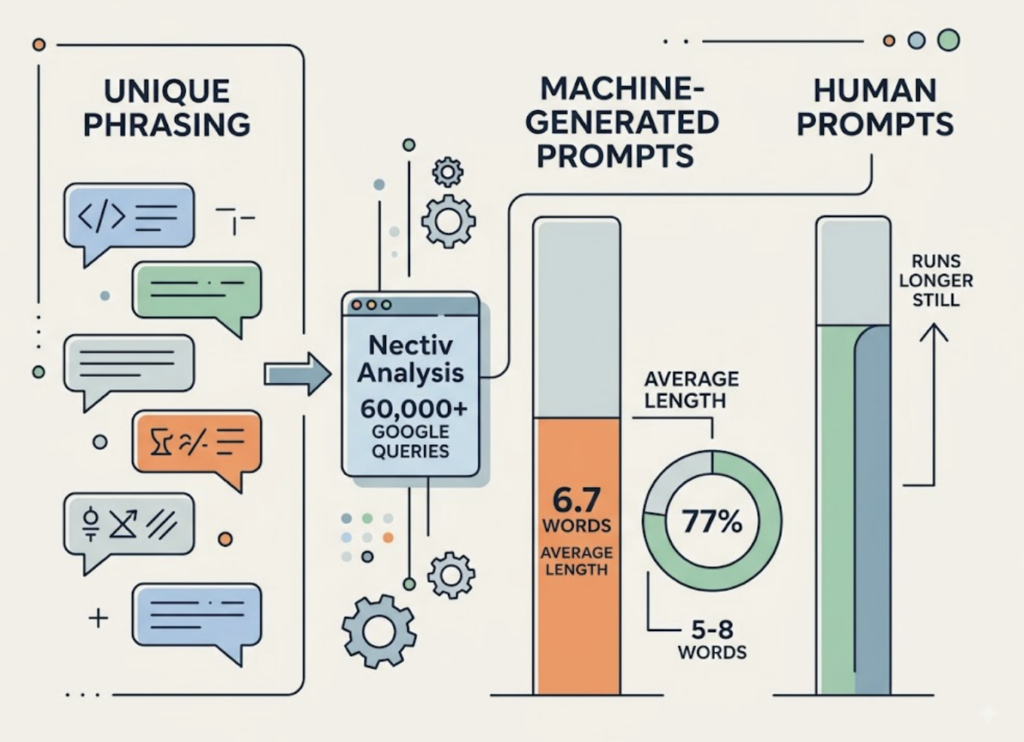
Phrasing is unique. Every user describes their own situation, so demand never aggregates into a countable string. Nectiv’s analysis of more than 60,000 Google fan-out queries found an average length of 6.7 words on the machine-generated side alone, with 77% falling between five and eight words. Human prompts run longer still.
Follow-ups are invisible. The second and third turns of a conversation are where the shortlist gets built, and no keyword tool has ever seen a second turn.
Many questions are new. Roughly 15% of daily searches are queries with no historical data at all. A tool that reports averages can’t report on something that happened for the first time this week.
Zero volume doesn’t mean zero demand. It means zero measurement.
How to Estimate AI Search Volume for Your Own Category
Start with real language, not exports. Pull the phrasing from sales call recordings, support tickets, and Reddit threads in your category. You want the sentence the buyer actually said, including the constraint that makes it specific.
Add persona variables. Take a base prompt and layer on team size, industry, budget, and use case. One question becomes eight, and each version can return a different brand list. This is how models personalize, so your tracking set should mirror it.
Balance the intent mix. Most brands over-index on comparison prompts and ignore the rest. Cover awareness, consideration, comparison, transactional, and generative intents, with a handful of prompts per type before you scale up the count.
Automate the runs. Answers shift between platforms and between days, so a screenshot is a data point with a shelf life of about an hour.
That last step is where a purpose-built platform earns its cost. Topify runs high-value prompt discovery continuously, surfacing new questions as AI recommendation patterns move, then works as an AI search rank tracker across ChatGPT, Gemini, Perplexity, DeepSeek, and other major engines so you can see where your brand sits relative to competitors in each answer. Source analysis closes the loop by showing which domains the models cited to build that answer, which is usually the fastest route to understanding why a competitor made the list and you didn’t. Seven metrics sit behind it: visibility, sentiment, position, volume, mentions, intent, and CVR.
Three Mistakes Teams Make With Zero-Volume Prompts
Tracking only head terms. A list of 40 category keywords with question marks appended is not a prompt set. It’s your old keyword list in costume, and it will report healthy numbers while you lose the specific, constrained questions where buying decisions get made.
Treating screenshots as data. Manual spot checks can’t produce trend lines, and trend lines are the only way to tell a real drop from normal answer variance.
Ignoring competitors. Your own mention rate means little without the relative view. Crackle PR’s Q2 2026 benchmark found 51% of B2B tech brands have zero citations across ChatGPT, Perplexity, and Gemini. In a category that empty, the brands that do show up own the whole answer.
Conclusion
The rows you deleted from that keyword export are now the competitive surface. Prompts with no measurable Google volume are where buyers describe their actual situation, and where models decide which three brands are worth naming.
Start small. Pick 20 prompts your customers have literally said out loud, run them across the platforms your buyers use, and see who the models recommend today. The gap between that answer and your positioning is your real GEO backlog. You can start tracking with Topify and have a baseline before your next reporting cycle.
FAQ
What is AI search volume?
AI search volume estimates how often a specific prompt gets asked inside AI platforms like ChatGPT, Gemini, and Perplexity over a given period. It’s the closest equivalent to keyword search volume, with one important difference: platforms don’t report it, so figures are modeled from panels and API sampling and should be read as directional rather than exact.
Can prompts really have zero Google search volume but high AI usage?
Yes, and it’s the norm rather than the exception. Research on Gemini’s query fan-out behavior found 95% of generated sub-queries carried no global search volume, largely because models write those queries at runtime and users phrase their own prompts differently every time.
How do I find AI search volume for my industry?
Start from real buyer language in sales calls, support tickets, and community threads, then run those prompts across multiple AI platforms and log how often your brand appears. Coverage across intent types tells you more than a single volume figure for any one prompt.
How many prompts should I track?
Most teams start between 50 and 100, weighted toward consideration and comparison intent, then expand as they see which themes actually return brand recommendations. Coverage matters more than raw count.

