

Your monthly report says your brand appeared in 62% of tracked AI answers, up from 48% last quarter. Leadership is happy. Then a sales rep forwards a screenshot: ChatGPT did mention you, but only after naming your competitor as the enterprise standard, and it described you as a decent pick for smaller teams.
Same mention. Opposite message.
Counting appearances tells you AI knows your brand exists. It doesn’t tell you whether AI is selling you or quietly steering buyers somewhere else. That’s the real job of brand analysis AI: reading how you’re described, not just how often.
Your Mention Count Went Up. That Might Be Bad News.
Mention rate is the easiest AI metric to report and the easiest to misread. It treats a glowing recommendation and a lukewarm aside as identical data points.
The scale of the blind spot is bigger than most teams assume. In one large dataset, 80.6% of AI brand mentions were classified as neutral, and positive mentions outnumbered negative ones by nearly 18 to 1. So the bulk of your “visibility” sits in a gray zone that a simple count can’t interpret.
Negative mentions are rarer, but they behave differently than on a search results page. BrightEdge found Google AI Overviews surfaced negative sentiment in roughly 2.3% of brand mentions, versus about 1.6% for ChatGPT, and noted that a negative AI response gets served again to every user asking a similar question.
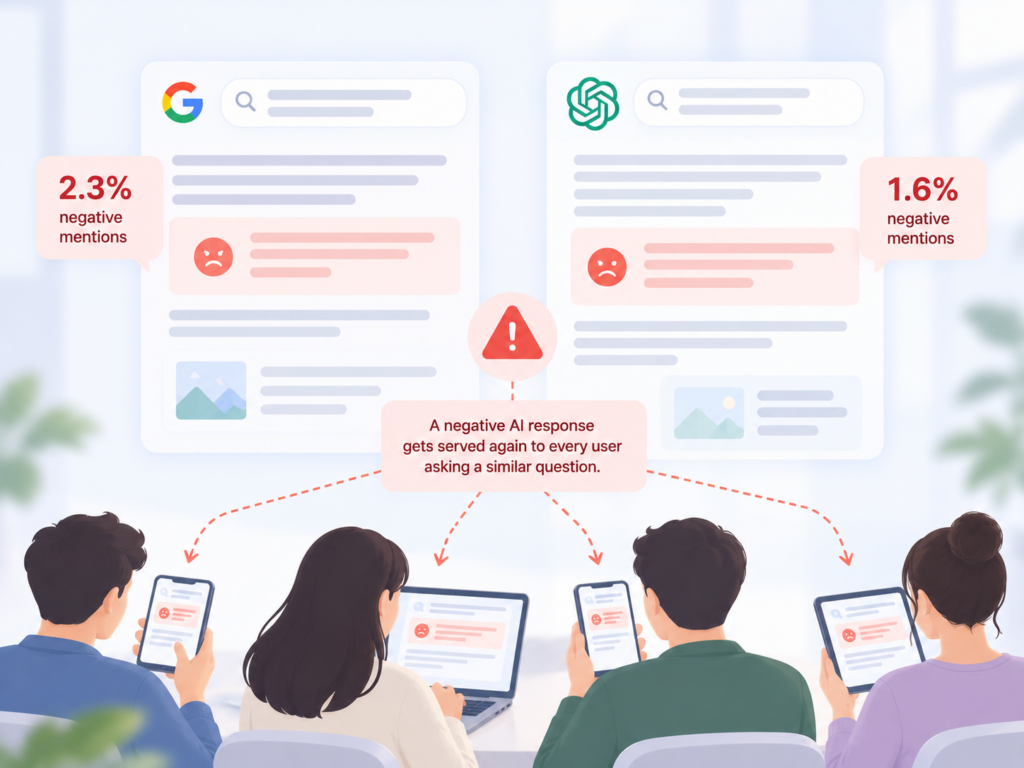
A bad review on page two gets skipped. A bad sentence in an AI answer gets repeated.
What Brand Analysis AI Actually Reads in an Answer
Good AI sentiment analysis works at the phrase level, not the answer level. The question isn’t “was the brand mentioned?” It’s “what job did the answer assign to the brand?”
Here’s how the same mention can carry very different weight:
| Answer phrasing | Counts as a mention? | What it actually signals |
|---|---|---|
| “X is the go-to choice for this use case” | Yes | Strong positive, primary recommendation |
| “X could work, though you may also want to consider Y” | Yes | Hedged, buyer is being redirected |
| “X offers basic features compared to Y” | Yes | Negative by comparison, no negative words used |
| “X is a cheaper alternative” | Yes | Positioning drift if you sell premium |
| “X had a data breach in 2024” | Yes | Controversy framing, top-of-funnel risk |
Every row scores the same on a mention dashboard. Only one of them is helping you.
That comparative row matters more than it looks. Analysts tracking Claude’s answers note it often expresses sentiment through comparison, so a line that positions a brand as lesser than a rival works as a negative signal even when no negative words appear. Keyword-based sentiment scoring misses this almost entirely.
Neutral Isn’t Safe: Where Brand Sentiment Hides
Most teams treat “neutral” as a pass. In practice, neutral often means AI mentioned you without giving the buyer any reason to pick you.
There are three places sentiment tends to hide:
Hedges and qualifiers. Words like “could,” “might,” and “worth considering” signal uncertainty. They rarely trigger a negative flag, but they soften intent at exactly the moment a buyer is deciding.
Attribute framing. Tone is only one layer. Brand perception also covers attributes, audience fit, objections, comparisons, factual accuracy, and answer position, and a brand can show up often while being framed as expensive or hard to implement. If AI keeps attaching “steep learning curve” to your product, that’s a sentiment problem wearing a neutral label.
Factual errors. Some of what AI says about you simply isn’t true. A 2026 arXiv preprint found that 11.0% of 98,020 atomic claims in Google AI Overviews weren’t supported by the pages they cited. That’s why sentiment work needs a fact-check layer, not just a tone score.
ChatGPT and Google Don’t Criticize the Same Brands
If you’re running brand analysis AI on a single engine, you’re seeing a fraction of the picture. The engines don’t just differ in volume. They differ in when and why they turn negative.
In BrightEdge’s analysis, Google AI Overviews was 44% more likely to surface negative brand sentiment than ChatGPT overall, yet ChatGPT concentrated its criticism about 13 times more heavily near the point of purchase. Specifically, 19.4% of ChatGPT’s negative sentiment landed in the consideration-to-purchase phase, compared with 1.5% for Google.
The triggers split, too. Google’s negativity skewed toward controversies like lawsuits, recalls, and data breaches, while ChatGPT leaned on product-evaluation themes such as feature gaps and value for money. And on overlapping prompts where both engines went negative, they flagged different brands 73% of the time.
Industry changes the math again. In apparel, the pattern flipped: ChatGPT was three times more negative than Google, because fewer controversy triggers pushed negativity toward product-evaluation queries.
Here’s the thing: even the user changes the answer. A 2026 study of 71,147 responses found ChatGPT, Claude, and Gemini shifted their recommendations when age, income, gender, or occupation changed, with the underlying question held constant. One snapshot from one account on one engine isn’t a sentiment baseline.
A 4-Step AI Sentiment Analysis Workflow
A sentiment number is only useful if you can trace it back to a cause. This is the workflow that tends to hold up when someone in leadership asks, “Why did this drop?”
Step 1: Build a Fixed Prompt Set by Funnel Stage
Split prompts into informational (“what is the best CRM for startups”), comparison (“X vs Y”), and purchase-intent (“is X worth the price”). Keep the set stable. If prompts change every month, you can’t tell a sentiment shift from a sampling shift.
Weight purchase-intent prompts heavily for ChatGPT, given where its criticism concentrates.
Step 2: Score Each Engine Separately
Don’t average ChatGPT, Gemini, Perplexity, and AI Overviews into one number. Because sentiment differs between models, a platform that scores each engine individually and stores the full response behind each score shows you how each one characterizes you, rather than an average that blurs the difference.
Step 3: Store Full Responses, Not Just Scores
A score of 58 tells you nothing about what to fix. The full answer tells you whether the problem is a hedge, a comparison, an outdated fact, or a controversy. Keep the raw text so you can compare this month’s wording against last month’s.
Step 4: Trace Sentiment to Sources in Aggregate
This is where most teams take a wrong turn. The common assumption is that if a positive page gets cited, the answer will inherit its tone. The data says otherwise. An analysis of 22,295 AI answers across ChatGPT, Perplexity, and Google AI Mode found that cited-page sentiment didn’t predict answer sentiment, with the answer acting as a synthesis of many sources rather than a transfer from one.
So look at the full pool of cited domains for a prompt cluster, not the single top citation. Sentiment tends to move when the aggregate signal across many cited sources shifts, plus, on ChatGPT, the underlying training data. If that pool is dominated by one outdated review site or a stale forum thread, that’s your lever.
Fixing Negative Framing Takes Longer Than Fixing Rankings
Once you know where the framing comes from, the fix depends on the engine.
For Google AI Overviews, controversy-driven negativity usually traces back to news coverage. The response is getting current, accurate context into the publications and pages AI is already pulling from: resolution notices, updated coverage, clear statements on your own site.
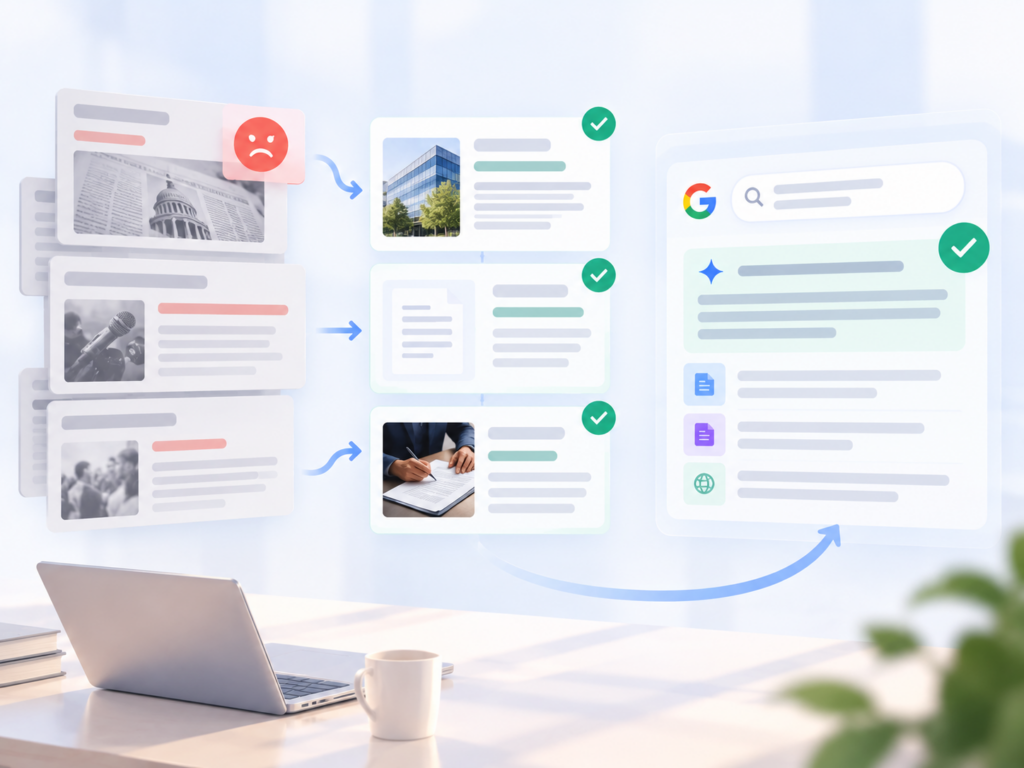
For ChatGPT, product-evaluation criticism tends to come from reviews, forums, and comparison content. BrightEdge attributes ChatGPT’s pattern to heavier reliance on product reviews, forums, and social discussions. That points you toward review platforms, community threads, and third-party comparisons where the “feature gap” narrative lives.
Set expectations internally. Because answer sentiment reflects the aggregate of many sources, one new blog post rarely moves the score. You’re usually looking at several months of consistent signal before the framing shifts, and you’ll only know it shifted if you’ve been tracking the same prompts the whole time.
Bottom line: sentiment is manageable, just slower and broader than a ranking fix.
Where Topify Fits in a Sentiment-First Brand Analysis Stack
For brand and PR teams that need phrase-level sentiment across engines, Topify is built around the workflow above rather than bolting sentiment onto a mention counter.
Its Sentiment Analysis assigns a 0-100 score to how AI describes your brand, and it sits next to Visibility and Position in the same view. In practice, that means you can see that you appear in 60% of answers, rank third on average, and carry a sentiment score that dropped 12 points on purchase-intent prompts, all for the same prompt cluster. That combination is what turns “we’re mentioned more” into “we’re mentioned more but recommended less.”
Competitor Monitoring auto-detects rivals and benchmarks Visibility, Sentiment, and Position side by side, which is how you catch the comparative framing that hides inside neutral answers. Source Analysis tracks which domains and URLs AI cites for each prompt, so you can map the aggregate source pool behind a negative shift instead of guessing from one page.
Coverage matters here too, given how differently engines behave. Topify tracks ChatGPT, Gemini, Perplexity, Google AI Overviews, DeepSeek, Doubao, Qwen, and others. The Basic plan starts at $99/month with a 30-day trial and 100 tracked prompts, which is enough to run a fixed funnel-stage prompt set for one brand and its main competitors.
The trade-off: like any sentiment tracker, the scores are only as good as your prompt set. Spend the first week getting prompts right before trusting the trend lines.
Conclusion
Mention counts answer one question: does AI know you exist? Sentiment answers the one that actually affects pipeline: is AI recommending you, hedging on you, or steering buyers to someone else?
Start small. Pick 30 prompts split across informational, comparison, and purchase intent. Score each engine separately, keep the full responses, and trace shifts back to the pool of sources behind them. Within a month, you’ll know whether your rising visibility is working for you or against you. If you want that workflow running without the spreadsheet, you can get started with Topify and build your first prompt set in an afternoon.
FAQ
Q: What is brand analysis AI?
A: Brand analysis AI refers to tools and methods that evaluate how AI engines like ChatGPT, Gemini, and Perplexity describe your brand. Beyond counting mentions, it scores tone, comparative framing, attributes, and factual accuracy in AI-generated answers.
Q: How accurate is AI sentiment analysis for brand mentions?
A: It’s generally reliable for explicit tone but weaker on hedges and comparisons unless it scores at the phrase level. The most dependable setups pair a numeric score with the stored full response, so a human can verify what drove each change.
Q: How often should I track brand sentiment in AI answers?
A: Weekly or daily tracking on a fixed prompt set works for most brands. Review the underlying answers whenever you ship a pricing change, a major launch, or face news coverage, since those events tend to shift framing.
Q: Can you change how ChatGPT describes your brand?
A: Yes, but not quickly. ChatGPT’s framing reflects many sources at once, especially reviews and forum discussions, so improving it means shifting the overall pool of content it draws from rather than publishing a single page.

