

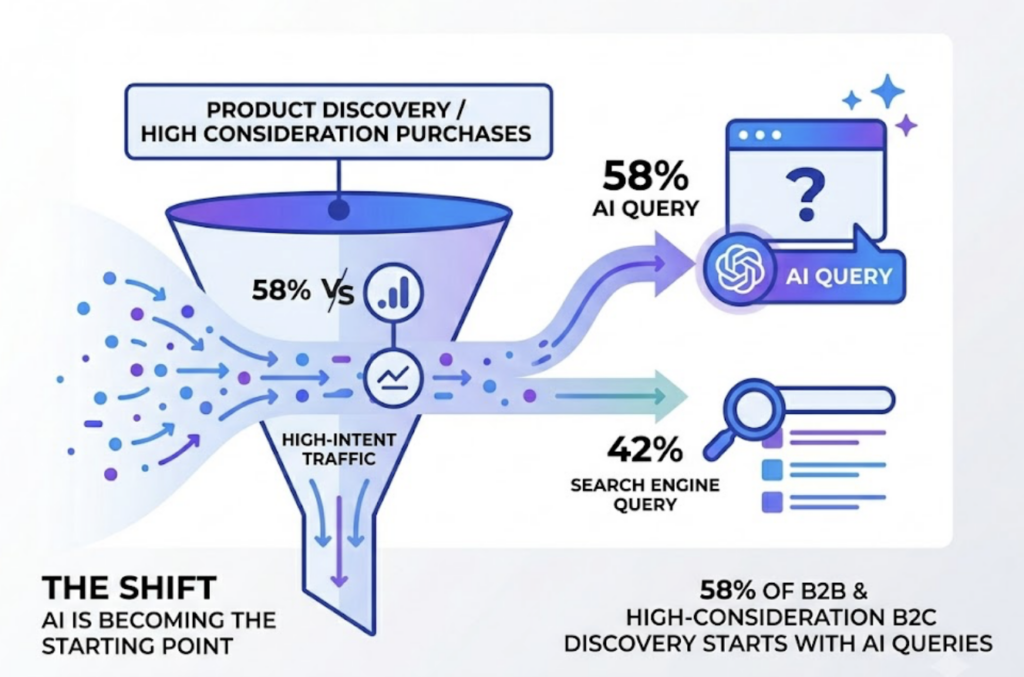
Your rank tracker shows green across the board. Search Console looks healthy. Domain authority is holding steady. By every metric in your search monitoring stack, things are fine. Yet according to 2026 market analysis, 58% of product discovery for B2B and high-consideration B2C purchases now starts with an AI-driven query, not a traditional search. Those conversations happen inside ChatGPT and Perplexity, and not a single dashboard you own can see them. The numbers you’re watching aren’t wrong. They’re just measuring a smaller and smaller slice of how customers actually find brands.
Your Search Monitoring Stack Was Built for a Shrinking Behavior
Most search monitoring setups share the same architecture: a rank tracker for keyword positions, Search Console for impressions and clicks, GA4 for sessions. All three rest on the same premise, that user intent gets resolved through a query followed by a click on a results page.
That premise carries three hidden assumptions. The “click” assumption defines success by traffic metrics like CTR and sessions. The “fixed ranking” assumption defines success by a numerical position from 1 to 10. The “uniform SERP” assumption presumes every user sees the same page of links for a given keyword.
All three are breaking at the same time.
The traditional ten blue links keep getting pushed further down the page or replaced outright by AI-generated summaries. And because AI models don’t operate on a rank 1 to 10 system, standard rank trackers return null or invalid results for queries that are generating real brand exposure inside LLMs. The tools aren’t failing. The behavior they were built to measure is shrinking.
Where Customers Actually Go: The AI Search Migration in Numbers
The migration isn’t speculative anymore. Three data points from 2026 research define its scale.
First, the high-intent shift: 58% of product discovery for B2B and high-consideration B2C purchases now begins with an AI query rather than a search engine query. These aren’t casual lookups. They’re the “what should I buy” and “which tool fits my use case” questions that used to feed your funnel through organic search.
Second, zero-click prevalence: 72% of all search interactions in the US, across both traditional search and AI platforms, now complete without a click-through to any third-party website. The answer gets consumed in place. No referrer, no session, no trace in GA4.
Third, platform scale: Perplexity and ChatGPT combined now handle over 1.2 billion daily active queries in the US as of Q1 2026. That’s not a novelty channel. That’s a primary search behavior running entirely outside your monitoring perimeter.
Here’s the uncomfortable part: the queries migrating fastest are the ones worth the most.
Why Rank Trackers Can’t See AI Answers
It’s tempting to treat this as a tooling upgrade problem. It isn’t. The object being measured has changed.
A SERP is a fixed page with discrete positions. An AI answer is generated fresh per conversation, shaped by phrasing, context, and the model’s citation choices. There’s no position 3 to track because there’s no stable page to track it on.
The disconnect shows up clearly in correlation research. Studies comparing Google rankings to AI citations found essentially no correlation between the two. A URL can sit at #1 on Google for a “best CRM” query and appear nowhere in the top five citations of ChatGPT’s response to the same question. The gap between AI search visibility and Google rankings isn’t a rounding error. It’s a structural divide: optimizing for Google’s algorithm doesn’t buy you visibility in the AI answer layer.
Which means a brand can hold every traditional ranking it has and still lose the recommendation moment that actually drives the purchase.
What Complete Search Monitoring Looks Like in 2026
The fix isn’t abandoning rank tracking. It’s widening the definition of search monitoring to match where questions actually get asked. In practice, that means shifting from rank tracking to visibility monitoring.
| Monitoring Dimension | Traditional Stack | AI-Era Stack |
|---|---|---|
| Primary metric | Keyword position | Share of voice in AI answers |
| Platform scope | Google, Bing | ChatGPT, Perplexity, Gemini, DeepSeek, AI Overviews |
| Data focus | Traffic and clicks | Citations, sentiment, direct mentions |
| Target audience | Searchers | High-intent questioners |
The AI-era columns aren’t replacements for the traditional ones. They’re the missing half. Your Google data still matters for the queries that stay on Google. But a complete search monitoring program now answers four questions the old stack can’t: Does AI mention your brand for the prompts that matter? Where does it position you relative to competitors? What sentiment does it attach to your name? And which sources is it citing when it forms those answers?
Extending Search Monitoring to AI Engines with Topify
Closing that gap manually means running hundreds of prompts across multiple AI platforms, week after week, and logging results by hand. Most teams try it once, get a snapshot, and never repeat it. The data goes stale within weeks because AI citation patterns shift constantly.
This is the gap Topify was built to fill. The platform treats the AI answer layer as a monitorable surface, executing your high-value prompts across ChatGPT, Perplexity, Gemini, and DeepSeek on a continuous schedule, then recording whether your brand gets mentioned, cited, or recommended in each response.
Three capabilities map directly onto the monitoring framework above.
Visibility Tracking measures your share of voice in AI answers over time. Instead of a keyword rank, you see mention frequency and position across platforms, so a drop in ChatGPT visibility shows up as a trend line, not a surprise in next quarter’s pipeline.
Source Analysis reverse-engineers the citations behind AI answers. It identifies exactly which domains each model treats as authoritative for your category. In practice, this tells you where to earn coverage: if Perplexity keeps citing two industry publications you’ve never pitched, that’s your content roadmap.
Competitor Monitoring tracks answer share of voice across your category, flagging when a rival starts gaining ground in AI-generated advice at your expense. You see emerging competitors the moment models start recommending them, not after they show up in lost deals.
Pricing keeps the entry point low for teams testing the channel. The Basic tier starts at $99/month and covers up to 100 custom-defined prompts, which is enough to monitor a full question library for one brand. If you want to gauge the gap before committing to anything, the free GEO tools reference lists no-signup checks you can run today, and you can get started with Topify once you’ve confirmed the blind spot is real.
The shift in mindset matters as much as the tooling: you stop tracking keywords and start tracking questions.
How to Start Monitoring Where Your Customers Actually Search
You don’t need to rebuild your reporting stack to close the gap. Four steps get a working program running in under a month.
- Audit your question library. Identify the top 50 high-intent questions customers ask in your category, like “best enterprise alternatives to X” or “which tool handles Y.” These are your prompts, the AI-era equivalent of a keyword list.
- Run baseline tests. Execute those prompts across ChatGPT, Perplexity, Gemini, and AI Overviews. Record where your brand appears, where it doesn’t, and who gets recommended instead.
- Deploy continuous monitoring. One-off snapshots decay fast because citation patterns shift every few weeks. Set up automated AI answer monitoring to capture weekly movement in mentions, sentiment, and citation authority.
- Integrate into reporting. Merge AI-layer visibility into your monthly dashboard. Treat AI citations as a leading indicator of brand authority, the same way GA4 traffic works as a lagging indicator of interest.
That last step is where the organizational shift happens. Once AI visibility sits next to organic traffic in the monthly review, the team stops treating it as an experiment and starts treating it as a channel.
Conclusion
Your search monitoring isn’t broken. It’s incomplete. The dashboards still accurately measure what happens on Google, but with 58% of high-intent discovery starting in AI tools and 72% of interactions ending without a click, the most valuable customer questions now get answered in places your stack can’t see. The brands that adapt first won’t be the ones with the best Google rankings. They’ll be the ones who noticed where the questions went, built a question library, baselined their AI visibility, and put the answer layer on the same dashboard as everything else. The migration already happened. The only open question is whether your monitoring follows it.
FAQ
Q: What is search monitoring?
A: Search monitoring is the practice of tracking how and where a brand appears when customers search for relevant topics. Traditionally it covered keyword rankings, SERP features, and organic traffic. In 2026, complete search monitoring also includes the AI answer layer: brand mentions, citations, and sentiment inside ChatGPT, Perplexity, Gemini, and Google AI Overviews.
Q: How is AI search monitoring different from rank tracking?
A: Rank tracking measures a fixed numerical position on a results page. AI answers have no fixed positions, so AI search monitoring measures share of voice instead: how often a brand gets mentioned, where it appears relative to competitors, what sentiment it carries, and which sources the AI cites.
Q: Which AI platforms should brands monitor?
A: Start with the platforms handling the most high-intent volume: ChatGPT, Perplexity, Gemini, and Google AI Overviews. Brands targeting markets where DeepSeek, Doubao, or Qwen have meaningful adoption should add those as well.
Q: How often should you monitor AI search results?
A: Weekly at minimum. AI citation patterns shift every few weeks as models update and source authority changes, so monthly snapshots tend to miss the movements that explain visibility gains or losses.

