

Most marketers assume their analytics stack still sees the whole picture. It doesn’t. In the first four months of 2026, 68.01% of Google searches ended without a single click, up from 60.45% just two years earlier. Your prospects are still searching. They’re just getting answers from AI Overviews, ChatGPT, and Perplexity before they ever reach your site, which means the most important part of their decision now happens where Google Analytics can’t follow. Search monitoring didn’t become less important. It became a different job.
Your Traffic Didn’t Disappear. It Moved Somewhere GA4 Can’t See.
Traditional search monitoring rests on one assumption: a user searches, clicks, and lands on a website where analytics picks up the trail. That chain held for two decades. It’s now breaking at the first link.
Only 276 out of every 1,000 Google searches reach the open web today. The rest end on the results page itself or stay inside Google’s own properties. AI-native experiences answer the question directly, so the click that used to feed your dashboards simply never happens.
Here’s the uncomfortable part. When a buyer asks ChatGPT “what’s the best CRM for a 20-person sales team” and acts on the answer, that interaction shapes a purchase decision, yet it leaves no trace in your reports. The decision moved upstream of your measurement.
That’s the gap most marketing teams still can’t see.
What Google Analytics Measures, and What It Misses
GA4 isn’t broken. It does exactly what it was designed to do: measure sessions, traffic sources, and conversion paths for visitors who actually arrive on your site. The problem is that “arriving on your site” is no longer where search behavior starts, or even where most of it ends.
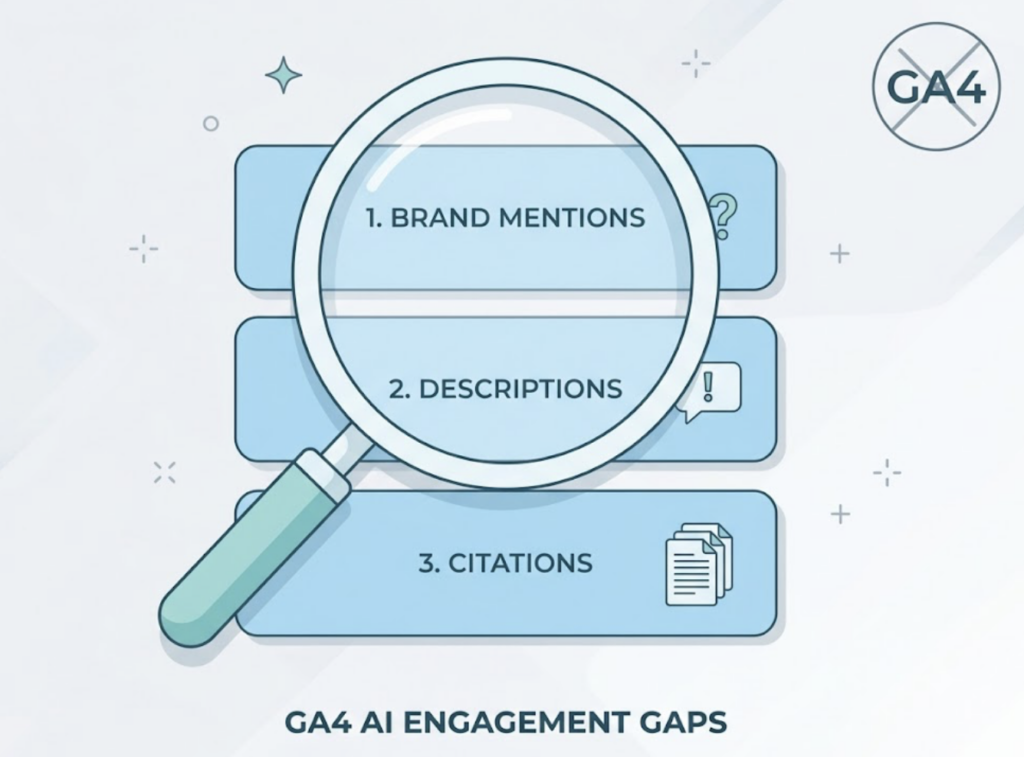
Three blind spots matter most. GA4 can’t tell you whether AI engines mention your brand at all. It can’t tell you how they describe you, accurately or otherwise. And it can’t tell you whose content they cite when they answer questions in your category.
There’s also a misclassification problem. Because most AI platforms don’t pass standard referrer headers, traffic arriving from ChatGPT, Claude, or Perplexity often lands in GA4 as “Direct.” Your AI-influenced visits exist in the data. They’re just wearing a disguise.
| Dimension | Traditional monitoring with GA4 | AI-era search monitoring |
|---|---|---|
| Primary metric | Sessions, clicks, pageviews | Mentions, citations, share of voice |
| Attribution | Referral paths | Largely invisible, misclassified as Direct |
| Decision stage captured | Post-click | Pre-click, answer consumption |
| View of performance | Website-centric | Ecosystem-centric |
Search Monitoring Now Has Three Layers, Not One
A complete monitoring stack in 2026 looks less like a single dashboard and more like three layers, each answering a different question.
Layer 1 is website behavior. GA4 or Matomo, measuring what happens after the click. This remains your bottom line for conversion and ROI, and nothing here suggests abandoning it.
Layer 2 is SERP performance. Search Console and rank trackers, measuring blue-link rankings and impressions. Still useful, but covering a shrinking share of decisions. Seer Interactive’s research found that when AI Overviews appear, organic CTR drops from 1.76% to 0.61%, a 61% decline. Even queries without AI Overviews lost 41% of their CTR year over year.
Layer 3 is the AI answer layer: whether your brand appears in AI-generated responses, how it’s positioned, what sentiment surrounds it, and which sources the engines cite. This is the layer where buying decisions increasingly form.
Most teams monitor the first two layers obsessively and the third not at all.
How to Monitor the AI Answer Layer
Monitoring this layer requires a different workflow than rank tracking, because there’s no fixed results page to scrape. In practice, four steps cover it.
First, define the prompts that matter. Not keywords, but the actual questions buyers ask AI assistants in your category. Second, track responses across multiple engines, since ChatGPT, Gemini, and Perplexity often recommend different brands for the same prompt. Third, analyze which sources the engines cite, because citations are where optimization leverage lives. Fourth, benchmark against competitors, since visibility is relative.
Doing this manually means re-running dozens of prompts across four or five platforms every week. Most teams that try it stop within a month.
This is where purpose-built tooling earns its place. Topify tracks brand visibility across ChatGPT, Gemini, Perplexity, DeepSeek, and other major AI engines, scoring performance on seven metrics: visibility, sentiment, position, volume, mentions, intent, and CVR. Its Source Analysis feature reverse-engineers the exact domains and URLs each engine cites, which tells you where to earn coverage if you want AI to start recommending you. The Basic plan starts at $99 per monthwith 100 tracked prompts, and there’s a set of free GEO tools if you want to audit your current AI visibility before committing to anything.
The payoff for getting cited is measurable. Brands cited within AI Overviews see 35% higher organic CTR than non-cited competitors on the same queries. Citation equity is becoming the new ranking.
A GA4 Fix You Can Ship This Week
While you build out Layer 3 monitoring, one quick adjustment recovers some visibility inside GA4 itself.
Create a custom channel group for AI traffic using a regex pattern that matches referrers from major AI platforms, something like chatgpt.com|claude.ai|perplexity.ai|gemini.google.com|copilot.microsoft.com. Position it above the Referral channel in your grouping order so these sessions don’t get swallowed by default buckets.
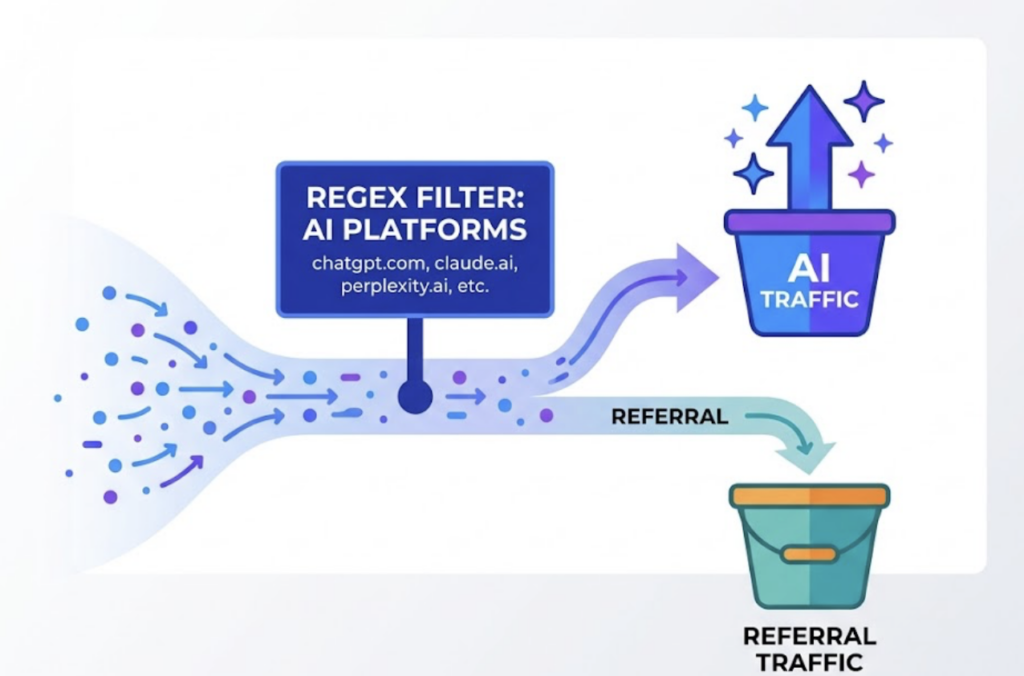
This won’t capture the answers users consumed without clicking. But it will at least show you the AI-referred sessions you’re currently misreading as Direct, and the trend line tends to be eye-opening on its own.
GA4 and AI Search Monitoring Work Better Together
None of this is an argument for replacing Google Analytics. The two systems answer complementary questions: AI visibility monitoring explains why exposure is rising or falling, and GA4 confirms whether that exposure converts.
The workflow looks like this in practice. Your AI monitoring flags that Perplexity stopped mentioning your brand for a high-volume prompt. Source analysis shows the engine now cites a competitor’s comparison page. You publish a stronger page, earn the citation back, and then watch GA4 to verify the downstream lift in AI-referred sessions and conversions.
Exposure data without conversion data is vanity. Conversion data without exposure data is a black box. You need both halves to run search as a managed channel rather than a mystery.
Conclusion
The “Search → Click → Session” model that Google Analytics was built for now describes less than a third of search behavior. Search monitoring in the AI era means watching three layers: your site, the SERP, and the AI answer layer where a growing share of decisions actually form.
Start with an audit. Run your ten most important buyer prompts through ChatGPT, Gemini, and Perplexity and note whether you appear, how you’re described, and who gets cited instead. If the answers surprise you, that’s your monitoring gap quantified. Get started with Topify to put that tracking on autopilot, and keep GA4 doing what it does best: proving the revenue impact.
FAQ
Q: Why doesn’t Google Analytics track AI search traffic?
A: Two reasons. Most AI-driven decisions happen without a click, so no session is ever created. And when users do click through from AI platforms, missing referrer headers often cause GA4 to misclassify those visits as Direct traffic.
Q: What should search monitoring include in the AI era?
A: Three layers: website behavior via GA4, traditional SERP performance via Search Console, and AI answer monitoring covering brand mentions, sentiment, position, and citations across engines like ChatGPT, Perplexity, and Gemini.
Q: How do I monitor brand mentions in ChatGPT?
A: Define the prompts your buyers actually use, run them regularly across AI platforms, and track whether and how your brand appears. Dedicated platforms automate this across hundreds of prompts and surface citation sources you can act on.
Q: Is traditional SEO still worth doing if clicks are declining?
A: Yes, because AI engines cite content that ranks and demonstrates authority. Strong SEO feeds AI visibility. The change is in measurement: clicks alone undercount your content’s influence, so pair rankings with citation and mention tracking.

