

Your keyword rankings are holding steady. Your domain authority climbed again last quarter. Then you ask ChatGPT for the best tool in your category, and it cites three competitors and a forum thread. Your brand, the one ranking #1 on Google for that exact query, doesn’t show up anywhere in the answer. The rankings dashboard that used to explain everything suddenly explains nothing here. Google position and AI citation share are measuring two different games, and the gap between them is where a lot of brands are quietly losing ground.
Your Rankings Are Solid. Your AI Citation Share Might Be Zero.
AI citation share is the percentage of AI-generated answers where your domain shows up as a cited source, measured against everyone else cited for the same set of queries. It’s a presence metric, not a position metric. You’re either in the answer or you’re not.
That distinction matters more than it sounds. A brand can hold the #1 spot on Google for a head term and still register a 0% citation share in the AI response for that same query. The ranking is real. The AI visibility is missing.
Here’s the part that catches most teams off guard.
Rankings and citations aren’t loosely correlated with a bit of noise. They’re decoupled. Being the top organic result tells you almost nothing about whether an LLM will pull your page into its answer, because the two systems were built to reward different things.
Google Ranks Pages. AI Cites Sources. Those Aren’t the Same Thing.
Traditional SEO metrics struggle to predict AI behavior for a simple reason: large language models don’t consult the Google index when they answer. They run on Retrieval-Augmented Generation, pulling passages from retrieved sources and synthesizing them into a single response.
Google’s ranking logic rewards lexical matching, backlink profiles, and domain authority. It produces a list of links and lets the user pick. LLM citation logic works differently. It parses content for entities, people, products, and concepts, along with the relationships between them, then extracts the passages that answer the question most cleanly.
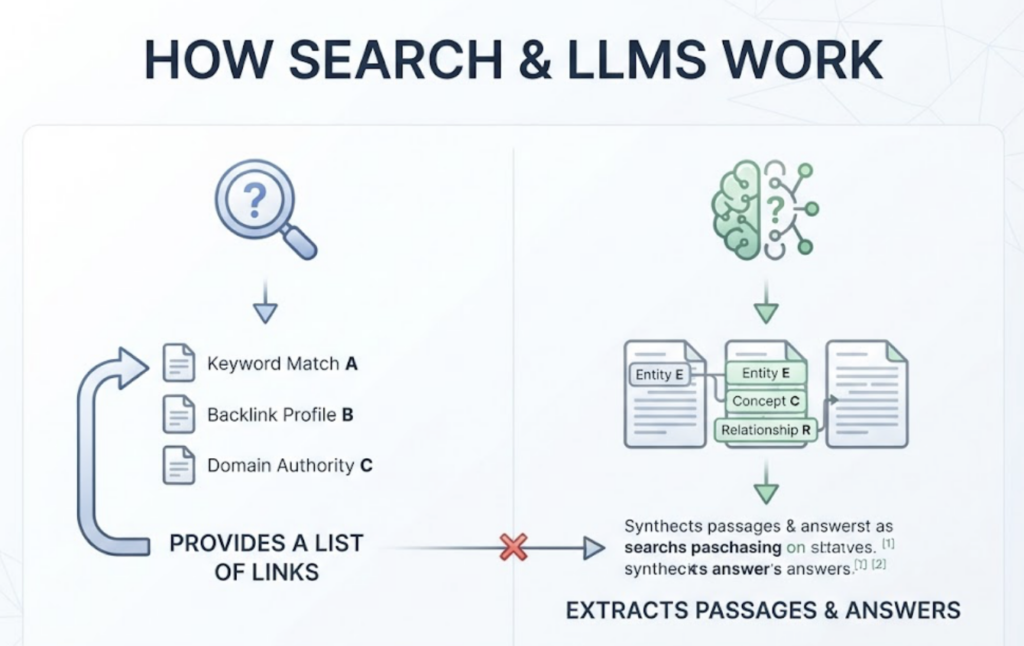
That’s the structural gap. Research on LLM citation behavior points to a strong preference for content that’s extractable: facts, definitions, and insights presented in standalone, structured segments that an AI can lift without losing context. A page that ranks #1 on keywords can be skipped entirely by an LLM if it never states a concise, self-contained answer.
The two systems don’t even share a unit of measurement.
| Dimension | Google Ranking | AI Citation |
|---|---|---|
| Primary unit | Page or URL | Passage or entity relationship |
| Primary currency | Backlinks and domain authority | Structural clarity and extractability |
| Output type | List of links | Synthesized factual answer |
| Success metric | SERP position | Citation frequency and presence |
Read that table as two separate scoreboards. Winning the left column is what your SEO team has optimized for over years. The right column is a different competition with different rules, and most brands haven’t started keeping score.
What Google Rankings Can’t Tell You About AI Search Visibility
The tools built for traditional SEO measure position. AI search visibility is a question of presence. That mismatch is why a rank tracker, no matter how good, can’t report your AI citation share. It’s measuring the wrong axis.
There’s a second blind spot: fragmentation. AI visibility isn’t universal across platforms. A domain can be cited heavily in Perplexity and ignored by Gemini or Google AI Overviews for the same query. Each engine retrieves and weighs sources on its own logic.
A single-source rank tracker gives you one number for one search engine. AI citation share lives across ChatGPT, Perplexity, Gemini, and AI Overviews at once, and those numbers rarely move together. Averaging them hides the story. You need per-platform visibility to see where you’re winning and where you’ve disappeared.
How to Actually Measure Your AI Citation Share
Moving past vanity metrics means treating citation share as something you calculate, not something you guess at. A repeatable framework looks like this.
Start by defining the perimeter. Pick 10 to 30 high-intent, category-specific prompts, a mix of head terms and the fan-out variations users actually type into AI tools. This is your measurement set.
Next, map the citation graph. For each prompt, record which domains appear in the AI’s sources or references. This tells you who the LLM already trusts for your category.
Then calculate the share. The standard normalization is straightforward:
Citation Share = (Total citations to your domain / Total citations across all domains in the set) × 100
Run it per platform and track it over time, not as a one-off snapshot. Citation patterns shift every few weeks, so last month’s number is often already stale.
Finally, do the competitive gap analysis. Find the “power pages” that competitors get cited for again and again, then deconstruct their structure: question-style headers, a direct answer in the opening line, clean schema markup. Those patterns are the reverse-engineering roadmap.
Reverse-Engineering Which Sources AI Decides to Cite
Knowing your citation share is dropped points to a problem. Fixing it means understanding why AI cites one source over another, and that’s where source-level tracking earns its place. Platforms like Topify are built around this exact question, tracking not just whether your brand gets mentioned but where the citation lands, down to the specific URL and passage.
Its Reverse-Engineer AI Citations view analyzes the precise domains and URLs that AI platforms pull from, so you can see whether you or your competitors dominate those references at scale. The immediate payoff is a target list: publications that cite a rival but never you become obvious priorities for content syndication and outreach.
That connects to the wider picture through Topify’s Comprehensive GEO Analytics, which tracks brand performance across major AI platforms on metrics like visibility, mentions, position, and sentiment. Citation frequency tells you how often you show up. Mention context tells you whether AI describes you as premium or budget. Position tells you where you land relative to competitors in the same answer. Together they add up to a working measure of AI share of voice.
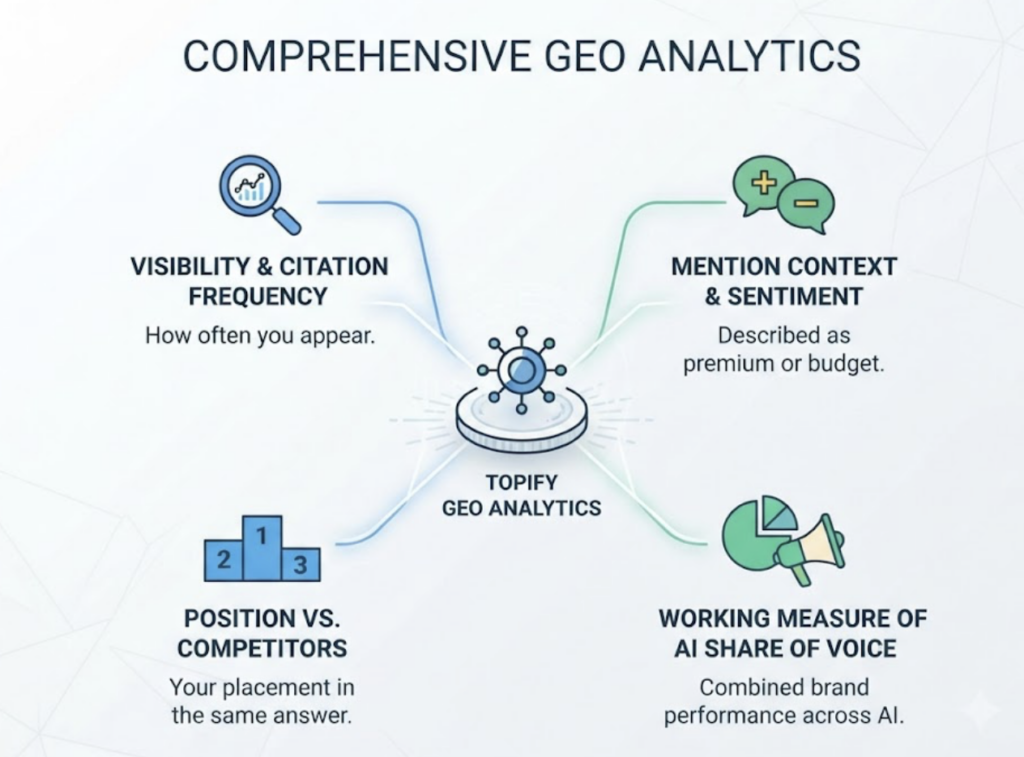
In practice, that means you can watch your citation share slip on a key prompt, trace it to a source that stopped referencing you, and see which competitor moved into that slot instead. The dashboard turns a vague sense of “we’re not showing up” into a specific, fixable diagnosis.
Competitor benchmarking closes the loop. Instead of guessing why a rival keeps appearing, you get the structural signals behind their cited pages and a clear read on how to close the gap.
What Changes Once You Track Citation Share Instead of Rankings
The shift is from a ranking-first mindset to an answer-first one. When a content team measures by position, they optimize pages to climb the SERP. When they measure by citation share, they optimize passages to be quotable by an AI. Those produce genuinely different edits: tighter definitions, direct opening answers, question-based headers, cleaner entity signals.
One pattern shows up repeatedly with teams that make the switch. They stop asking “why did our ranking drop” and start asking “which prompts are we losing citation share on, and to whom.” The second question is answerable, and it points straight at the content that needs work.
Your first step doesn’t require a full platform rollout. Pick five prompts your buyers would realistically type into ChatGPT or Perplexity, run them, and write down who gets cited. If your brand ranks well on Google but isn’t in those answers, you’ve just confirmed the gap. Now you have something to fix.
Conclusion
Google rankings and AI citation share were never going to move in lockstep, because one rewards pages and backlinks while the other rewards extractable, well-structured sources an LLM can trust. Treating a strong SERP position as proof of AI visibility is the mistake quietly costing brands their place in AI answers. As more buying research moves into AI interfaces, citation share becomes the more honest proxy for digital authority. Start by measuring where you actually stand across the platforms your audience uses, then optimize your content to be cited, not just ranked.
FAQ
Q: What is AI citation share?
A: It’s the percentage of AI-generated answers, across a defined set of prompts, where your domain appears as a cited source, measured against all other domains cited for those same prompts. It measures presence in AI answers rather than position in a search results page.
Q: How do I measure AI citation share?
A: Define 10 to 30 category prompts, record which domains each AI platform cites for them, then divide your citations by the total citations across all domains and multiply by 100. Track it per platform over time, since ChatGPT, Perplexity, Gemini, and AI Overviews cite different sources.
Q: Google rankings vs AI citation share, why don’t they match?
A: They run on separate mechanics. Google ranks whole pages using backlinks and domain authority. LLMs cite individual passages based on structural clarity and extractability. A #1 page with no concise, standalone answer can be ignored by an AI entirely.
Q: Does good SEO help my AI citation share at all?
A: It helps but it isn’t sufficient. Strong authority and clean technical SEO make your content easier to retrieve, but you still need extractable structure, direct answers, question-style headers, and clear entity signals for an LLM to actually cite you.

