

Your domain authority is 75. Your blog ranks on page one for a dozen high-intent keywords. Your content team ships two articles a week. Then a prospect asks ChatGPT, “What’s the best platform for [your category]?” and the model cites three competitors, a Reddit thread, and a niche blog you’ve never heard of. Your brand doesn’t appear once.
The uncomfortable part isn’t that the AI got it wrong. It’s that you had no way of knowing it happened. Traditional SEO dashboards don’t track what large language models choose to cite, and that blind spot is costing pipeline every single day.
Your Brand Has Content Everywhere, but AI Might Not Be Citing Any of It
For two decades, digital visibility meant accumulating backlinks and climbing index-based rankings. That model assumed a static list of blue links. It doesn’t describe how AI search works.
Generative engines use retrieval-augmented generation (RAG) to pull specific sources into a synthesized answer. AI citation tracking is the discipline of monitoring exactly which domains and URLs an LLM retrieves when it constructs those answers. It’s the difference between knowing your page exists and knowing whether AI actually uses it.
Here’s why traditional metrics fail as a proxy. A Princeton University study examining 10,000 complex queries across multiple generative engines found that keyword stuffing, a core legacy SEO tactic, caused a 20% relative decline in AI visibility. Separate case studies tracking thousands of B2B queries found that brands ranking on Google’s first page appeared in only 8% of AI-generated answers. Their lower-ranked competitors, the ones with structurally optimized content, secured 65% of citations.
High domain authority doesn’t translate to high AI citation rates.
The AI search ecosystem itself is diversifying fast. ChatGPT still leads with over 800 million weekly active users, but its overall referral share contracted from 89.2% to 81.4% in Q1 2026. Google’s Gemini nearly tripled its share from 4.3% to 11.6%, making it the second-largest consumer AI referral source. Anthropic’s Claude more than doubled to 3.6%, and Perplexity holds between 4.2% and 6.5%. Any ai search visibility analysis tool that only covers one engine is showing you a fraction of the picture.
What AI Citation Tracking Actually Measures
Many teams confuse brand mentions with citations. They’re not the same thing. A mention means the AI said your name. A citation means the AI retrieved your URL and linked to it as a source. If ChatGPT mentions your product but cites a competitor’s comparison page to back the claim, the competitor captures the authority signal and the referral click.
True AI citation tracking breaks down into three core metrics. Citation Source identifies the exact URL or domain the model retrieved. Citation Frequency measures how often a domain gets referenced across a broad set of prompts. Citation Share, sometimes called Share of Model, benchmarks your citation rate against competitors within the same prompt categories.
These metrics form the data layer beneath any ai brand visibility analysis tool. You can’t manage visibility without first understanding who the AI is actually citing at the URL level.
The challenge is that each platform cites differently. ChatGPT typically provides 3 to 5 footnote-style citations per answer, with a commercial brand citation rate of 50% to 60%. It leans toward long-form authority pieces between 1,500 and 3,000 words. Perplexity, built around verification, cites sources in 95% of responses and hits a brand citation rate of 75% to 85% for commercial queries. Gemini operates at 55% to 65%, rewarding E-E-A-T signals and schema markup. Claude mirrors academic research patterns, favoring content that itself contains rigorous internal citations and outbound reference links.
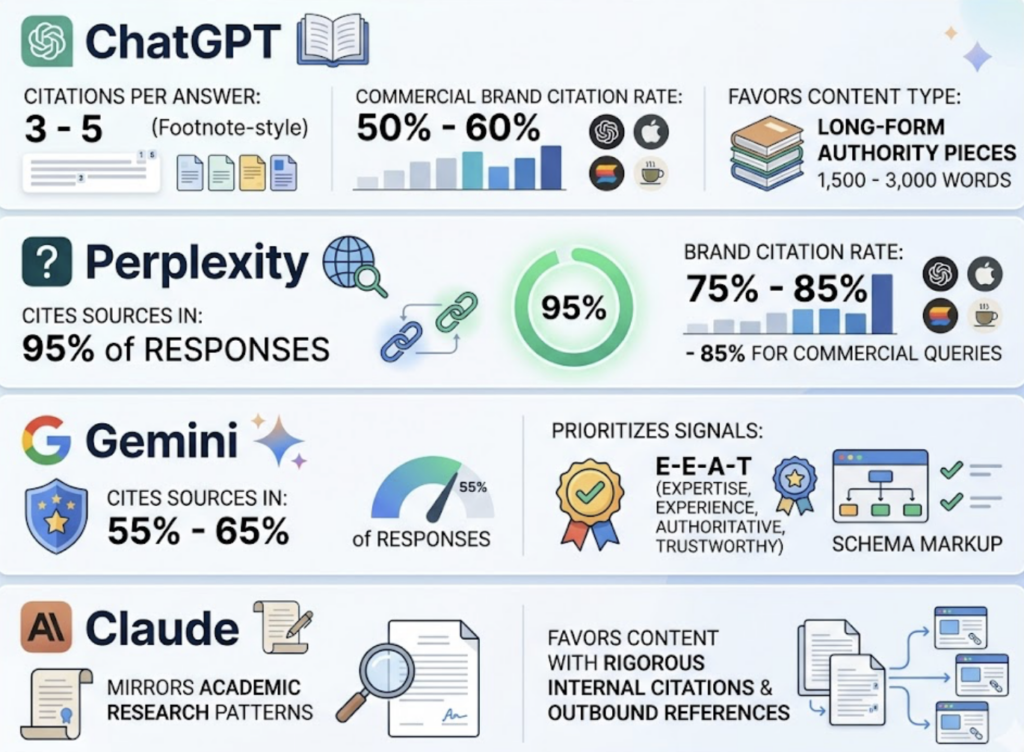
A single content format optimized for ChatGPT will likely underperform on Perplexity or Claude. That’s why 47% of AI search users now engage with two or more generative platforms, and why cross-platform tracking isn’t optional.
The Visibility Gap Most Brands Don’t Know They Have
The visibility gap is the measurable disparity between a brand’s presence in traditional search results and its presence in AI-generated answers. It shows up in three common ways.
The first is competitor substitution. A buyer prompts an LLM with a commercial-intent query in your category. You rank first on Google, but the AI cites three competitors because their documentation was better structured for RAG extraction. You don’t even know it happened.
The second is hallucinated obsolescence. The AI mentions your brand but pulls outdated information from its training data instead of performing a live retrieval. It might cite deprecated pricing, discontinued features, or resolved controversies as though they’re current.
The third is third-party dependency. The model recommends your product, but every citation points to G2, Capterra, or Reddit instead of your official site. You get the mention; a review aggregator gets the traffic and the algorithmic authority.
Most brands can’t detect any of these scenarios without specialized ai search visibility gap analysis tools that run programmatic prompt variations across multiple LLMs and map the exact URLs cited against your domain.
The commercial stakes are severe. AI-referred traffic converts at rates that dwarf traditional organic. ChatGPT referral traffic converts at 15.9%, Perplexity at 10.5%, Claude at 5%, and Gemini at 3%. Compare that to the 1.76% average for traditional organic search. Visitors from ChatGPT view an average of 2.3 pages per session with a 62% engagement rate. By general industry estimates, an AI-referred visitor is between 4.4 and 9 times as commercially valuable as a standard organic visitor.
A visibility gap isn’t a theoretical problem. It’s a direct leak of high-intent pipeline revenue.
How to Choose an AI Search Visibility Analysis Tool
The market is saturated with legacy SEO platforms bolting on “AI” features. To separate genuine capability from rebranding, evaluate any search visibility analysis tool or llm visibility analysis tool across five dimensions.
Platform coverage comes first. Generative search is fractured, and a tool limited to one or two engines leaves you exposed. Look for simultaneous tracking across ChatGPT, Perplexity, Gemini, Claude, AI Overviews, and emerging models like DeepSeek and Qwen.
Citation source depth matters more than mention volume. The tool must parse footnotes, reference cards, and superscript links to identify exact URL-level provenance. Mention counts without source attribution are actively misleading.
Competitor benchmarking should be native, not bolted on. You need Share of Model tracking that benchmarks your citation frequency and sentiment against designated rivals within the same prompt environments.
Data update frequency is non-negotiable. LLM outputs are non-deterministic, shifting by 40% to 60% across different sessions. Manual spot-checks are statistically unreliable. The tool must run automated, high-frequency prompt tracking to establish smoothed trend lines.
Actionability separates monitoring from optimization. The platform should identify specific content gaps, missing structured data, and entity deficiencies that require intervention, not just display dashboards.
The most common mistake teams make is investing in a tool that tracks mentions while ignoring citation sources entirely. The second most common mistake is monitoring only ChatGPT and missing the verification-heavy traffic flowing through Perplexity and the growing Gemini ecosystem.
Here’s how the leading platforms compare on these dimensions:
| Platform | Cross-Platform LLM Coverage | URL-Level Citation Depth | Sentiment Analysis | Starting Price | Primary Audience |
|---|---|---|---|---|---|
| Topify | ChatGPT, Perplexity, Gemini, Claude, DeepSeek, Qwen, AI Overviews | Yes (Core Feature) | Enhanced (0-100 Scale) | $99/mo | Marketing Teams, SEO Agencies |
| Profound | 10+ engines including Grok and Meta AI | Partial (Domain focused) | Deep | $499/mo | Fortune 500, Enterprise Risk |
| Semrush AI Toolkit | Perplexity + 5 others, Google AI Overviews | Basic (Mention focused) | Standard | $99/mo (Add-on) | Existing Semrush Users |
| Peec AI | Core B2B generative engines | Yes | Standard | €89/mo | Global Multilingual Brands |
| Omnia | ChatGPT, Perplexity, Google AI Mode | Yes | Supported | €79/mo | E-commerce, Startups |
| Keyword.com | 10+ models including Mistral | Yes (Timestamped) | Advanced over time | $24.50/mo | Technical SEO Specialists |
| Otterly.AI | ChatGPT, Perplexity, AI Overviews | Basic | Basic | $29/mo | Solo SEOs, Small Teams |
Where Topify Fits: AI Citation Tracking at the Source Level
For marketing teams trying to understand why high-ranking content gets ignored by LLMs, Topify operates as a diagnostic system at the source level, not just the mention level.
The core differentiator is Source Analysis. Where most tracking platforms stop at detecting whether a brand name appeared in an AI response, Topify isolates the exact domains and URLs that generative models retrieved to construct their answers. It parses footnote mechanics and embedded reference links to map the competitive citation picture based on actual data reliance.
Topify covers ChatGPT, Perplexity, Google Gemini, Claude, DeepSeek, Qwen, and Doubao simultaneously. In a market where 47% of users engage with multiple AI platforms, single-engine monitoring creates dangerous blind spots.
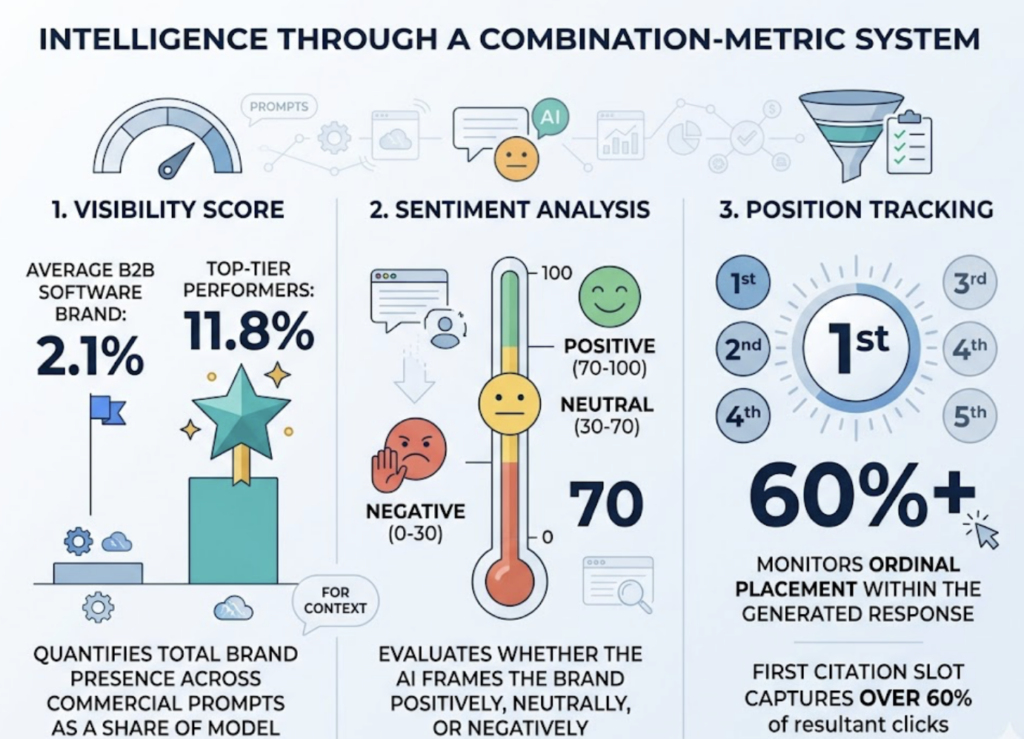
The platform frames this intelligence through a combination-metric system. Visibility Score quantifies total brand presence across commercial prompts as a Share of Model benchmark. (For context, the average B2B software brand maintains a visibility score of just 2.1%, while top-tier performers reach 11.8%.) Sentiment Analysis evaluates whether the AI frames the brand positively, neutrally, or negatively on a 0-to-100 scale. Position Tracking monitors ordinal placement within the generated response, because the first citation slot captures over 60% of resultant clicks.
Here’s what this looks like in practice. A mid-market SaaS team notices pipeline velocity dropping to a smaller competitor. They run 100 high-intent comparison prompts across ChatGPT and Perplexity through Topify. The dashboard reveals the gap: their product pages get mentioned, but the AI is linking to the competitor’s documentation because it features structured comparison tables. Topify’s gap prioritization surfaces the highest-value missing queries. The team restructures their pages with block-formatting and explicit statistics targeting the extraction preferences. They set automated alerts to track the uplift in citation share over the following weeks.
Pricing starts at $99 per month, covering 100 prompts and 9,000 AI answer analyses across multiple platforms. Teams can get started directly to run their first citation audit.
From Citation Data to Action: A 3-Step Workflow
Knowing your citation data is step zero. The real value comes from a systematic workflow that turns gaps into pipeline.
Step 1: Audit. Input your brand domain and a list of 50 to 100 high-intent commercial prompts into your AI citation tracking platform. Run them programmatically across ChatGPT, Perplexity, Gemini, and AI Overviews. Capture which specific URLs the models cite for each query. This produces an unvarnished baseline Visibility Score, stripped of legacy SEO vanity metrics.
Step 2: Identify gaps. Cross-reference the audit results to isolate queries where competitor domains hold the primary citation slots and your brand is absent. Examine the cited competitor URLs to identify their structural advantage. Did the AI prefer them because they used a dense HTML table? A specific statistical data point? A concise upfront definition? Rank the missing citations by commercial impact to focus resources on the highest-value pages first.
Step 3: Optimize with structured content. The Princeton GEO-bench study showed that adding precise, verifiable statistics to content increases AI citation probability by 37%. Integrating expert quotations improves visibility metrics by 22%. Listicle and table formats achieve a 25% citation rate compared to just 11% for standard narrative content.
In practice, this means restructuring pages around a “Bottom Line Up Front” architecture: lead with a 2-to-3 sentence definitive answer, break long articles into 200-to-400 word blocks with explicit H3 headings, and embed comparative tables and concrete numbers that serve as extraction anchor points for LLMs.
The results compound. One B2B SaaS company implemented this exact framework over 90 days. They started with an 8% AI visibility baseline. After shifting from standard content marketing to structured knowledge engineering, their citation rate tripled to 24% across platforms. That optimized visibility generated 47 qualified leads from AI referral traffic, converting at 18.7%, which was 2.8x higher than their standard traffic. The campaign produced €64,000 in closed revenue and a 288% return on investment.
Conclusion
The blind spot most marketing teams operate with today isn’t a lack of content or domain authority. It’s the inability to see whether AI is actually citing that content when buyers ask questions. And in an environment where AI-referred visitors convert at 4.4 to 9 times the rate of traditional organic traffic, that blind spot has a direct revenue cost.
Closing the gap starts with measurement: auditing your citation baseline across multiple AI platforms, diagnosing where competitors hold citation slots you don’t, and re-architecting content for RAG extraction. The brands that treat AI citation tracking as a recurring operational discipline, not a one-time curiosity, are the ones securing the first-citation positions that capture the majority of downstream clicks. Start your audit today and turn the invisible into the measurable.
FAQ
Q: What is AI citation tracking and why does it matter?
A: AI citation tracking monitors how generative platforms like ChatGPT, Perplexity, and Gemini reference specific domains and URLs when constructing their responses. It matters because LLMs are replacing traditional search as the primary research channel for high-intent buyers. If an AI answers a prompt by citing a competitor’s page instead of yours, your brand is functionally invisible in the fastest-growing consideration channel, losing referral traffic that converts at rates far above traditional search.
Q: What’s the best AI search visibility analysis tool for small teams?
A: For small teams, Topify offers the strongest balance of depth and accessibility. Starting at $99 per month, it provides URL-level Source Analysis across all major models (ChatGPT, Perplexity, Gemini, Claude, and more), plus Visibility, Sentiment, and Position tracking. This gives smaller teams enterprise-grade citation intelligence without the $500+ monthly costs of Fortune 500-oriented platforms.
Q: How is AI citation tracking different from traditional backlink monitoring?
A: Traditional backlink monitoring uses web crawlers to map static hyperlinks between domains, determining Domain Authority based on historical index data. AI citation tracking measures dynamic, probabilistic retrieval events: what an active LLM chooses to reference in real-time when answering a conversational prompt. A page can have thousands of backlinks and receive zero AI citations if its content isn’t structured for RAG extraction.
Q: Can AI brand visibility analysis tools track multiple AI platforms at once?
A: Yes. Leading AI brand visibility analysis tools like Topify are built specifically for cross-platform tracking. Because different models (ChatGPT, Perplexity, Gemini, Claude) use distinct retrieval algorithms and formatting preferences, single-engine monitoring creates blind spots. Simultaneous cross-platform tracking is the only way to get an accurate picture of your brand’s true AI footprint.

