
A VP of Data Engineering typed into ChatGPT: “Best cloud data platform for real-time analytics with strong governance.” The AI listed five options. Your platform, with SOC 2 compliance, sub-second query latency, and 500+ enterprise customers, wasn’t mentioned. The problem isn’t your product. It’s that AI doesn’t recognize your authority in the category.
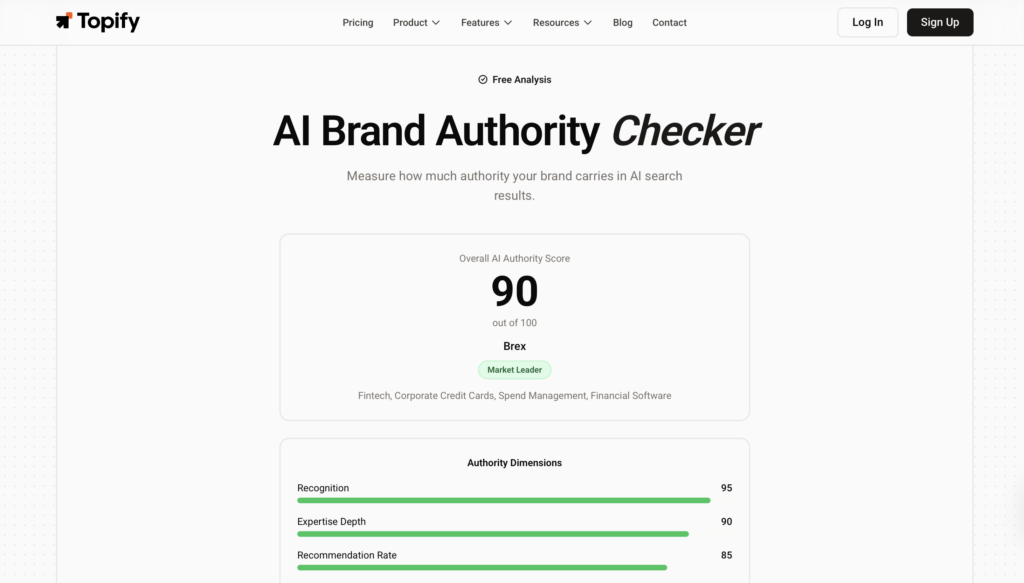
There’s a way to measure that gap. Topify‘s Brand Authority Checker scores how AI models perceive your data brand across four dimensions: recognition, expertise depth, recommendation rate, and trust signals.
✅ Free ⚡ Results in 60 seconds 🔒 No signup required
AI Brand Authority Checker
The Four Scores That Tell You If AI Trusts Your Data Brand
The data industry runs on trust. Buyers don’t pick a data warehouse or analytics platform on impulse. They evaluate security posture, uptime guarantees, compliance certifications, and integration depth before signing a contract. AI models now compress that entire evaluation into a single generated response.
Brand Authority Checker breaks down how AI perceives your brand into four measurable dimensions. Here’s what each one means for a data company.
What Each Metric Means for Data Companies
| Metric | What It Measures | What It Means for Data Companies | Common Low-Score Cause |
|---|---|---|---|
| Recognition Score | How consistently AI identifies your brand in the data category | Low score = AI doesn’t associate you with data warehousing, analytics, or data engineering | Limited presence in non-gated industry publications |
| Expertise Depth | How well AI understands your technical capabilities | Low score = AI may describe you as a “BI tool” when you’re a full lakehouse platform | Technical docs locked behind login walls |
| Recommendation Rate | How often AI includes you in category recommendations | Low rate = buyers asking “best data platform for X” won’t see your name | Weak third-party citation signals (reviews, benchmarks, analyst reports) |
| Trust Signals | External validation AI detects about your brand | Weak signals = AI can’t verify your compliance claims or enterprise track record | Few structured references in media, G2, or industry benchmarks |
A data platform might score 85 on Recognition (AI knows you exist) but 40 on Expertise Depth (AI thinks you only handle structured SQL workloads when you actually support ML pipelines, streaming, and unstructured data). That mismatch costs deals before your sales team even gets a call.
Three Scenarios Data Companies Discover After Running the Check
Scenario 1: The “Wrong Category” Problem. Your platform supports real-time streaming analytics, but AI consistently describes you as a traditional data warehouse. The Expertise Depth score is low because AI’s training data references your 2022 product capabilities, not your current feature set.
Scenario 2: The “Invisible Mid-Market” Problem. You’re a $50M ARR data platform with strong NPS and a growing enterprise customer base. But AI only recommends the top three names in the category (the ones with billions in revenue and massive content footprints). Your Recommendation Rate is near zero.
Scenario 3: The “Trust Gap” Problem. You hold SOC 2 Type II and HIPAA BAA certifications, but AI doesn’t mention them when buyers ask about compliant data platforms. Your Trust Signals score reveals that AI can’t find structured evidence of your compliance posture.
How to Run a Brand Authority Check
The process takes less than a minute. Go to the Brand Authority Checker, enter your brand name and primary category (e.g., “cloud data platform” or “data analytics”), and review the four-dimensional score breakdown. No account creation, no credit card, no waiting period. You’ll see where AI rates your brand strong and where the gaps are.
Data Buyers Ask AI These Questions. Where Does Your Brand Rank?
The data industry’s buying process has shifted. 37% of product discovery queries now start in AI interfaces like ChatGPT and Perplexity. For enterprise data platform purchases, that number is likely higher. Data engineers and analytics leaders aren’t just googling “Snowflake vs Databricks” anymore. They’re asking AI to evaluate trade-offs, recommend architectures, and shortlist vendors.
Here are the prompts that matter most for data companies:
| AI Prompt Example | Platform | Search Intent | What a Low Authority Score Means |
|---|---|---|---|
| “Best data platform for real-time analytics” | ChatGPT | Purchase shortlisting | Your brand doesn’t appear in the initial recommendation set |
| “Data warehouse vs lakehouse for ML workloads” | Perplexity | Architecture decision | AI positions your brand on the wrong side of the debate |
| “Most secure data platform for healthcare data” | Gemini | Compliance verification | AI can’t verify your HIPAA/SOC 2 claims |
| “ETL tools comparison 2026” | ChatGPT | Competitive evaluation | You’re listed below competitors with weaker products but stronger AI signals |
| “Best data governance solution for mid-size companies” | Google AI Overview | Category research | AI doesn’t associate your brand with governance capabilities |
Each of these prompts represents a moment where AI is shaping a buyer’s shortlist. If your brand authority score is low in any of the four dimensions, you’re likely absent from these critical conversations.
AI Is the New Analyst Report. Trust Is the Moat. And the Battleground Is a Prompt.
Data industry buyers used to rely on Gartner analyst reports and Forrester evaluations to build vendor shortlists. That process took weeks. Now, a data architect can ask ChatGPT for a platform recommendation and get a structured comparison in 30 seconds.
That’s the first shift: AI is the new analyst report.
The implications are significant. Analyst firms evaluate vendors through structured methodologies, briefings, and reference checks. AI models evaluate brands through whatever signals they can find in their training data and live web access. Your positioning in an AI-generated answer depends on citation patterns, structured data, entity signals, and the volume and quality of third-party references.
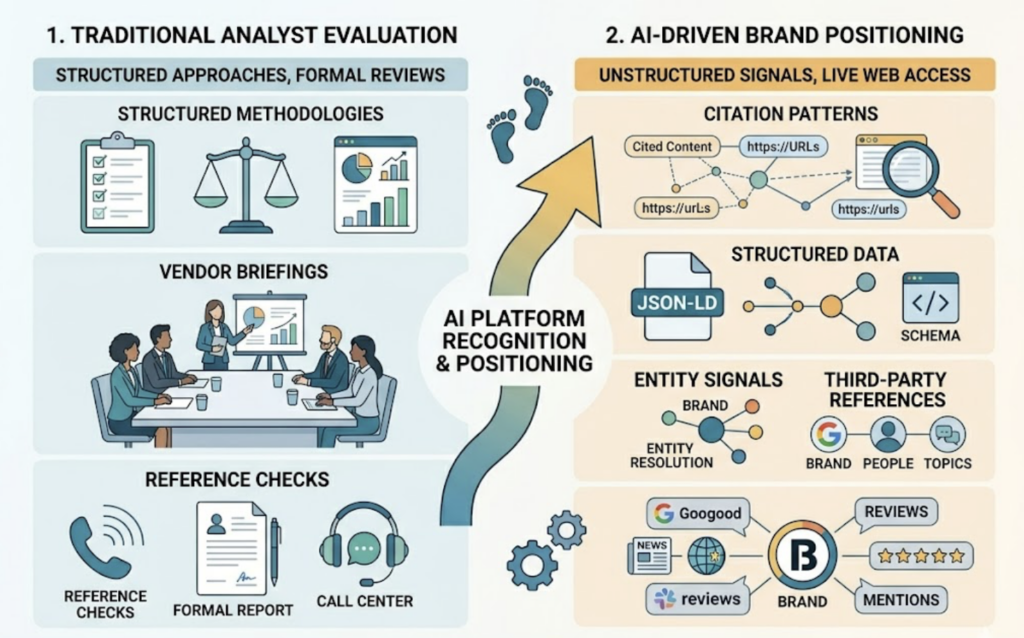
Here’s the thing: trust has always been the moat in data. Enterprise buyers won’t move their data infrastructure to a platform they don’t trust. But AI measures trust differently than humans do. A human buyer reads your compliance page, talks to a reference customer, and reviews your SOC 2 report. AI looks for external validation signals: are industry publications citing your compliance posture? Do benchmark reports include your platform? Are third-party review sites (G2, TrustRadius) consistently mentioning your security credentials?
If those signals are weak or locked behind gated content, AI can’t detect them. Your brand may be highly trusted by existing customers but appear untrustworthy to AI.
The third shift is about the battleground itself. Comparison prompts like “Snowflake vs Databricks” or “best data platform for AI workloads” are the highest-value AI search moments in the data industry. 74% of data consulting firms work with multiple platforms. When a buyer asks AI to compare options, the model’s framing of each brand determines the first impression. If AI describes your platform as “strong in traditional SQL workloads” while describing a competitor as “optimized for AI-native architectures,” that framing sticks.
These three dynamics compound. AI acts as the analyst, evaluates trust through its own signal framework, and delivers its verdict in a single prompt response. Data brands that don’t measure and optimize their AI authority are losing influence at the exact moment buyers are forming opinions.
One Score Is a Starting Point. Continuous Tracking Is the Strategy.
The Brand Authority Checker gives you a clear snapshot of where your data brand stands in AI’s evaluation. But AI models update regularly, new content enters their training data, and competitor signals shift. A score that looks healthy today could drop next quarter after a model refresh.
That’s where Topify’s Comprehensive GEO Analytics picks up. It turns a one-time authority check into a continuous monitoring system, tracking your brand’s recognition, expertise depth, recommendation rate, and trust signals across ChatGPT, Perplexity, Gemini, and Google AI Overviews, with historical trend data and automated alerts when scores shift.
| Capability | Brand Authority Checker (Free) | Topify Platform |
|---|---|---|
| Check frequency | One-time snapshot | Daily / weekly continuous monitoring |
| AI platforms covered | Single check | ChatGPT + Perplexity + Gemini + AI Overviews |
| Historical trends | Not available | Full trend history with drift alerts |
| Competitor tracking | Not available | Real-time competitor authority benchmarking |
| Actionable recommendations | Manual interpretation | Automated GEO optimization suggestions |
| Team collaboration | Individual use | Multi-seat dashboard for data and marketing teams |
Plans start at $99/month with a 7-day free trial, no credit card required. For data companies managing visibility across multiple product lines or sub-brands, the Pro plan supports multi-brand tracking. You can start a free trial and see your continuous authority data within minutes.
Conclusion
Data buyers are making shortlist decisions inside AI chat interfaces before they visit your website. The brands that appear in those AI-generated answers are the ones that get evaluated. The ones that don’t appear get skipped entirely.
Start with a baseline. Run your brand through the Brand Authority Checker and see how AI scores your recognition, expertise depth, recommendation rate, and trust signals. That single check will tell you whether AI is helping or hurting your pipeline.
For a broader diagnostic, Topify’s free tools cover additional dimensions. The GEO Score Checker evaluates whether AI crawlers can access your site’s technical infrastructure. The Competitor Analysis tool shows how AI positions your brand relative to other data platforms. And the AI Visibility Report measures how often your brand gets mentioned across major AI platforms.
FAQ
Is the Brand Authority Checker free? Do I need to sign up?
Yes, it’s completely free and requires no account creation. Enter your brand name and category, and you’ll get your four-dimensional authority score in under 60 seconds.
What’s the difference between the free tool and the Topify platform?
The free Brand Authority Checker gives you a one-time snapshot. The Topify platform provides continuous monitoring, historical trends, competitor benchmarking, and automated optimization recommendations across all major AI search platforms.
How often should a data company check its AI authority score?
At minimum, after any major product launch, model update (GPT or Gemini refresh), or competitive shift. For continuous coverage, the Topify platform runs automated checks on your chosen schedule. Quarterly manual checks with the free tool are a reasonable starting point for teams not yet on the platform.
Why might a well-known data platform still score low on AI authority?
Brand awareness in the traditional market doesn’t automatically translate to AI authority. Common causes include technical documentation locked behind login walls, limited third-party citations in non-gated content, outdated product descriptions in AI training data, and weak structured data signals on your public-facing pages.