

Your TMS ranks on page one for “best transportation management system.” Your WMS content pulls steady organic traffic. Your domain authority is solid. Then a logistics manager asks ChatGPT, “What’s the best TMS for mid-market companies?” and gets a shortlist of five vendors. You’re not on it.
That disconnect between Google rankings and AI recommendations is widening fast. 73% of B2B buyers now use AI tools like ChatGPT and Perplexity during purchase research. And the vendors AI recommends aren’t always the ones with the strongest backlink profiles.
51% of Software Buyers Now Start in a Chatbot, Not Google
The numbers have shifted faster than most logistics SaaS marketing teams realize.
G2’s April 2026 study of 1,076 B2B software buyers found that 51% now begin their purchasing process in an AI chatbotrather than a traditional search engine. That’s up from 29% just twelve months earlier. Even more telling: 69% of buyers said an AI chatbot led them to select a different vendor than they initially planned.
For logistics SaaS, this means the buyer evaluating freight audit platforms, route optimization tools, or warehouse management systems is increasingly forming a shortlist inside ChatGPT or Perplexity before ever visiting your website.
One-third of buyers in the G2 study purchased from a vendor they’d never heard of before the AI surfaced it. That’s pipeline you can’t recover with retargeting ads, because the buyer never visited your site in the first place.
Why Traditional SEO Metrics Don’t Explain AI Invisibility
Brand web mentions correlate with AI citation at 0.664, while backlinks correlate at roughly 0.2. The backlink-heavy SEO playbook that worked for a decade is now a secondary signal for AI recommendation engines.
AI search also isn’t one channel. Only 11% of domains are cited by both ChatGPT and Perplexity. Perplexity pulls roughly 46.7% of its top citations from Reddit. Gemini prioritizes pages that already rank well in traditional Google search. A logistics SaaS brand winning on one platform might be invisible on another.
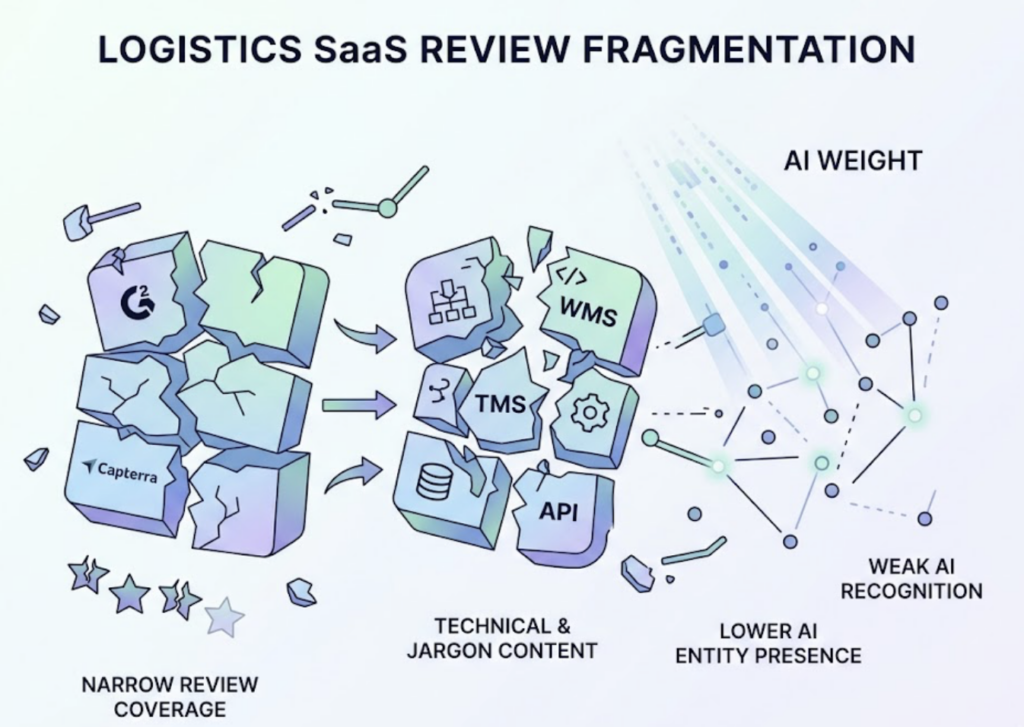
That fragmentation creates a specific problem for logistics SaaS companies. The category has narrower review coverage on platforms like G2 and Capterra compared to horizontal SaaS. The content tends to be technical and jargon-heavy. And most logistics brands haven’t built the kind of entity presence across community platforms that AI models weight heavily.
13 Free AI Visibility Tools That Show Where Your Logistics Brand Stands
The gap between “we think we’re visible” and “we’ve actually checked” is where most logistics SaaS teams get stuck. Topify offers 13 free tools that cover different dimensions of AI visibility, from baseline diagnostics to competitive intelligence. No signup required for any of them.
Generate Your Free AI Visibility Report
Here’s how to use them, grouped by what they diagnose.
Check Your Baseline Visibility
Start here. These tools answer the first question: does AI even know your brand exists?
The AI Visibility Report generates probe questions relevant to your category and queries ChatGPT, Gemini, and Perplexity. You’ll see mention rates, ranking positions, and which platforms include your brand. For a logistics SaaS company, this tells you whether AI recommends you when someone asks about TMS platforms, freight visibility tools, or supply chain software.
The GEO Score Checker evaluates your site across four dimensions: AI bot access, structured data, content signals, and overall visibility. If your score is low, it pinpoints whether the issue is technical (AI crawlers can’t reach your content) or structural (your content isn’t formatted for extraction).
The Brand Profile Checker shows how AI models describe your brand and who they list as your competitors. This is often where logistics SaaS companies get their first surprise: the AI might position you as a “startup-friendly tool” when your actual market is enterprise freight operations.
Understand How AI Perceives Your Brand
Visibility is binary: you’re either mentioned or you’re not. Perception is nuanced, and it’s where the real optimization opportunities hide.
The Brand Sentiment Checker scores how positively or negatively AI models describe your brand. A logistics SaaS company with strong product capabilities but poor review coverage might see neutral or tepid sentiment, which translates to weaker recommendation positioning.
The Brand Authority Checker measures recognition, expertise depth, recommendation rate, and trust signals across AI platforms. For logistics SaaS brands competing against incumbents like SAP or Oracle’s logistics modules, this tool reveals whether AI considers you an authority in your niche or just another name in a crowded list.
The Knowledge Freshness Checker flags whether AI models are working with outdated information about your brand. If you launched a major feature update six months ago but AI still describes your product based on two-year-old data, your visibility score might be fine while your conversion potential isn’t.
Find the Prompts That Actually Drive Pipeline
Knowing you’re invisible is step one. Knowing which prompts matter is what makes the data actionable.
The Prompts Researcher generates the exact questions users ask AI platforms about your category. For logistics SaaS, this surfaces prompts like “best WMS for e-commerce fulfillment,” “TMS comparison for LTL shipping,” or “freight audit software for 3PLs.” These are the prompts you need to appear in.
The AI Search Volume Checker estimates how often specific prompts are searched across AI platforms. Not all prompts are equal. A prompt with high AI search volume in your category is worth more than one that sounds relevant but rarely gets asked.
The Social Question Search finds real user questions from community platforms. Since Perplexity pulls heavily from Reddit, and AI models generally weight community discussion as a trust signal, understanding what logistics professionals actually ask on social platforms informs both your content strategy and your community presence.
The AI Trends Tracker shows which topics are gaining traction in AI search. Logistics is moving fast right now. Agentic AI, autonomous freight, and AI-powered customs compliance are all trending categories. If your content doesn’t cover emerging topics, AI models have nothing to cite.
Benchmark Against Competitors
AI recommendations are relative. You’re not just trying to be visible, you’re trying to rank above the other four vendors in the response.
The Competitor Analysis tool shows your top AI competitors, their strengths and weaknesses, and how they’re positioned relative to your brand. In logistics SaaS, you might discover that a smaller competitor with aggressive content marketing is outranking you in AI responses despite having a fraction of your market share.
The User Review Echo aggregates real user reviews from across platforms. AI models weigh recent, authentic reviews heavily when forming recommendations. If your competitor has 50 fresh G2 reviews and you have 12 from 2024, that review gap likely explains a recommendation gap.
Fix Technical Blockers
Sometimes the issue isn’t your content or brand strength. It’s that AI crawlers literally can’t access your site.
The AI Robots Checker shows which AI crawlers your robots.txt file allows or blocks, including GPTBot, ClaudeBot, and PerplexityBot. If you’re blocking these crawlers, which many logistics SaaS sites do by default, no amount of content optimization will help. This is a two-minute check that can uncover a foundational problem.
A Step-by-Step AI Visibility Audit for Logistics SaaS
Running all 13 tools at once generates a lot of data. Here’s a practical sequence that prioritizes the highest-impact checks first.
Start with the AI Robots Checker. If AI crawlers are blocked, fix that before anything else. Then run the GEO Score Checker to get a composite view of your technical readiness. Next, pull your AI Visibility Report to see where you actually appear, and on which platforms.
Once you have baseline data, use the Prompts Researcher to identify the 10-15 prompts most relevant to your logistics SaaS category. Check their AI search volume. Then run the Competitor Analysis to see who AI recommends instead of you on those prompts.
The Brand Sentiment Checker and Brand Authority Checker tell you why you’re positioned where you are. The Knowledge Freshness Checker confirms whether AI is working with current information. And the User Review Echo highlights whether your review profile supports or undermines your authority.
This full audit takes less than an hour. What you get is a clear map of where you stand, where the gaps are, and which gaps matter most for pipeline.
From One-Time Audit to Continuous AI Visibility Monitoring
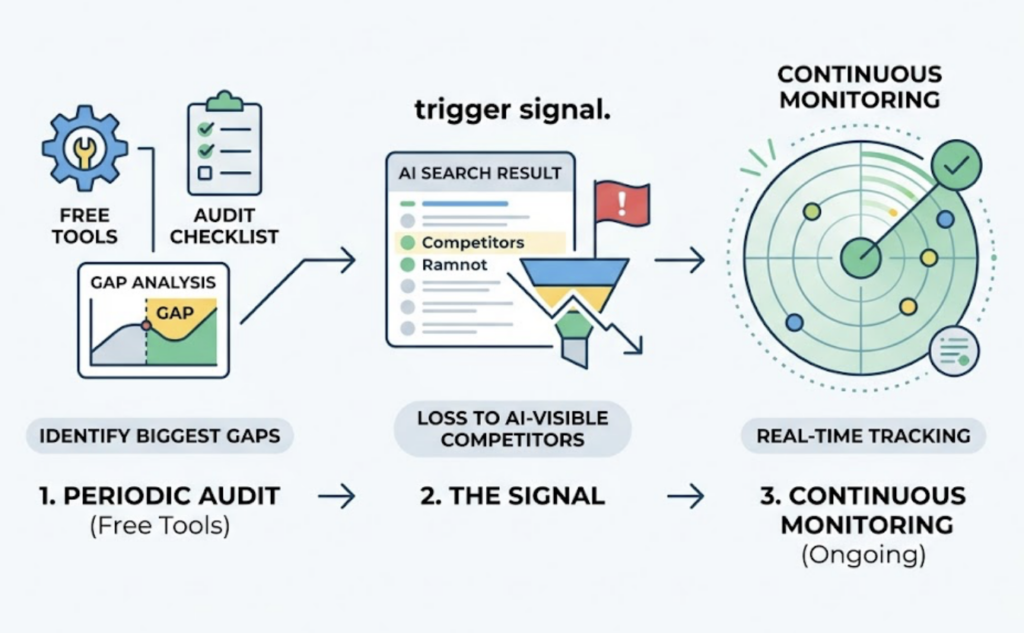
Free tools give you a snapshot. But AI recommendations aren’t static. Models retrain, new content gets indexed, and competitor strategies shift. Research suggests that only about 30% of brands maintain consistent visibility across multiple regenerations of the same query.
That’s where the diagnostic tools hit their ceiling. They tell you where you stand today, but they can’t tell you when a competitor overtakes you next month or when a model update drops your visibility overnight.
Topify’s full platform tracks brand visibility continuously across ChatGPT, Perplexity, Gemini, DeepSeek, and AI Overviews. It monitors seven metrics in a single dashboard: visibility, sentiment, position, volume, mentions, intent, and CVR. For logistics SaaS teams where a single enterprise deal can be worth six figures, the cost of being invisible on one high-intent prompt far outweighs a monthly subscription.
The practical path: start with the free tools. Run the audit. Identify the biggest gaps. If the data shows you’re losing pipeline to competitors who are visible in AI search, that’s the signal to move from periodic checks to continuous monitoring.
Conclusion
AI search traffic converts at roughly 5x the rate of traditional organic traffic. For logistics SaaS companies, where buyer intent is high and deal sizes are significant, that conversion advantage makes AI visibility a pipeline issue, not a marketing experiment.
The 13 free tools covered here give you a clear starting point: check whether AI knows your brand, understand how it perceives you, identify the prompts that drive pipeline, and benchmark against competitors. That’s a lot of diagnostic power for zero cost and less than an hour of work. The logistics SaaS brands that treat AI visibility as a board-level priority now will own the category recommendations for years. The ones that keep measuring against 2023 dashboards will keep wondering why pipeline growth doesn’t match SEO performance.
FAQ
What is AI visibility for logistics SaaS?
AI visibility measures how often your logistics SaaS brand appears in AI-generated responses when users ask platforms like ChatGPT, Perplexity, or Gemini about transportation management systems, warehouse software, freight tools, or supply chain platforms. It’s distinct from traditional SEO rankings because AI models use different signals to decide which brands to recommend.
How do I check if my logistics SaaS brand appears in ChatGPT?
The fastest way is to run Topify’s free AI Visibility Report. It queries multiple AI platforms with prompts relevant to your category and returns mention rates, ranking positions, and platform-by-platform breakdowns. You can also manually ask ChatGPT category-specific questions, but the free tool covers more ground in less time.
Do backlinks still matter for AI search visibility?
They matter less than you’d think. Research shows brand mentions correlate with AI citations at 0.664, while backlinks correlate at approximately 0.2. Unlinked brand mentions, structured entity content, and review presence tend to be stronger signals for AI recommendation engines than traditional link-building.
How often should I audit my AI visibility?
At minimum, quarterly. AI models retrain regularly, and competitor activity can shift your position between audits. For logistics SaaS companies in competitive categories like TMS or WMS, monthly checks using free tools are practical. Continuous monitoring through a platform like Topify is the most reliable approach for tracking changes in real time.

