

You typed your product category into ChatGPT. The engine listed three competitors, explained why each one fits different use cases, and sent users off to explore. Your brand wasn’t mentioned.
That’s not a content quality problem. It’s an AI search optimization problem. And for most startups, it’s already happening at scale.
Most Startups Don’t Realize They Have an AI Visibility Problem
Traditional SEO built a false sense of security. A brand ranking on page one of Google assumes that ranking translates into discovery across the board. It doesn’t.
By 2026, traditional search engine volume is projected to decline 25% as users shift to AI-driven interfaces. Meanwhile, 93% of AI Mode searches end without a click at all, as users get complete answers directly from the engine. Organic CTR for queries with AI Overviews has dropped 61% overall.
That’s not a temporary dip. That’s a structural shift in how people find brands.
The paradox: the traffic that does come from AI is far more valuable. ChatGPT referrals convert at 14.2% compared to Google’s 2.8%. Claude referrals hit 16.8% with a 23% lower bounce rate. Users arrive pre-vetted, high-intent, and ready to act.
The problem isn’t the quality of AI traffic. The problem is getting into the answer in the first place.
The 5 Metrics That Define AI Search Optimization Startups Visibility
Most startups still measure AI performance with Google Analytics, which categorizes much of AI-referred traffic as “Direct.” That makes it nearly impossible to track what’s actually working.
AI search optimization for startups requires a different metrics framework entirely.
| Metric | What It Measures | Why It Matters at Startup Stage |
|---|---|---|
| Answer Visibility Rate | How often your brand appears in AI responses for target prompts | Binary: you’re in the answer or you’re invisible |
| Citation Share | % of cited sources in AI responses that come from your domain | Indicates your content is selected as “source of truth” |
| Position in Response | Where in the synthesized answer your brand is mentioned | First-paragraph mentions outperform footnotes significantly |
| Sentiment Score | How AI frames your brand (helpful, credible, recommended vs. neutral) | AI doesn’t just list brands; it characterizes them |
| Prompt Coverage | Number of distinct user queries where your brand is cited | The ceiling most startups hit without realizing it |
Research analyzing 75,000 brands found that brand web mentions carry the strongest correlation with appearance in AI Overviews, with a Spearman coefficient of 0.664. Backlink volume, by contrast, scores only 0.218.
That’s the shift in signal weight that most startups still haven’t accounted for.
Platforms like Topify track all seven of these dimensions (including intent and CVR) across ChatGPT, Gemini, Perplexity, and other major AI engines. Instead of patching together data from multiple sources, you get a single view of how AI systems actually perceive and represent your brand.
Why Prompt Coverage Is the Invisible Ceiling on AI Search Optimization Startups Visibility Metrics
Here’s the scenario that plays out constantly: a startup tracks five brand-name prompts, sees decent visibility, and assumes AI search is under control.
It isn’t.
Most purchase decisions in AI search happen through unbranded, category-level prompts. Someone asking “best tool for managing remote payroll” isn’t searching for your brand. They’re asking the AI to make a recommendation, and the engine’s answer depends entirely on whether your brand has established authority within that topic cluster.
Advanced teams maintain a 75/25 split: roughly 75% unbranded prompts (informational, commercial intent) and 25% branded. The unbranded queries reveal where the brand is genuinely competitive in the wider category. If you’re missing from those conversations, it indicates an authority gap.
Topify’s High-Value Prompt Discovery surfaces the specific prompts driving AI recommendations in your category. The Basic plan covers 100 prompts with 9,000 AI answer analyses per month. As your strategy matures, you can expand prompt coverage to match the full scope of your target audience’s search behavior.
How Startups with Top AI Search Visibility Actually Build It
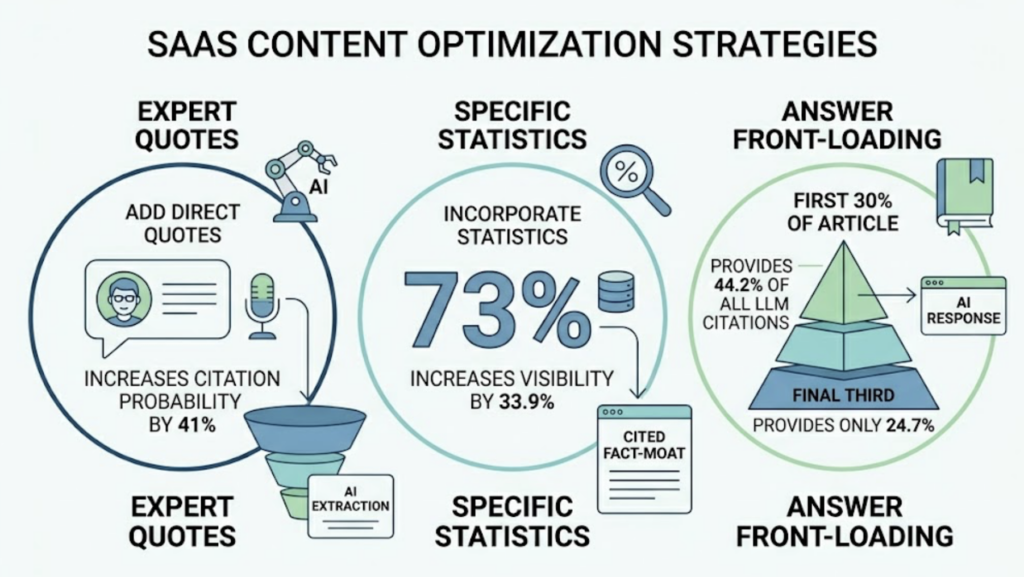
The GEO (Generative Engine Optimization) framework, validated across 10,000 queries, shows that specific content modifications can increase AI visibility by up to 40%. The tactics aren’t complicated, but they require a deliberate shift in how you approach content.
Three changes with the highest measured impact:
Adding direct expert quotes improves citation probability by 41%. AI models treat quoted statements as concrete extraction points. A sentence with a named expert behind it is far more likely to appear in a synthesized response than the same claim written in marketing copy.
Incorporating specific statistics increases visibility by 33.9%. “Most users prefer X” is skippable. “73% of users in a 2025 survey preferred X” is citable. The number creates a “fact-moat” that the AI must attribute to a source.
Front-loading answers matters more than most teams realize. Research from early 2026 found that 44.2% of all LLM citations come from the first 30% of an article, while the final third accounts for only 24.7%. If your key claims are buried in section five, they’re likely never making it into an AI response.
Q&A-formatted content triggers AI summaries 60% of the time. Structuring sections around specific user questions (what, why, when, how) increases the probability your content is pulled into the synthesis layer.
That last point is worth sitting with for a moment.
Most startup content is optimized to impress human readers navigating a page. AI search optimization requires optimizing for extraction: making the key answer available within the first two lines of each section, removing density that makes summarization harder, and replacing vague qualifiers with precise numbers.
Competitor Benchmarking: The AI Search Optimization Move Most Startups Skip
Knowing your own AI visibility score is necessary. Knowing how it compares to competitors is what drives strategy.
A critical benchmarking signal is the “read vs. cited” gap. If an LLM bot like GPTBot is crawling your site but consistently citing a competitor for the same category queries, your content is being read and rejected in favor of something with higher signal density or entity trust. That’s a specific, fixable problem, and you can’t see it without competitor-level tracking.
Benchmarking at the AI search layer should focus on three dimensions: citation distribution (which third-party publishers are being cited as authoritative for your category), narrative displacement (how often a competitor appears in responses to queries about your product category), and sentiment divergence (whether the AI is framing a competitor more favorably than your brand).
Topify’s Competitor Monitoring automates this across platforms, giving a side-by-side view of Visibility, Sentiment, and Position for your brand versus competitors in real time. You don’t have to manually run queries across four AI engines to figure out where the gaps are.
The High-Value Traffic Case for Investing in AI Search Optimization Now
There’s a practical objection most startup marketing teams raise: AI search is hard to attribute, so it’s hard to justify in a budget conversation.
It’s worth addressing that directly.
Most AI platforms don’t pass consistent referral data, which causes Google Analytics 4 to bucket AI-referred visits as “Direct” traffic. This creates an attribution gap that makes AI search look less impactful than it is. Analysis of 12 million website visits shows that AI-driven traffic converts at 4-5x the rate of traditional Google traffic. Perplexity referrals average 12.4% conversion with 41% longer session times. That’s not noise; that’s a distinct audience quality signal.
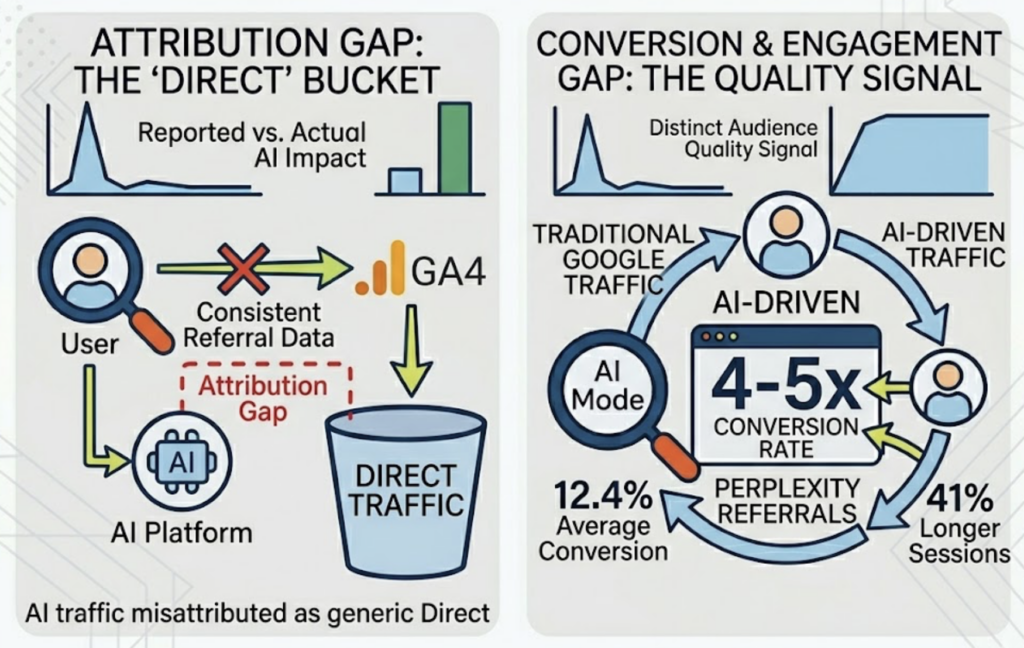
The implication for startups is that the ROI from AI search optimization is likely already showing up in your data. It’s just being misclassified.
By 2028, US revenue influenced by AI-powered search is estimated to reach $750 billion. The brands capturing that traffic won’t be the ones with the most backlinks. They’ll be the ones with the highest entity authority, the clearest factual signals, and the widest prompt coverage.
What Startups Can Do This Week to Move the Needle
AI search optimization doesn’t require a six-month content overhaul to see early results. Three actions have measurable impact within weeks.
First, audit your current AI citations. Run your top 20 unbranded category prompts across ChatGPT, Perplexity, and Gemini. Note where competitors appear and you don’t. That list is your priority queue. Topify’s visibility trackingautomates this baseline across platforms so you’re working from data rather than spot checks.
Second, retrofit your top-performing pages. Add one statistic and one expert quote to the first 30% of your five highest-traffic articles. This doesn’t require new content, it requires upgrading what already ranks for traditional search so it also qualifies for AI citation.
Third, expand your prompt tracking. If you’re monitoring fewer than 50 prompts, you’re seeing a fraction of where your brand is (or isn’t) appearing. At $99/month, Topify’s Basic plan covers 100 prompts with 9,000 AI answer analyses and 200 research credits, which is enough to build a real baseline across your core topic clusters.
Track it. Optimize it. Repeat.
Conclusion
The startups that dominate AI search in three years are making decisions right now: which prompts to own, which content to retrofit, which competitors to benchmark against.
AI search optimization isn’t a separate channel from your existing strategy. It’s the layer that determines whether your existing content actually reaches the users who are looking for exactly what you build.
The answer to “Who should I use for [your product category]?” is being written by AI engines today. Topify helps you make sure your brand is part of that answer, tracked, measured, and optimized across every major platform.
FAQ
What are the most important AI search visibility metrics for startups?
The five metrics that matter most are answer visibility rate, citation share, position in response, sentiment score, and prompt coverage. Traditional metrics like keyword ranking and CTR don’t capture whether your brand is appearing in AI-synthesized answers. AI search optimization startups visibility metrics need to be tracked at the prompt level, not the page level.
How do I know if my startup is being recommended by AI search engines?
Run your top category-level, unbranded queries across ChatGPT, Perplexity, and Gemini, and note whether your brand appears in the responses. For a systematic view, platforms like Topify track brand mentions across AI engines continuously, so you’re not dependent on manual spot checks.
How does AI search optimization differ from traditional SEO for startups?
Traditional SEO optimizes for retrieval: getting your page indexed and ranked in a list. AI search optimization optimizes for synthesis: getting your content selected as a cited source in a generated answer. The signals that drive synthesis (brand web mentions, factual specificity, structured formatting) are different from and often more important than classic link-building volume.

