

A developer typed into Perplexity: “Best architecture firms for mixed-use development in Austin.” Five names came back. Your firm, with 30 years of commercial experience and a portfolio of LEED-certified projects, wasn’t on the list. The developer shortlisted those five firms and never searched further.
The issue isn’t your track record. It’s that AI doesn’t recognize it.
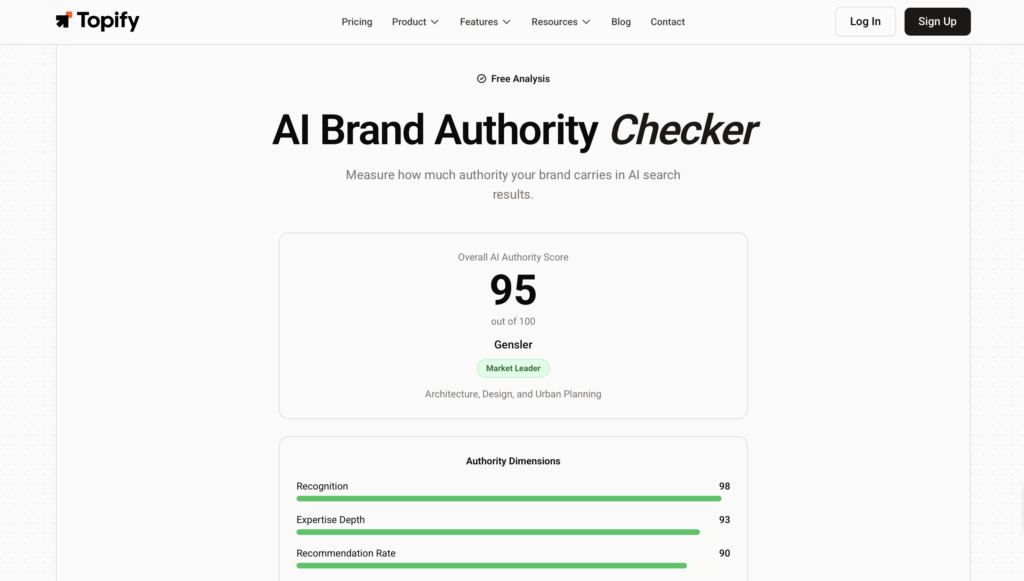
There’s a way to see exactly where the disconnect is. Topify‘s Brand Authority Checker scores how AI models perceive your architecture firm’s authority, broken down into four dimensions that directly affect whether you get recommended when a client, developer, or procurement officer asks AI for help.
✅ Free ⚡ Results in 60 seconds
AI Brand Authority Checker
The Four Authority Scores, Translated for Architecture Firms
The Brand Authority Checker doesn’t give you a single pass/fail rating. It breaks AI’s perception of your firm into four distinct scores, each mapping to a specific business development problem architecture practices face.
| Metric | What It Measures | What It Means for Architecture Firms |
|---|---|---|
| Recognition (0-100) | How often AI identifies your firm in your category | Below 40: AI doesn’t associate you with your core practice area (healthcare, hospitality, residential) |
| Expertise Depth (0-100) | How well AI understands your capabilities | Below 50: AI may describe your firm as “general practice” while ignoring your specialization in adaptive reuse or net-zero design |
| Recommendation Rate (0-100) | How often AI recommends you vs. alternatives | Below 30: you’re losing RFP shortlists before your BD team even knows the project exists |
| Trust Signals (0-100) | External validation AI detects (media, citations, reviews) | Below 40: AI can’t find enough third-party evidence to vouch for your firm’s credibility |
Here’s the thing. A firm with a Recognition score of 80 but a Trust Signals score of 25 has a very specific problem: AI knows who you are, but doesn’t trust you enough to recommend you. That’s a different fix than a firm scoring low across all four.
The gap between these scores tells you exactly where to focus your marketing and PR investment.
Three Scenarios Architecture Firms Discover After Running the Check
Scenario 1: The “Invisible Specialist” Your firm has won AIA Honor Awards for healthcare architecture. But AI only associates you with “commercial architecture” in general terms. The Expertise Depth score is 35, while Recognition sits at 70. AI knows your name but doesn’t understand what you actually do. This typically happens when a firm’s website and third-party profiles use broad language instead of specific project-type descriptions.
Scenario 2: The “Outdated Portfolio” Your firm pivoted from residential to mixed-use development three years ago. AI still describes you as a residential practice. The Recognition score reflects the old identity, and the Recommendation Rate for mixed-use queries is near zero. AI models train on historical data, and without fresh, structured signals, the old identity persists.
Scenario 3: The “Reputation Gap” Your firm has 25 years of editorial coverage in Architectural Record, Dezeen, and ArchDaily. But your Trust Signals score is 42. The problem: AI doesn’t weigh beautiful project photography or social followings. It weighs structured citations, third-party validation, and consistent editorial signals that it can parse and verify.
How to Run Your Architecture Firm’s Authority Check
The process takes less than a minute. Go to Brand Authority Checker, enter your firm’s name or domain, and you’ll get a four-dimensional authority breakdown. No signup required, no credit card, no strings attached.
Once you have your scores, focus on the lowest dimension first. A firm with strong recognition but weak trust signals needs a different strategy than a firm that’s invisible across the board. The scores give you a diagnostic starting point, not just a number.
Published Everywhere Except Where Clients Now Search
Architecture firms have spent decades investing in the right places: competition entries, magazine features, conference presentations, and portfolio books. That investment built real reputations. But AI search operates on a different signal set entirely.
The Designer AI Visibility Index, launched in May 2026 by 5W and Haute Living, audited how architects and designers appear across ChatGPT, Claude, and Perplexity. The finding was blunt: most of the most-published architects in the United States, including firms with seven-figure project pipelines and twenty years of editorial coverage, are functionally invisible inside AI answers.
AI engines don’t pattern-match against portfolio images or Instagram grids. They pattern-match against credentialed editorial features, structured profiles, FAQ data, and authoritative third-party citations. That’s a fundamentally different signal set than what most architecture firms have been building.
Here’s what your potential clients are actually asking AI right now:
| AI Prompt Example | Platform | Search Intent | What It Reveals |
|---|---|---|---|
| “Best architecture firm for sustainable office buildings in Denver” | ChatGPT | Purchase decision | Whether your firm gets named when a developer is shortlisting |
| “Which architects specialize in adaptive reuse of industrial buildings?” | Perplexity | Expertise verification | Whether AI understands your niche specialization |
| “Compare architecture firms for K-12 school design” | Gemini | Competitive research | Where you rank against firms AI considers authoritative |
| “Recommend an architect for a net-zero mixed-use project” | ChatGPT | Qualified lead query | Whether your sustainability credentials register with AI |
| “Top hospitality architects for boutique hotel renovation” | Perplexity | Sector-specific shortlist | Whether AI places you in the right project-type category |
Each of these prompts represents a potential project. If your firm doesn’t appear, you’re not losing a ranking. You’re losing the meeting.
What the Authority Gap Means for Your Firm’s Pipeline
Award-Winning Doesn’t Mean AI-Visible
The Designer AI Visibility Index confirmed what many architecture firms haven’t realized yet: editorial coverage and AI visibility are not the same thing. A firm featured in Architectural Digest, Dezeen, and ArchDaily for two decades can still score below 30 on AI authority metrics.
Why? AI models evaluate authority through a completely different lens. Portfolio quality, design awards, and project photography carry almost zero weight in AI’s trust model. What AI looks for is structured data, consistent entity signals, third-party citations it can parse, and editorial content formatted in ways that AI crawlers can index and verify.
Run your firm through the Brand Authority Checker and you’ll likely see the gap in real numbers. The Recognition score might be decent if your firm has been around long enough. But Expertise Depth and Trust Signals often tell a very different story.
The Compounding Window Is Open Now
The architecture category in AI search hasn’t been seriously competed for yet. Citation share is sitting in the open, and firms that build structured AI authority in 2026 will compound an advantage that late movers will spend years trying to close.
AI engines have a recency bias toward authoritative sources that have produced consistent, structured coverage in the last 12 months. A firm that begins building that presence today creates a compounding signal loop: more structured authority leads to more AI citations, which leads to more visibility, which reinforces authority further.
A firm that waits until 2028 to address AI visibility will face a category where competitors have already established citation dominance. The recovery timeline, based on patterns observed across other professional services categories, is typically two to three years of consistent effort just to catch up.
Your Expertise Depth Is Probably Dangerously Narrow in AI
This one is subtle and easy to miss. Your firm might be recognized by AI, it might even get recommended occasionally, but AI’s understanding of what you do could be incomplete or wrong.
A firm known for healthcare architecture might find AI only associates it with hospital design, completely missing its expertise in outpatient clinics, research labs, or senior living facilities. A firm with a strong mixed-use portfolio might get pigeonholed as “residential” because that’s what most of its older, indexed content describes.
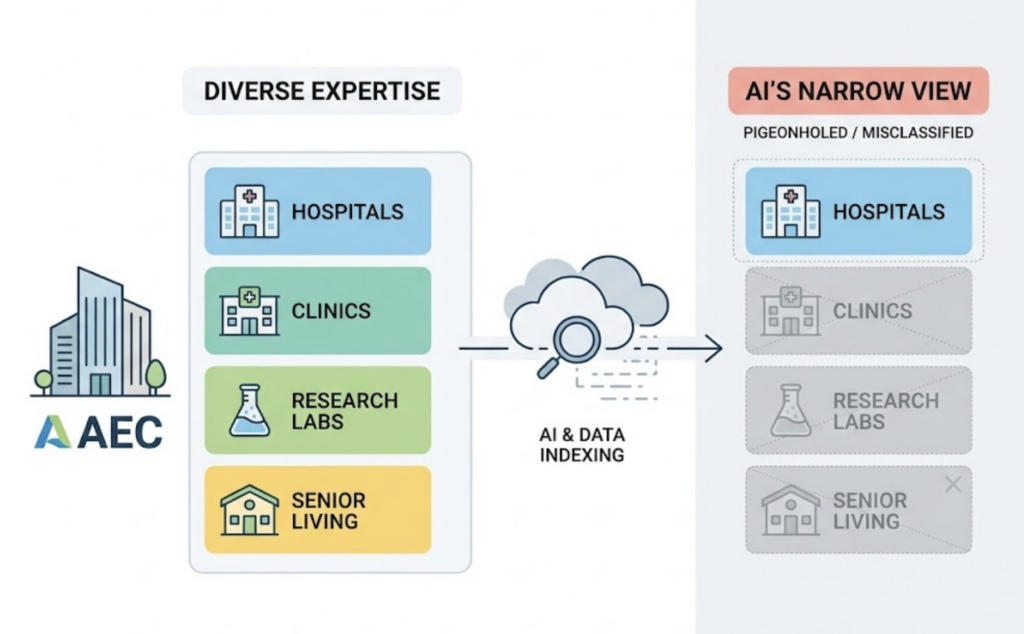
The Brand Authority Checker’s Expertise Depth score surfaces this kind of misrepresentation. A score below 50 in this dimension means AI is either describing your capabilities incorrectly or incompletely. And every incomplete description is a project type you’re invisible for.
One Score Is a Starting Point. Tracking It Over Time Is the Strategy.
Your Brand Authority Checker results tell you where you stand right now. But AI models update their training data, adjust ranking signals, and shift recommendations on a rolling basis. A score of 72 today could drop to 55 next quarter without any change on your end.
Topify‘s platform picks up where the free tool leaves off. The Comprehensive GEO Analytics dashboard tracks your authority, sentiment, and visibility scores continuously across ChatGPT, Perplexity, Gemini, and Google AI Overviews. You’ll see trend lines, get alerts when scores shift, and receive specific recommendations for what to fix.
Here’s how the free check compares to the full platform:
| Capability | Free Brand Authority Checker | Topify Platform |
|---|---|---|
| Check frequency | One-time snapshot | Continuous daily/weekly monitoring |
| AI platforms covered | Aggregated score | Per-platform breakdown (ChatGPT, Perplexity, Gemini, AI Overviews) |
| Historical data | None | Full trend history with alerts |
| Competitor comparison | Not included | Real-time benchmarking against other firms |
| Action recommendations | General | Specific, one-click GEO optimization |
| Team collaboration | No | Unlimited team member seats |
Every plan starts with a 7-day free trial, no credit card required. The Starter plan begins at $99/month.
Conclusion
Architecture firms have spent decades building reputations through design quality, editorial coverage, and word-of-mouth referrals. That investment is real. But the client discovery funnel has shifted, and AI search now sits at the top of it, particularly for high-value developer, corporate, and UHNW clients.
The firms that diagnose their AI visibility gap now and build structured authority in 2026 will define who gets shortlisted in this new channel. The firms that wait will spend years catching up in a category that’s already been claimed.
Start with a free check. Run your firm through the Brand Authority Checker and see exactly how AI perceives your authority today. Then decide whether a one-time snapshot is enough, or whether continuous monitoring through Topify’s platform fits your growth strategy.
While you’re assessing your brand authority, a few other free checks can round out the picture. Topify‘s GEO Score Checker evaluates whether AI crawlers can actually access and index your firm’s website. The AI Visibility Report shows how often your firm gets mentioned across major AI platforms. And the Competitor Analysis tool reveals which firms AI considers your competitors and how you compare.
FAQ
Is the Brand Authority Checker really free? Do I need to create an account?
Yes, it’s completely free. You don’t need to sign up, provide an email, or enter a credit card. Enter your firm’s name or domain, and you’ll get your four-dimensional authority breakdown in under 60 seconds.
What’s the difference between the free tool and Topify’s paid platform?
The free Brand Authority Checker gives you a one-time snapshot of how AI perceives your firm’s authority right now. Topify’s platform (starting at $99/month) adds continuous monitoring, historical trend tracking, competitor benchmarking, per-platform breakdowns, and one-click optimization recommendations. The free tool tells you where you stand; the platform helps you improve over time.
How often should an architecture firm check its AI visibility?
AI models update their training data and recommendation algorithms regularly. A quarterly check with the free tool is a reasonable minimum. Firms actively investing in content, PR, or website updates should monitor monthly or continuously through Topify’s platform to see how those investments translate into AI authority changes.
Our firm has won multiple AIA awards and is featured in major publications. Why would we score low on AI authority?
AI models don’t evaluate authority the way industry peers do. Awards, portfolio photography, and social followings carry minimal weight in AI’s trust model. AI looks for structured data, parseable third-party citations, consistent entity signals, and editorial content formatted for AI crawlers. A firm can be highly respected in the profession and still invisible to AI because its authority signals aren’t structured in ways AI can read.

