

Your shopper just asked ChatGPT, “What’s the best low-sugar kombucha brand?” Five names came back. Yours wasn’t one of them.
That’s not a hypothetical. U.S. ChatGPT users now generate over 84 million shopping-related queries every week, and a growing share of those queries involve food and beverage recommendations. “Best protein bar for gut health.” “Top organic baby food brands.” “Healthiest energy drinks with no artificial sweeteners.” These prompts don’t return ten blue links. They return a short list of brand names, and if your brand isn’t on it, you’ve lost the sale before the shopper even opens a browser tab.
Here’s the thing. Most F&B brands still measure visibility by shelf placement, retail distribution, and Google rankings. None of that tells you whether AI recommends your product when a consumer asks for it by category, by dietary need, or by functional benefit.
A second shelf has appeared. It’s invisible, it’s powered by large language models, and it’s already influencing purchase decisions. Topify offers a free tool that lets you see exactly how AI perceives your brand, in under 30 seconds. The Brand Sentiment Checker analyzes AI’s emotional and qualitative read on your brand: what it considers your strengths, where it flags weaknesses, and what overall sentiment score it assigns. For F&B brands navigating this shift, it’s the fastest way to find out if AI trusts you enough to recommend you.
What AI Actually Thinks About Your F&B Brand (And How to Check in 30 Seconds)
Traditional brand health trackers measure what consumers say in surveys. The Brand Sentiment Checker measures something different: what AI models believe about your brand based on everything they’ve ingested from the open web.
AI Brand Sentiment Checker
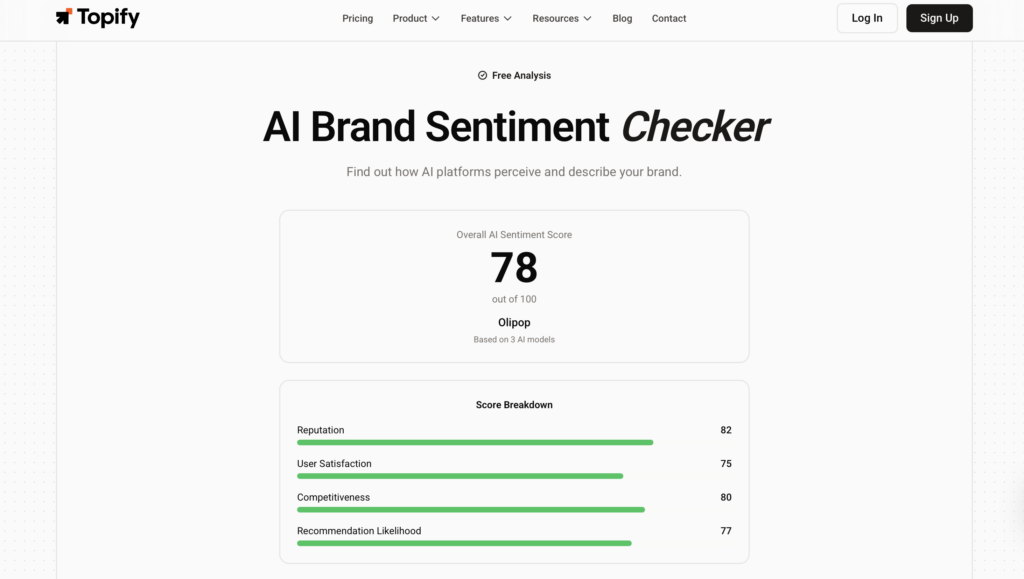
You enter your brand name. The tool returns four things: an overall sentiment score, a list of perceived strengths, a list of perceived weaknesses, and the core narrative AI associates with your brand. No signup required.
For F&B brands, this output is unusually revealing. Here’s why: AI models don’t evaluate your packaging design, your in-store displays, or your trade spend. They evaluate your digital footprint. That includes product reviews, Reddit threads, nutritional claims on your website, press coverage, and third-party mentions across industry publications.
The table below breaks down each metric and what it means in an F&B context.
| Metric | What It Measures | F&B Example |
|---|---|---|
| Overall Sentiment Score | AI’s net positive/negative perception of your brand | A plant-based protein brand scoring 72/100 vs. a legacy snack brand at 45/100 |
| Perceived Strengths | Attributes AI associates with your brand positively | “Clean ingredients,” “transparent sourcing,” “strong community reviews” |
| Perceived Weaknesses | Attributes AI flags as concerns or gaps | “Limited flavor variety,” “premium pricing questioned,” “few third-party endorsements” |
| Core Narrative | The story AI tells about your brand when prompted | “A DTC functional beverage brand focused on gut health, popular among health-conscious millennials” |
What This Looks Like for an Organic Snack Brand vs. a Functional Beverage Startup
Consider two brands running the same check.
An established organic snack company might see high sentiment driven by years of press coverage and retail presence, but a core narrative that’s stuck in 2021. AI still describes them as “a family-friendly organic option” when the brand has since pivoted to high-protein, performance-focused positioning. That gap between current strategy and AI perception is a visibility liability.
A newer functional beverage startup might see lower overall sentiment (less data available) but sharper strengths: “innovative adaptogen formulation,” “strong Reddit buzz,” “endorsed by registered dietitians.” The narrative is current, but the authority signals are thin.
Both brands have work to do. But they can’t prioritize that work without first seeing the data.
The F&B Prompts That Drive AI Recommendations
AI visibility in food and beverage isn’t abstract. It comes down to specific prompts that real consumers type into ChatGPT, Perplexity, and Google’s AI Overview. Each prompt is a moment where AI either mentions your brand or doesn’t.
The prompts fall into three buckets: functional need, dietary restriction, and category comparison. Here’s what that looks like in practice.
| Prompt Example | Intent Type | Brand Visibility Opportunity |
|---|---|---|
| “Best high-protein snacks for weight loss” | Functional need | Brands with strong nutritional claims + positive review sentiment |
| “Healthiest sparkling water brands 2026” | Category comparison | Brands with broad third-party mentions + clean ingredient narratives |
| “Best baby formula for sensitive stomachs” | Dietary restriction | Brands with expert endorsements + trust signals in AI’s training data |
| “Top organic coffee brands with fair trade certification” | Values-driven | Brands with structured sustainability data + media coverage |
| “GLP-1 friendly snack options” | Emerging health trend | Brands already creating content around GLP-1 compatible nutrition |
| “Best kombucha for gut health Reddit” | Social proof seeking | Brands with active Reddit presence + authentic user reviews |
The pattern is clear. AI doesn’t recommend brands based on ad spend or shelf placement. It recommends based on the information it can find, verify, and synthesize across the open web.
If your brand hasn’t published content around these prompt themes, if your reviews don’t mention the functional benefits consumers search for, and if third-party sources haven’t covered your brand in the right context, you’re invisible to these queries. That’s not a marketing problem. It’s a discoverability problem.
AI Doesn’t See Your Packaging. It Reads Your Digital Footprint.
For decades, F&B brands invested in packaging design, shelf strategy, and in-store merchandising to win at the point of purchase. Those investments still matter in physical retail. But AI search operates on entirely different inputs.
When a consumer asks Perplexity “what’s the best plant-based protein powder,” the AI doesn’t scan grocery aisles. It scans the web. And research shows that Perplexity references user reviews in 100% of its responses, while ChatGPT includes review content in 58% of answers.
That means your reviews are now part of your AI packaging.
Most F&B brands don’t think about reviews this way. They treat reviews as a customer service metric or a conversion rate optimizer on their DTC site. But in the AI search era, every review is a data point that shapes how language models describe, evaluate, and recommend your product.
Here’s what AI actually pulls from when building a brand recommendation:
Product reviews on your own site, Amazon, and third-party platforms. AI models synthesize these into sentiment signals. A brand with 2,000 reviews averaging 4.5 stars and frequent mentions of “great taste” and “clean ingredients” gets a very different AI profile than one with 200 reviews and complaints about texture.
Reddit and Quora threads. These are among the highest-signal sources for LLM training data. If consumers are recommending your brand in r/HealthyFood or r/Supplements, that directly feeds AI’s perception. If they’re not, your competitors who do have that presence will get the mention instead.
Industry publications and earned media. Coverage in Food Navigator, Food Dive, or niche nutrition outlets tells AI that your brand has category authority. Press releases on your own blog don’t carry the same weight.
Structured data on your website. Product schema markup, nutritional information in structured format, FAQ content that answers common consumer questions. AI crawlers need machine-readable information to index your brand correctly.
The gap between brands that invest in these signals and those that don’t is widening. Analysis from Ahrefs found that brands with the most web mentions appear up to 10 times more often in AI-generated search results than competitors in the same category.
From Sentiment Score to Shelf Strategy: A Three-Step Playbook
Knowing your AI sentiment score is the diagnostic. Acting on it is the strategy. Here’s a practical framework for F&B brands, starting with the Brand Sentiment Checker output.
Step 1: Audit your AI narrative. Run your brand through the Brand Sentiment Checker and compare the core narrative against your current positioning. If AI describes you as “an affordable snack brand” and you’ve spent two years repositioning as a premium wellness brand, that mismatch tells you exactly where to focus. Update your website copy, product descriptions, and structured data to reflect your current story.
Step 2: Close the review gap. Check whether your reviews mention the functional benefits and attributes that matter for AI search prompts in your category. If consumers search for “high protein” and none of your reviews mention protein content, you’re missing a key signal. Encourage post-purchase reviews that speak to specific product benefits, not just generic satisfaction.
Step 3: Build third-party authority in AI-indexed sources. Identify the publications, forums, and community platforms that AI models draw from. Contribute expert content to industry outlets. Participate genuinely in Reddit communities relevant to your category. Secure earned media that covers your brand in the context of the trends consumers are searching for: gut health, clean labels, functional nutrition, sustainability.
This isn’t a one-time fix. AI models update their knowledge bases continuously, and the brands that show up consistently across these signals are the ones that stay in the recommendation set.
One Snapshot Is a Start. Continuous Tracking Is the Strategy.
The Brand Sentiment Checker gives you a point-in-time read. That’s valuable for an initial audit. But F&B is a fast-moving category. Seasonal launches, reformulations, PR crises, competitor moves, and shifting health trends all change how AI perceives your brand week to week.
This is where Topify’s full platform picks up. The table below shows what you get with the free tool vs. what continuous monitoring unlocks.
| Capability | Free Brand Sentiment Checker | Topify Platform |
|---|---|---|
| AI sentiment snapshot | One-time check | Continuous tracking with trend lines |
| Competitive benchmarking | Not included | Real-time competitor sentiment + ranking comparison |
| Prompt-level visibility | Not included | Track your brand across specific high-value prompts |
| Cross-platform coverage | Single model snapshot | ChatGPT, Perplexity, Gemini, Google AI Overview |
| Historical trends | Not available | Week-over-week sentiment and visibility changes |
| Actionable alerts | Not available | Notifications when sentiment shifts or competitors gain ground |
For F&B brands running seasonal campaigns, launching new SKUs, or managing a reformulation rollout, continuous tracking turns AI visibility from a guessing game into a managed channel. You can see whether your new “high-protein, low-sugar” positioning is actually changing how AI describes you, or if the old narrative is still sticky.
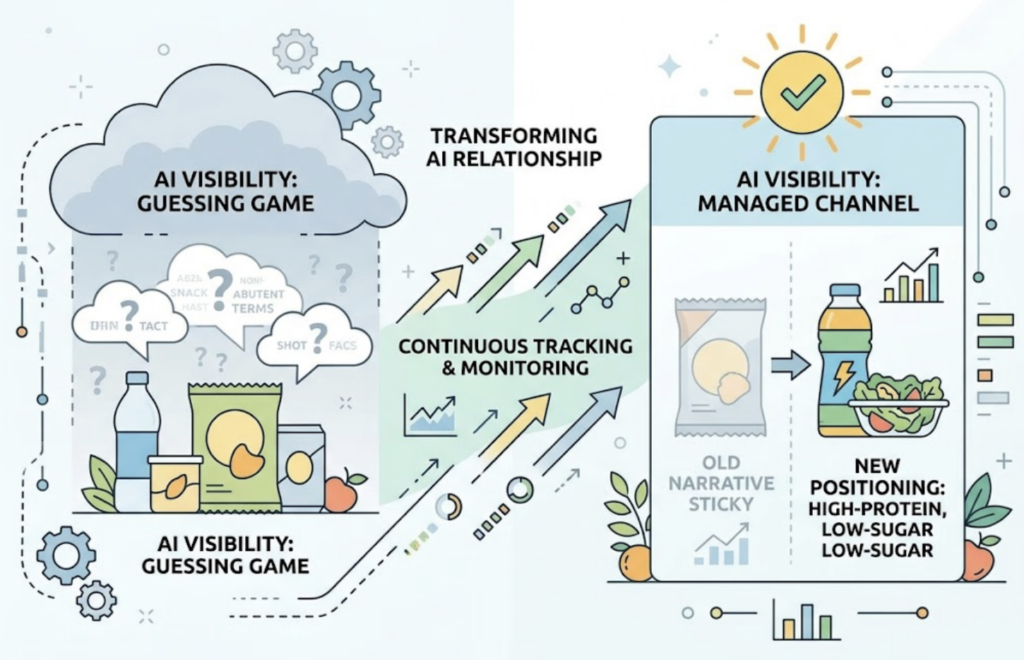
Topify’s Comprehensive GEO Analytics dashboard brings sentiment, visibility scores, citation trends, and competitive benchmarking into a single view. Plans start at $99/month with a 7-day free trial, no credit card required. You can start a free trial and see your full AI visibility profile across platforms within minutes.
Conclusion
F&B brands are entering a period where AI search is becoming a legitimate product discovery channel. The majority of food shoppers haven’t made the switch yet, but the infrastructure is already built: agentic shopping tools from OpenAI, Google, and Perplexity are live, review data is being ingested at scale, and consumers who do use AI for food recommendations are acting on what they see.
Your first step is simple. Run your brand through the Brand Sentiment Checker and see what AI actually says about you. It takes 30 seconds, costs nothing, and the answer might surprise you.
From there, expand your audit. Use the AI Visibility Report to see how often your brand gets mentioned across major AI platforms. Check the Prompts Researcher to discover the exact questions your category’s consumers are asking AI. And run the AI Robots Checker to make sure AI crawlers can actually access your product pages.
The brands that treat AI visibility as a channel now will own the second shelf when the rest of the market catches up.
FAQ
How do AI search engines decide which food and beverage brands to recommend?
AI models like ChatGPT and Perplexity don’t rely on paid ads or shelf placement. They synthesize information from product reviews, Reddit discussions, industry publications, structured website data, and third-party mentions. Brands with stronger, more consistent signals across these sources are more likely to appear in AI-generated recommendations. Running a free Brand Sentiment Checker scan is the fastest way to see how AI currently perceives your brand.
Do customer reviews actually affect whether AI recommends my product?
Yes. Perplexity references user reviews in 100% of its product recommendations, and ChatGPT includes review content in 58% of its responses. For F&B brands, this means reviews that mention specific attributes like “clean ingredients,” “great taste,” or “good for gut health” directly shape AI’s perception and recommendation behavior.
My brand has strong retail distribution. Doesn’t that mean AI already knows about us?
Not necessarily. AI models don’t scan store shelves or track distribution data. They read your digital footprint: website content, schema markup, earned media, community discussions, and online reviews. A brand with wide retail presence but a thin digital footprint can still be invisible to AI search.
How long does it take for AI models to update their perception of my brand?
It varies by platform. Some AI models update their web-crawled data weekly, while others rely on training data with longer refresh cycles. In general, consistent improvements to your digital presence, such as new reviews, updated structured data, and fresh earned media, start influencing AI recommendations within a few weeks to a few months.
Is AI visibility relevant for F&B brands that sell primarily through retail, not DTC?
Yes. Even when the final purchase happens in a store, the discovery and consideration phase is shifting online. A consumer who asks ChatGPT “best organic granola brands” and gets a list of five names will look for those brands at their local grocery store. AI visibility influences which brands enter the shopper’s consideration set, regardless of where the transaction happens.

