


Your team found a topic pulling solid AI search volume, built three pieces of content around it, and watched it do nothing for pipeline. The number wasn’t wrong. It just wasn’t telling you what you assumed it was telling you. AI search volume shows how often people ask about something inside ChatGPT, Perplexity, or Gemini. It says nothing about whether your brand shows up in the answer, what it’s compared against, or whether anyone acts on what they read. Treat it as the whole story and you’ll keep chasing high-volume topics that never move a single metric your finance team cares about.
What AI Search Volume Actually Measures
AI search volume estimates how often a prompt, or a cluster of closely related prompts, gets submitted to AI platforms in a given month. It plays roughly the same role prompt volume plays for GEO that keyword volume plays for traditional SEO: a way to rank topics by demand.
The scale behind that number is real. By July 2025, ChatGPT was fielding an estimated 2.5 billion prompts a day, according to OpenAI, up from 1 billion just eight months earlier. That’s the base a modern AI search volume tool is sampling from, and it’s why the metric exists at all.
But the shape of the demand is different from what keyword tools were built to count. Google’s average US query held near 3.3 to 3.4 words for most of a year. Inside AI assistants, queries average roughly 23 words, about six times longer than a typical search box query. A volume number built on twenty-three-word prompts about someone’s team size, budget, and current tools isn’t measuring the same behavior a keyword tool measures. It’s measuring something closer to a conversation.
Why a High Volume Number Can Still Mean Nothing
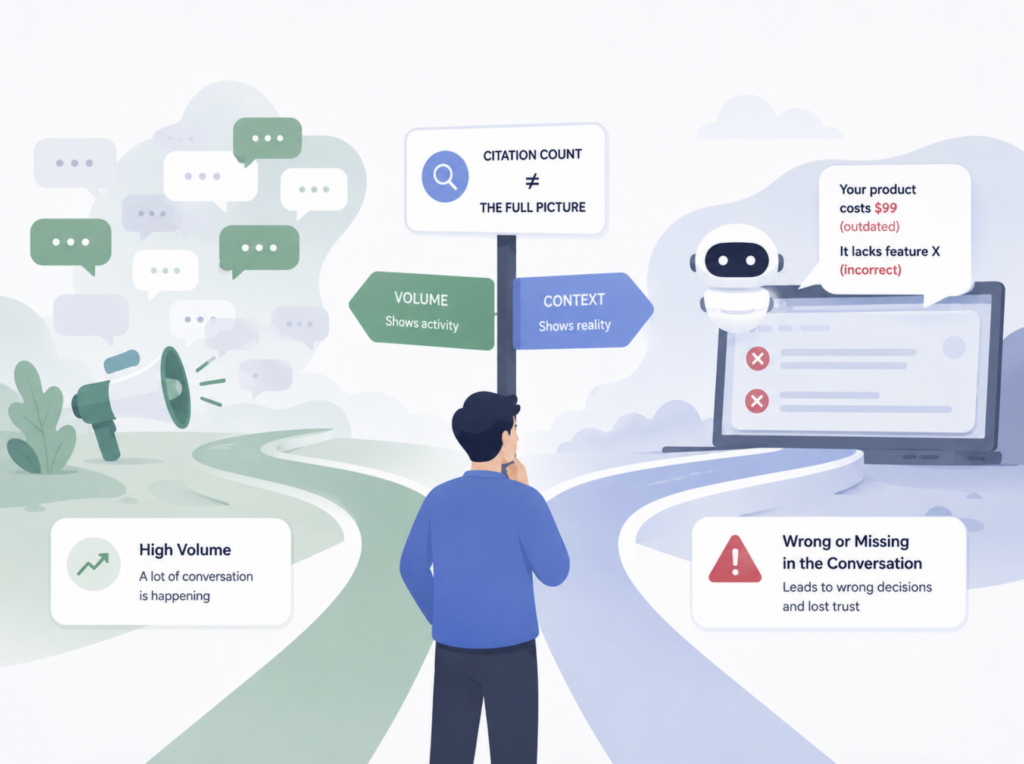
Here’s the gap. A topic can carry heavy AI search volume while your brand gets zero mentions inside it. Or you get mentioned constantly, in a version of your positioning that doesn’t match reality. Volume alone can’t tell you which one is happening.
Marketing teams already have a name for this pattern. A high AI visibility rate without citation share context can look strong right up until a competitor shows up twice as often in the same set of answers. The same logic applies to volume: a topic showing 8,000 monthly prompts means nothing if your domain never enters the conversation.
That’s the gap most brands still can’t see.
Citation count has the same blind spot. Being cited constantly with outdated pricing or the wrong feature set does more damage than being cited less often but accurately. Volume tells you a conversation is happening. It doesn’t tell you what’s being said about you inside it, or whether you’re in it at all.
The Three Numbers That Turn Volume Into a Decision
A useful measurement program treats volume as the entry point, not the scoreboard. One framework for AI visibility measurement breaks this into layers: a headline citation share number, a check on whether that citation is even accurate, and a downstream conversion metric that ties exposure back to revenue. Volume decides which topics deserve attention. These three numbers decide whether to act on them.
Position or mention rate. For a given high-volume topic, what share of AI answers actually name your brand? This is the fastest way to separate topics worth investing in from topics where you’re simply not part of the conversation yet.
Sentiment and accuracy. When you do get mentioned, is the description correct and on-message? A citation that gets your pricing tier wrong or calls you a budget option when you’re positioned as premium isn’t a win, even if it counts toward a visibility dashboard.
Conversion signal. This is the number that matters most to leadership. AI-referred visitors tend to convert differently than standard organic traffic. Semrush research puts AI-sourced traffic’s conversion rate at roughly 2.3 times that of typical organic search, and separate data from Conductor found AI-referred visitors converting at close to twice the rateof regular organic visitors. Fewer visits, higher intent. That’s the trade the zero-click era makes: fewer sessions overall, since about 60% of searches now end without a click per Bain’s research, but the sessions that do land are worth more.
How This Looks in Practice
Take a topic showing strong AI search volume in your monthly report. Check position first: are you named in more than a token share of answers for that topic. If yes, check sentiment: is the description accurate. If both hold up, check conversion: is the traffic or lift you’re seeing from that topic actually landing somewhere. A topic that fails any one of these three checks isn’t dead, but it’s not the priority the volume number made it look like.
Where Topify Fits
This is the exact gap Topify was built to close. Most AI visibility tools stop at a volume or visibility dashboard and leave you to stitch position, sentiment, and conversion data together yourself, often across three separate subscriptions.
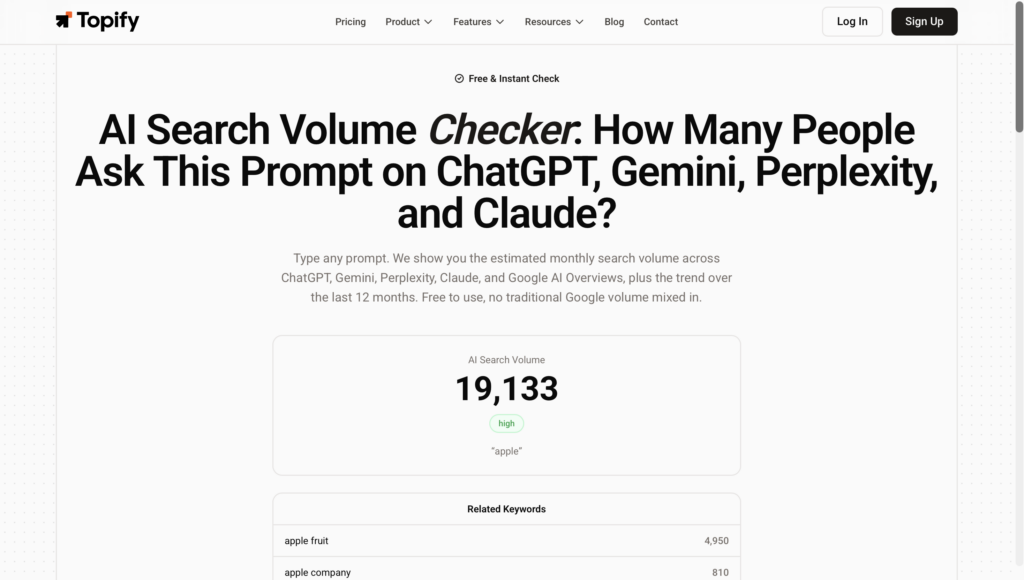
Topify’s AI Search Volume Checker surfaces the raw demand signal, the same kind of prompt-level volume data covered above, and pairs it in one view with Position Tracking, Sentiment Analysis, and CVR, its own measure of how likely an AI answer is to send someone toward your brand. In practice, that means you can spot a high-volume topic, check in the same dashboard whether you’re actually named in it, and see whether that exposure is translating into anything, without exporting three reports and reconciling them by hand.
AI Search Volume Checker
If you want to see where your own volume data currently stands against those three checks, you can get started with Topify and run your first check for free.
A Quick Way to Sanity-Check Your Own Volume Numbers
Pull your top three to five topics by AI search volume this month. For each one, note your position or mention rate, whether the sentiment reads accurately, and whether there’s any conversion or branded search lift tied to it. Topics that score well on volume but fail on all three checks are candidates to deprioritize. Topics that score well on volume and position but haven’t been checked for conversion are your next test.
Conclusion
The high-volume topic that went nowhere wasn’t a fluke, and it wasn’t a reason to stop trusting AI search volume as a metric. It’s a reason to stop reading it alone. Volume tells you where demand exists. Position, sentiment, and conversion tell you whether that demand is worth anything to you specifically. Before your next content or PR decision leans on a volume number, check it against those three before you commit budget to it.
FAQ
Q: Is AI search volume the same as Google search volume?
A: No. Google search volume counts short keyword-style queries in a search box. AI search volume estimates demand for much longer, conversational prompts, often around 20 words or more, sent to platforms like ChatGPT, Gemini, and Perplexity.
Q: How is AI search volume calculated?
A: AI platforms don’t publish prompt-level logs, so vendors model it from consented panels, sampling, and extrapolation. That makes it directional, useful for ranking topics and spotting trends, rather than a precise monthly count.
Q: What’s a good AI search volume tool?
A: Look for one that pairs volume with position, sentiment, and conversion data in the same view, rather than a standalone volume number with nothing to check it against.
Q: Should I create content for every high-volume AI topic?
A: Not automatically. Check your position and mention rate for that topic first. High volume with no brand presence usually means the topic needs a different strategy, not just more content.

