

Your dashboard shows an AI search volume of 40,000 for your top branded query this month. You open Google Analytics expecting a matching bump in referral traffic. It’s flat. Maybe even down. The number you’ve been tracking looks enormous, but nothing in your traffic reports confirms that anyone actually clicked through. That gap between what AI search volume promises and what your server logs show is where most teams’ expectations quietly break.
What AI Search Volume Actually Measures
AI search volume counts how often a topic, brand, or question gets raised inside conversational platforms like ChatGPT, Perplexity, and Gemini. It’s not pulled from clicks. It’s an estimate of query and mention frequency across AI systems, built from a completely different data layer than the referral numbers in your web analytics.
That’s a meaningful departure from how “search volume” worked in traditional SEO. On Google, search volume was always treated as a rough proxy for potential traffic. Rank well, and a chunk of that volume showed up in your logs. AI search volume doesn’t carry the same guarantee, mainly because the platforms generating it aren’t built to send people anywhere.
The confusion is understandable. Marketers spent a decade training themselves to read “volume” as “opportunity for clicks.” A brand can now appear prominently inside an AI answer while receiving zero referral traffic from that appearance, and that single fact breaks the old mental model completely.
Part of the disconnect comes from how the number gets built in the first place. Most AI search volume figures are modeled estimates, drawn from prompt patterns, aggregated query data, and conversational trend signals, rather than a direct count of pageviews. That makes the metric closer to a demand signal than a traffic forecast. It tells you a topic is gaining traction inside AI conversations well before your web analytics would ever pick it up.
Why the Click Doesn’t Always Follow the Volume
The short answer is zero-click behavior. AI platforms are engineered to resolve the question inside the conversation, not to hand the user off to a website. Depending on the platform, zero-click rates on AI search products run between 60% and 93%, which means the exception is the click, not the answer.
Google’s own AI layer shows the same pattern. Out of every 1,000 searches on the open web, only a minority still end in a click to an outside site, and when an AI Overview appears on the results page, roughly 83% of those queries end without any click at all. In Google’s AI Mode specifically, that zero-click rate climbs into the low 90s.
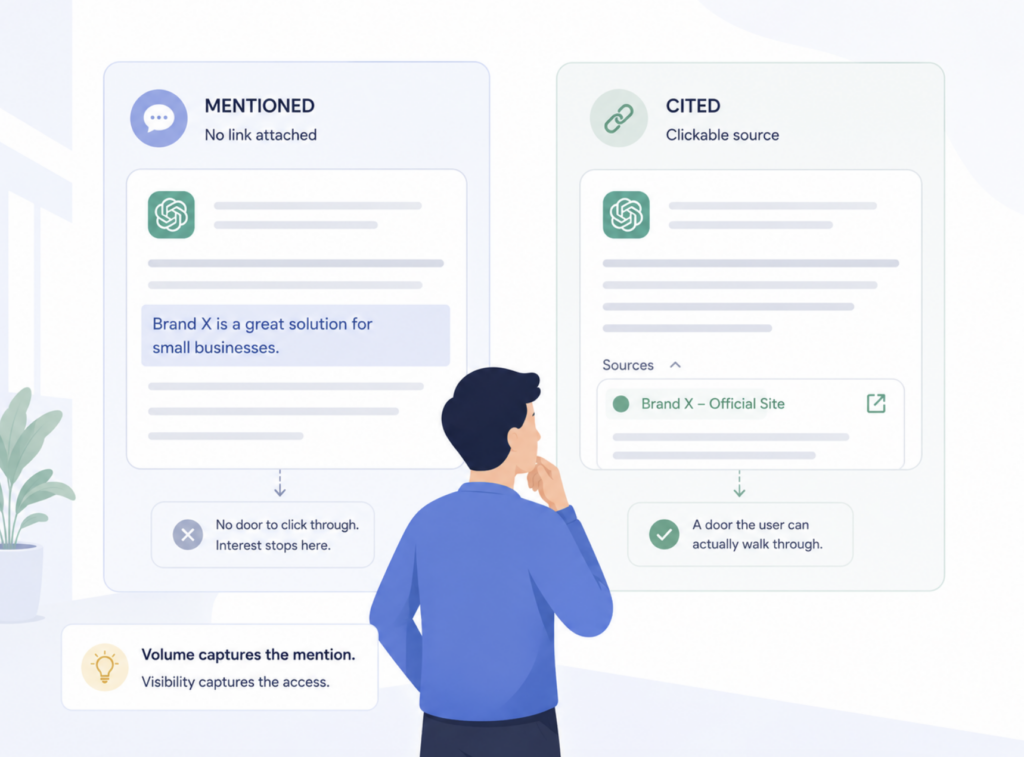
There’s also a visibility layer most teams miss entirely. Being mentioned by an AI system isn’t the same as being cited as a clickable source. A brand can show up favorably in a ChatGPT answer with no link attached at all, or with a link so far down the response that the reader never scrolls to it. Volume captures the mention. It says nothing about whether that mention came with a door the user could actually walk through.
On top of that, a large share of AI search sessions never register as referral traffic in the first place. Mobile app usage, in-app browsers, and truncated referrer strings mean most AI search activity never appears in server logs or referral reports at all, even when a click genuinely happened. Some of the “missing traffic” isn’t missing. It’s just invisible to the tools measuring it.
That’s the piece attribution models weren’t built to catch. A user asks ChatGPT about your product category, sees your brand mentioned, closes the app, and later types your brand name directly into Google. Analytics logs that as direct traffic. Nothing in that chain connects it back to the AI search volume that actually triggered it, which is exactly why volume and traffic can move in opposite directions on the same dashboard.
When AI Search Volume Does Predict Traffic
Volume isn’t a dead metric. It just predicts traffic unevenly, and the deciding factor is query intent.
Informational queries, the kind where the user just wants an answer, tend to end the interaction inside the AI platform. There’s rarely a reason to click through when the chatbot already delivered a complete response. This is where volume and traffic diverge the hardest.
Commercial and transactional queries behave differently. When someone is comparing products, checking pricing, or looking for a specific vendor, they’re far more likely to want to verify the answer on the actual site. The traffic that does convert from AI referrals reflects that: visitors referred by ChatGPT convert at roughly 7% on transactional sites, compared with 5% from Google, and they stay noticeably longer once they arrive.
That quality gap shows up across multiple studies. AI-referred visitors convert at close to 4.4 times the rate of traditional organic visitors, with longer sessions and higher return rates. The volume for decision-stage queries is smaller than the volume for broad informational ones, but it converts into traffic and revenue far more reliably.
The practical takeaway: don’t judge every high-volume topic by the same yardstick. A spike in AI search volume for “what is [category]” behaves nothing like a spike for “[brand] pricing” or “[brand] vs [competitor],” even if both show up as the same number on a dashboard.
The Metric You’re Missing: Mentions, Position, and CVR
Reading AI search volume in isolation is where most GEO strategies go wrong. The number that actually predicts business outcomes is a combination: how often you’re mentioned, where you sit in the answer, and how likely that specific answer is to drive a real interaction.
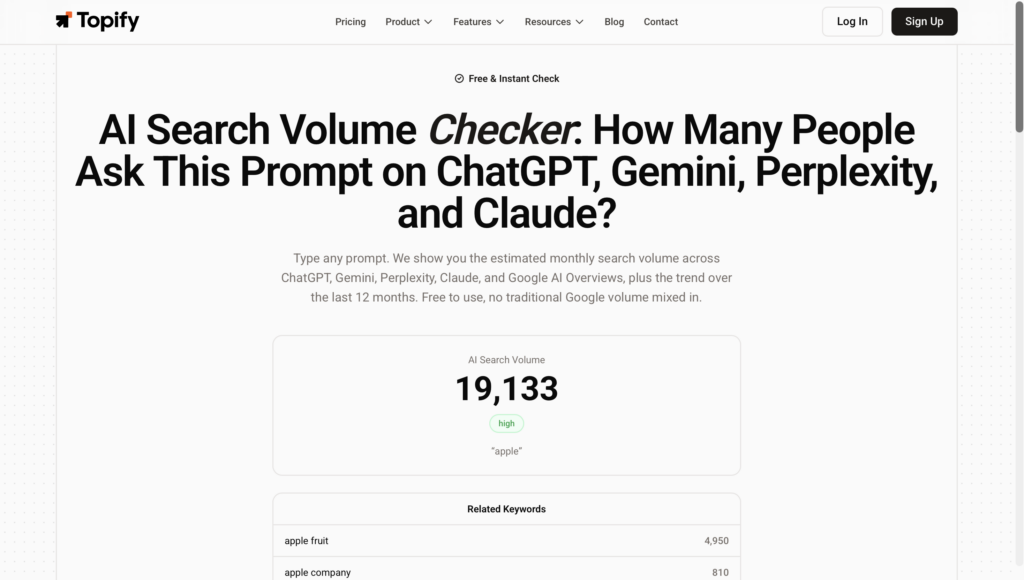
This is the gap Topify’s AI Volume Analytics is built to close. Instead of reporting volume as a standalone figure, it pairs topic and prompt-level volume data with mention frequency and position tracking across ChatGPT, Perplexity, Gemini, and other major platforms. You can check what volume looks like for your own prompts directly through the AI Search Volume Checker before deciding whether a topic is worth building content around.
AI Search Volume Checker
Volume alone tells you a topic is being talked about. Position tells you whether your brand shows up early enough in the answer to be noticed. Neither one tells you whether that visibility is likely to turn into an actual visit or a business outcome, which is where CVR (Conversion Visibility Rate) comes in. It’s built specifically to estimate how likely a given AI answer is to push someone toward engaging with your brand, closing the exact question that raw volume can’t answer.
For a marketing team deciding where to put content resources next quarter, that combination changes the decision entirely. A topic with massive volume but low CVR is a brand-awareness play, not a traffic play. A topic with modest volume but high CVR might be a better use of the same hour of writing time.
How to Read the Combination
A simple way to triage: high volume paired with high CVR is worth prioritizing first, since it signals both reach and conversion potential. High volume with low CVR is still valuable as a brand-visibility channel, just not one to expect referral traffic from. Low volume with high CVR points to a smaller but highly convertible long-tail opportunity, often worth more per unit of effort than the headline numbers suggest.
Picture two topics on the same content calendar. One is a broad informational query, generic enough that AI systems answer it fully without ever needing to send anyone to your site. It shows enormous volume and a low CVR. The other is a narrower, decision-stage question, tied to your product category, where AI answers tend to reference a specific vendor by name. It shows a fraction of the volume but a CVR several times higher. Judged purely on volume, the first topic looks like the obvious priority. Judged on the combination, the second one is where the content budget should actually go.
Conclusion
AI search volume is a real signal, and it’s worth tracking. It just measures how often a topic gets raised in AI conversations, not how many people land on your site because of it. Treating the two as interchangeable is what leads teams to overinvest in high-volume topics that were never going to send traffic, and underinvest in smaller ones quietly driving conversions.
The fix isn’t ignoring volume. It’s reading it alongside mentions, position, and CVR before deciding where the next piece of content goes.
FAQ
Q: Does AI search volume matter if it doesn’t guarantee traffic?
A: Yes. High AI search volume still signals that a topic or question is actively surfacing in conversational search, which shapes brand perception even without a click. It’s a visibility metric first, a traffic metric second.
Q: What’s the real difference between AI search volume and traffic?
A: AI search volume counts how often a topic or prompt comes up across AI platforms. Traffic counts actual visits to your site. The two only align closely for decision-stage, transactional queries where users are motivated to verify an answer externally.
Q: How do you measure AI search clicks if referral data is unreliable?
A: Combine what referral data you do capture with mention and position tracking across AI platforms, then layer in a conversion-likelihood metric like CVR to estimate real business impact rather than relying on click counts alone.
Q: Why does zero-click AI search happen so often?
A: AI platforms are designed to answer the question directly inside the conversation. For most informational queries, there’s no incentive for the user to leave the chat interface, which is why zero-click rates on AI search products commonly exceed 60%.

