

Your keyword report says the category term you own gets 8,000 searches a month, and you’re sitting at position three. Then a buyer opens ChatGPT and types twenty-three words about their team size, their budget, and the tool they already run. Not one of those words appears in your keyword tool. The answer names three vendors. Yours isn’t among them.
Nothing in your reporting stack explains what happened, because that stack counts strings typed into a search box, not questions asked of a model. Prompt search volume is the number built to close that gap, and most dashboards still don’t have a row for it.
Keyword Volume Stops Working When Nobody Types Keywords
The shape of demand changed before the measurement did.
Google’s average US query has held steady at 3.33 to 3.36 words for most of a year, then climbed past 3.51 words by May 2026 after AI Mode rolled out. That’s a modest move. Inside AI assistants, the move isn’t modest at all: SOCi’s 2026 Visibility Index found LLM queries average 23 words, roughly six times a traditional search query.
Semrush’s database of over 239 million prompts shows the same pattern at scale. Prompts routinely run fifteen to twenty-five words and carry context, constraints, and qualifications that never survive the trip into a keyword field.
Volume didn’t disappear. It changed shape.
And the scale is no longer a rounding error. ChatGPT alone handles more than 2.5 billion prompts per day across roughly 900 million weekly active users. Every one of those prompts is demand your keyword tool has no way to see.
What Prompt Search Volume Actually Measures
Prompt search volume is the estimated number of times a given prompt, or a cluster of similar prompts, gets submitted to AI platforms in a month. Think of it as the AI-era counterpart to keyword search volume, with one difference that matters: no AI platform publishes this data.
That means every number you see is modeled. Vendors build estimates from panel data, systematic prompt sampling, extrapolation from related keyword demand, and observed answer behavior. Methodologies differ, so two tools can disagree on the same topic.
What the data does reveal is composition, and composition is where the strategy lives. A Search Engine Land survey of how people actually prompt found that 24.5% of prompts include the word “best”, 28% mention price or budget, 16% are explicitly location-based, and 32% include personal attributes such as profession, life stage, or health condition.
Those aren’t keywords. They’re qualifying conditions, and they decide which brands make the shortlist.
The Long Tail Didn’t Get Longer. It Got Personal.
Here’s the shift that breaks the old model. In an August 2025 survey, roughly half of free-text prompts were still SEO-keyword-shaped: short, ambiguous, brand-and-attribute driven. By January 2026, that share had fallen to about 30%.
The other 70% grew longer and more contextualized.
You can’t win those prompts by matching phrasing, because the phrasing is close to one-of-a-kind. You win them by covering the constraint. A page that says “CRM software for small teams” competes weakly against a page that specifies seat counts, pricing tiers, migration paths from named incumbents, and what happens when a ten-person team doubles.
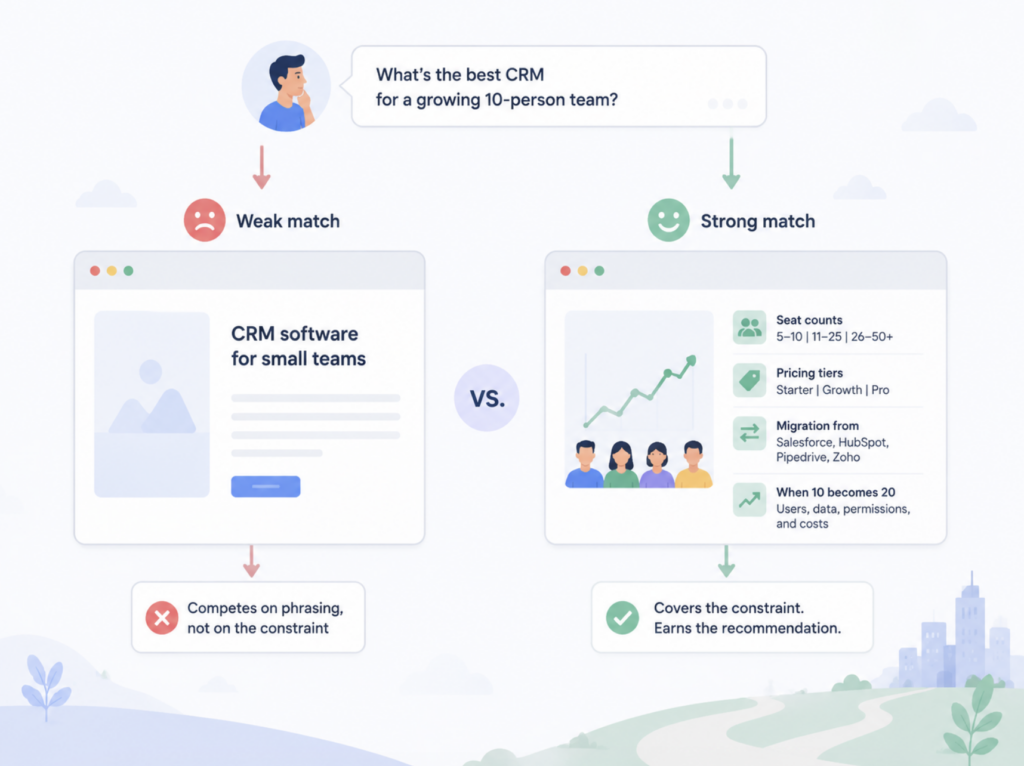
That’s the practical difference between a keyword strategy and a prompt search strategy. One targets a phrase. The other targets a decision.
Prompt Search Volume Tells You Where Demand Is Moving
Keyword volume describes a channel that’s mature and measurable. Prompt search volume describes one that’s growing and partially blind. Running only the first is comfortable. Running only the second is reckless.
| Dimension | Keyword search volume | Prompt search volume |
|---|---|---|
| Data source | Engine-reported query and click logs | Modeled from panels, sampling, extrapolation |
| Typical query shape | 3 to 4 words | 15 to 25 words with context |
| Repeatability | Stable month over month | High share of one-off phrasings, clustered by topic |
| What it predicts | Ranking opportunity on a results page | Whether your brand enters the answer at all |
| How to read it | Absolute numbers are usable | Trends beat absolute numbers |
The useful move is watching the ratio per topic. When a topic’s AI demand starts outrunning its Google demand, answer-first content moves up the queue for that topic and only that topic.
Two more numbers make the case for paying attention. ChatGPT performs a live web search on roughly 31% of prompts, with the model’s own behind-the-scenes queries averaging 5.48 words. And according to Ahrefs data cited by Search Engine Land, AI search visitors convert at 23 times the rate of traditional organic visitors, even though the raw session count is far smaller.
Fewer sessions, much higher intent. That’s a channel worth measuring properly.
Where Prompt Search Data Gets Oversold
Now the honest part, because vendors tend to skip it.
Prompt volume estimates are directional. Treat a specific number the way you’d treat an analyst forecast: useful for ranking priorities, unreliable as a headline figure in a board deck.
The bigger issue is answer variance. Growth Memo’s analysis of prompt tracking methodology found that only 2.3% of citations survive three runs of the same prompt. Run a prompt once and you’ve flipped a coin with the result hidden from you.
So single-prompt testing tells you almost nothing. Repeated runs across a stable prompt set, tracked over weeks, tell you a lot.
Three practical guardrails. Track trends inside one tool rather than comparing absolute numbers across vendors. Run each prompt multiple times before you record a result. Refresh monthly for stable categories and weekly for fast-moving ones like AI tooling, finance, and tech.
How to Put Prompt Search Volume to Work in 30 Days
Start by building a controlled prompt set instead of chasing a leaderboard. Pick five to ten topics you want AI systems to associate with your brand, then write prompts across the funnel for each: category discovery, comparison, objection, and purchase.
Layer in the constraint patterns the data already surfaced. Budget, team size, location, and personal context show up in a large share of real prompts, so your set should reflect that instead of testing clean category terms nobody actually types.
Then run the set consistently and record four things: whether you appear, which competitors appear, which sources get cited, and how your brand gets described.
This is where tooling stops being optional, because doing it by hand across four platforms and fifty prompts is a full-time job. Topify tracks volume as one of seven metrics alongside visibility, sentiment, position, mentions, intent, and CVR, so a spike in prompt demand for a topic sits next to whether you’re actually showing up for it. Its High-Value Prompt Discovery surfaces new high-volume prompts as AI recommendation patterns shift, and its citation analysis maps the exact domains and URLs the models pull from, which is usually where the fixable gap turns out to be.
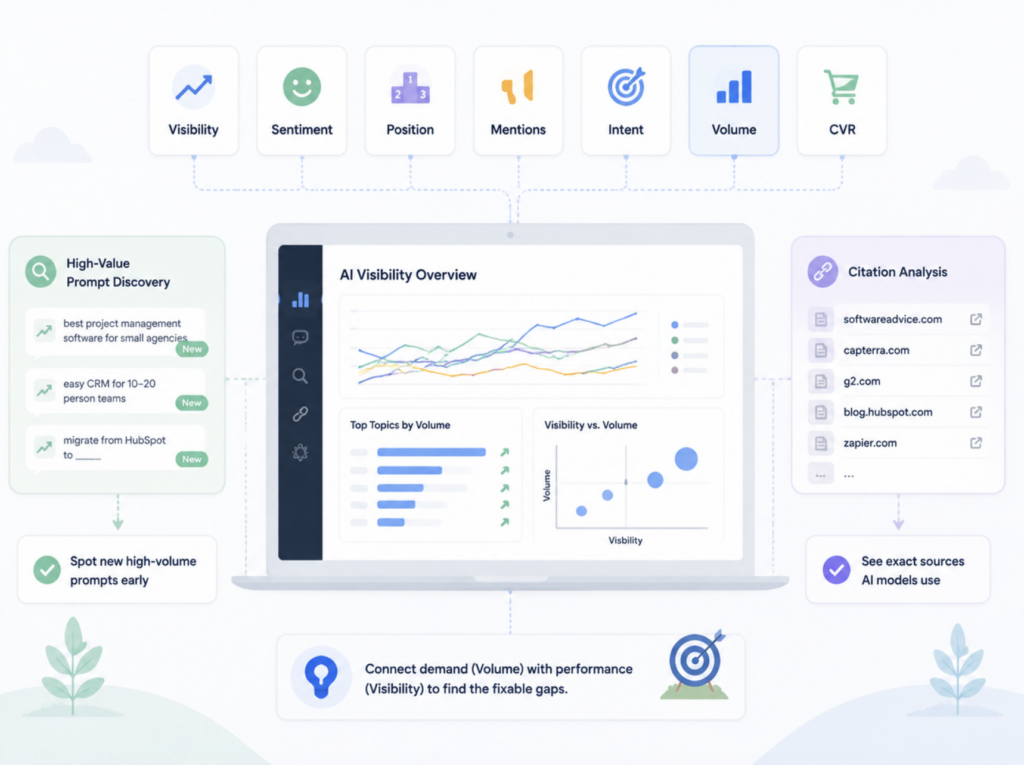
Coverage matters here too. Prompt demand splits across ChatGPT, Gemini, Perplexity, and regional engines including DeepSeek, Doubao, and Qwen, and a tool that only reads one platform will miss most of the picture. Plans start at $99 a month for 100 tracked prompts, and you can get started with a trial before committing budget.
Bottom line on sequencing: map intent, cluster into topics, prioritize by prompt search volume, validate with repeated manual testing, then track visibility over time. Prompt volume is the prioritization input, not the whole program.
Conclusion
The buyer who skipped your brand in that ChatGPT answer didn’t type a keyword. They described a situation, and the model matched that situation to whichever sources covered it best. Prompt search volume is the first metric that puts a number on how often those situations come up in your category.
It’s modeled data, it varies between vendors, and it deserves skepticism on any single figure. It’s also the only demand signal that maps to how a growing share of your market now asks questions. Run it alongside keyword volume, watch the ratio per topic, and move answer-first content to the front of the queue when AI demand starts winning.
The teams that build this measurement habit now will be reading trend lines while everyone else is still guessing.
FAQ
Q: What is prompt search volume?
A: It’s the estimated number of times a specific prompt, or a cluster of closely related prompts, is submitted to AI platforms like ChatGPT, Gemini, Perplexity, and Google AI Mode in a given month. It plays the same prioritization role that keyword search volume plays in traditional SEO.
Q: Is prompt search volume data accurate?
A: It’s directional rather than exact. AI platforms don’t publish prompt-level data, so every estimate is modeled from panels, sampling, and extrapolation. Use it to rank priorities and read trends over time, not to report precise monthly figures.
Q: Does prompt search volume replace keyword research?
A: Not yet, and probably not entirely. Google still handles the majority of global queries, and many AI prompts mirror underlying keyword demand. The workable approach in 2026 is running both side by side: keyword volume for SEO, prompt search volume for GEO and AEO.
Q: How often should you track prompt search volume?
A: Monthly works for most categories. Fast-moving verticals such as AI tools, finance, and tech benefit from weekly checks, while stable categories can be reviewed quarterly. Consistency inside one tool matters more than frequency.

