

You pull up two GEO tools and ask both the same question: how much ai search volume does your category get each month. One says 40,000. The other says 2.1 million. Same topic, same month, off by two orders of magnitude. Nobody made a mistake. The two tools measured completely different things and shipped the number under the same label. Before you sign a contract, plan content, or report a number to your CMO, you need to know which of the three things it’s actually counting.
AI Search Volume Isn’t One Metric. It’s Three.
The term got popular fast, and vendors rushed to attach it to whatever data they already had. That’s the root of the confusion. Three genuinely different datasets are being sold under one name:
- Keyword-style volume, traditional Google search demand, relabeled for the AI era.
- Prompt volume, how often people actually type or speak a question to an AI assistant.
- Citation volume, how often a brand gets named inside the AI’s answer to that question.
Each one answers a different business question. Mix them up, and you’ll end up optimizing for the wrong thing, or worse, paying for a number that never moves the metric your team actually reports on.
Keyword-Style Search Volume: The Google Habit Carried Over
Keyword-style volume is the easiest number for a vendor to produce, since the infrastructure already exists. Take the query, run it through the same estimation methods used for Google Keyword Planner, and report a monthly figure. Keyword search volume estimates the number of times a specific keyword or phrase is entered into a search engine, typically Google, within a set period. That’s a perfectly good number. It’s just not an AI number.
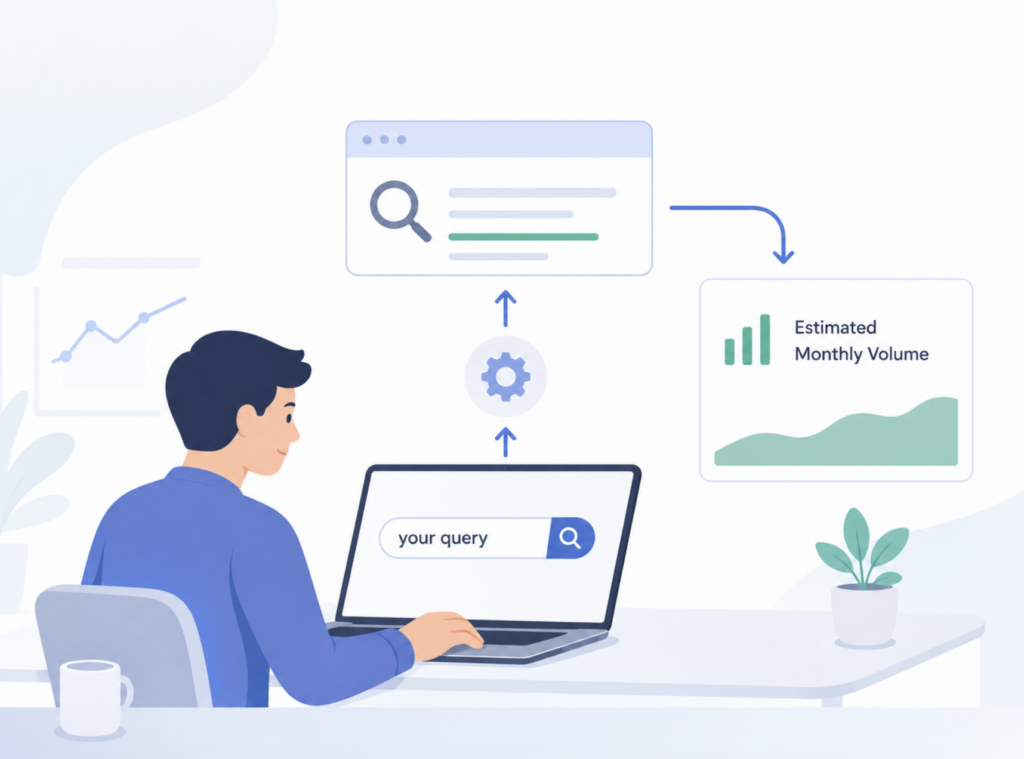
The gap shows up in what it leaves out. A growing share of queries now resolve inside an AI Overview or a chat answer without a click ever happening, and AI assistants generate roughly 45 billion monthly sessions globally, equal to about 56% of traditional search engine volume, though the genuinely search-equivalent share of that is closer to 28%. None of that activity shows up in a keyword tool, because a keyword tool was never built to see it.
If a vendor’s “AI search volume” figure turns out to be their existing keyword database with a new label on top, you’re paying for old data in new packaging.
AI Prompt Volume: How Often People Actually Ask AI
Prompt volume is a different animal. It’s the estimated frequency of an actual question, phrased the way people phrase it, sent to ChatGPT, Perplexity, or Google’s AI surfaces. AI search volume, in this sense, is the estimated frequency with which topics or questions get entered into AI tools, typically modeled as intent clusters rather than exact-match keywords, since one underlying question can surface as dozens of prompt variations.
Getting this number is harder than pulling keyword data. None of the major AI platforms publish query logs, so vendors work from consented panels or sampled prompt sets and extrapolate from there. That’s part of why prompt-volume figures shift around more than keyword estimates do.
The payoff shows up downstream, once you know a prompt’s volume. When ChatGPT switched from citation chips to inline branded hyperlinks in May 2026, tracked OpenAI referral traffic across millions of visits jumped roughly 1.6x almost overnight, turning what used to be an abstract prompt count into a real traffic number. That’s the layer Topify‘s AI Volume Analytics is built to track: real prompt frequency across ChatGPT, Perplexity, and Google’s AI surfaces, refreshed as the underlying intent clusters shift rather than left to go stale between quarterly reports. You can check your own category’s prompt volume here.
Why Most Tools Stop Here
Most products marketed as AI search volume tools stop exactly at this layer. More than a dozen platforms now track prompt-level AI visibility, ranging from budget options around $29 a month up to enterprise tools processing hundreds of millions of real prompts. Knowing how big a topic is doesn’t tell you whether your brand gets to say anything when someone asks about it. That gap is exactly what the next layer closes.
AI Citation Volume: How Often Brands Get Named in the Answer
Citation volume answers the question marketing teams actually care about: when the AI generates an answer to that high-volume prompt, does your brand get named. AI share of voice is the percentage of AI-generated responses that mention, cite, or recommend a brand across a defined set of category prompts, measured against every brand mentioned in those same answers. It’s a completely separate number from prompt volume. A topic can pull millions of monthly prompts while your brand still gets zero mentions in the answers.
This number also moves more than most people expect. Citation share can drift 40 to 60% month over month in active categories, which means a single snapshot report is close to meaningless on its own. Scale matters too. Research tracking citation patterns across brands found that global household names appear in roughly 73% of relevant AI answers, established mid-market brands in 44%, and niche or small brands in just 11%. If your team is buying “AI search volume” hoping it doubles as a brand health score, it won’t. Volume tells you the size of the room. Citation volume tells you whether anyone in that room is saying your name.
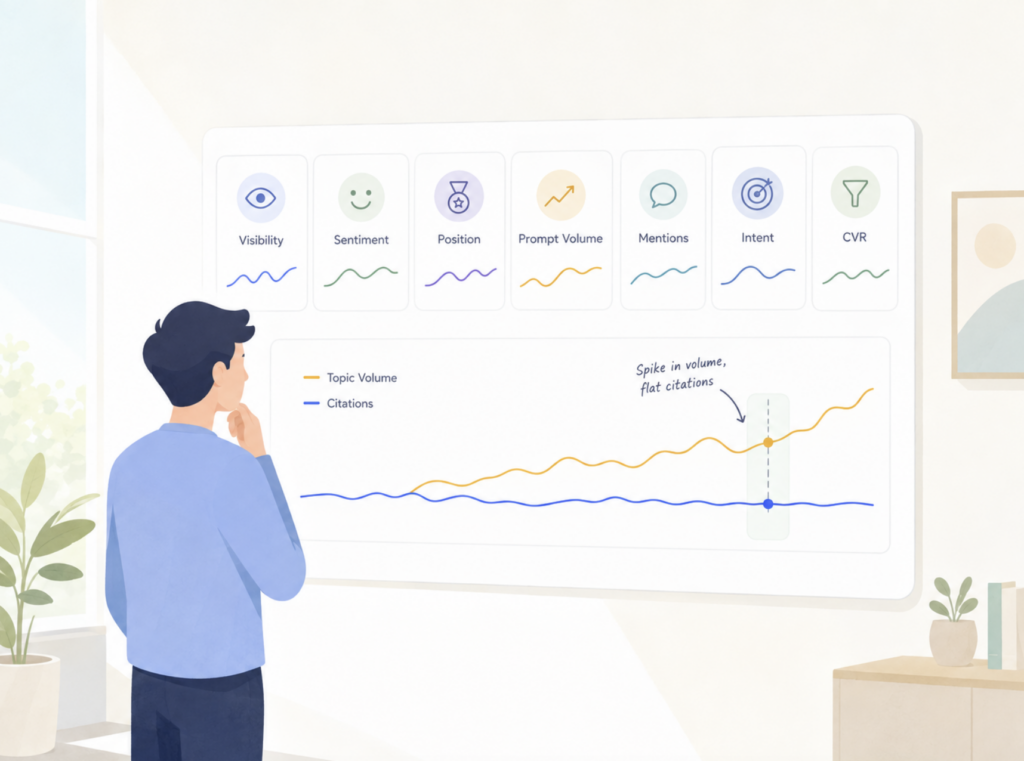
This is why Comprehensive GEO Analytics keeps these numbers next to each other instead of splitting them across separate reports. Visibility, sentiment, position, prompt volume, mentions, intent, and CVR sit in one view, so a spike in topic volume and a flat citation line show up on the same chart instead of two different dashboards nobody cross-references.
How to Check Which Volume You’re Actually Buying
Before you compare a price tag, ask the vendor three questions.
First, ask what’s actually being counted. If the answer sounds like a repackaged keyword tool with an AI label, that’s a signal.
Second, ask whether you can see the underlying prompts, not just the aggregate number. A real prompt-volume dataset should let you read the actual questions behind the count, not just a chart.
Third, ask whether the report separates prompt volume from citation volume, or bundles them into one blended score. Citation rate and mention rate measure genuinely different things, and treating them as interchangeable is one of the more common mistakes teams make when a high mention count with few sourced citations behaves very differently in terms of the traffic and trust it produces.
If a vendor can’t answer these three questions clearly, you’re not buying a metric. You’re buying a guess with a decimal point attached.
There’s a fourth question worth asking internally, before you even talk to a vendor: which layer actually matches the decision you’re trying to make. A content team deciding what to write next needs prompt volume, since that’s the demand signal. A brand or comms team reporting on AI visibility needs citation volume, since that’s the exposure signal. Buying the wrong layer for the decision in front of you is a more common mistake than buying from the wrong vendor entirely.
Conclusion
Two GEO tools showing 40,000 and 2.1 million for the same topic aren’t lying to you. They’re counting different things and calling it the same name. Keyword-style volume tells you what people typed into Google. Prompt volume tells you what people are actually asking AI. Citation volume tells you whether your brand shows up when they ask. Before your next renewal, or your next number in front of leadership, figure out which one you’re looking at, and make sure it’s the one that actually answers the question you were asked.
FAQ
Q: Is AI search volume the same as keyword search volume?
A: No. Keyword search volume estimates Google demand for a term. AI search volume, depending on the vendor, usually refers to prompt volume or citation volume, both measured from AI assistant activity rather than search engine queries.
Q: How do vendors measure AI prompt volume if AI platforms don’t publish query data?
A: Most estimate it from consented consumer panels or sampled prompt sets, then extrapolate across intent clusters. That’s part of why prompt-volume numbers from different vendors can vary widely for the same topic.
Q: What’s the difference between AI search volume and AI citation volume?
A: AI search volume, in its prompt-volume sense, measures how often a question gets asked. Citation volume measures how often your brand gets named in the answer to that question. A topic can carry huge volume and zero citation volume for your brand at the same time.
Q: Which AI search volume tool is most accurate?
A: No single tool is definitively correct, since each uses its own panel or sampling method. The more useful question is which layer of volume a tool actually measures, and whether it lets you see the underlying prompts rather than just a final score.

