

Your team hit page one for the keywords that matter. Rankings are stable, traffic is steady, the dashboard looks healthy. Then a buyer opens ChatGPT, types a plain question about your category, and reads back a confident answer that recommends three competitors and never names you. None of your SEO reports flagged it, because they were built to measure where you sit on a results page, not what an AI assistant decides to say. That blind spot has a name now, and an AI response monitoring tool is what’s built to close it.
What an AI Response Monitoring Tool Is, and Why SEO Tools Miss It
An AI response monitoring tool tracks how large language models describe, recommend, and cite your brand inside the answers they generate. Not where you rank on a results page. What the model actually says when someone asks a question in your category.
That distinction matters because the two measure different things. Traditional SEO tools track keyword position and clicks, which are outbound signals about user behavior. AI monitoring tracks mention, framing, and citation, which are signals about how much authority the engine assigns you. The shift is from traffic-focused metrics to influence-focused ones, and it changes what “doing well” even means.
Here’s the gap most teams run into. You can hold page-one rankings for your core terms and still be absent from the synthesized answer a buyer reads first. The results page and the AI response are now two separate surfaces. One you’ve optimized for years. The other you probably haven’t measured at all.
So this isn’t a rank tracker with a new label. It watches a moving, conversational output instead of a static list. That’s a different problem, and it needs different instrumentation.
How an AI Response Monitoring Tool Works
The mechanism is less about keywords and more about prompts. These tools simulate the questions real users ask, then read what the model answers back.
A typical pipeline runs in four steps. First, prompt-level sampling: instead of tracking a keyword, the tool runs a set of natural queries like “what’s the best CRM for remote teams” and captures the full response. Second, cross-platform aggregation: the same prompts get sent across ChatGPT, Gemini, Perplexity, and others, since each model answers differently. Third, NLP analysis: the raw text gets parsed to extract whether your brand appears, how it’s framed, and whether it’s cited as a source. Fourth, high-frequency sampling, because models get updated and retrained, so a single snapshot ages fast.
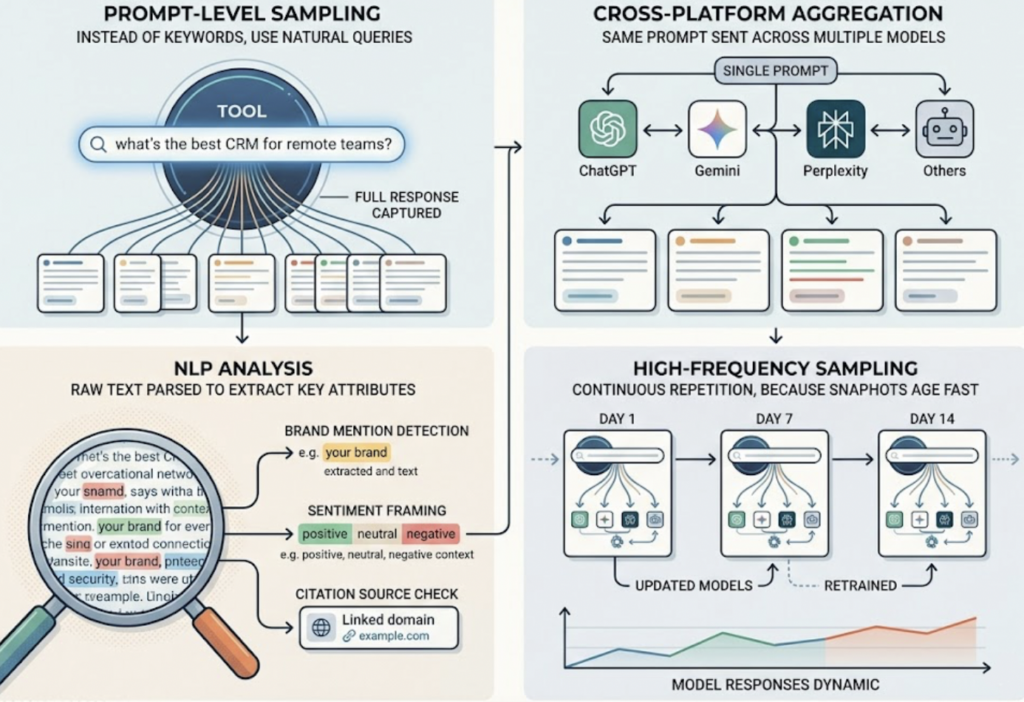
That last point is the one teams underestimate. AI answers aren’t deterministic. Ask the same question twice and the wording, and sometimes the recommendation, shifts. Run it next week after a model update and it can shift again.
This is why monitoring one platform once tells you almost nothing. You’re auditing one corner of a store and calling it inventory. Real monitoring means repeated sampling, across engines, over time, so you can separate noise from an actual change in how the model treats your brand.
How to Measure AI Response Monitoring: The Metrics That Matter
The fastest way to waste a monitoring tool is to track total mentions and stop there. Mention count is a vanity metric. It tells you the AI said your name, not whether that helped you.
These are the dimensions worth watching:
| Metric | The question it answers |
|---|---|
| Visibility Score | Is your brand present in your category’s AI conversations at all? |
| Mention Rate | How consistently does the model reference you across different queries? |
| Sentiment | How does the AI frame you, premium choice or budget alternative? |
| Citation Share | Does the AI trust your domain enough to link it as a source? |
| Position | Are you the top recommendation or a footnote at the end of the list? |
The interplay between these matters more than any single number. A high mention rate with low citation share, for example, means the model knows you exist but doesn’t trust your content enough to point back to you. That’s a content and authority problem, not a visibility one, and you’d never see it if you only counted mentions.
Position is the other underused signal. Being named tenth in a list of ten is technically a mention. It’s also functionally invisible to a user who reads the first two.
AI Response Monitoring in Practice: Three Examples
Abstract metrics get clearer with concrete situations. Here are three patterns these tools surface that teams rarely catch on their own.
A category recommendation with no mention. A buyer asks ChatGPT for the top tools in your space and gets five names. Yours isn’t one. Visibility Score and Mention Rate flag this right away, and the absence is the whole story.
A sentiment mismatch. You’ve positioned as enterprise-grade, but Perplexity describes you as “a good option for small teams.” The mention is there, so a mention counter says you’re fine. Sentiment analysis says your narrative is drifting away from your positioning.
A competitor owning the citation. The AI answers a question your content should own, but it cites a rival’s domain as the source. Citation Share and source analysis catch this, and it points to a specific fix: a page or topic where a competitor is being trusted and you aren’t.
Each example maps to a different metric. That’s the point. You can’t see all three with one number.
Common Mistakes That Make AI Response Monitoring Useless
Most monitoring setups fail in predictable ways. Several of these mistakes quietly erode visibility before anyone notices.
The vanity mention trap. Counting total mentions without reading context. A mention as “a competitor to avoid” looks identical to a glowing recommendation in a raw count, and the two mean opposite things.
The static snapshot. Pulling a monthly or quarterly report and treating it as current. Model behavior can shift in days, so a delayed report produces delayed decisions.
The SEO and GEO silo. Running AI visibility separately from on-site content. The schema, summaries, and structure that help models cite you live in your SEO work, and ignoring that link leaves citations on the table.
The citation-to-mention gap. Seeing high mentions, assuming success, and missing that citation share is near zero.
Track the wrong thing consistently and you still end up blind.
A Checklist and Strategy for AI Response Monitoring
Monitoring tells you where you stand. A strategy tells you what to do about it. Here’s a working checklist to improve AI response monitoring results, not just collect them.
- Baseline audit. Establish a visibility score against a fixed set of category-relevant prompts before changing anything.
- Entity accuracy. Make sure core facts like founding, mission, and product line stay consistent across LinkedIn, Crunchbase, and other third-party sources the models cross-reference.
- Structured content. Add JSON-LD schema so models can parse your organizational data cleanly.
- Answer-first formatting. Move concise, high-value tables and lists into the first 150 words of key pages.
- Authority building. Earn mentions in high-authority publications, since models validate trust through external signals.
- Continuous benchmarking. Compare citation share against named competitors to find source opportunities, the domains that cite your peers but not you.
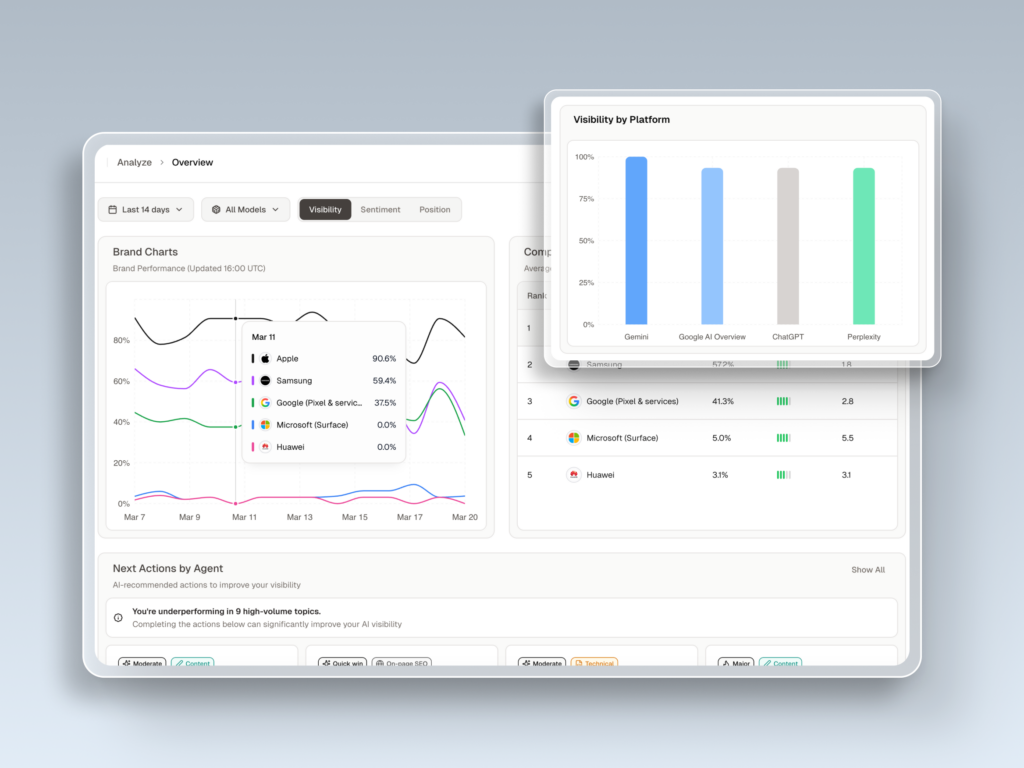
This is where a platform earns its place. Topify runs this loop across major AI engines and reports on seven dimensions, including Visibility, Sentiment, Position, and source analysis, in one view. In practice that means you can watch a drop in ChatGPT mentions and trace it to a specific source that stopped citing you, without stitching together exports from four tools.
Choosing a Tool: Features, Coverage, and Pricing
When you compare tools for AI response monitoring, four things separate useful platforms from dashboards full of numbers.
Platform coverage. A tool that only watches ChatGPT misses how Gemini and Perplexity treat you. Multi-engine coverage isn’t optional.
Metric depth. Mentions alone aren’t enough. You want sentiment, position, and citation share, because those are what actually drive a decision.
Source analysis. The ability to reverse-engineer which domains the AI cites tells you exactly where to compete for trust.
Acted on, not just reported. Data that sits in a dashboard changes nothing. The better tools connect monitoring to a next step.
Topify covers ChatGPT, Gemini, Perplexity, and other engines, layers Competitor Monitoring and CVR on top of the core metrics, and lets you move from insight to action without manual workflows. Pricing starts at $99/month on the Basic plan, with Pro at $199/month and Enterprise from $499/month, and you can see the full breakdown on the Topify pricing page. For a deeper look at how these tools are built and which to pick, this guide to AI answer monitoring tools is a useful next read.
If you want to see where your brand stands today, you can get started with Topify and run a baseline in a few minutes.
Conclusion
The visibility gap is simple to state and easy to miss: you can rank well and still be invisible in the answers buyers read first. An AI response monitoring tool exists to close that gap by tracking what models say, how they frame you, and whether they cite you, across engines and over time.
Start with a baseline audit. Watch sentiment and citation share, not just mentions. And treat AI visibility as a continuous signal, since the models change faster than any monthly report can keep up with. The brands that measure this now are the ones AI will recommend later.
FAQ
Q: What is an AI response monitoring tool?
A: It’s a platform that tracks how large language models like ChatGPT, Gemini, and Perplexity mention, describe, and cite your brand inside their generated answers. Unlike an SEO rank tracker, it monitors the synthesized response itself rather than your position on a results page.
Q: How do you improve AI response monitoring results?
A: Start with a baseline audit, keep brand facts consistent across third-party sources, add schema markup, format key pages answer-first, and benchmark citation share against competitors. Improvement comes from acting on the gaps the tool surfaces, not from collecting more reports.
Q: How much does an AI response monitoring tool cost?
A: It varies by platform and coverage. Topify, for example, starts at $99/month for Basic, $199/month for Pro, and from $499/month for Enterprise, with prompt volume and platform coverage scaling by tier.
Q: How is this different from a rank tracker?
A: A rank tracker measures where a URL sits on a static search results page. An AI response monitoring tool measures a moving, conversational output, including whether you’re mentioned, how you’re framed, and whether the model trusts your domain enough to cite it.

