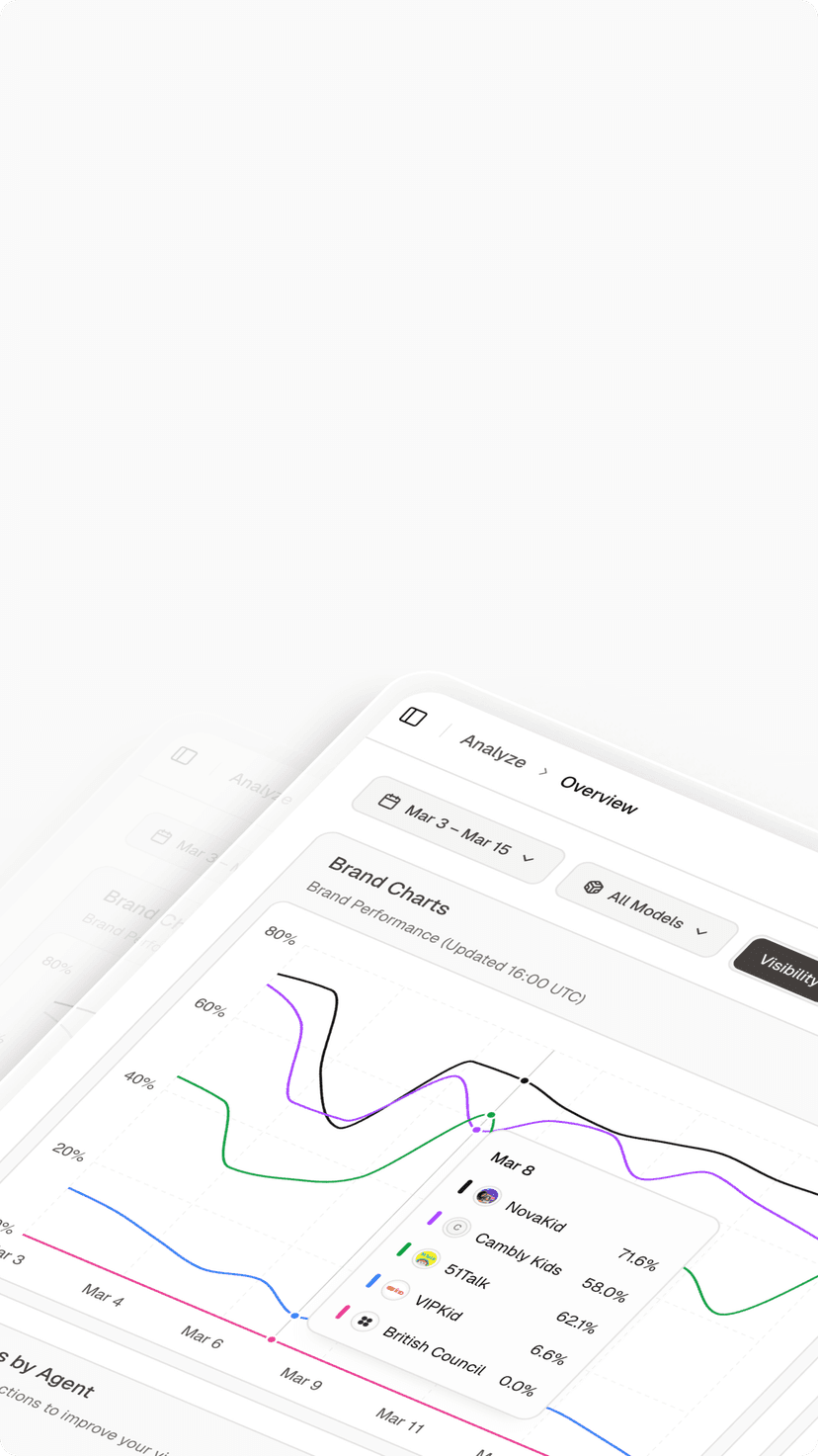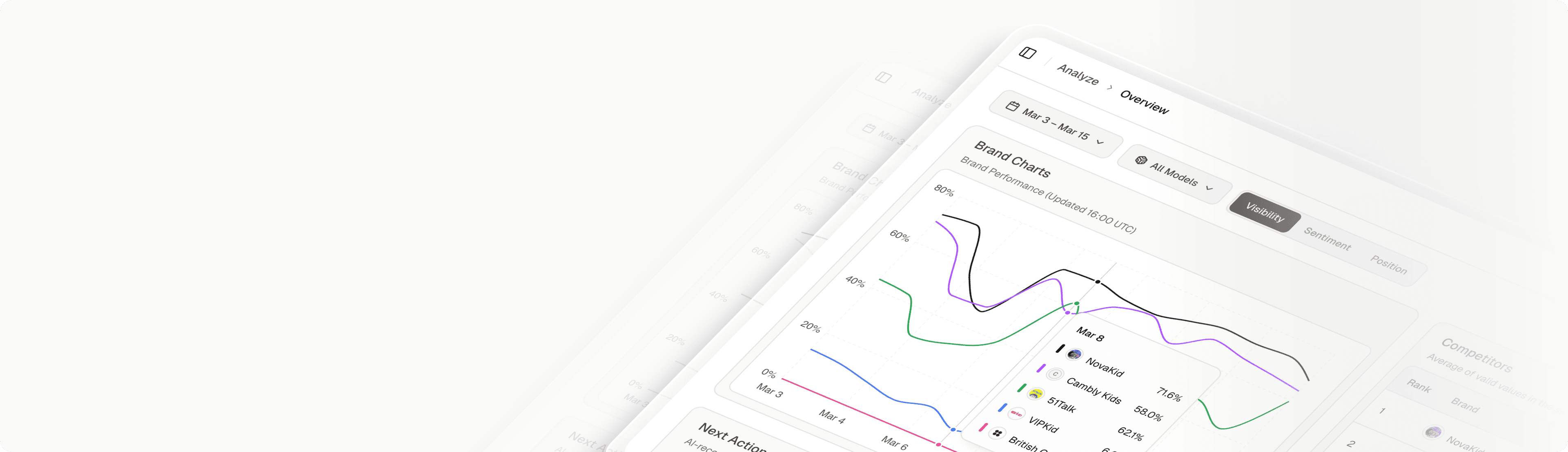

Your keyword rankings look healthy. Your domain authority climbed all year. Then a buyer types “best tool in your category” into ChatGPT, reads the three names it recommends, and picks one. Your brand wasn’t in the answer, and nothing in your analytics stack flagged it.
That’s the blind spot most marketing teams are carrying right now.
Google rankings tell you where you sit on a page of links. They say nothing about whether an AI model mentions you, trusts you, or quietly sends a buyer to a competitor instead.
What a ChatGPT Visibility Tracker Actually Measures
A ChatGPT visibility tracker monitors how often, in what context, and with what authority your brand shows up inside ChatGPT’s answers. Instead of a position on a results page, it measures your presence inside synthesized, conversational responses.
The distinction matters more than it sounds. Traditional SEO tracks a URL’s rank against a keyword. AI visibility tracks whether the model names you at all when someone asks a question your business should own.
These are distinct ecosystems, not the same channel measured twice. A page can rank first on Google and still go uncited by ChatGPT, because the model isn’t ranking links. It’s deciding which brands to fold into a single recommendation.
So the question shifts. Less “where do I rank for this keyword,” more “does the AI mention me, and does it trust my content enough to cite it.”
How a ChatGPT Visibility Tracker Works
Tracking a non-deterministic system means you can’t just check one query once. ChatGPT’s answers vary, and its citation patterns drift as models update. Measurement has to be structured and continuous.
Most trackers run on the same core loop:
Prompt sampling. The tool runs hundreds or thousands of industry-relevant prompts through ChatGPT, mimicking how real buyers actually ask. One query tells you nothing. A standing set of prompts tells you a pattern.
Answer capture and parsing. Each response gets captured and scanned for brand mentions. Better tools layer in entity recognition and sentiment scoring, so a mention isn’t just counted but judged as positive, neutral, or negative.
Citation attribution. When ChatGPT surfaces sources, the tracker logs which URLs were cited. That lets you tie your share of voice back to specific pages on your site, the same way Semrush frames ChatGPT visibility tracking around the prompts and sources that actually drive mentions.
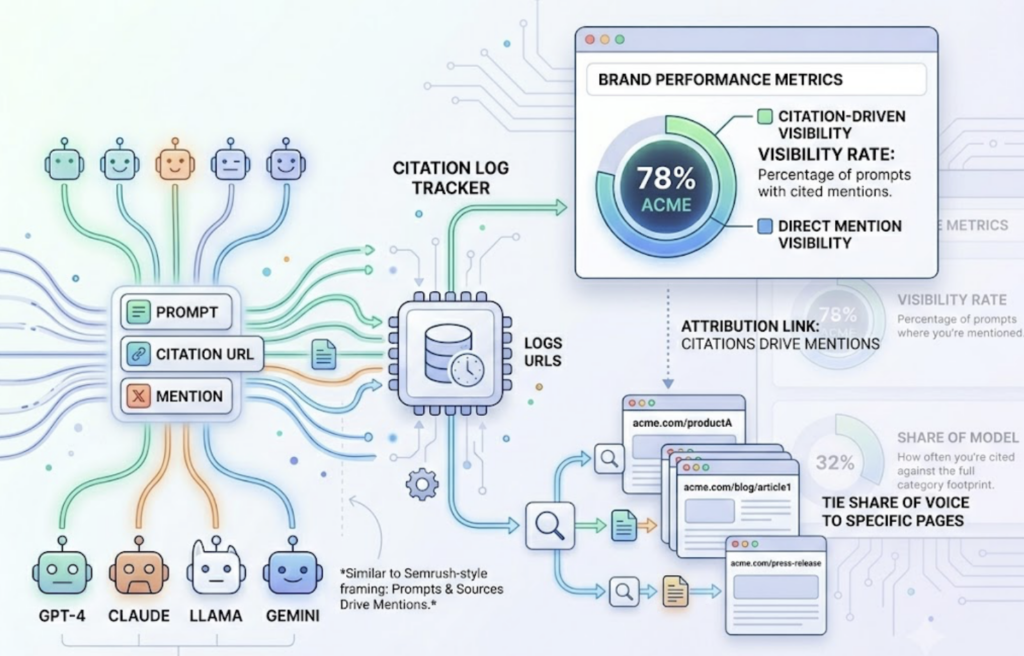
Continuous monitoring. Because model behavior shifts, often every few weeks, last month’s snapshot is already stale. Visibility is a trend line, not a one-time audit.
The Metrics Behind ChatGPT Visibility Tracking
Counting mentions is the floor, not the whole picture. A useful ChatGPT visibility tracking setup reports a few metrics together, because each answers a different question.
| Metric | What it measures | Why it matters |
|---|---|---|
| Visibility Score | A 0-100 index of your presence relative to competitors | A fast health check across the whole prompt set |
| Mention Rate | The share of tracked prompts where your brand appears | Shows how consistently AI surfaces you |
| Citation Share | Your links in citations versus competitors’ | Signals whether the model treats your content as a source of truth |
| Sentiment | The tone of each mention, positive to negative | Flags reputational risk before it spreads |
| Positioning | Where you land in the answer, lead recommendation or footnote | Top placement carries far more trust than a passing mention |
Read in isolation, any one of these can mislead. A high mention rate paired with negative sentiment isn’t a win. A strong visibility score with near-zero citation share means the model talks about you but doesn’t cite you, which is fragile the moment a better-sourced competitor shows up.
That’s the gap a single number can’t show you.
How to Improve Your ChatGPT Visibility
Improvement comes down to two things: making your content easy for the model to extract, and making your brand worth trusting.
Start with structure. LLMs favor concise, extractable data, so lead with answer-first formatting. Put the key takeaway in the first 150 words, use clear headers, and break dense points into tables or short lists the model can lift cleanly.
Then check technical access. An outdated robots.txt that blocks GPTBot or PerplexityBot makes you invisible to retrieval-augmented systems no matter how good your content is. JSON-LD schema markup helps the model resolve your entities, like Organization, FAQ, and Person, with less ambiguity.
Authority does the rest. AI models lean on primary sources, so unique data, proprietary statistics, and genuine expert insight are harder for the model to skip or hallucinate around. Off-page signals count too, since models cross-reference how you’re discussed on Reddit, review sites, and industry press before recommending you.
If you want a low-cost starting point, a set of free GEO tools can cover the first audit before you commit to a paid platform.
What to Look for in a ChatGPT Visibility Tracking Tool
The market is crowded, and the tools don’t measure the same things. Roundups like Yotpo’s LLM monitoring list show how wide the range gets, from single-platform mention counters to full optimization suites. A few criteria separate the useful ones.
| Criterion | What good looks like | Why it matters |
|---|---|---|
| Platform coverage | Tracks ChatGPT plus Perplexity, Gemini, and others | Buyers don’t use one AI engine |
| Citation depth | Reports the exact domains and URLs cited | Tells you what to fix, not just that you’re missing |
| Competitor benchmarking | Compares your mentions and position against rivals | Context turns a number into a target |
| Actionability | Connects findings to next steps | A dashboard that doesn’t change behavior is overhead |
This is where a dedicated platform tends to pull ahead of a spreadsheet and a handful of manual prompts. Topify treats ChatGPT visibility as an AI optimization service rather than a static report, tracking your brand across ChatGPT, Perplexity, Gemini, and other engines from one view. Its Visibility Tracking measures how often you surface across hundreds of monitored prompts, while Source Analysis reverse-engineers the exact domains and URLs ChatGPT cites, so you can see whether your pages or a competitor’s are feeding the answer. Competitor Monitoring then benchmarks your mention rate and position against rivals in the same prompts, and the CVR metric estimates how likely those answers are to push a reader toward your brand. The result reads less like a wall of numbers and more like a map of where to act next.
ChatGPT Visibility Tracker Pricing: What to Expect
Pricing usually scales with three things: how many prompts you track, how many AI platforms you cover, and how many seats and projects your team needs. A solo founder watching one product has very different needs than an agency reporting on a dozen clients.
As a reference point, Topify’s pricing starts at $99 a month for a Basic plan covering ChatGPT, Perplexity, and AI Overviews, 100 tracked prompts, and a 30-day trial. The Pro tier runs $199 a month with 250 prompts and more seats, and Enterprise begins around $499 a month with a dedicated account manager.
The trade-off to weigh isn’t sticker price. It’s prompt volume against coverage. A cheap tool that only watches ChatGPT leaves the rest of the AI answer surface unmonitored, which is often where the visibility gap actually lives.
Common Mistakes in ChatGPT Visibility Tracking
Most failures aren’t strategic. They’re small oversights that quietly tank your results, and AEO Vision catalogs the same recurring ones.
The first is blocking AI crawlers. A stale robots.txt rule against GPTBot removes you from the retrieval layer entirely, and you’ll never see why your mention rate flatlined.
The second is inconsistent entity data. When your founding date, name, or category differs across your site, LinkedIn, and Crunchbase, the model loses confidence in your brand entity and hedges by leaving you out.
The third is ignoring freshness. Models favor current information, so dated stats and untouched pages read as obsolete.
And the fourth is treating AI visibility as a footnote under Google organic. They’re separate systems, and a strong SERP position is no guarantee of an AI citation. Folding ChatGPT visibility tracking into your existing SEO report without giving it its own metrics is how the gap stays invisible.
Conclusion
ChatGPT doesn’t rank links. It chooses brands. A ChatGPT visibility tracker exists to show you whether you’re one of them, how consistently, and what’s driving the answer when you’re not.
Start by measuring your current mention rate and citation share, fix the technical and entity basics, then watch the trend over time rather than chasing a single snapshot. If you’d rather see your baseline across ChatGPT and other engines in one place, you can get started with Topify and check where your brand stands before your next planning cycle.
FAQ
Q: What is a ChatGPT visibility tracker? A: It’s a tool that monitors how often and in what way your brand appears in ChatGPT’s answers. Instead of tracking a page’s rank against a keyword, it measures your presence, sentiment, and citation share inside the AI’s synthesized responses.
Q: What’s an example of ChatGPT visibility tracking in practice? A: A SaaS brand runs 200 buying-intent prompts through ChatGPT each week, tracks how often it’s named versus three competitors, and notices its mention rate dropping after a source page it relied on stopped citing the brand. That trend, caught early, is the kind of signal these tools surface.
Q: How is a ChatGPT visibility tracker different from a rank tracker? A: A rank tracker reports your position in a list of links for a keyword. A visibility tracker reports whether an AI model mentions and cites you at all. High Google rankings don’t guarantee AI citations, since the two run on different logic.
Q: How often should I check my ChatGPT visibility? A: Continuously, not occasionally. Citation patterns shift with model updates, sometimes within weeks, so a monthly trend line is far more reliable than a one-time audit.