

You can pull up your SERP rankings in seconds. You know which keywords moved, which pages gained traffic, and where you sit against competitors. Then a buyer opens ChatGPT, asks for the best option in your category, and gets five recommendations. None of them are you. Nothing in your analytics stack flagged it, because those tools watch the list of links, not the answer the model hands people directly. That blind spot has a name now, and an AI response monitoring solution exists to close it. The hard part is knowing what to actually watch.
What an AI Response Monitoring Solution Actually Is
Traditional rank trackers measure your position in a static list of links. An AI response monitoring solution measures something different: how language models describe, cite, or ignore your brand inside their generated answers.
The discipline breaks into three layers. Presence is whether you get mentioned at all. Narrative is how you’re framed, “market leader” versus “expensive alternative.” Authority is whether the engine trusts you enough to cite you as a source.
Most teams can see SERP movement but have no read on any of these. As one breakdown of what AI search monitoring should track puts it, presence in the answer is now its own surface, separate from the ranked page. That’s the gap most analytics setups can’t see.
How AI Response Monitoring Software Reads What Models Say
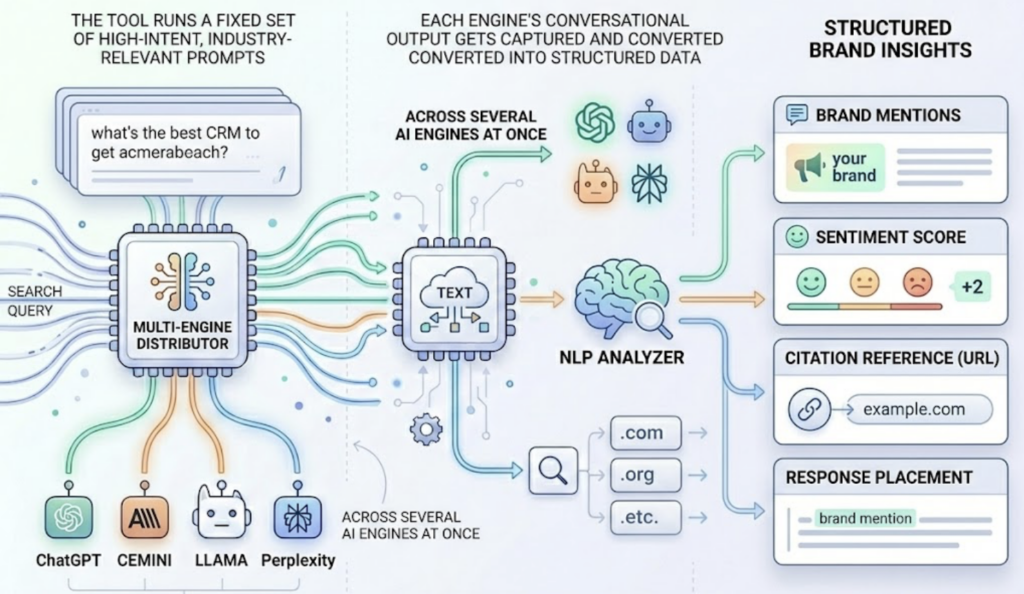
AI response monitoring software works through a synthetic sampling pipeline built to mirror how real users ask questions.
It starts with prompt injection: the tool runs a fixed set of high-intent, industry-relevant prompts across several AI engines at once. Each engine’s conversational output gets captured and converted into structured data through natural language processing. From there, the system parses brand mentions, scores sentiment, identifies the exact URL cited as a reference, and records where in the answer your brand appears.
Frequency is the part teams underestimate. AI models are non-deterministic and they drift as they get updated, so a one-time snapshot ages fast. Continuous, high-frequency sampling is what catches the moment an engine swaps its preferred sources for your category. Weekly sampling is a reasonable floor for stable categories. Daily makes sense for fast-moving, competitive ones.
The Signals a Good AI Response Monitoring Tool Should Capture
A useful AI response monitoring tool moves past vanity mentions and tracks signals that map to a business question. Counting how often you show up means little if you don’t know whether the engine trusts you or what it says about you.
Here’s how the core signals translate into something a marketing lead can act on:
| Signal | What it tells you |
|---|---|
| Visibility Score | Overall brand health across the AI-search ecosystem |
| Mention Rate | Top-of-mind status inside the model’s working knowledge |
| Citation Share | How much the engine trusts your content as a source of truth |
| First-Mention Position | A predictor of trust and click-through, since the first source cited tends to win attention |
| Sentiment Accuracy | Catches hallucinations or misaligned descriptions that damage reputation |
Citation Share and First-Mention Position are the two most teams overlook. Getting mentioned tenth, after three competitors and two review sites, is not the same win as being the first name the model reaches for. Semrush’s guidance on measuring AI search visibility makes a similar point: report on trust and prominence, not raw mention counts.
Why a Platform Beats a Patchwork of Point Tools
Plenty of teams try to manage this with manual queries or a few disconnected point tools. That patchwork breaks down for three reasons, and they’re worth naming.
First, platform divergence. ChatGPT, Gemini, and Perplexity weight signals differently, so you might be the top pick on Perplexity and invisible on Gemini. A single-engine view gives you a skewed read of where you actually stand.
Second, attribution. Knowing you lost visibility isn’t enough. An integrated AI response monitoring system adds source-gap analysis: it tells you which specific domains the engine is citing instead of yours, which is the difference between a problem you can see and a problem you can fix.
Third, actionability. Data with no loop back to your content is just a number that went down.
| Approach | Coverage | Attribution | Action loop |
|---|---|---|---|
| Point tools / manual queries | Usually one engine | Mention spotted, cause unknown | Manual, ad hoc |
| Integrated platform | Multiple engines in one view | Source-gap analysis built in | Anomaly triggers a content task |
The takeaway isn’t that point tools are useless. It’s that a connected platform turns scattered observations into a system you can run a quarter on.
Turning Monitoring Into a Dashboard You’ll Actually Use
Raw monitoring data sits there. A dashboard makes it move. The goal of any AI response monitoring dashboard is a closed loop: an anomaly like a drop in citation share should surface clearly and point to a specific fix, such as a stale statistic or missing schema on a page the engine used to cite.
Strong AI response monitoring analytics do the connective work for you. They tie a visibility dip on ChatGPT back to the source that stopped referencing you, then frame it as a task instead of a chart. That’s the line between a tool that reports and a system that drives action. If you want a deeper look at how a single-pane view comes together, this walkthrough of an AI search monitoring dashboard covers the layout in practice.
Where Topify Fits
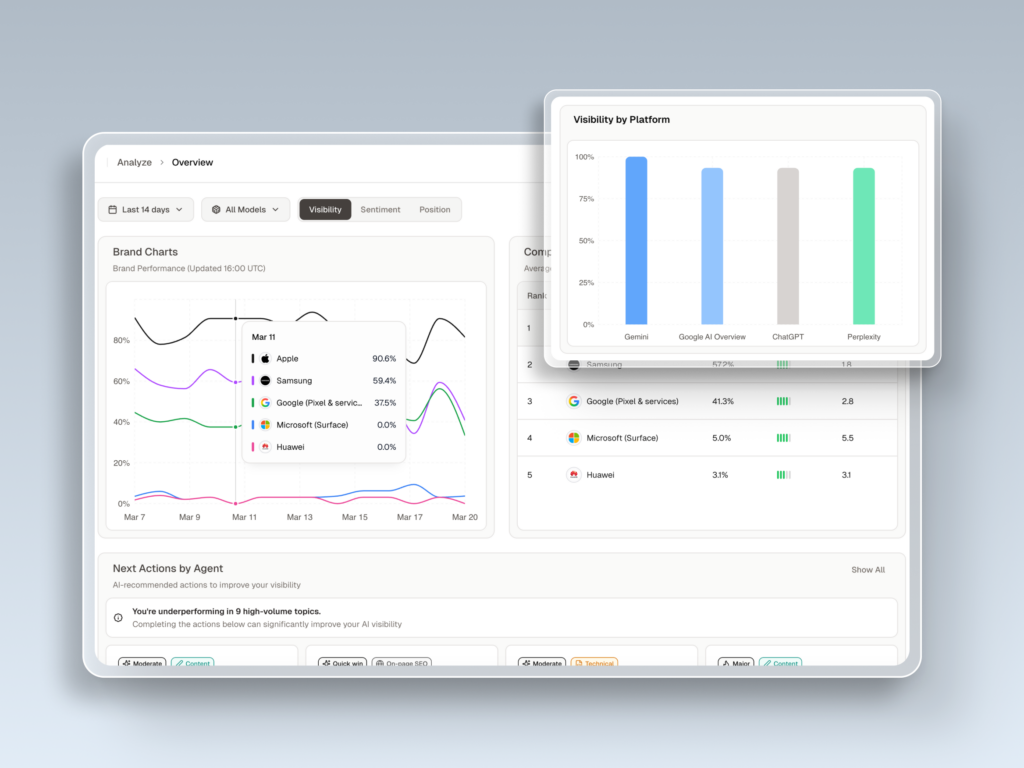
For teams tracking presence across several engines at once, Topify tends to stand out by pulling Visibility, Sentiment, Position, and Source data into one view rather than four exports.
In practice, that means you can spot a drop in ChatGPT mentions and trace it, in the same dashboard, to the exact domain that stopped citing your brand. Its coverage spans ChatGPT, Gemini, Perplexity, DeepSeek, and other major engines, so you’re not reading a single-platform slice and calling it your AI presence. Competitor Monitoring runs alongside it, tracking your citation share against your top three rivals as the engines shift.
The setup mirrors the strategic baseline most teams should start with anyway: define a golden set of 50 to 100 category-defining prompts, then watch citing, not just ranking. You can pressure-test where you stand first with free GEO tools, then get started on continuous tracking once you’ve found the gaps.
Conclusion
The blind spot is real: most teams can see their SERP position and almost nothing about what AI says when a buyer asks directly. Closing it doesn’t start with buying the flashiest dashboard. It starts with deciding what to track, presence, citation share, first-mention position, and sentiment, then sampling it often enough to catch the drift. Build the baseline, watch citing over ranking, and treat a misaligned AI narrative as the reputation issue it is. The brands that measure this now are the ones that won’t get quietly written out of the answer later.
FAQ
Q: What’s the best tool for tracking brand visibility in ChatGPT?
A: The strongest option is one with multi-platform coverage rather than a ChatGPT-only view, since monitoring a single engine gives a skewed read of your overall AI-search presence. Look for a tool that reports citation share and sentiment, not just mention counts.
Q: How is AI response monitoring different from traditional SEO tracking?
A: Traditional SEO tracks your rank on a list of links. AI response monitoring tracks your presence, authority, and narrative framing inside the answer itself, which is where AI users increasingly make decisions.
Q: How often should an AI response monitoring system refresh data?
A: Weekly sampling is the practical minimum for stable categories. Daily sampling is the better call for competitive, fast-moving markets, since models update and shift their preferred sources frequently.
Q: Can one platform monitor multiple AI engines at once?
A: Yes. Integrated platforms now use API-based access to the leading models, letting you see your performance on ChatGPT, Gemini, Perplexity, and others in a single dashboard instead of querying each one by hand.

