

Your SEO dashboard says everything’s fine. Rankings are stable, organic traffic is up, domain authority keeps climbing. Then your VP asks a simple question: “What does ChatGPT say when someone asks for a product like ours?” You check. Your brand isn’t mentioned. Neither is your top-ranking blog post. The 57-page content strategy you built for Google has zero influence on what AI tells your potential customers.
That’s the gap traditional SEO tools can’t close. They weren’t built to track what AI chooses to say.
What an AI Answer Monitoring Tool Actually Tracks
An AI answer monitoring tool is a specialized platform that tracks how a brand, product, or topic is represented across large language model interfaces. Think ChatGPT, Perplexity, Gemini, Google AI Overviews, and other AI-driven search experiences. Instead of monitoring keyword rankings on a results page, these tools monitor the AI’s synthesized response itself.
The core tracking dimensions typically include four layers:
| Dimension | What It Answers |
|---|---|
| Visibility | Does the AI mention your brand at all? |
| Position | Where does your brand appear relative to competitors in the response? |
| Sentiment | Is the AI describing your brand positively, neutrally, or negatively? |
| Citation Sources | Which URLs is the AI referencing as its “evidence”? |
Here’s a distinction worth noting. A keyword AI overview checker focuses specifically on whether your brand shows up in Google’s AI Overview snippets. That’s useful, but narrow. A full AI answer monitoring tool spans multiple platforms, tracking the quality and context of mentions across the entire AI ecosystem.
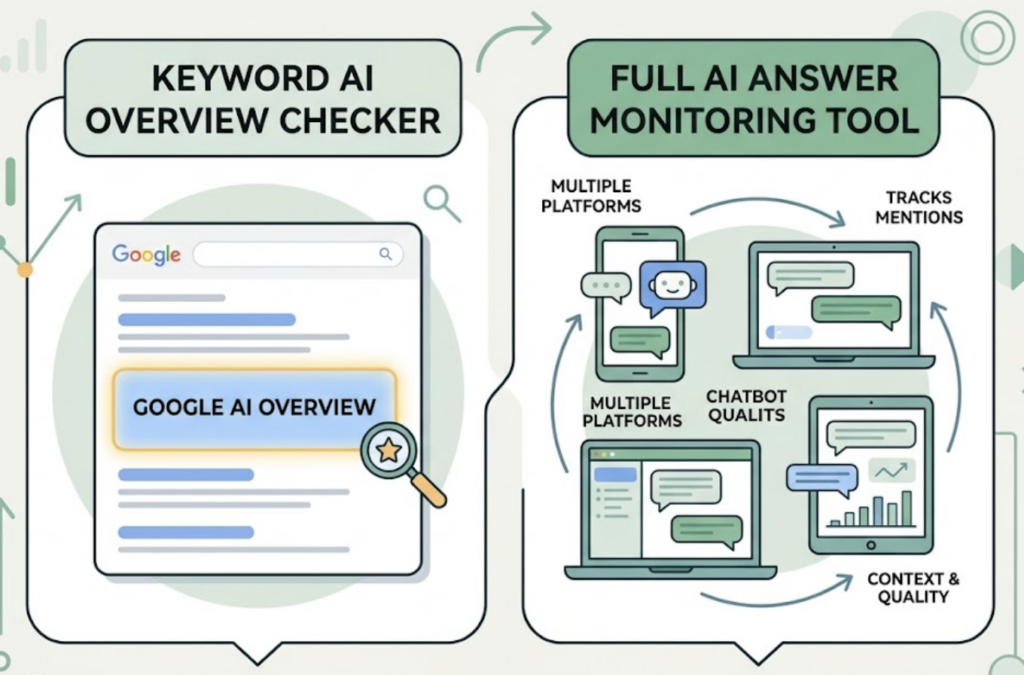
That scope difference matters. Your brand might rank well in AI Overviews but be completely invisible in Perplexity or ChatGPT, where a growing share of your audience is asking purchase-intent questions.
How AI Answer Monitoring Tools Work Under the Hood
The technical workflow behind these tools follows a structured pipeline, not a single keyword lookup.
Step 1: Prompt-level tracking. Instead of tracking keywords the way traditional SEO tools do, AI answer monitoring tools track prompts: the actual conversational queries users type into AI models. “What’s the best project management tool for remote teams?” is a prompt. “Project management tool” is a keyword. The difference in specificity changes what the AI returns entirely.
Step 2: Cross-platform aggregation. Tools query multiple LLM APIs at scale, including GPT-4, Gemini, Perplexity, and others, using a predefined set of high-intent brand or topic prompts. Each platform has different weighting mechanisms, different training data, and different citation behaviors. Monitoring just one gives you a partial picture at best.
Step 3: Structured analysis. Using NLP and LLM-based categorization, the raw unstructured text from AI responses gets converted into structured data: brand mentions mapped, sentiment scores assigned, citation behavior tracked over time.
One technical detail that often gets overlooked: accuracy depends heavily on sampling frequency. LLMs are non-deterministic and undergo rapid model updates. A weekly snapshot might miss a shift that happened on Tuesday and reverted by Thursday. High-frequency monitoring, daily or even more frequent, is what separates reliable data from stale reports.
The Metrics That Separate Useful Data from Dashboard Noise
Not every number on a monitoring dashboard deserves your attention. The metrics that actually drive decisions tend to fall into a clear hierarchy.
Visibility Score answers the most basic question: does the AI know your brand exists? If your Visibility Score across ChatGPT and Perplexity is near zero, nothing else matters yet. This is where you start.
Sentiment Score tells you how the AI frames your brand. A brand can be visible but poorly described. If Gemini calls your premium product “a budget option,” that’s a Sentiment problem, not a Visibility problem. Tracking sentiment on a 0-100 scale helps you catch narrative drift before it solidifies.
Citation Share measures how often AI platforms reference your domain versus competitor domains. This is the metric that connects AI monitoring back to content strategy. If a competitor’s blog post is being cited 4x more than yours for the same prompt, you know exactly where to focus your content investment.
AI Search Volume maps the popularity of specific prompts. Not all prompts are equal. A prompt that generates 10,000 AI searches per month is worth more monitoring attention than one that gets 50.
One metric that’s still evolving is Position Rank. Because AI responses aren’t linear like a search results page, “position” often refers to the order of citation or the amount of the response dedicated to a brand. It’s useful directionally, but treat it as a trend indicator rather than an absolute ranking.
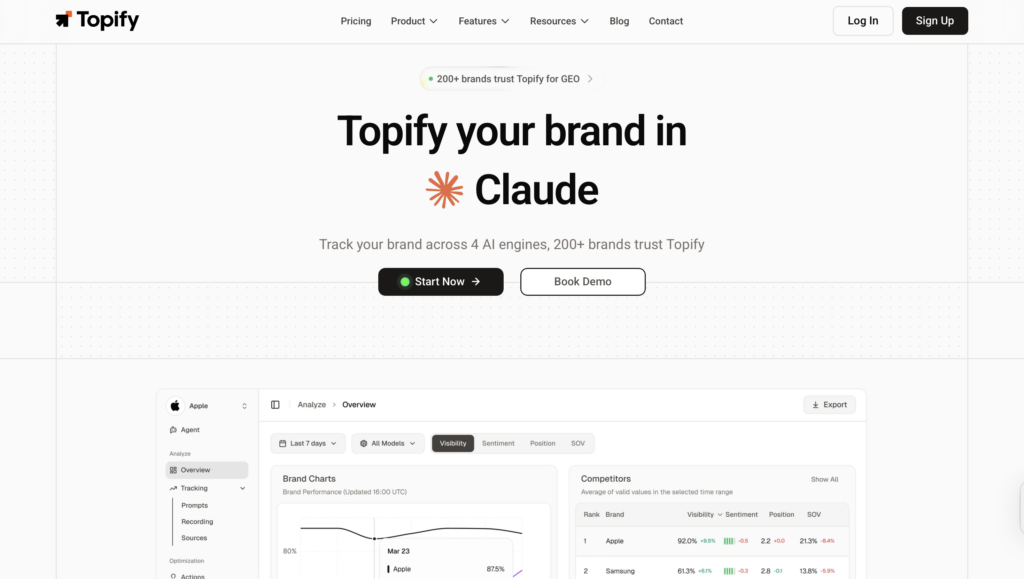
For marketing teams tracking visibility across multiple AI platforms, Topify combines all seven of these dimensions, including visibility, sentiment, position, volume, mentions, intent, and CVR, into a single dashboard. In practice, this means you can spot a drop in ChatGPT mentions and trace it back to a specific source that stopped citing your brand, all without switching between tools.
5 Mistakes That Make AI Answer Monitoring Useless
Most teams that try AI answer monitoring don’t fail because they picked the wrong tool. They fail because of how they use it.
Mistake 1: Monitoring only one AI platform. ChatGPT is the most visible, so it’s where most teams start and stop. But Perplexity weights real-time web sources differently than Gemini, which leans into its own ecosystem integration. A brand that’s cited heavily in ChatGPT might be completely absent in Perplexity. Cross-platform coverage isn’t optional.
Mistake 2: Using SEO keywords instead of real user prompts. “CRM software” is a keyword. “What’s the best CRM for a 20-person sales team that uses Slack?” is a prompt. AI models respond to conversational queries with very different answers than they do to keyword-style inputs. If your monitoring is built around keywords, you’re tracking the wrong inputs.
Mistake 3: Only checking if you’re mentioned. Visibility without context is misleading. A brand that’s mentioned but described as “outdated” or “overpriced” is worse off than one that isn’t mentioned at all. Sentiment analysis isn’t a nice-to-have. It’s core to understanding what monitoring data actually means.
Mistake 4: No competitive baseline. Monitoring your own brand in isolation tells you nothing about whether you’re gaining or losing ground. Without competitor benchmarking, you can’t tell if a visibility drop is specific to your brand or a broader shift in the AI model’s behavior.
Mistake 5: Monitoring too infrequently. AI models update their training data and system prompts regularly. A single model update can overnight change your brand’s visibility for key prompts. Monthly check-ins miss these shifts entirely. Daily or weekly monitoring is the minimum frequency for catching meaningful changes.
A Practical Checklist for Choosing the Right AI Answer Monitoring Tool
When evaluating tools, here’s what to weigh:
| Evaluation Criteria | What to Look For |
|---|---|
| Platform Coverage | Does it track ChatGPT, Perplexity, Gemini, AI Overviews, and regional models? |
| Prompt Capacity | How many prompts can you monitor? 50 is a demo. 200+ is operational. |
| Metric Depth | Does it go beyond visibility to include sentiment, position, citation share? |
| Competitor Monitoring | Can you benchmark against competitors automatically? |
| Execution Layer | Does it just report data, or does it help you act on it? |
| Pricing Model | Usage-based vs. flat rate? Does it scale with your needs? |
Most tools in this space stop at the reporting layer. They show you dashboards but leave the “what do I do about it” to you.
Topify takes a different approach. Beyond tracking across ChatGPT, Gemini, Perplexity, DeepSeek, and other major AI platforms, it includes a one-click execution layer. You define your optimization goals in plain English, review the proposed strategy, and deploy it. The system handles prompt discovery, competitive benchmarking, and citation analysis in one workflow.
On pricing, Topify’s plans start at $99/month for the Basic tier (100 prompts, 9,000 AI answer analyses, 4 projects) and scale to $199/month for Pro (250 prompts, 22,500 analyses, 10 seats). Enterprise plans start at $499/month with dedicated account management. You can check the full breakdown on the Topify pricing page.
The question to ask isn’t just “which tool has the most features.” It’s which tool connects monitoring data to action without requiring your team to build the bridge manually.
How to Build an AI Answer Monitoring Strategy That Compounds
Buying a tool is step one. Making it compound over time is where the real value shows up.
Start with your prompt library. Don’t monitor every possible query. Start with 20-30 high-intent prompts that your customers actually ask: product comparisons, use-case questions, “best tool for X” queries. These are the prompts where AI visibility directly influences purchase decisions.
Establish a baseline. Run a comprehensive audit before you change anything. Document your Visibility Score, Sentiment, and Citation Share across all tracked platforms. This is your day-zero snapshot, and every future optimization will be measured against it.
Set up competitor benchmarking. Identify 3-5 direct competitors and track the same prompts for their brands. Topify’s Dynamic Competitor Benchmarking automatically detects competitors and provides side-by-side comparisons on visibility, sentiment, and position. Knowing that a competitor gets cited 3x more for a specific prompt tells you exactly where to focus.
Close the optimization loop. This is where monitoring turns into growth. When data shows “the AI doesn’t associate our brand with sustainable packaging,” the action is clear: create or strengthen content on that topic across your owned channels. Update your key landing pages. Build entity associations that AI models can pick up.
Then validate. Measure the change in Citation Share and Sentiment after your content adjustments go live. If Citation Share climbs but Sentiment stays flat, your content is getting referenced but the messaging needs work. If both move, you’ve closed the loop.
The teams that get compounding returns aren’t the ones with the fanciest dashboards. They’re the ones running this cycle, monitor, diagnose, act, validate, every two to four weeks.
Conclusion
The gap between what traditional SEO tools measure and what AI models actually say about your brand is only getting wider. An AI answer monitoring tool doesn’t replace your existing analytics stack. It fills the blind spot that no keyword tracker, rank checker, or traffic dashboard can cover.
Start with a focused set of high-intent prompts. Establish your baseline across platforms. Build the optimization loop. The brands that figure this out early won’t just be visible to AI. They’ll be the ones AI recommends first.
FAQ
Q: What is an AI answer monitoring tool?
A: An AI answer monitoring tool is a platform that tracks how your brand appears in AI-generated responses across models like ChatGPT, Perplexity, and Gemini. It monitors visibility, sentiment, positioning, and citation sources to show you what AI is telling your potential customers about your brand.
Q: How does an AI answer monitoring tool work?
A: These tools operate through a three-step pipeline. First, they track specific conversational prompts across multiple AI platforms. Then they aggregate the AI-generated responses. Finally, they use NLP to convert unstructured AI answers into structured data: brand mentions, sentiment scores, citation patterns, and visibility trends over time.
Q: How much do AI answer monitoring tools typically cost?
A: Pricing varies by platform and scale. Entry-level plans for comprehensive tools like Topify start around $99/month for 100 tracked prompts and 9,000 AI answer analyses. Mid-tier plans run $199/month with higher prompt limits and team seats. Enterprise options with dedicated support typically start at $499/month.
Q: Can I use an AI answer monitoring tool alongside traditional SEO tools?
A: Yes, and you should. Traditional SEO tools track how you rank in search results. AI answer monitoring tools track how you’re represented in AI-generated answers. They measure different things. Using both gives you full visibility across both traditional and AI-driven search channels.

